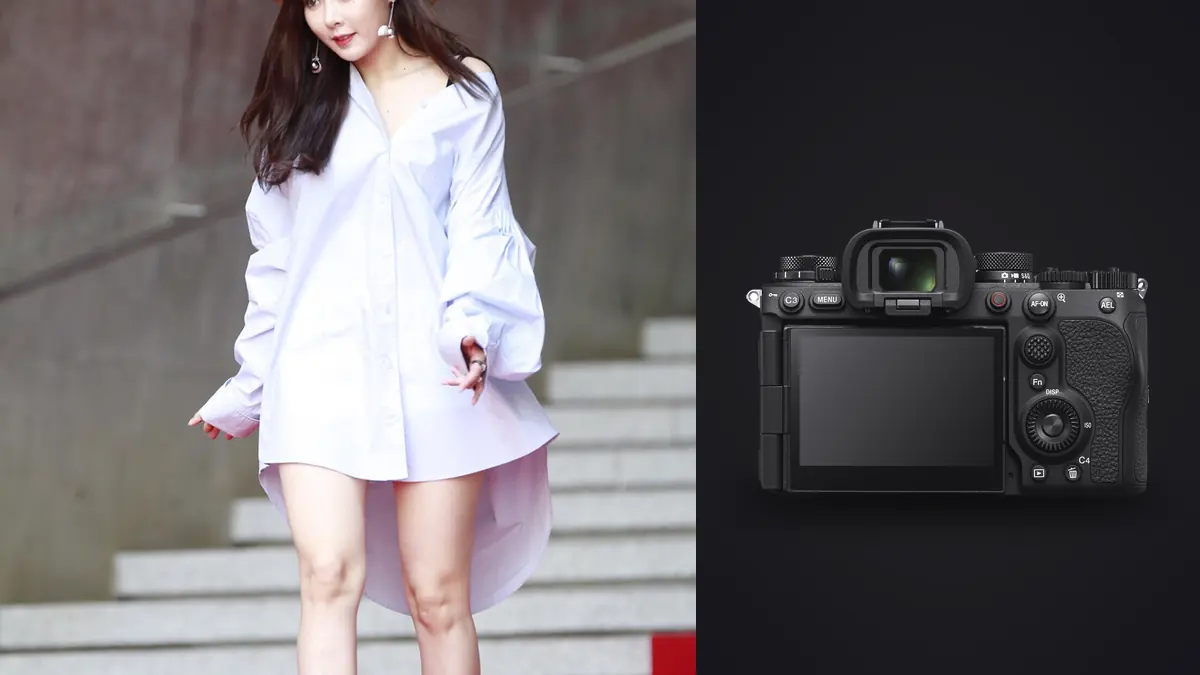
A commercial lookbook day rarely looks glamorous from behind the camera. It's a garment rack, a steamer running in the corner, a client rep checking looks off an iPad, and a schedule that wants forty outfits done before the light or the model's call time runs out. The camera body matters here in ways that don't show up in a spec sheet comparison: how fast you can chimp a frame, whether the flash actually syncs at the shutter speed you need, and whether the files are still manageable at 6pm when everyone wants a select. The Sony A9 III gets talked about mostly for sports and wildlife, but a fair amount of what makes it interesting there turns out to matter just as much on a fashion set, for different reasons.
The global shutter is the part that actually changes your day
Sony built the A9 III around a fully electronic global shutter, meaning there's no mechanical curtain and no rolling readout at all. Every pixel on the sensor is exposed and read at the same instant. On paper that sounds like a spec for freezing a cyclist's spokes. On a lookbook set it solves two much more mundane problems: banding under LED continuous light and a genuine sync speed ceiling that no longer exists.
Most fashion studios these days mix strobes with continuous LED panels for video content or just to give the model something to work against that isn't a blinding flash pop every three seconds. Rolling shutter sensors can pick up visible banding from LED flicker at fast shutter speeds, and it's the kind of thing you don't always catch on a small screen until you're looking at full-res files back at the desk. The A9 III's global readout doesn't have that failure mode. You can run a fast shutter under LED without doing flicker-free mode roulette first.
Flash sync at any shutter speed is the bigger deal
The camera syncs strobes at every shutter speed up to 1/80,000s. That's not a typo and it's genuinely useful for garment work: overpowering bright daylight on a rooftop lookbook shoot without stopping down to f/16 and losing your background separation, or freezing fabric mid-motion on a moving-garment shot without the usual HSS power tax that eats two or three stops of flash output. On a normal camera, high-speed sync means your strobe is firing a pulse train and you're paying for it in guide number. Here the strobe fires once, at full power, and the sensor's global exposure catches all of it. For anyone shooting flowy fabric, veils, or jewelry that needs a hard freeze under low ambient, that's a real creative option, not a workaround.
Frame rate and buffer during rapid outfit turnover
Lookbook pacing is stop-and-go: a burst of twenty or thirty frames while the model holds a pose sequence, then a five-minute gap while wardrobe swaps the next look. The A9 III shoots up to 120fps with full autofocus and metering tracked on every frame, though in practice you rarely need to run it past 20-30fps for lookbook work since 120fps produces more redundant frames than any human wants to sort through later. What matters more day to day is that the buffer essentially stops being a variable you think about. With a fast CFexpress Type A card you can burst through a full pose sequence, several times in a row, without the camera locking up mid-shoot the way older buffers would after fifteen or twenty raw frames.
The pre-capture function is worth setting up specifically for fashion work. Half-press the shutter and the camera continually buffers up to a second of frames before your actual press, so the exact instant a coat flares open or hair settles after a spin doesn't depend on your reaction time. It's a small feature that ends up mattering more on a moving-garment shot than on a static three-quarter pose.
Where 24.6 megapixels is fine, and where it isn't
This is the honest tradeoff. The A9 III's stacked sensor tops out at 24.6 effective megapixels, which is noticeably lower than Sony's resolution-focused bodies. For lookbook delivery meant for a website, an ecommerce product page, a PDF catalog, or social carousels, that resolution is plenty and the files stay lighter and faster through a culling and edit pass. For a print catalog running full-bleed spreads, or for retouchers who like heavy crop-and-recompose latitude on a shot that wasn't quite framed right, 24.6MP gives you noticeably less room to work with than a 50-plus megapixel body. If the deliverable is print-heavy, this is the one spec on the A9 III worth pausing on before you book it for the job.
How it stacks up against the other obvious picks
Fashion studios usually end up choosing between three Sony bodies for this kind of work, and each one trades away something different.
| Body | Shutter type | Max flash sync | Resolution | Where it wins on a lookbook job |
|---|---|---|---|---|
| Sony A9 III | Global (fully electronic) | 1/80,000s at any speed | 24.6MP | Motion-heavy garment shots, LED-lit sets, high-volume burst days |
| Sony A7R V | Mechanical / rolling e-shutter | 1/250s (mechanical) | 61MP | Static product and catalog work needing crop room and print resolution |
| Sony A1 II | Rolling e-shutter, fast readout | 1/400s (mechanical) | 50.5MP | Studios wanting one body for both fashion stills and behind-the-scenes video |
None of these is wrong for lookbook work, they're just optimized for a different point in the shoot. If the brief is mostly static outfit-on-model shots against a seamless, the resolution advantage of the A7R V or A1 II can outweigh what the A9 III offers. If the brief has any real movement in it, fabric flaring, jumps, spins, or a model who doesn't hold still between the "hold" and the shutter click, the A9 III earns its keep.
Autofocus that tracks a whole outfit, not just a face
Sony's subject recognition on the A9 III extends past eye detection into full human pose tracking, meaning it can hold focus on a moving subject even when the face is turned away or obscured by a hat brim or a raised arm mid-spin. For fashion this matters more than people expect, because a lot of a lookbook shoot is not a straight-on portrait. It's a three-quarter turn, a coat swirl, a hand adjusting a cuff. The AF system staying locked onto the person rather than hunting for a clean eye means fewer soft frames in a burst, which sounds small until you're the one culling four hundred frames from a single look and counting how many are actually sharp.
Tethering and getting client sign-off without slowing down
Commercial lookbook work almost always has someone from the brand or the agency on set who needs to approve a look before the rack moves on to the next outfit. The A9 III tethers over USB-C to Capture One or Imaging Edge Desktop with a stable enough connection that I leave it running for the whole day rather than reconnecting between setups, which used to be a recurring annoyance on older bodies where the tether would drop every hour or so under a busy shoot. Wireless tethering to a tablet over the built-in wifi works as a backup when the laptop is across the room, though I still default to the wired connection whenever the layout allows it, since a dropped wireless tether mid-burst is the kind of thing that eats five minutes you don't have on a forty-look day.
Having a client watching a big screen rather than squinting at the rear LCD changes the pace of approvals in a way that's easy to underrate until you've run a shoot without it. A "yes, next look" from across the room happens in seconds instead of someone walking over to check the camera back each time, and that adds up over a full day of outfit changes.
Battery life and card choice on a full shooting day
The A9 III's battery is rated for a modest number of stills shots by CIPA standards, and running the rear screen active for tethered review the whole day, along with the EVF, means I go through two to three batteries on a typical eight-hour lookbook session. That's not unusual for a mirrorless body running this much continuous shooting and live preview, but it's worth packing spares rather than assuming one battery gets you through a full call sheet.
Card choice matters more here than on a slower body. CFexpress Type A cards unlock the camera's real buffer depth and write speed; dropping down to a UHS-II SD card in the second slot works fine as a backup or overflow, but if you're leaning on the fast burst modes during motion shots, a CFexpress card in the primary slot is the difference between the buffer clearing quickly between bursts and waiting on a write indicator while the next look is already standing by.
Lenses that actually get used on this kind of set
The 24-70mm GM II covers the bulk of a standard lookbook shoot: full-length outfit shots, waist-up detail crops, and enough working distance to stay out of the stylist's way between frames. For close detail work, hardware, embroidery, texture, an 85mm or 90mm macro earns its place in the bag. On location lookbooks with more environmental context, a 35mm prime is worth having for a wider establishing frame that isn't just the standard 50mm perspective every other brand's lookbook uses. None of this is A9 III specific, it's the same lens logic that applies to any fashion body, but it's worth noting the camera doesn't demand anything unusual from the lens lineup to get the benefit of its shutter and AF advantages.
The part of the day nobody plans for: sorting the output
A lookbook day with continuous shooting bursts easily produces several thousand frames by the time the last look wraps, and a meaningful chunk of that is duplicate poses within a burst, near-identical frames a few milliseconds apart while a model held a position. Sorting that by eye at 11pm is where a lot of the actual fatigue on this job comes from, and it's also where the file count from a high-frame-rate body like the A9 III can work against you if your culling workflow hasn't caught up to your camera's output.
This is where I've leaned on imagic for the back half of the day. It runs the sharpness and eye-closure scoring locally on the machine, so a set of unreleased garments for a client with an embargo never has to touch a cloud upload step before the edit even starts, which matters more on commercial fashion work than most other genres because of the NDA terms involved. The duplicate and burst clustering groups those near-identical frames from a held pose automatically, so instead of scrolling through thirty nearly-identical shots of one look you're picking between the three or four the software has already flagged as the sharpest of the group. For more on how that scoring actually works under the hood, see how AI photo culling works.
Once the picks are made, imagic's apply_my_style feature applies a preset trained on your own past edits rather than a generic filter, which keeps a full day of lookbook shots, different backdrops, different lighting setups between looks, landing on a consistent color baseline before anything goes to a retoucher. It's not a replacement for a full retouch pass, but it closes the gap between "just shot" and "client can see something coherent" fast enough to matter when the studio wants a same-day gallery. If the broader workflow around this is new to you, these workflow tips cover more of the ground between capture and delivery.
A starting point for settings
Nothing here is gospel, every studio's lighting is different, but this is a sensible starting point on a strobe-lit lookbook set with the A9 III before adjusting for the room:
- Shutter around 1/250s to 1/500s for standard poses, pushed to 1/2000s or faster on garment-motion shots using the full-speed sync
- Aperture f/7.1 to f/9 for enough depth to keep an outfit sharp front to back without going so far that skin and fabric texture flatten out
- ISO locked at base (native 250) since strobe output does the real work and there's no rolling shutter tradeoff to compensate for
- AF set to human pose tracking with a wide zone rather than a single pinpoint, since the subject rarely stays in one spot in the frame between shots
Frequently Asked Questions
Does the global shutter cause any image quality tradeoff compared to a mechanical shutter?
The main tradeoff is dynamic range headroom, which sits a bit behind Sony's higher-resolution bodies in very high-contrast scenes. For strobe-lit studio work where you're controlling the lighting ratio anyway, this rarely shows up as a practical problem.
Is 24.6 megapixels enough for a full lookbook campaign?
For web, ecommerce, and PDF-delivered lookbooks, yes, comfortably. For large-format print catalogs or campaigns that need aggressive cropping in post, a higher-resolution body is worth considering instead or alongside it.
Can the A9 III handle continuous LED lighting as well as strobes?
Yes, and this is one of its clearer advantages. The global shutter avoids the banding that rolling-shutter cameras can pick up from flickering LED panels at fast shutter speeds, which matters on sets that mix continuous light with strobe.
How does local AI culling handle an unreleased fashion collection?
Software like imagic that scores and clusters frames locally, without uploading files anywhere, keeps embargoed garment images off any third-party server during the edit, which is worth checking for on any culling tool before a shoot involving pre-release product.