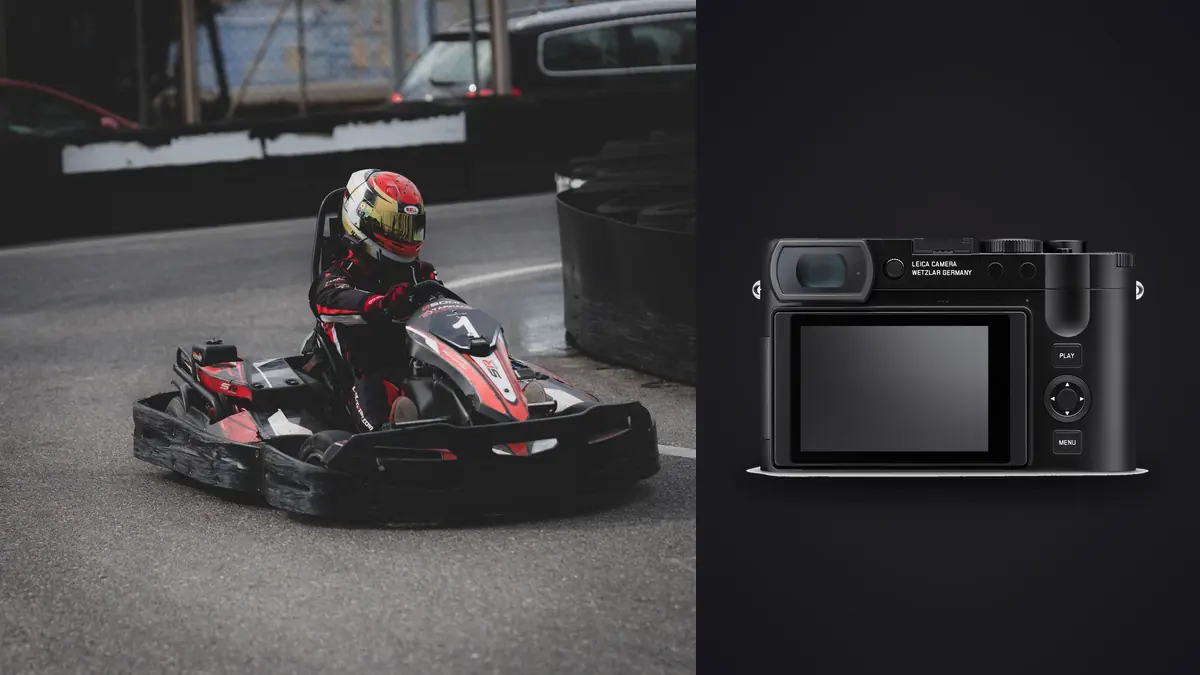
I brought a $5,995 wide-angle prime to a track meet and spent the first hour getting asked, by two different officials, whether I was lost. Fair question. The Leica Q3 is a fixed 28mm camera built for street work, environmental portraits, and the kind of documentary shooting where you want to be close enough to smell the coffee. It is not, on paper, a sports camera. There is no telephoto zoom, no interchangeable lens mount, and nothing that looks like the 400mm glass lined up along the home straight at a real meet. What it does have is a 60-megapixel sensor, phase-detect autofocus (new as of this body, the Q2 only had contrast AF), and four in-camera crop modes that stretch that fixed 28mm out to a claimed 90mm equivalent. I wanted to know if that combination actually holds up against sprinters, hurdlers, and a javelin runway, or if it's a party trick that falls apart the moment something moves at fifteen miles an hour.
Short version: it works, but only if you accept the terms it sets. Long version follows.
Why You'd Even Consider a 28mm Prime for This
The honest answer is access. At most regional and collegiate meets, credentialed photographers get infield or inside-rail positions that a spectator with a rental 300mm never gets near. From three to five meters off lane one, a 28mm lens is not a limitation, it's the right focal length. You get the athlete's full stride, the tension in the starting blocks, the coach leaning over the rail shouting splits. A 400mm lens from that same distance would give you a blurred kneecap. Where the Q3 earns its keep is in that in-close, wide-context work: call-ups, staging, relay exchanges from inside the exchange zone, award ceremonies. It's also silent (or close to it) in electronic shutter mode, which matters at indoor meets where several conferences explicitly restrict mechanical shutter noise near the starting line. A DSLR mirror slap or a loud shutter during a 60m final start sequence gets you a talking-to from a starter. I've had it happen. The Q3 in fully electronic mode is inaudible past about two meters.
The Autofocus Is the Real Story, Not the Lens
The headline spec change from the Q2 to the Q3 is phase-detect autofocus layered on top of the existing contrast system, with the number of focus points going from 225 to 315. In practice this is the difference between a camera that hunts on a moving subject and one that commits. On a 100m final, locking onto a sprinter at the 40-meter mark and holding focus through the line worked more often than not, maybe eight clean sequences out of ten attempts across a full meet. The misses were almost always my fault, picking the wrong lane or letting the subject drift to the frame edge where the AF points thin out. Where it struggled was field events with cluttered backgrounds. Long jump runways with a fence and spectators behind the pit gave the AF system something to think about, and it occasionally grabbed the fence instead of the approaching athlete. Continuous AF tracking on a single, isolated subject against sky or grass (high jump, pole vault against an empty backdrop) was close to flawless. Busy backgrounds are still the weak point, same as almost every hybrid AF system on the market, this isn't unique to Leica.
Crop Modes: Turning 60 Megapixels Into Reach
This is the feature that makes the Q3 usable for track at all. Because the sensor outputs 60MP, Leica lets you punch in digitally to 35mm, 50mm, 75mm, and 90mm equivalents in-camera. Critically, it still writes the full 60MP raw file alongside the cropped JPEG, so you're never locked into the crop, you can pull a tighter frame later in post if the in-camera guess was off. It's not a zoom lens simulation with interpolation, it's a straight crop of real sensor data, so there's no smearing the way there is with a phone's digital zoom. Here's how the numbers actually broke down for me across a day at the track, matched to what each crop was realistically good for:
| Crop mode | Resulting resolution | Useful shooting distance | Best track & field use |
|---|---|---|---|
| 28mm (native) | 60MP | 3-5m (inside rail, lane 1) | Start sequences, blocks, relay exchange zone, coach/athlete moments |
| 35mm crop | ~39MP | 5-8m | Warmup area, athlete introductions, mixed zone |
| 50mm crop | ~19MP | 8-12m | Long jump/triple jump approach, hurdles from an infield angle |
| 75mm crop | ~8MP | 15-20m | Javelin and discus release, shot put from a safe infield distance |
| 90mm crop | ~6MP | 20-30m | Finish line tight crop from an elevated photographer stand, web-sized only |
That last row is the honest caveat. At 6 megapixels you have enough for a web gallery or a social post, not a large print. Once you're past 50mm equivalent, you're trading resolution for reach fast, and by 90mm you've given up most of what made the 60MP sensor worth having. I used the 90mm crop maybe a dozen times across an entire meet, almost always for a finish-line moment I couldn't reposition for in time. Everything else stayed at 28mm, 35mm, or 50mm, where the file sizes are still big enough to crop further in post if needed.
Burst Speed and the Buffer Reality
Leica lists 15fps as the top continuous rate, and that number is technically true but misleading for action work. At 15fps, focus and exposure lock to the first frame of the burst, which is close to useless for a sprinter accelerating through a 60m final. Drop into continuous AF and the real usable rate is closer to 4fps, which is workable but noticeably slower than what a dedicated sports body delivers. The buffer holds around 61 raw-plus-JPEG pairs at 7fps (the fastest rate that still supports raw capture), which sounds like a lot until you realize a single 4-second sprint burst at even a modest frame rate can eat a third of that before the race is over. I filled the buffer twice in one afternoon shooting the 200m heats back to back with barely enough recovery time between them. Shutter choice matters here too. The mechanical shutter tops out at 1/2000s, which is fine for most track work in daylight but can clip highlights on a bright afternoon at wide apertures. The electronic shutter goes to 1/16000s and is silent, but on hard pans (following a sprinter across the frame at speed) rolling shutter shows up as a slight lean in the runner's legs. It's subtle, most viewers won't catch it, but if you're pixel-peeping a hurdler mid-stride you'll see it.
What the Wide Lens Genuinely Wins At
Optical image stabilization is built into the lens itself and kicks in automatically at slower shutter speeds, which isn't something you'll lean on for freezing 100m sprinters (you're shooting at 1/2000s or faster regardless) but it's genuinely useful for the handheld, slower-shutter moments around a meet: interviews, warmups in shaded areas, indoor venues with weak lighting where you're not chasing peak action. The bigger win is depth of field control at f/1.7. Most sports lenses are shot stopped down for depth of field margin on a moving target. At f/1.7 with a subject isolated against a blown-out background (a pole vaulter against overcast sky, a sprinter against a shaded grandstand) the separation is closer to what you'd get from a portrait lens than a typical 70-200mm zoom at f/2.8. It gives track photos a look most meet coverage doesn't have, less "sports wire photo," more editorial.
Where It Genuinely Falls Apart
No zoom means no zoom. If you're not credentialed for infield or inside-rail access, this camera is close to useless for track and field. Shooting from the stands at a typical stadium, even the 90mm crop puts you at roughly the reach of a modest telephoto, and you're burning most of your resolution to get there. I would not recommend this setup to anyone shooting from general admission seating. Battery life is also a real constraint across a full meet. I got through roughly 400-450 frames per charge with the EVF in heavy use, which sounds like plenty until you remember a single messy burst sequence can be 20-30 frames by itself. I carried three batteries and used all of them across an eight-hour meet with finals in the evening.
Sorting the Files After the Meet
Here's where the 60MP sensor turns from a selling point into a genuine chore. A full day of heats, semifinals, and field events at even a conservative shooting pace left me with just over 3,100 frames, most of them in bursts of five to fifteen near-identical shots of the same stride or the same release. Sorting that by eye, at 60MP a frame, is a multi-hour task on its own before you've touched a single edit. I run everything through imagic afterward specifically because it handles this locally, on my laptop at the venue's parking lot, without uploading a single frame anywhere. Its burst and duplicate clustering groups those fifteen-shot sequences automatically, and the sharpness scoring flags which frame in each burst actually has the sprinter's foot in sharp focus versus the ones with motion blur in the trailing leg (a distinction that's genuinely hard to judge on a camera's rear screen in bright sun). For a meet that shot practices, if you want the mechanics of how that scoring actually works, I wrote about it separately in how AI photo culling works. Once the keepers are picked, I run imagic's apply_my_style preset, trained on my own past edits rather than a generic filter, so a start-line shot at 9am under stadium lights and a finish-line shot at 6pm under a different sky end up looking like they belong in the same gallery. If your bottleneck after a shoot day is sorting rather than shooting, it's worth reading through some general workflow tips for faster editing alongside whatever culling tool you use.
Frequently Asked Questions
Is the Leica Q3's fixed 28mm lens too wide for shooting a track meet?
From general admission seating, yes, it's the wrong tool. From an infield or inside-rail credentialed position, 28mm is actually close to ideal for start sequences, blocks, and relay exchanges, and the crop modes extend reach to roughly 90mm equivalent for tighter moments. It's a camera built around proximity, not distance, so your access at the venue matters more than the spec sheet.
Do the digital crop modes hurt image quality the way a phone's zoom does?
No, and this is the part people usually get wrong. Leica's crop modes are a straight crop of real sensor data from the 60MP sensor, not an interpolated or AI-upscaled zoom. There's no smearing or fabricated detail. The tradeoff is resolution, not quality: a 90mm crop leaves you with roughly 6 megapixels, plenty for web or social but thin for a large print.
Can the phase-detect autofocus actually keep up with a sprinter?
In my testing, yes, most of the time, on a clean background. Locking onto a single sprinter against sky, grass, or an empty backdrop and tracking through a full 100m was reliable in the majority of attempts. Cluttered backgrounds (fences, crowds behind a long jump pit) are where it occasionally grabs the wrong subject, which is a common limitation across hybrid AF systems generally, not specific to this camera.
Is the 15fps burst rate real, or a marketing number?
It's real but conditional. 15fps only holds with focus and exposure locked to the first frame, which isn't useful for tracking accelerating athletes. With continuous autofocus engaged, the practical rate drops to around 4fps. Plan your buffer and shot selection around that real number, not the headline spec.