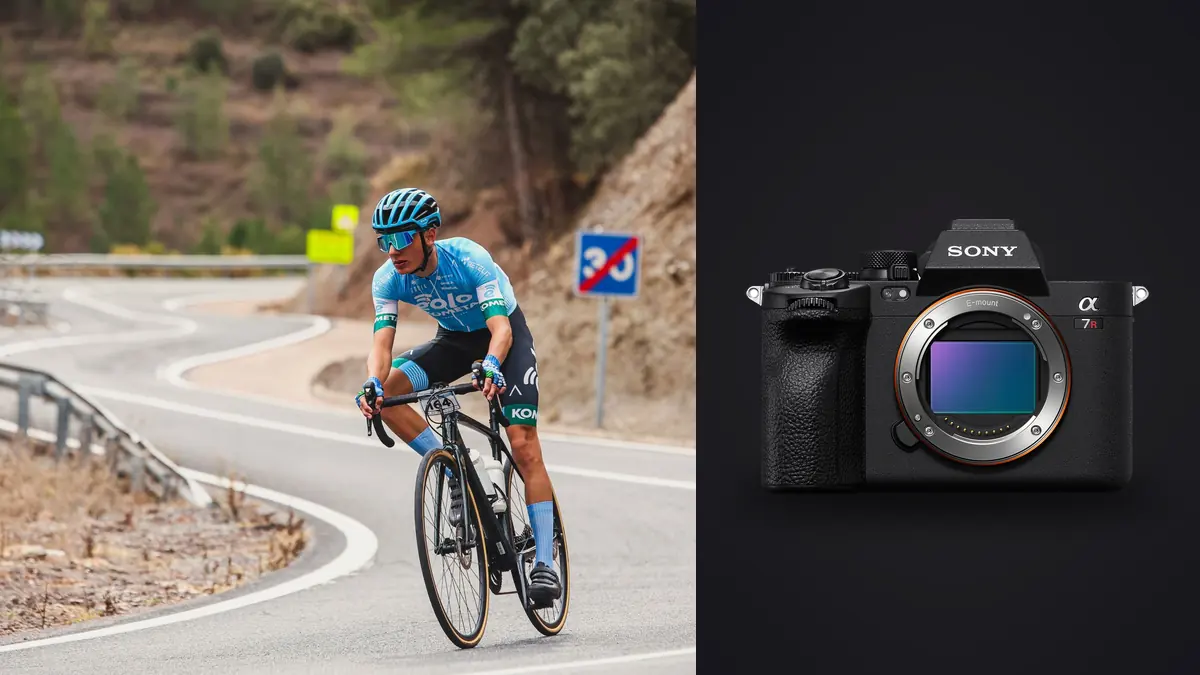
When I told another shooter at a regional meet last spring that I was running an A7R V for the 400m and long jump, he laughed and asked if I'd left my A9 II at home by accident. Fair reaction. Sony built the A7R V for landscape and studio work, not for a camera that has to track a sprinter closing at nineteen feet per second. But I've now shot four full meets with it, from prelims through finals, and I want to lay out honestly where it earns its keep on a track and where it makes you work for the shot.
Why a 61-megapixel body ends up trackside at all
The A7R V carries the same 61MP sensor Sony has used since the A7R IV, so nobody bought this camera for burst speed. What changed is the dedicated AI processing unit bolted onto the BIONZ XR pipeline, which gave Sony's subject recognition a real jump in reliability, and that upgrade happens to matter a lot for track and field. The other reason I keep bringing it is more mundane: credential access. At most high school and regional college meets you don't get infield passes. You're shooting from the stands or from behind a rope line thirty to sixty meters back, and at that distance a 24MP sensor leaves you cropping into mush by the time you isolate one runner in a pack of eight. With 61MP of raw data, I can crop a sprinter down to a tight three-quarter frame and still print at a size that holds up, something that simply isn't an option on an A9 II shooting the same distance.
That trade only works if you accept what you're giving up, which is speed and shutter behavior built for exactly this kind of subject. So let's get into that part first, because it's the part that actually changes how you shoot.
The catch: it's still a rolling shutter sensor
Sony did not stack this sensor. That's the single fact that should shape every decision you make with this body on a track. In electronic shutter mode, the sensor reads out line by line rather than all at once, and on fast horizontal motion that shows up as skew, a runner's legs leaning at an angle that doesn't match their torso, or a discus appearing to bend mid-spin. I noticed it worst on 100m and 200m starts shot with a hard pan, where the background streaked in a way that looked like a lens defect until I realized it was readout lag catching up to my pan speed.
My workaround is boring but it works: mechanical shutter for anything with a hard horizontal pan (sprint starts, relay handoffs, the last ten meters of any dash), and electronic shutter only for subjects that are either stationary relative to the frame or moving mostly vertically, like a pole vaulter clearing the bar or a high jumper at the apex. Mechanical caps you at 10fps regardless, so you're not losing much speed by choosing it, and you sidestep the skew entirely. Discus and hammer throw are the events where I still get caught out occasionally, because the rotational motion during the wind-up moves fast enough in-frame to warp even at a distance.
Autofocus that actually keeps up (most of the time)
This is where the A7R V surprised me. Sony's human pose recognition doesn't need a face in frame to hold focus, it tracks skeletal position, and on a track that's the difference between a keeper and a miss. Runners spend most of a race facing away from any camera position you'll realistically have, and older Sony bodies I've used would hunt the moment the face turned. The A7R V held onto a runner's hips and shoulders coming off the final turn in the 400m without hunting, which genuinely changed how many usable frames I got out of a race compared to my old A7 III.
Hurdles is the stress test. The lead leg blocks the face for most of the clearance, and I was skeptical going in. Across two meets it tracked through the block reliably, picking the torso back up the instant the leg cleared, though I did lose focus briefly on a couple of frames where a trailing hurdler's silhouette overlapped the lead runner. Where the camera actually limits you is timing, not tracking. At 10fps mechanical you have roughly a hundred milliseconds between frames, and the peak of a pole vault clearance or the exact moment a long jumper's foot hits the board can slip between two frames. I've started firing a beat early on anything with a defined peak moment, eating a few throwaway frames on the front end so I don't miss the one that matters.
How it actually compares to the cameras built for this job
I'm not going to pretend the A7R V competes on paper with Sony's actual sports bodies. Here's how the three stack up for the specific demands of track and field, based on what I've shot with each (I borrowed a colleague's A9 II for one meet as a direct comparison).
| Camera | Sensor type | Max continuous | Raw buffer (approx.) | Rolling shutter risk | Body price at launch |
|---|---|---|---|---|---|
| Sony A7R V | 61MP, non-stacked | 10fps | ~180 compressed raw | Noticeable on fast pans, e-shutter | ~$3,900 |
| Sony A9 II | 24MP, stacked | 20fps electronic, blackout-free | Deep enough to rarely hit the wall in a race | Effectively none | ~$4,500 |
| Sony A1 | 50MP, stacked | 30fps electronic | ~230 compressed raw | Minimal | ~$6,500 |
What the table doesn't show is the resolution trade. The A9 II gives you speed and zero rolling shutter worry, but 24MP means you'd better already have the framing right, because there's little room to crop after the fact from the stands. The A1 splits the difference on paper, and if I were building a kit from scratch for meets where I had infield access every week, I'd probably lean that way. But for the access-limited reality most of us shoot in, the A7R V's extra resolution buys back some of what its slower fps costs you.
Cards, buffer, and the file-size tax nobody mentions
A 61MP compressed raw file runs around 60MB, and uncompressed pushes past 120MB. Shoot a full meet with prelims and finals across sprints, hurdles, and field events, and you're looking at several hundred gigabytes by the time you pack up. Buffer clearing matters as much as buffer depth here, because a full CFexpress Type A card clears fast enough that you're rarely locked out during a race, while the same body on a UHS-II SD card will make you feel every one of those 60MB files during a long burst. I run CFexpress Type A in the primary slot and SD as JPEG backup, which costs more up front (Type A cards are pricier and less common than the Type B format Canon and Nikon use) but it's the difference between shooting through a photo finish and watching a buffer indicator crawl.
The volume problem doesn't end when you pack up the camera. A single meet can leave you with three or four thousand frames, a large share of them near-duplicate bursts of the same stride or the same vault attempt. This is where I lean on imagic once I'm back at the laptop. It runs local sharpness scoring across the take, which matters a lot on hurdles and long jump sequences where half the frames in a burst are a touch off the focal plane and easy to overlook when you're scrolling tired at 11pm. It also clusters those 10fps bursts together instead of making you page through forty nearly identical frames of the same 400m stride one by one, which is the part of a meet night that used to eat the most time. Everything runs on the machine itself, no upload queue, which matters at venues where the wifi is either nonexistent or locked behind a school login nobody hands out to visiting photographers.
If you're trying to tighten that whole process rather than just survive one meet, the breakdown in how AI photo culling works covers the mechanics of sharpness and duplicate detection in more depth than I have room for here.
Lenses that actually make sense for this specific job
Glass matters more than the body debate, honestly. If I only had rope-line access, the 200-600mm G is the lens I reach for most, because it covers both the backstretch sprints and the far throwing circles without a lens change, at the cost of being slow to hand-hold for a full session. When I've had infield or corner access, the 70-200mm GM II earns its price, sharp wide open and fast enough to follow a relay handoff without hunting. For the rare meet where I've had a dedicated photographer position near the finish line, a 300mm f2.8 GM gives you working distance on the 100m and 200m without cropping as hard, though it's a lens you commit to for the day, not one you're swapping in and out of a bag between events. I haven't found the AI tracking to struggle noticeably with a 1.4x teleconverter on the 70-200, but AF does slow down enough on the 300mm plus converter combo that I avoid stacking it during anything with a hard start.
A settings starting point, by event
This is roughly what I dial in before each event group, adjusted for available light. Treat it as a starting point, not gospel, stadium lighting varies enough meet to meet that you'll still need to check your histogram.
| Event | Shutter speed | Drive mode | AF area |
|---|---|---|---|
| 100m / 200m sprints | 1/2000 or faster | Mechanical, continuous hi | Tracking, expanded flexible spot |
| 400m / relays | 1/1600 to 1/2000 | Mechanical, continuous hi | Tracking, wide |
| Long / triple jump | 1/2000, e-shutter fine here | Continuous hi, fire early on approach | Tracking, expanded flexible spot |
| High jump / pole vault | 1/1600 | Mechanical for the bar clearance itself | Zone or expanded spot, locked on the bar |
| Discus / hammer / shot put | 1/2000 | Mechanical only (rotation warps under e-shutter) | Tracking, wide, catch the release |
Getting through a season's worth of frames without dreading it
The camera decisions above are the fun part. The part that actually determines whether you keep shooting meets is what happens after, when you're staring at a memory card full of thousands of raw files at the end of a long Saturday. This is where I lean on a faster culling and edit routine rather than opening every frame in Lightroom cold. My own habit is to run the take through imagic first to flag the sharp frames and thin the burst clusters, then only open the survivors in my full editor. Across a season shooting the same track club, I also built out an apply_my_style preset in imagic from a batch of edits I was happy with, mixed daylight and stadium-light shots, so new meets land close to my usual color and contrast before I touch a slider by hand. It's not a substitute for actually editing, but it means I'm not rebuilding a look from zero every Sunday night, and since it runs locally I can do the whole pass in the car in the parking lot before I've even left the venue.
Frequently Asked Questions
Is the Sony A7R V actually fast enough for competitive track and field?
For most amateur, high school, and regional college meets, yes, with the caveat that you'll miss more peak-action frames than you would on a 20fps body. I treat the slower fps as a timing discipline problem rather than a dealbreaker: fire a touch earlier than feels natural and you'll catch the moment more often than not. For elite meets where you're being judged on split-second peak frames against other shooters running A1s and A9 IIs, the fps gap becomes a real disadvantage.
Should I shoot compressed or uncompressed raw at a track meet?
Compressed lossless, almost always. The visual difference against uncompressed is not something I can pick out in a finished edit, but the buffer and card-space savings are real when you're shooting several hundred frames per event across a full day.
Does the rolling shutter actually ruin panning shots of sprinters?
Not if you shoot mechanical shutter for the pan-heavy events. It only becomes a visible problem in electronic shutter mode during fast horizontal motion, which is exactly the situation a sprint start creates. Switch to mechanical for sprints and relays and the skew issue mostly disappears, at the cost of capping you at 10fps, which you're already at in mechanical mode anyway.
What's the fastest way to get through thousands of track photos after a meet?
Cull before you edit, not during. I run everything through imagic's sharpness scoring and burst clustering first so I'm reviewing maybe four hundred candidate frames instead of four thousand raw ones, and because it processes locally I can start that pass before I'm even home from the venue. Trying to make keep-or-toss decisions while also color grading in the same pass is where most of the wasted time actually happens.
Where this leaves me
I wouldn't tell a photographer building a dedicated sports kit from scratch to buy an A7R V for track and field over an A9 II or A1. But if you already own one for portrait or landscape work and you're wondering whether it's worth dragging to a meet, the answer is yes, with real caveats you now know how to shoot around. The resolution buys you crop latitude that a faster, lower-megapixel body can't match from the stands, and the AI tracking is genuinely good enough to keep up with a body that turns away from you mid-stride. You're trading peak-moment precision for image quality after the fact, and for the access most of us actually get at a track meet, that trade is closer than it looks on a spec sheet.