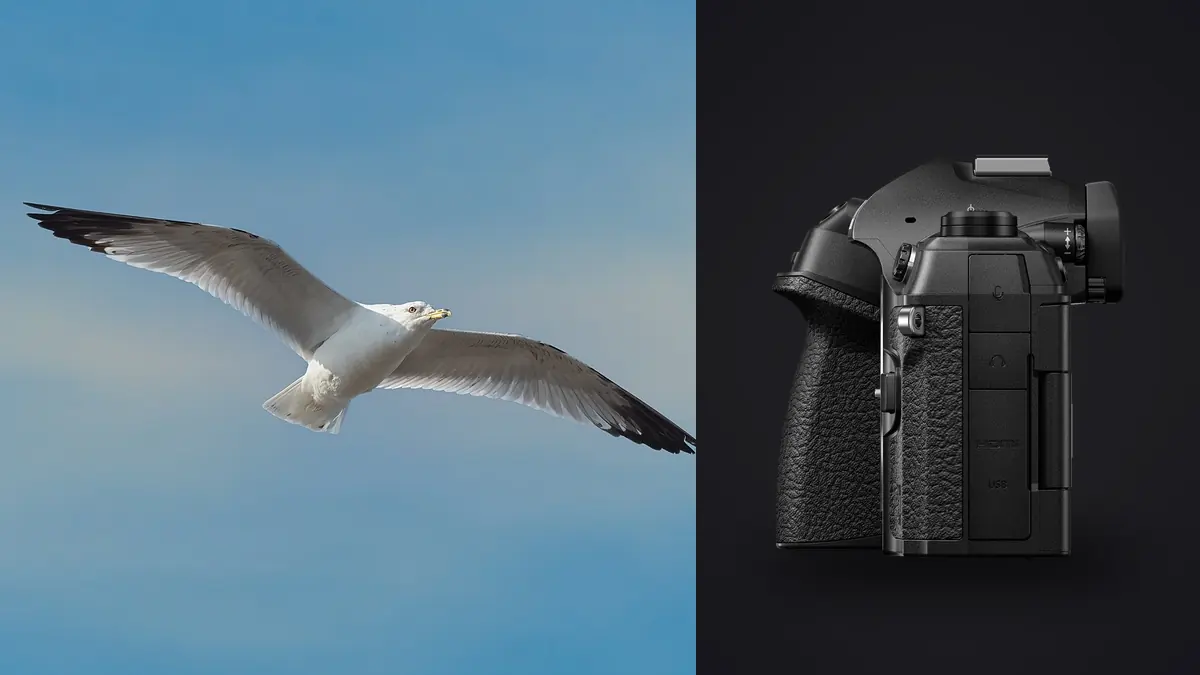
I picked up an OM-1 Mark II last winter mostly out of curiosity about whether Micro Four Thirds could still hold its own against the full-frame stampede for birds in flight. I'd shot the original OM-1 for a season of osprey dives and a miserable, wonderful week photographing a red kite roost, so I already knew the platform's quirks. The Mark II isn't a reinvention. It's the same 20-megapixel stacked sensor and the same body shape, with a handful of changes that matter more than the spec sheet suggests once you're actually tracking a tern folding into a dive at thirty feet.
This isn't a lab review. It's what changed in my keeper rate, what still frustrates me, and which parts of the system genuinely earn their place in a birding bag that already has to carry a tripod head, a rain cover, and too much coffee.
The crop factor is the whole argument
Micro Four Thirds gets dismissed a lot in wildlife circles, usually by people comparing pixel-level noise crops at ISO 12800 and ignoring what happens before you ever press the shutter. For birds in flight specifically, the 2x crop factor is the reason to consider this system at all. A 300mm f/4 PRO lens, which weighs about 1.27kg and costs roughly $2,500, gives you a 600mm field of view. The equivalent full-frame reach from Canon or Nikon runs closer to 3kg and $12,000+ for anything with a comparable maximum aperture. That difference isn't academic when you're holding a lens up, panning on a moving subject, for six hours straight along a shoreline.
I noticed the weight advantage most on long days chasing terns over open water, where you can't rest the lens on anything and every missed take-off costs you the shot. With the 300mm PRO on the OM-1 Mark II, the whole rig is under 2kg with the body and a battery grip removed. I could hand-hold a full afternoon of active flight photography without the shoulder fatigue that used to force me onto a monopod by hour three with heavier gear.
The tradeoff is real too, and I'm not going to pretend it isn't. Twenty megapixels leaves less room to crop a bird that's smaller in frame than you wanted, and the noise floor climbs faster than full-frame sensors once you're past ISO 3200. Overcast dawn starts with a fast-moving subject sometimes force a choice between shutter speed and a clean file, and on this sensor that choice bites earlier than it would on a 45-megapixel full-frame body.
Bird Detection AI, three months in
The subject-detection algorithm carried over from the original OM-1 firmware but got a real revision for the Mark II, and it shows in cluttered scenes. Against open sky, tracking a gull or an osprey, it's essentially unshakeable. It finds the head, locks onto the eye when the bird is close enough, and holds through fairly aggressive banking turns.
Where it still stumbles is exactly where I expected it to: birds crossing in front of branches, reeds, or a busy water surface with reflections. I lost a sequence of a kingfisher launching off a low perch because the system jumped to a sunlit leaf mid-frame and never recovered before the bird was gone. That kind of failure is less frequent than it was on the original OM-1, where I'd see it several times a session, but it hasn't disappeared. If you're shooting raptors against open sky most of the time, you'll rarely notice it. If your local patch is a wooded creek with warblers darting through branches, budget for some frustration.
Small, fast songbirds are the other honest weak spot. The detection model is tuned more effectively for larger raptors and waterbirds than it is for a warbler at range, where the subject occupies a tiny fraction of the frame. I still often fall back to manual single-point AF with a small target for that kind of work rather than trust the bird-detect mode to find something the size of a few pixels.
Drive modes and Pro Capture, the part that actually wins shots
The headline burst numbers get repeated everywhere, so here's what they mean in practice. SH1, the mechanical shutter mode, tops out around 10fps with full continuous AF and AE tracking, and in three months I never once saw it choke on buffer regardless of card speed. That's my default for perched birds and general flight where I'm not chasing a single wingbeat.
SH2, the electronic silent mode, is rated up to 50fps with continuous tracking, and this is the mode for wing-up, wing-down sequences where you want to pick the exact frame with the wings in the position you want. Buffer depth is where I have to give a personal number rather than a marketing one: shooting RAW on a fast UHS-II card, I could hold 50fps for a bit over three seconds, somewhere around 150 frames, before the rate audibly stepped down. That's improved from the original OM-1, which had a reputation for choking mid-burst on exactly this kind of sequence, and it was enough buffer for essentially every real flight sequence I shot, since a bird rarely holds a clean flight line for three straight seconds anyway.
Pro Capture is the feature I'd genuinely miss if I went back to a conventional shutter. Set it to buffer 35 frames before the shutter button is fully pressed, and a half-press starts recording into a rolling buffer that only commits to the card once you finish the press. For a heron launching off a branch, human reaction time alone means you're already too late by the time you see the wings unfold. Pro Capture gave me the half-second before my own reflexes kicked in, and it's responsible for more of my favorite frames from this camera than the autofocus system is.
| Drive mode | Approx. fps | AF/AE tracking | Best use in the field |
|---|---|---|---|
| SH1 (mechanical) | 10fps | Full, per frame | Perched birds, general flight, no buffer worries |
| SH2 (electronic, silent) | 50fps | Full, per frame | Wingbeat sequences, close passes, dive sequences |
| Pro Capture (SH2) | up to 50fps, buffered pre-shutter | Full, per frame | Launches, take-offs, anything faster than your reflexes |
| SH2 (120fps mode) | 120fps | Locked to first frame | Predictable glide paths only, not erratic flight |
Lens pairings that actually make sense for BIF
The body is only half the system, and for birds in flight the lens choice arguably matters more than which generation of OM-1 you're holding. I've spent time with three of these and borrowed the fourth for a weekend, and they land in genuinely different niches rather than being interchangeable options at different prices.
| Lens | 35mm-equivalent reach | Weight | Where it fits |
|---|---|---|---|
| M.Zuiko 300mm F4 IS PRO | 600mm | ~1,270g | Lightest true prime, best for all-day handholding, my default |
| M.Zuiko 100-400mm F5-6.3 IS | 200-800mm | ~1,120g | Budget entry point, noticeably softer wide open past 350mm |
| M.Zuiko 150-400mm F4.5 TC1.25x PRO | 300-800mm (up to 1000mm with built-in TC) | ~1,875g | Reference-grade sharpness, but costs more than two of these bodies combined |
| Panasonic Leica DG 100-400mm F4-6.3 II | 200-800mm | ~985g | Lightest zoom, AF motor noticeably slower to react than native Olympus glass |
For most people getting into BIF work on this system, I'd point them at the 300mm PRO with a 1.4x teleconverter kept in a pocket for when the bird lets you close the distance. It's the combination I reach for most, and it's the one that never once felt like it was holding the autofocus system back.
What actually changed from the original OM-1
If you already own the first OM-1, the case for upgrading specifically for BIF work is narrower than OM System's marketing suggests. The sensor is identical. The autofocus algorithm is refined rather than replaced, and the improvement shows up mostly in reduced false-positive tracking jumps rather than a dramatically stickier lock. The buffer handling is meaningfully better, and if buffer chokes were the thing that cost you shots on the original body, that alone might justify the move.
The parts that don't get discussed enough are the small physical changes. The grip is slightly deeper, which matters after four hours holding a long lens. Heat dissipation is improved, which shows up in video work more than stills, but I did notice the body ran cooler to the touch during a long, hot afternoon of continuous 50fps bursts. And the handheld high-resolution shot mode got a real upgrade, though that feature is close to useless for anything that's moving, so it doesn't touch the BIF use case directly.
If you're buying new and have no existing OM-1 glass, I'd still get the Mark II over a used original at similar money, mostly for the buffer improvement and the fact that you get current-generation firmware support going forward. If you already own a working OM-1 and your frustration is with lens reach rather than the body, put the upgrade money into the 300mm PRO instead.
The unglamorous part: what a good BIF day does to your card
Here's the thing nobody puts in the marketing copy. A genuinely good three hours with terns diving or a raptor working a thermal, shot on SH2 with Pro Capture engaged, will leave you with four to six thousand RAW frames by the time you're back at the car. Most of those are the same bird in nearly the same position, six or eight frames apart, with the wing angle as the only real difference between them.
That's the part of this workflow that used to eat my evenings. Scrubbing through a folder of a thousand near-identical frames of one heron flight, trying to spot which one has the wingtip in the cleanest position and the eye actually sharp rather than just close to sharp, is not photography. It's data entry. I run those folders through imagic now specifically because it runs entirely on my own machine, no upload queue, no waiting on a remote server while I'm sitting in a car park with patchy signal after a shoot. It clusters the burst sequences automatically and scores sharpness locally within each cluster, so instead of eight visually similar frames I'm looking at the one or two the software actually flagged as sharpest, and I can confirm or overrule that call in seconds rather than minutes.
The other piece that's become part of my actual routine is the apply_my_style feature. I settled on a fairly specific look for backlit raptor shots against open sky over the past year, contrast pulled up a bit more than usual, warmth held back slightly to keep white plumage from going yellow. Rather than rebuilding that from scratch on every new batch, imagic learns it from edits I've already finished and applies it as a starting point on the next folder, which turns what used to be a slow first pass into something closer to a final check. If you're dealing with the same kind of burst-heavy volume, it's worth reading through our breakdown of how AI photo culling actually works to see what's happening under the hood, and there's a broader set of habits in our faster workflow guide that pairs well with any high-fps body, not just this one.
Weather sealing and battery life, briefly
The IP53 rating isn't a marketing number in practice. I've had this camera out in genuine drizzle, sea spray off a jetty, and one memorably cold, wet dawn at just above freezing, and it never hesitated. The buttons stayed responsive with wet gloves, which is more than I can say for some bodies I've used in similar conditions.
Battery life is the one place I'd flag a real caveat for a full day of BIF work. CIPA rates it around 500 shots, but that number means almost nothing once you're shooting SH2 bursts all day. On a heavy shooting day with Pro Capture engaged for long stretches, I burned through a battery in under three hours. I now carry three batteries as standard rather than the two I used to think were plenty, and I'd tell anyone buying into this system for serious flight work to do the same from day one.
Frequently Asked Questions
Is 20 megapixels actually enough resolution for distant birds in flight?
It's enough if you're disciplined about getting close with a long lens rather than relying on heavy cropping after the fact. A bird that fills a third of the frame at capture still leaves you with a usable print-quality file after cropping to a tighter composition. Where it falls short is distant, small subjects you were hoping to salvage in post, since there just isn't the pixel density to recover detail that wasn't resolved at capture.
Does the smaller sensor really hurt low-light performance for dawn and dusk flight shots?
Yes, noticeably, compared to current full-frame bodies. Files start showing visible noise in shadow areas past ISO 3200 in a way that a 45-megapixel full-frame sensor handles more gracefully. In practice this means I lean harder on fast glass and accept slightly slower shutter speeds during the first and last twenty minutes of usable light, rather than pushing ISO as far as I would on other systems.
Which lens should someone actually start with for this kind of shooting?
The 300mm F4 PRO, in almost every case. It's light enough for extended handholding, sharp wide open, and its 600mm equivalent reach covers the majority of realistic BIF distances without forcing you into the price and weight of the 150-400mm zoom. Add a 1.4x teleconverter later once you know how often you actually need the extra reach.
Is the Mark II worth buying over a used original OM-1 specifically for birds in flight?
If buffer depth or overall responsiveness during long bursts was frustrating you on the original body, yes. If your limitation has been lens reach rather than the camera itself, the money is usually better spent on glass, since the sensor and core autofocus behavior haven't fundamentally changed between the two generations.