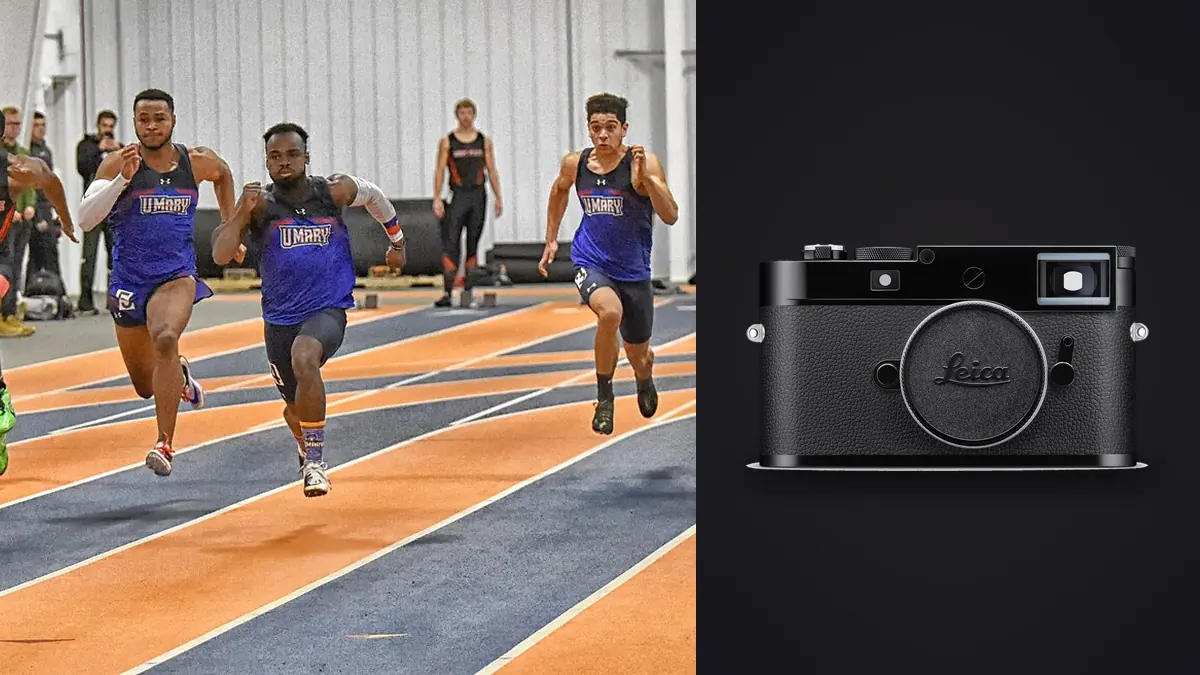
The first time I brought a Leica M11 to a track meet, a coach I know glanced at the body slung around my neck and asked if I'd left my "real camera" at home. Fair question. The M11 has no autofocus, no subject tracking, no continuous eye detection, and a native lens lineup that tops out around 135mm. Every one of those is a liability at a 400m oval where the action is fast, far away, and moving laterally across your frame. And yet I keep bringing it, because the frames it produces when the technique is right have a rendering quality that my mirrorless sports body doesn't match, and because the constraints force a shooting discipline that actually suits track better than spray-and-pray burst mode does.
This isn't a camera review. It's a record of what actually works when you point a 60-megapixel rangefinder at sprinters, hurdlers, and distance runners, and what doesn't.
The core problem: there is no autofocus to fall back on
The M11 focuses the way every M-mount Leica has focused since the 1950s: you align a small rangefinder patch in the center of the viewfinder with your subject, twist the lens focus ring until the two overlapping images merge, and shoot. There's no motor, no phase-detection array, no algorithm guessing at what you meant to focus on. For portraits, street work, or anything that holds still or moves at walking pace, this is manageable and even enjoyable. For a 400m runner covering the backstretch at roughly 8-9 meters per second, trying to rangefinder-focus in real time is a losing game. By the time your eye confirms the patch has merged, the runner has moved a meter and a half past the plane you focused on. So you don't try to focus on the runner. You focus on the track.
Zone focusing is the only technique that scales
Pick a spot, a lane line, a hurdle takeoff mark, the edge of the finish tape, and pre-focus the lens on that exact distance using the distance scale, not the rangefinder patch, while nothing is happening. Then stop the lens down enough that your depth of field swallows a meter or so of error in either direction. At f/5.6 with a 90mm lens focused at 15 meters, you get roughly 1.3 meters of usable depth of field, enough to cover a runner's stride length as they cross your pre-focused zone. At f/8 that window opens further, which is why most of my keeper frames from meets were shot between f/5.6 and f/8 rather than wide open. Wide-open apertures on M-mount glass look gorgeous on a static subject and are nearly unusable for zone-focused action, because the margin for error collapses to a few centimeters. The workflow becomes: frame the zone, confirm focus on something stationary in that spot (a cone, a lane marker, another photographer's shoulder), wait, and fire a short burst the instant the runner's foot lands inside your zone. It's closer to trap-focus street photography than anything in a typical sports-shooting workflow, and it takes a full meet or two before the timing stops feeling like guesswork.
Lens reach is the real limiting factor, not focus speed
Track photographers usually reach for 300mm, 400mm, or longer glass to compress distance and fill the frame from the stands. M-mount lenses don't go there. The longest lens Leica currently makes for the M mount is the APO-Telyt-M 135mm f/3.4, and most working M shooters are carrying something shorter than that, a 90mm APO-Summicron or a 75mm Summilux. That means the M11 only works at a track meet if you physically move close to the action rather than sitting back and zooming in. In practice that means credentialed infield access, a spot right at the fence near the blocks, or positioning at the finish line where meets typically allow photographers closer than they'd allow at midtrack. Here's roughly what different M-mount focal lengths give you at distances you can actually reach at a typical scholastic or club meet:
| Focal length | Realistic shooting distance | What you get in frame | Best use at a meet |
|---|---|---|---|
| 35mm | 5-8m | Full body plus surrounding lanes, environmental context | Blocks and start, wide shot of a hurdle flight |
| 50mm | 8-12m | Head to knee on one or two athletes | Hurdle approach, mid-race straight from close rail |
| 75mm | 12-18m | Tight upper body, one athlete fills most of frame | Finish line if you're positioned right at the tape |
| 90mm | 15-25m | Portrait-tight on a single runner | Backstretch runners shot from the infield rail |
| 135mm | 20-35m | Tightest usable frame, some crop still needed for full body | Distance events and field events shot from behind a barrier |
Notice what's missing from that table: anything that lets you shoot a 100m final from the general-admission bleachers 40 meters back. That shot simply isn't available to you on this camera without cropping so hard you throw away most of the 60MP sensor's advantage. The M11 rewards photographers who plan their position around the lens they're carrying, not the other way around.
Shutter speed, and a trap the electronic shutter sets for you
Freezing a sprinter's stride at full extension needs at least 1/2000s; anything slower and the lead foot and trailing arm both show soft motion blur, which sometimes looks intentional and often just looks like a miss. For a straight-on approach shot, where the runner is moving mostly toward the camera rather than across it, you can get away with 1/1000s. For a lateral pan across the frame, which is most of what you shoot on a backstretch or in a relay exchange, 1/2000s is close to the minimum I'd trust. The M11 gives you two very different shutters to hit those speeds. The mechanical shutter runs up to 1/4000s and behaves the way you'd expect: clean, no distortion, works at any speed for any kind of motion. The electronic shutter extends up to 1/16000s, which sounds like the better tool for freezing motion, but it reads the sensor line by line rather than all at once. Pan a lateral shutter that reads slowly relative to a sprinter's leg speed and you get a visible skew, straight lane lines bending, spokes-effect distortion on fast-moving limbs. I learned this the hard way on a 200m turn where a whole burst of otherwise well-focused frames came back with legs that looked subtly sheared. For anything with lateral motion at a track meet, stick to the mechanical shutter and accept the 1/4000s ceiling; it's plenty for this use case anyway. Save the electronic shutter for genuinely static subjects, award presentations, team photos, warm-up portraits.
Burst shooting at 60 megapixels has a buffer wall
The M11 shoots continuous bursts at up to 4.5 frames per second, which is modest next to a dedicated sports body, but it's enough once you accept that you're not tracking a runner through an entire race, you're firing a short burst the moment they cross your pre-focused zone. Four or five frames at 4.5fps covers the width of that zone comfortably. Where it bites is file size. A full-resolution DNG at 60MP runs somewhere around 80-120MB depending on scene detail even with Leica's lossless compression, and the buffer empties into the card at whatever speed your UHS-II card allows. Fire off a longer burst chasing a hurdle sequence and you'll feel the camera stall for a few seconds while it clears frames. Two things fixed this for me. First, switching to the M11's DNG "M" (36MP) or "S" (18MP) capture mode for meets where I know I'm cropping in anyway for reach; the buffer holds noticeably more frames before slowing. Second, using the fastest UHS-II card I own rather than whatever was already in the bag, since write speed is the actual bottleneck once the buffer fills, not sensor readout.
Where the M11 actually earns its spot in the bag
I don't bring this camera to shoot a whole meet. I bring it for specific moments where the discipline of pre-focus and the rendering of the lens actually pay off: the crouch in the blocks before a sprint final, the exact instant a hurdler's lead leg clears the barrier, relay exchanges in the zone where both runners are briefly at a known, fixed distance, and the finish line if I can get tape-side access. Those are all situations where the subject passes through a predictable plane, which is exactly what zone focusing needs. I also use it heavily between races, athletes stretching, coaches giving last instructions, the walk back from the track, where there's no fast lateral motion and the rangefinder's actual strength (quiet, unobtrusive, genuinely fast to operate once you're used to it) takes over from its weakness. What I don't attempt anymore: continuous events like the 800m or 1500m where a runner needs to be tracked across multiple laps and changing distances. A camera with real autofocus tracking will beat the M11 there every time, and there's no zone-focus trick that fixes a subject whose distance from you is constantly changing.
Sorting the results afterward
Manual-focus action shooting has a wider miss rate than autofocus shooting, that's just true, and a meet with several hundred frames means a real sorting job afterward. This is the part of the workflow where I actually rely on imagic. Its local sharpness and focus scoring flags which frames in a burst landed in that narrow zone-focus window and which drifted soft, which matters a lot more here than on a typical shoot because the misses genuinely look sharp at thumbnail size and only reveal the focus miss at 100%. I don't have to zoom into every 60MP file by hand to find the two keepers out of a six-frame burst. The duplicate and burst clustering helps just as much, since a hurdle sequence or a relay exchange usually produces four or five nearly identical frames a fraction of a second apart. Instead of scrolling past the same moment five times, imagic groups the burst so I'm comparing frames against each other directly rather than against the whole day's take. And because everything runs locally rather than through a cloud upload, the 60MP DNGs never leave the drive, which matters more than it sounds like it should when a single meet can produce 40-60GB of RAW files that I'd rather not wait to sync anywhere. For the edit itself, I trained imagic's apply_my_style preset on a set of track edits I'd already finished and was happy with, contrast curve, the way I handle grass and track surface color, skin tones under stadium lighting. New imports from a meet now come in with that treatment already applied as a starting point, which saves real time given how much of a track shoot's editing is repetitive across frames shot in the same light. If you're building out a broader workflow around a manual camera like this, our breakdown of how AI photo culling actually works covers the sharpness-scoring approach in more depth, and the workflow speed tips piece has a few habits that pair well with a high-miss-rate shooting style like zone focusing.
Frequently Asked Questions
Does the Leica M11 have any autofocus at all for tracking runners?
No. The M11 is a purely manual rangefinder camera with no autofocus system of any kind, so there's no tracking mode, no eye detection, and no continuous AF to fall back on. Every focus decision is made by hand using the rangefinder patch or, for fast action, by pre-setting the lens to a known distance and letting the runner move into that zone. Anyone expecting even basic contrast-detect autofocus as a backup will be disappointed; it simply isn't there.
What shutter speed actually freezes a sprinter's stride on this camera?
For a lateral pan across the frame, 1/2000s is close to the practical minimum before leg and arm motion blur starts showing up in the lead limbs. A straight-on approach shot is more forgiving and can work at 1/1000s. Use the mechanical shutter rather than the electronic one for any lateral motion; the electronic shutter's line-by-line readout produces visible skew on fast-moving limbs during a pan, even though its top speed of 1/16000s looks like the better spec on paper.
Is 4.5fps continuous shooting really enough for track and field?
It's enough if you build the shot around a pre-focused zone rather than trying to track a runner across the whole frame. A short burst of four or five frames at 4.5fps easily covers the width of a well-chosen focus zone, like a hurdle takeoff point or a relay exchange mark. It's not enough for open tracking across a full race the way a dedicated sports body with high-speed burst and autofocus tracking would be, and that's simply outside what this camera is built to do.
Which M-mount lens should I bring if I can only carry one to a meet?
A 90mm, ideally the APO-Summicron, is the most versatile single choice. It reaches close-cropped shots on the backstretch from a reasonable infield distance and still lets you back up for hurdles or blocks shots without feeling too long. A 135mm gets you tighter distance-event and field-event frames from behind a barrier, but it's a harder lens to zone-focus accurately given the narrower depth of field at any given aperture, and it leaves you with almost nothing for closer action like relay exchanges.