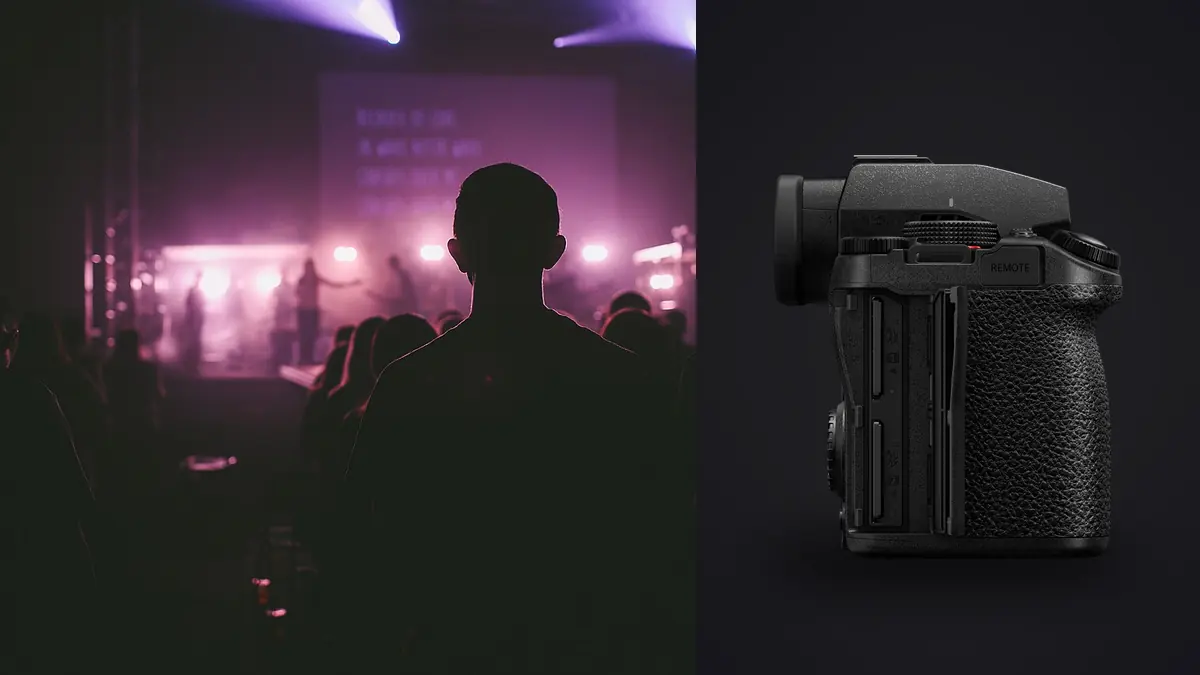
I picked up the S5IIX about eight months ago specifically because my old A7 III body was starting to miss focus on singers who wouldn't stay in one spot under a single moving spotlight. The S5IIX wasn't bought for its video specs, even though that's mostly what it gets reviewed for online. It got bought because Panasonic finally put real phase-detect autofocus into an S5-body camera, and because I needed something that could survive being rained on at an outdoor stage in September without complaint.
This isn't a spec sheet regurgitation. It's what changed in my actual workflow shooting three-song pit sets, full headline sets from the wings, and the odd acoustic show in a 200-cap room where the "stage lighting" is two ceiling-mounted par cans and whatever the bartender left on.
Why This Body Ended Up in the Pit Bag
The S5IIX shares its sensor and autofocus system with the S5II, not the original S5. That distinction matters more than most gear write-ups let on. The original S5 used Panasonic's old DFD contrast-detect system, which was fine for landscape and portrait work where the subject holds still, and genuinely bad for a singer spinning under a strobe. It hunted. It grabbed the mic stand instead of the face. I sold mine after a festival where I came home with maybe thirty usable frames out of four hundred.
The S5IIX's phase-hybrid AF, with the 24.2MP sensor carrying actual phase-detect pixels across the frame, changed that math. It's not flawless (more on that later) but it holds onto a face through a spin, through a jump off the drum riser, through a guitarist stepping in front of the singer for two seconds and stepping back out. That's the difference between a camera you point and one you have to actively fight.
The body itself is the same dual-grip magnesium shell as the S1 series, just lighter. Weather sealing has saved me twice this year, once at an outdoor stage during a light drizzle set, once when a fan threw a full cup of something sticky in the photo pit and it landed square on the top plate. Wiped it off, kept shooting. I wouldn't test that on purpose, but it's nice knowing the body doesn't flinch.
Autofocus in a Room With No Light
Club gigs are the real test, not arenas. Arenas have production budgets and predictable rigs. A 150-cap club with a single moving-head fixture and a hazer that hasn't been serviced since 2019 is where autofocus systems go to die. The S5IIX's low-light AF is rated down to around -6 EV in low-light AF mode, and in practice that's usable but not magic. Below roughly the light level of a single warm-toned spotlight on a dark stage, the camera starts to hunt the same way any hybrid system does, hunting a half-stop, catching, hunting again on the next frame.
What actually helps more than the EV rating is switching AF area mode depending on the act. For a static singer at a mic stand, I run a small tracking box locked to the face. For a drummer or anyone moving unpredictably across the stage, I widen to zone AF and let the camera pick within the box rather than trying to keep a pinpoint locked on a moving head. Full-frame tracking sounds appealing in theory and in practice it grabs the brightest thing in frame, which at a gig is usually a stage light, not a face.
Shutter Choice and the LED Banding Problem
Nobody warns you about this until it happens. Most modern stage lighting rigs, especially the cheap LED wash and moving-head fixtures that smaller venues rent, run on pulse-width modulation to dim. Your eye doesn't see the flicker. Your sensor does, especially in electronic (silent) shutter mode, where the rolling readout scans the sensor row by row over several milliseconds instead of exposing the whole frame at once. Shoot a fast electronic-shutter burst under one of these rigs and you'll get horizontal bands of dead or off-color light cutting across half your frames, and it's often invisible on the tiny rear LCD until you get home and look at full size.
The S5IIX's mechanical shutter tops out at 9fps with continuous AF, which is plenty for tracking a beat or a jump without needing the 30fps electronic mode that Panasonic markets so heavily. I default to mechanical for anything under stage lighting I don't control, and only drop to electronic for the rare all-natural-light acoustic set where there's no flicker source to fight. It costs some burst speed. It saves an entire card of unusable frames.
| Venue / lighting situation | ISO range I run | Shutter speed | Shutter mode | Note |
|---|---|---|---|---|
| Small club, single warm wash, hazer | 3200-10000 | 1/250-1/320 | Mechanical | Highest banding risk, avoid electronic entirely |
| Mid venue, moving heads + strobes | 2000-6400 | 1/500-1/640 | Mechanical | Freeze the strobe hits, watch for blown highlights on the flash pop |
| Theater, controlled follow-spot | 1250-3200 | 1/320 | Mechanical or electronic | Cleanest light of the four, least banding risk either way |
| Outdoor festival, daylight set | 100-400 | 1/1000+ | Electronic fine | No flicker source, use the burst speed for stage moves |
| Outdoor festival, night headliner | 1600-6400 | 1/320-1/500 | Mechanical | Big LED video walls behind the act are the worst banding offenders |
That night headliner row is the one people underestimate. It's not the stage lights that cause problems, it's the LED video wall behind the band that every festival main stage runs now. Those panels refresh at rates that clash badly with fast shutter speeds, and I've had entire sequences ruined by a moiré-like shimmer across the wall in the background while the subject in front of it looked perfectly fine.
Glass for a Three-Song Pit Set
Most photo pits enforce the standard first-three-songs, no-flash rule, and you're usually shooting from a barrier six to ten feet below stage height, shoulder to shoulder with four other photographers. Zoom range matters less than most people think going in. I run a 24-105mm f4 for wide stage shots and crowd context, and a 70-200mm f2.8 for tight face shots from the pit, and honestly the 70-200 stays mounted for eighty percent of the set.
For rooms below maybe 300 capacity where you're closer to the stage, I've started favoring a fast prime instead, usually the Lumix S 50mm f1.8. Two extra stops of light over the f4 zoom is a real difference when you're at ISO 6400 already and don't want to push to 12800 just to keep shutter speed above 1/320. The IBIS in the S5IIX is rated to 6.5 stops with a stabilized lens, which is excellent for static subjects, but it does nothing for a moving singer. Stabilization stops your hands from shaking. It doesn't stop the performer from blurring at a slow shutter speed, so don't let a good IBIS number talk you into shutter speeds you wouldn't otherwise trust.
Battery Life Across a Full Night
The DMW-BLK22 battery is rated around 370 shots CIPA with the LCD, and using the EVF constantly through a three-band bill, which is how most nights actually go for me, brings that down noticeably. I carry three batteries for anything past a single headline set and I've drained two of them on a busy festival day with back-to-back acts and no real downtime to charge between sets. Dual SD card slots are a small thing that matters more than it sounds like it should. Backup recording to the second card while shooting three acts back to back with no laptop nearby has saved me from a corrupted card exactly once, which is exactly once more than I wanted to need it.
Getting Through the Card Before Deadline
Here's the part gear reviews never cover and the part that actually decides whether the night was worth it. A three-band festival day leaves me with somewhere between 900 and 1,400 raw files by the time I'm walking to the car. You still want a gallery sorted the same night or, at the latest, by mid-morning the next day. Nobody wants to sit there clicking through 1,400 nearly identical burst frames trying to tell which one has the eyes actually open and the focus actually on the face rather than half an inch behind it on the mic.
This is where I stopped doing that manually. I run the card through imagic before I touch Lightroom at all. The local sharpness and focus scoring catches the exact problem burst shooting creates at gigs, where five frames in a row look nearly identical on a phone screen but only two are actually critically sharp on the eyes once you're at 100%. It flags those without me squinting at a laptop screen in a venue parking lot at 1am. The burst and duplicate clustering does the heavier lifting though, since a 9fps mechanical burst through a two-minute chorus produces a lot of frames that are functionally the same shot, and getting that pile down to the handful worth reviewing is most of the actual time savings. Because it runs entirely on the laptop with the files never leaving the machine, I'm not uploading unreleased festival photos to some third-party server before the artist's team has cleared what's allowed to go out, which some tour photographers care about more than others but I'd rather not have to think about it either way.
Once I'm down to the real shortlist, I lean on the apply_my_style preset that's trained on my own past edits rather than a generic preset pack, since gig lighting swings so hard between venues that a fixed preset either crushes the shadows in a dark club shot or blows out an outdoor daylight set, and having something calibrated to how I've actually graded my own concert work in the past gets me to a consistent look across a mixed gallery faster than building it from scratch each time. If you're new to building a culling pass that doesn't eat your whole night, the breakdown in how AI photo culling actually works covers the mechanics in more depth than I'll get into here, and the workflow tips in getting through a shoot faster apply just as well to a stack of concert files as they do to a wedding.
Where It Falls Short
I'd be lying if I said this camera solved everything. The buffer on mechanical burst is generous but not infinite, and if you hold the shutter down through an entire guitar solo hoping the shot lands somewhere in there, you can hit the buffer wall mid-song and miss the actual moment while the camera catches up writing to card. Rolling shutter on the electronic mode is worse than the flagship stacked-sensor bodies from other brands, which matters if you're shooting a lot of fast-panning stage moves under electronic shutter, though I've mostly sidestepped that by staying mechanical as described above. And at just under 2.9 pounds with the 70-200 attached, a full pit-and-wings night leaves my shoulder in worse shape than my old lighter APS-C setup ever did. None of that has made me regret the switch. It just means the camera has a personality, the way every tool built for a specific job does, and it's worth knowing the rough edges before you're relying on it under a stage light at 11pm on a Friday.
Frequently Asked Questions
Does the S5IIX cause banding under typical concert lighting?
It can, but the cause is almost always electronic (silent) shutter mode meeting PWM-dimmed LED fixtures, not a flaw specific to this camera. Switching to the mechanical shutter, which tops out at 9fps with continuous AF, eliminates the vast majority of banding I run into at club and mid-size venue shows. Reserve electronic shutter for daylight festival sets or fully incandescent stage lighting where there's no flicker source to begin with.
Is the autofocus actually reliable for a moving singer in a dark venue?
Considerably better than the original S5's contrast-only system, thanks to the phase-hybrid AF shared with the S5II. It holds a face through spins and stage moves well below club-level lighting. It's not immune to hunting once light drops below roughly the equivalent of a single dim spotlight, and it will occasionally lock onto a bright stage light instead of a face if you're using full-frame tracking instead of a tighter zone.
What lens actually earns its keep in a three-song pit set?
A 70-200mm f2.8 covers most of what a barrier photo pit needs for tight performer shots, and it's the lens I have mounted for the majority of any set. In smaller rooms where you're closer to the stage, a fast prime like a 50mm f1.8 buys two extra stops over an f4 zoom, which matters once ISO is already pushed past 6400 and you don't want to climb further just to hold shutter speed.
Is it worth upgrading from the original Lumix S5 just for concert work?
If autofocus reliability on moving subjects is the bottleneck in your current results, yes, the jump from DFD contrast detection to phase-hybrid AF is the single biggest practical change between the two bodies for this genre specifically. If your S5 keeps up fine because you mostly shoot static performers or well-lit theater shows, the upgrade matters less and the money is better spent on faster glass.