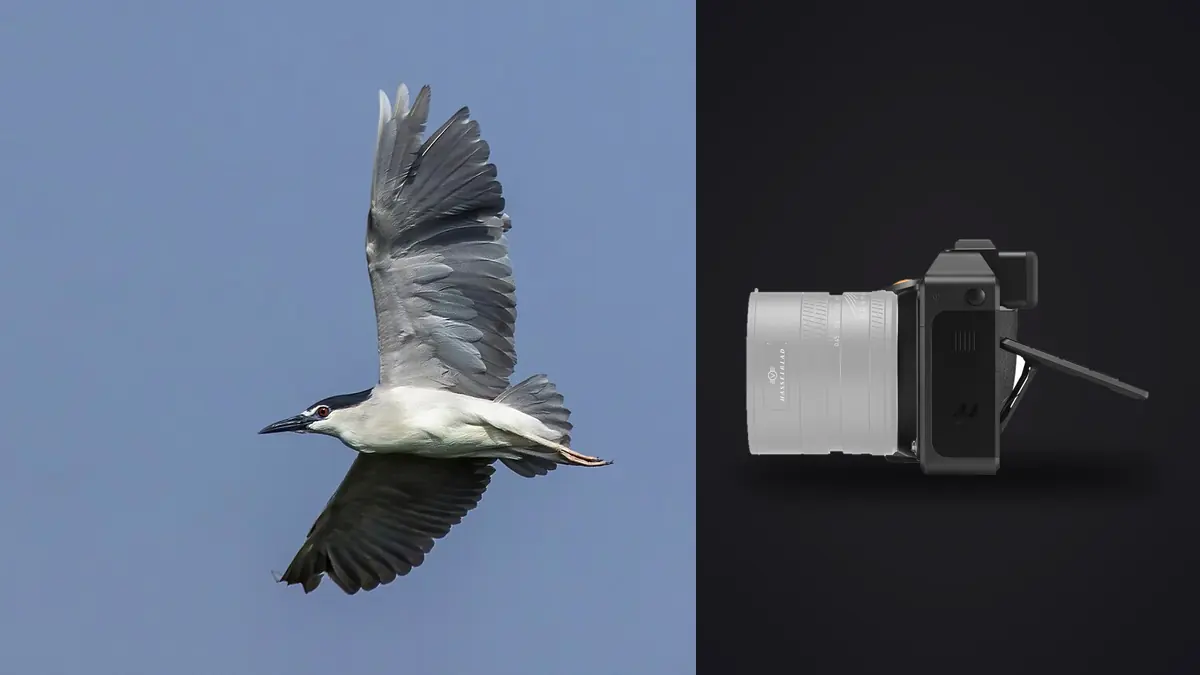
Why I brought a medium format landscape camera to a heron colony
A friend who shoots raptors for a living saw me unpacking the X2D 100C at a heronry last spring and asked, not unkindly, whether I'd gotten lost on the way to a studio. It's a fair question. Hasselblad built this body for architecture, portraiture, and product work, the kind of shooting where the subject holds still and you have all the time in the world to nail focus. Birds in flight are the opposite of that brief in every way. So this isn't a marketing recap of the spec sheet. It's what actually happened across four outings, two coastal colonies and one river blind, when I pointed a camera that was never designed for this job at gulls, herons, and a pair of ospreys that would not cooperate.
The short version: it worked far less often than my usual crop-sensor rig, and when it worked, the files were worth the frustration. Everything below is the long version, with the numbers and the workarounds that actually mattered.
Autofocus: phase detection helps, but there's no bird-eye tracking mode
The X2D 100C was the first Hasselblad X body to add on-sensor phase-detection autofocus, replacing the contrast-only system in the X1D II. That upgrade matters and I don't want to undersell it. On a perched bird, or a heron standing in shallow water waiting for a fish to swim past, the X2D locks quickly and holds focus through small movements. It's genuinely usable for that class of shot in a way the older body wasn't.
Once the subject leaves the perch, the gap shows up. There's no subject-detection mode built for animals, no eye tracking that recognizes a bird's head against a moving wing and busy background. You get a focus point or zone you place and re-place yourself, and the algorithm holding that lock across an erratic flight path (an osprey banking hard over water is not a smooth, predictable line) is simply not built for that kind of chase. On a Sony or Canon flagship with bird-eye AF, I expect a high hit rate on a bird crossing the frame at a moderate distance. On the X2D, I treated every flight pass as a coin flip and adjusted my expectations accordingly: fewer attempts, more setup, more reliance on predicting the flight line before I raised the camera rather than trusting the AF to find it mid-motion.
What did help was pre-focusing on a fixed point, a snag the ospreys used as a fishing perch, a gap in the reeds the herons flew through on approach, and waiting for the bird to cross that plane. That's an old-school technique that large-format and view camera shooters have used forever, and it's the technique that actually makes this body workable for flight shots at all.
No mechanical shutter changes how you think about wingbeats
The X2D 100C has no mechanical shutter option at all, it's fully electronic. That has one real upside for wildlife work: there's no shutter slap, so a heron on final approach doesn't flare off at the click the way it sometimes will with a loud DSLR mirror. Flash sync up to 1/4000s is also a neat trick, though I never found a practical use for it chasing birds outdoors.
The downside is rolling shutter. A fully electronic sensor reads out line by line rather than all at once, and on a subject moving fast across the frame (a gull cutting past at speed, wings snapping through a downbeat) that readout lag can skew straight lines into a subtle diagonal smear. Wingtips were where I saw it most, a faint bend that wasn't there on the same bird a stop later, once it slowed to glide. I didn't get catastrophic jello-effect distortion, the sensor's readout speed is fast enough that most flight shots at typical panning speeds looked fine, but I started shooting at 1/2000s or faster specifically to shrink the readout window, and I avoided fast horizontal pans across a stationary background whenever the light allowed it. If you're used to a stacked-sensor body with a fast electronic readout, you can relax those habits. On the X2D, I couldn't.
Frame rate and buffer force a different shooting rhythm
Hasselblad rates the X2D 100C at roughly 3.3 frames per second in continuous shooting, and that number is the single biggest adjustment coming from a wildlife-oriented body. My usual APS-C setup shoots 20 fps electronic and I lean on that heavily for BIF work, firing a burst through a wingbeat cycle and picking the sharpest frame after the fact. At 3.3 fps, a full wingbeat might only get one or two frames inside it. You lose the luxury of spraying and sorting.
Buffer depth compounds it. Each raw file out of the 100MP sensor runs well over 100MB, and even with the internal SSD and a fast CFexpress card, the buffer clears out after somewhere around fifteen to twenty consecutive frames before the write speed catches up and the camera stalls. In practice that meant I stopped trying to hold the shutter down through an entire flight sequence and instead fired short, deliberate two- or three-frame bursts timed to the part of the wingbeat I actually wanted, wings up, wings fully extended, or the moment just before touchdown. It's a slower, more considered way to shoot birds, closer to how you'd work a static portrait than how you'd chase a tern colony.
Even at that reduced rate, a few hours in a hide still leaves you with hundreds of near-duplicate frames of the same bird at slightly different wing positions, and at 100MP+ per file that's a lot of data to review on a laptop screen at 1am. This is the point in the workflow where I've started running everything through imagic before I even open Lightroom. It does its sharpness and focus scoring locally on the raw files, so I'm not uploading gigabytes of medium format data anywhere, and the duplicate and burst clustering groups those near-identical wingbeat sequences together instead of making me scroll past forty flat variations of the same pass. It doesn't replace judgment on which wing position looks best, but it cuts the pile down to a shortlist fast, which matters more with 150MB files than it ever did with 25MB ones. If you're new to that kind of triage step, how AI photo culling works covers the mechanics in more depth than I have room for here.
Reach: the lens lineup wasn't built with birders in mind
This is the part that will actually decide whether this camera makes sense for you. The XCD system's longest native lens is the 300mm f/3.2, released well after the body itself, and Hasselblad's medium format sensor carries a 0.79x crop factor relative to full frame, so that 300mm lens behaves like roughly 237mm in full-frame terms, shorter than a kit telephoto zoom on most mirrorless systems. Add the 1.7x teleconverter (compatible with a limited set of XCD lenses including the 300mm) and you get an actual focal length of 510mm, which works out to about 403mm full-frame equivalent, at a slower effective aperture. That's simply not enough reach for anything but confiding, close, or habituated birds. Distant raptors on a cliff face, small songbirds in canopy, anything that keeps its distance, you'll be cropping hard or walking away without the shot. The table below lines up what I actually carried against the setups birders around me were using on the same outings.
| Kit | Full-frame equivalent reach | Max burst rate | Typical raw buffer | Kit weight | Approx. price (body + lens) |
|---|---|---|---|---|---|
| Hasselblad X2D 100C + XCD 300mm f/3.2 + 1.7x TC | ~403mm | 3.3 fps | ~15-20 frames | ~2.1 kg | ~$13,500 |
| Full-frame mirrorless + 600mm f/4 prime | 600mm | 20-30 fps (electronic) | 1,000+ frames | ~3.2 kg | ~$18,000 |
| APS-C mirrorless + 100-400mm zoom | ~600mm (1.5x crop) | 20 fps | 200+ frames | ~1.4 kg | ~$3,800 |
| Micro Four Thirds + 300mm f/4 + 1.4x TC | ~840mm | 60 fps | 100+ frames | ~1.6 kg | ~$4,500 |
Read that table and the case against the X2D for this genre writes itself on paper. But there's one column missing that matters in practice: pixel count on subject after the crop. A 403mm-equivalent frame from the X2D that gets cropped down to simulate an 800mm field of view still leaves you somewhere around 25 megapixels of usable resolution, because you started from 100. Do that same crop from a 24MP full-frame file shot at 600mm and you're down in single-digit megapixels, unprintable at any real size. So the reach disadvantage is real, but it's partially, not fully, offset by how much sensor you have left over once you've cropped your way out of the problem.
Where the sensor actually earns its keep
The moments this camera justified itself weren't the fast passes, they were the quiet ones. A backlit egret against a bright sky at dawn, wings translucent, is exactly the kind of high-contrast scene that clips highlights or crushes shadow detail on a smaller sensor. The X2D's dynamic range pulled feather edge detail out of that backlight that I know for a fact my APS-C body would have lost. Iridescent plumage, a grackle's neck, a kingfisher's back, held color separation through the highlight roll-off in a way that made the extra weight in my bag feel less pointless in the edit. For anything printed large, a 100MP file of a perched raptor with genuinely sharp focus on the eye is a different object than a heavily upsized crop from a smaller sensor. If your end goal for wildlife work is gallery prints rather than fast turnaround for a client or a feed, that's a real, non-marketing reason to consider this body, just not for the flight shots specifically.
One workflow habit that helped on a five-day coastal trip: I ran a batch of my keeper files from the first two days through imagic's apply_my_style preset, trained on edits I'd already made to older heron and gull images, so the color and contrast treatment stayed consistent across days with wildly different light (overcast one morning, harsh midday sun two days later) without me manually matching curves file by file each night. Since it runs locally, that also meant I wasn't waiting on a hotel wifi connection to process anything, which mattered more than I expected at a lodge with one bar of signal.
Field adjustments that actually made a difference
A few habits changed the hit rate more than any setting did. Working from a boat or a floating hide put subjects close enough that the 403mm-equivalent reach stopped being a constraint, gulls and terns working a baitfish ball will come within twenty feet without much coaxing. Shooting perched-to-launch sequences, where the bird is stationary when you acquire focus and you fire through the first wingbeat as it pushes off, gave a far higher keeper rate than trying to pick up an already-flying bird cold. And I stopped chasing anything moving laterally at speed close to the lens; the combination of slow AF response and rolling shutter risk made those attempts a near-total waste of frames. The IP53 weather sealing did hold up fine through two mornings of coastal drizzle, for what it's worth, that part of the spec sheet is not oversold.
Who this setup actually makes sense for
If you photograph raptors at range, fast-moving shorebirds, or anything where you need a high burst rate and long native glass to compensate for distance and unpredictability, this isn't your camera and I'd steer you toward a dedicated wildlife body instead, that's not a controversial opinion after actually shooting with it. Where the X2D 100C earns a place in a birding kit is narrower: close-range, habituated, or perched subjects; slower species like herons and egrets that give you time to compose; and photographers whose priority is a handful of exceptional large-format prints per trip rather than a high volume of usable frames. It's a specialist's second body for this genre, not a first one, and the price tag on the table above makes that a fairly expensive lesson to learn the hard way. For the culling and edit-matching side of a shoot with this many large files, tools built for local, offline review earn their keep fast; see our notes on tightening up a photo workflow if huge raw files are new territory for you.
Frequently Asked Questions
Does the Hasselblad X2D 100C have bird-eye or animal-detection autofocus?
No. The X2D 100C has phase-detection AF spread across most of the frame, which is a real improvement over the contrast-only system in the X1D II, but there's no subject-recognition mode for animals or birds specifically. You place the focus area yourself and track manually, which is a meaningful difference from flagship wildlife bodies with dedicated bird-eye tracking.
What frame rate can I realistically expect for flight sequences?
Hasselblad rates continuous shooting at about 3.3 fps, and that held up in my field use. Buffer depth runs out after roughly fifteen to twenty raw frames given the file size, so long, sustained bursts through an entire flight pass aren't realistic. Short, timed two- or three-frame bursts work better than holding the shutter down.
What's the longest effective reach I can get for birds with this system?
The longest native lens is the XCD 300mm f/3.2, which is roughly 237mm in full-frame terms after the 0.79x crop factor. Adding the 1.7x teleconverter gets you to about 403mm equivalent. That's short by wildlife-lens standards, so this system suits close or habituated subjects far better than distant ones.
Is the fully electronic shutter a problem for panning shots of fast birds?
It can be. There's no mechanical shutter option, and the rolling readout can introduce a subtle skew on fast-moving subjects like wingtips at speed. It wasn't severe in my testing, but shooting at 1/2000s or faster and avoiding aggressive lateral pans against a static background reduced it noticeably.