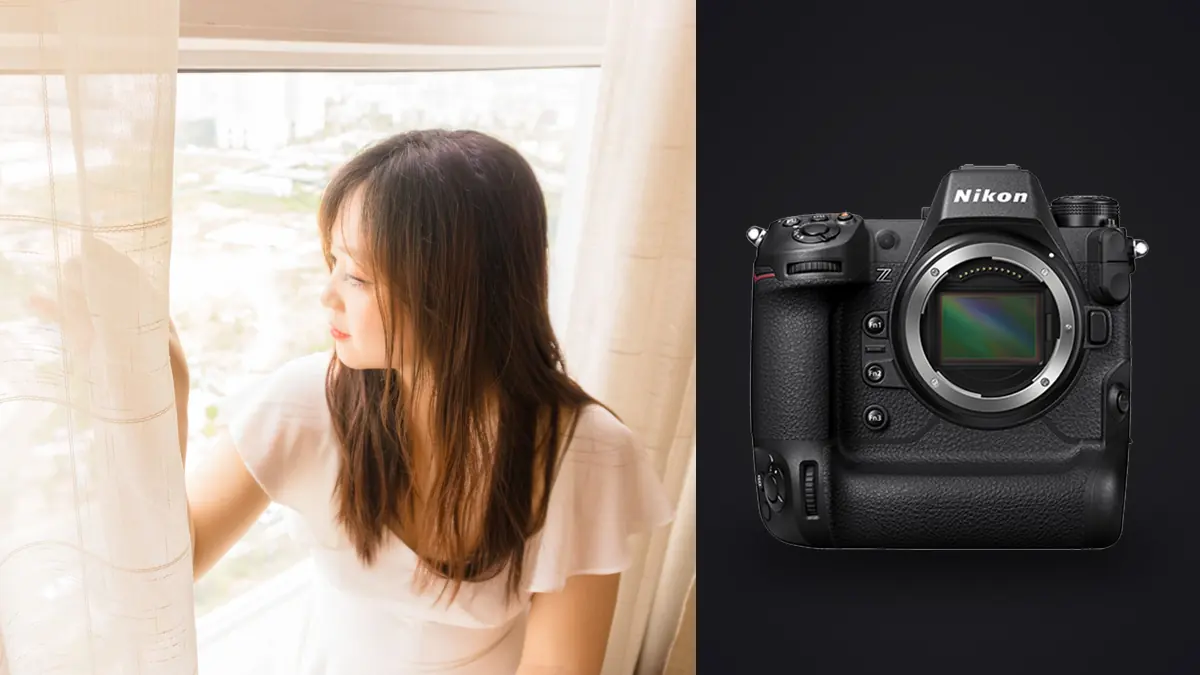
The first time a client watches you unpack a camera that was built to photograph bald eagles from four hundred meters away, in her bedroom, for a boudoir session, she is going to ask a question. Usually it is some version of "is that thing going to be loud?" The Nikon Z9 is, in a strange way, one of the better answers I have found to that exact worry in about a decade of shooting portrait work that leans intimate. Nikon did not design it for boudoir photographers. It was built for people chasing hockey pucks and peregrine falcons. But several of the choices that make it a sports and wildlife body happen to solve real problems in a bedroom or a hotel suite too, and after two years shooting one as my main body for this genre, I think it is worth explaining exactly which parts matter and which parts are just spec-sheet noise.
No mechanical shutter changes how the room feels
The Z9 was the first Nikon flagship with no mechanical shutter at all. Everything is electronic, front and rear curtain both. For sports shooters this is mostly a durability and blackout-free-viewfinder story. For boudoir work it is something else entirely: the camera makes no clack, no slap, no little mechanical stutter every time you press the button. In a quiet bedroom with soft music playing, that matters more than most gear reviews ever mention.
A client who is nervous about being photographed in lingerie or less notices sound. A loud shutter is a small, repeated reminder that a machine is recording her, and it breaks the conversational rhythm you are trying to build between frames. With the Z9 I can fire off a burst while still talking, mid-sentence, and she genuinely does not always know a photo was taken. That sounds like a small thing until you have shot the same pose on a D850 and watched a client flinch slightly at the mirror slap on frame one of a series.
The tradeoff is one you have to manage on your end: since there is no mechanical curtain, fast lateral motion (a hair whip, a sheet pulled quickly across frame) can show mild rolling shutter skew if the movement is genuinely fast. In practice, most boudoir movement is slow and controlled, a slight shift of weight, a hand moving through hair, so I run into this maybe once a session, usually when someone tosses a robe off camera. Worth knowing, not worth worrying about.
Autofocus has to work through hair, lace, and one bedside lamp
Studio boudoir with three strobes and a beauty dish is one kind of lighting problem. A lot of real boudoir work happens in a client's own bedroom or a rented Airbnb suite with whatever window light and lamps are already there. That means autofocus is frequently hunting in 200 to 400 lux, sometimes less once curtains come out for a moodier look.
The Z9's low-light AF claims (down around minus seven EV with a fast prime) hold up better than I expected walking in skeptical. Eye-detect will lock through a fair amount of hair and through most sheer fabric, though a heavy lace overlay directly across the eyes will occasionally make it grab the pattern in the lace instead of the eye behind it. When that happens I drop out of subject tracking and use a single focus point placed manually, which is a habit worth building before your first paid session rather than during it. Back-button focus is close to mandatory here: recomposing constantly between full-body and detail shots means you do not want the shutter button re-triggering AF every time you reframe.
One practical note: the articulating rear screen gets used constantly in this genre in a way it rarely does in headshot work. Low, floor-level angles shooting up along a bed, or shots from above while standing on a chair, are common compositions, and being able to flip the screen rather than lie on the floor with your eye to the viewfinder keeps the session moving and keeps you talking to your client instead of disappearing behind the camera.
Lens pairings that actually make sense in a bedroom
Studio portrait advice about lenses does not transfer cleanly here, mostly because bedrooms are small. A typical primary bedroom is somewhere between three and four meters across, which puts hard limits on what focal length lets you get a comfortable full-length shot without backing into a closet.
| Lens | Best use in this genre | Working distance in a ~3.5m room | What I actually notice |
|---|---|---|---|
| Z 35mm f/1.8 S | Full-room environmental shots, showing the space | Comfortable at 2 to 3m | Great when the room itself (a claw-foot tub, a bay window) is part of the story; too wide for close detail work, distorts hands and hips if you get near |
| Z 50mm f/1.2 S | General coverage, three-quarter and full-body | Comfortable at 2.5 to 3.5m | Heavy (about 1kg) but the rendering at f/1.2 is worth carrying it; my most-used lens for this work by a wide margin |
| Z 85mm f/1.2 S | Tight portraits, face and shoulders, compression | Needs 3.5m or more, tight in a small room | Beautiful separation but you will be backed against a wall in a lot of real bedrooms; better suited to hotel suites with more floor space |
| Z 105mm f/2.8 MC | Detail shots: hands, jewelry, fabric texture, tattoos | Works from close range down to true macro | Underrated for this genre specifically; the macro focusing range covers detail work no other lens on this list handles as well |
| Z 24-70mm f/2.8 S | One-lens sessions, fast-moving coverage | Flexible across the whole shoot | The practical choice when you are also directing posing and do not want to swap glass mid-flow; loses a bit of the wide-aperture look |
If I had to keep one lens, it would be the 50mm f/1.2. It is genuinely heavy on a body that is already not light, and after a two-hour session my shoulder knows about it, but the rendering at wide apertures gives skin a quality the f/1.8 version does not quite match. The 105mm macro gets underused by people coming from wedding or event backgrounds because it feels like a specialty lens, but detail shots (a hand resting on a collarbone, a ring, the texture of a silk robe) sell just as often as full-body frames in a finished gallery, and this is the lens that makes those actually sharp instead of soft-adjacent.
Exposure choices for mixed window and lamp light
Most boudoir sessions happen with one dominant light source, either a north-facing window or a single warm lamp, sometimes both fighting each other in the same frame. A few settings that consistently work for me on the Z9:
I shoot aperture priority more often than full manual in this genre specifically, which is a bit of a confession since I run manual almost everywhere else. Poses change fast, someone shifts from sitting to lying down and the light on them shifts with it, and I would rather trust the Z9's metering (which is genuinely good at holding skin tone exposure, better than older Nikon bodies I have used) and watch the histogram than ride shutter speed manually through twenty pose changes. Auto ISO with a floor shutter speed around 1/160 for handheld work, capped around ISO 6400, covers almost everything. Past 6400 the files are still usable but I start being more deliberate about noise reduction in post, since skin at high ISO in warm lamp light shows chroma noise in a way that reads as texture problems rather than grain people find flattering.
Aperture sits between f/1.8 and f/2.8 for most frames. Wider than that and depth of field gets thin enough that a slight forward lean during a pose puts an eye out of focus while the nose stays sharp, which is a wasted frame you cannot fully recover even with the Z9's excellent files. White balance I set manually rather than trusting auto, usually landing around 3800 to 4200K when a warm lamp is the key light, then shooting raw so I have room to correct if I guessed wrong. Auto white balance on the Z9 tends to fight the warmth of lamp light and neutralize it more than I want for this look.
What happens to the files after the shutter closes
This is the part that rarely gets discussed in gear reviews but matters enormously for boudoir specifically: session volume. A two-hour session with continuous shooting on a body this capable can easily produce 1,500 to 2,500 frames, most of them near-duplicates of the same pose held for two or three seconds while a client breathes and shifts slightly. Culling that down to a deliverable gallery of 40 to 60 images is its own job, and it is a job where the sensitivity of the subject matter changes how you want to do it.
I run everything through imagic before I touch Lightroom. It clusters the burst sequences and near-duplicate poses together automatically, so instead of scrolling through eleven nearly identical frames of the same reclined pose I am comparing a handful of already-grouped options and picking the one where the eyes are actually sharp. The sharpness scoring catches the frame where focus landed exactly where it needed to (usually the near eye, sometimes a hand or a piece of jewelry on a detail shot) faster than I catch it scrubbing through full-res images myself, especially at the end of a long shoot day when my own eyes are tired. If you have not tried an automated first pass on a shoot this size, the guide on how AI photo culling actually works is a decent starting point before you assume it will not hold up on skin tone or low-light frames, because that was my own skepticism going in too.
The part that actually matters most for this genre specifically: everything runs locally on my laptop. No cloud upload, no third-party server the files pass through on the way to being sorted. Given that the subject matter is by definition private, sometimes deeply so, it is hard to be comfortable running a client's session through a cloud culling service even if the terms of service claim the files are deleted afterward. A local-first tool removes that entire category of risk, which for this genre is not a minor convenience, it is close to a requirement I now treat as non-negotiable when picking software.
Editing consistency without a huge time cost
Boudoir clients tend to book once, sometimes as a gift to a partner or for themselves around a specific milestone, and they compare their gallery against the polished examples in your portfolio, not against a raw export. Getting a consistent, flattering color and tone treatment across sixty images without spending four hours per gallery is the actual bottleneck once culling is done. I built a preset in imagic's apply_my_style feature off about eighty of my own previously finished edits, so the AI pass matches my usual warm, slightly desaturated skin tone treatment before I go in for the finishing touches on the handful of hero images. It is not a replacement for a trained eye on the final selects, but it cuts the flat first-pass edit down from something that used to eat most of an evening to something closer to twenty minutes, which is the difference between offering a three-day turnaround and a two-week one. If your current workflow is eating whole evenings on repetitive edits, the practical suggestions in this workflow guide line up closely with what actually saved me time here.
Frequently Asked Questions
Is the Z9 too physically intimidating for an intimate session?
Visually, maybe more than acoustically. The integrated vertical grip makes it look like a lot of camera, and a first-time client who has never seen a professional body up close sometimes comments on the size before you have even turned it on. I have found the fix is conversational, not technical: show her the back screen, let her see a frame or two early, and the size stops registering after the first five minutes. The silence of the shutter does more to put people at ease than the body size does to make them nervous, in my experience.
Do I need the S-line lenses, or will older F-mount glass adapted onto the Z9 work fine?
Adapted F-mount glass works, and I shot my first year of Z-mount boudoir work on an adapted 85mm f/1.4G with no real complaints. The autofocus is measurably slower to acquire in low light through the FTZ adapter compared to native Z glass, which matters more in this genre than in bright outdoor portrait work because you are already asking the AF system to work harder. If budget forces a choice, I would put the money into one native fast prime (the 50mm f/1.2 or 85mm f/1.2) and adapt everything else.
What is the highest ISO you would actually deliver to a client from this camera?
Around 6400 without much hesitation, up to 12800 if the alternative is missing the shot entirely, with the understanding that I am going to spend extra time on noise reduction for anything past 8000 before it goes into a gallery. Skin tone is unforgiving of noise in a way landscape or street work is not; noise that looks like film grain on a building looks like a skin condition on a person, so I am more conservative here than my ISO ceiling on other genres.
How do you handle client privacy given how sensitive boudoir files are?
Dual card slots recording simultaneously so there is a backup the moment the card leaves the camera, encrypted drives for transfer and archive, and a culling and editing workflow that never touches a cloud server, are the three non-negotiables I have settled on. The dual-slot backup is a Z9 hardware feature; the local-only processing is a software choice, and after seeing how many culling tools default to cloud processing, checking that explicitly before adopting a new tool is worth the five minutes it takes.