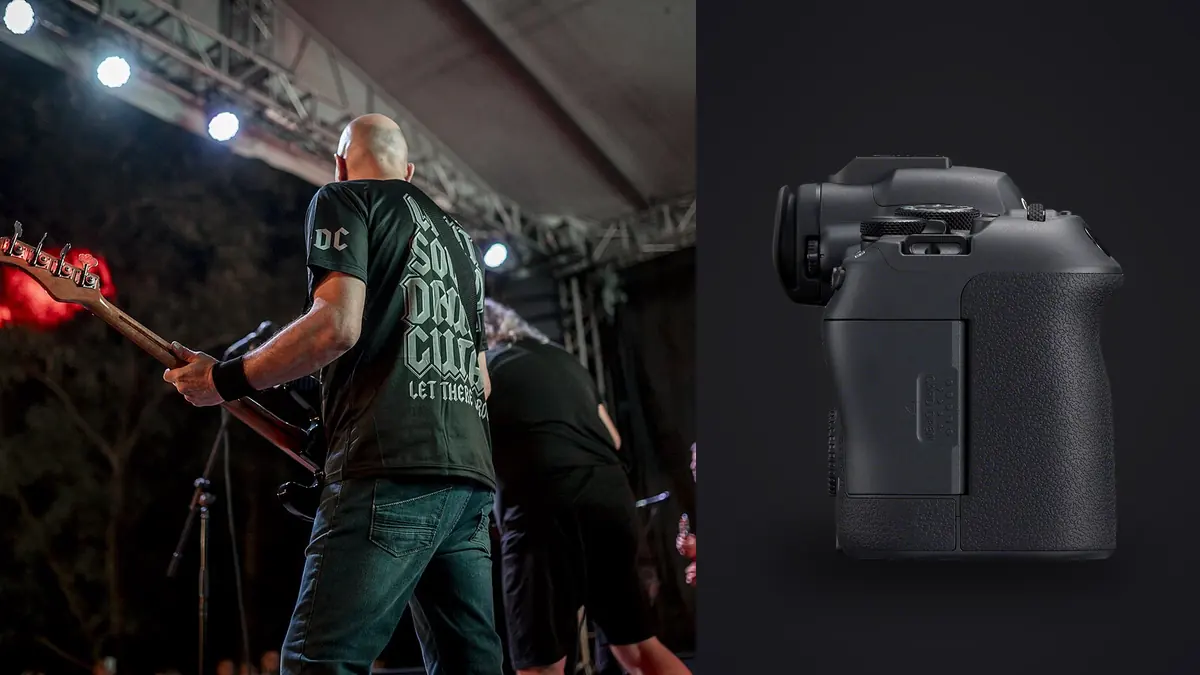
The Canon EOS R6 Mark II is a practical concert camera for photographers who want a full-frame body, responsive autofocus, manageable 24.2-megapixel files, dual SD card slots, and access to RF or adapted EF lenses. It can cover clubs, theaters, and festivals effectively when shutter mode and lens speed are matched to the light.
Its main limitations are equally important. The sensor is not stacked, so very fast electronic capture can show rolling-shutter distortion, and pulsing LEDs can produce bands or color variation. Its resolution gives less room for severe soundboard crops than a higher-resolution body. Buying fit therefore depends on venue distance, light, lens ownership, output, and tolerance for those electronic-shutter constraints.
Match the camera to the normal venue
From a small club barrier, a standard zoom or fast prime can fill the frame, and the R6 Mark II resolution is generally sufficient for web, editorial, and normal print use. In a theater, a longer zoom may be needed from a fixed aisle or rear position. At an arena soundboard, focal length and crop latitude become central.
Write down the most common access: distance, first-three-song restriction, flash rule, bag limit, lighting type, and delivery. A camera that feels ideal near the stage may be the wrong choice when most assignments happen far back. If access changes from show to show, lens flexibility matters more.
The body is smaller than an integrated-grip professional camera, which is helpful in a crowded room and on a long festival day. A separate grip can change handling when vertical work or a heavier lens demands it. Test the complete combination, not the body alone.
Twenty-four megapixels are enough until reach fails
The R6 Mark II's resolution is ample for many concert deliveries and keeps RAW files more manageable than a high-resolution alternative. It supports reasonable crop correction, but a loose full-stage frame cannot always become a detailed headshot. Atmospheric haze, focus, and motion can reduce crop quality before pixel count is exhausted.
At close and medium positions, frame with the lens rather than planning to crop. At a distant position, compare a longer lens, an APS-C body, or a higher-resolution full-frame option using the actual output. Do not judge only through an extreme screen crop; export at publication dimensions.
Moderate resolution does not automatically mean better high-ISO performance in every comparison. Exposure, sensor design, processing, and final size all matter. A properly exposed file reduced for delivery can look strong, while a heavily lifted underexposure from any camera remains difficult.
Autofocus suits performers but cannot choose the story
Face and eye detection can follow a singer or musician through many pose changes. The camera may still select a nearer performer, printed face, video wall, or audience member when several options overlap. Use a restricted AF area and begin tracking on the intended subject.
Map an AF-area override to a reachable button. A broad area acquires an isolated performer quickly; a small point or zone works through microphone stands and crowded stages. Back-button focus is useful if practiced, but changing technique immediately before a show can create more misses than it prevents.
Autofocus does not freeze a drumstick, jumping singer, or moving hair. Set shutter speed for the gesture. If the eye is sharp and hands blur, tracking worked and motion rendering needs adjustment.
Electronic burst speed comes with visible limits
The camera offers a very fast electronic continuous mode, but its conventional sensor reads progressively. Fast pans and lateral movement can skew guitar necks, drumsticks, microphone stands, or LED panels. The effect may be small in one pose and obvious in the next.
Pulsing stage LEDs can interact with electronic readout to create brightness bands or different color across the frame. Anti-flicker and high-frequency flicker controls may help in supported settings, but they require testing. Mechanical shutter is the dependable fallback when electronic artifacts appear.
The slower mechanical burst is often sufficient for concert timing and produces fewer redundant files. The decision should be based on motion, lighting, and required moment rather than on the highest number in the menu. Short bursts around a jump or expression are easier to review than continuous capture through a song.
Low light makes lens choice more important than body speed
A fast standard zoom covers many pit situations, while a telephoto zoom is essential from a distant theater or arena position. Fast primes gather more light in dark clubs and can simplify the background, but they reduce framing flexibility when the photographer cannot move.
RF lenses provide native integration. Supported EF lenses can work through Canon's adapter, preserving existing glass, but each lens should be tested for autofocus, flare, balance, and handling. Stage point lights reveal ghosts and veiling flare that daylight samples may not show.
Choose aperture for both exposure and depth. Wide open can isolate a singer, yet a turned face or two-person interaction may need more depth. Raising ISO can be preferable to losing the far eye or instrument detail that the brief requires.
Dual SD slots are useful with the right cards
Both slots use SD media, which simplifies a matched card set. Duplicate RAW recording provides an in-camera second copy when the cards sustain the selected format and drive mode. Separate RAW and JPEG can support fast sharing but is not duplicate RAW protection. Overflow offers capacity without redundancy.
Use tested UHS-II cards where the performance plan requires them, and verify camera compatibility rather than relying only on label speed. Keep blank, exposed, and copied cards physically distinct. A card from a finished support act should not be formatted because the headline set is about to start.
Buffer recovery and card writing should be tested with the exact RAW choice. A high electronic rate can produce more files than expected in seconds. The operational solution is burst discipline as much as faster media.
Battery and handling fit long event days
The articulating screen can support low or overhead angles, while the electronic viewfinder remains the main tracking tool. Configure displays so exposure and AF information do not cover the performer's face. Reduce rear-screen brightness enough not to distract an audience.
Carry protected charged batteries and replace them during predictable breaks rather than waiting for an important song. Wireless transfer, frequent review, cold, and high display brightness affect endurance, so avoid promising a fixed count. Test the actual routine.
A cross-body or dual-camera strap should keep equipment from hitting barriers and people. Check mounting points, adapter seating, and lens hoods before entering a pit. Compact size helps only when the carry system remains controlled.
Stage lighting still requires exposure discipline
Spotlights can clip skin and pale clothing while the rest of the stage remains dark. Use manual exposure when performer light is stable even if backgrounds change, or manual shutter and aperture with Auto ISO when intensity shifts. Protect the highlights that carry detail without underexposing every face for a tiny lamp.
Colored LEDs can clip one channel before the overall histogram reaches the edge. A saturated red wash may erase skin texture in red even when average luminance looks safe. Lower exposure or wait for a different lighting cue when color detail matters.
Automatic white balance can chase each stage color. A fixed reference can keep a song sequence coherent, while RAW capture leaves adjustment latitude. Preserve the designed atmosphere rather than neutralizing every colored cue.
Consider rolling-shutter tolerance honestly
Some concert photographers rarely use electronic shutter and will see little practical disadvantage. Others need silence at classical performances or rely on the fastest rate for dynamic artists. Those users should test the exact venue lighting and movement because the R6 Mark II's non-stacked sensor is a meaningful limitation in that mode.
If repeated electronic artifacts are unacceptable, a stacked-sensor camera may be a better fit. If mechanical shutter is permitted and fast enough for the work, the R6 Mark II remains highly capable. The correct answer depends on how often the limitation intersects the paid assignment.
Rent the camera for a show with representative LEDs and motion. Photograph vertical stage elements while panning, compare electronic and mechanical sequences, and process the RAW files. A showroom cannot reproduce this test.
Account for workflow before buying
Concerts create repeated bursts with small differences in eye focus, hand position, microphone obstruction, and light. imagic can ingest supported Canon CR3 files locally, score sharpness and exposure, and group near-duplicates without uploading unreleased images. A human still decides performer priority, expression, and editorial value.
Non-destructive edits can balance exposure and color across songs, and JPEG or TIFF exports can be created after culling. The desktop page describes that local route, while the camera hardware guides provide broader comparison context. imagic is not a cloud sync service or full digital asset manager, so archive and transfer need their own plan.
Who should choose the R6 Mark II
It is a strong fit for photographers working mostly from close or medium positions, delivering common editorial or gallery sizes, valuing dual SD slots, and comfortable using mechanical shutter when LEDs cause trouble. Existing EF or RF lens ownership strengthens the case.
It is a weaker fit for distant positions that demand aggressive cropping, repeated silent high-speed work under difficult LEDs, or assignments where an integrated grip and the fastest professional handling are essential. A higher-resolution or stacked-sensor body may address those specific needs more directly.
Compare systems as complete kits: body, lenses, adapter, cards, batteries, carry method, RAW support, and output. The least expensive or smallest body is not good value if the required lens or shutter behavior remains missing, and the most specialized body is unnecessary when the venue never triggers its advantage.
A buying-fit checklist
- Distance: test the farthest normal venue at the real delivery size.
- Light: compare mechanical and electronic shutter under representative LEDs.
- Motion: inspect fast hands, stands, and panning lines for distortion.
- Lens: select aperture and reach for clubs, theaters, and festivals.
- Cards: verify duplicate recording and sustained bursts with both SD cards.
- Handling: carry the complete kit through a realistic event duration.
- Files: process CR3 images and export at the recipient's dimensions.
- Alternative: identify whether resolution, stacked readout, or size matters most.
Frequently asked questions
Is the R6 Mark II resolution enough for concerts?
Yes for many web, editorial, and normal print deliveries when the lens and position frame the performer well. Distant photographers who crop heavily should compare a higher-resolution body.
Does electronic shutter work under concert LEDs?
It can, but rolling distortion, bands, or color variation may appear with fast motion and pulsing fixtures. Test the venue and keep mechanical shutter as a fallback.
Is the R6 Mark II better for clubs or arenas?
Its size, autofocus, and moderate resolution fit close and medium club or theater positions well. Arena soundboard work depends more heavily on long lenses and crop latitude.