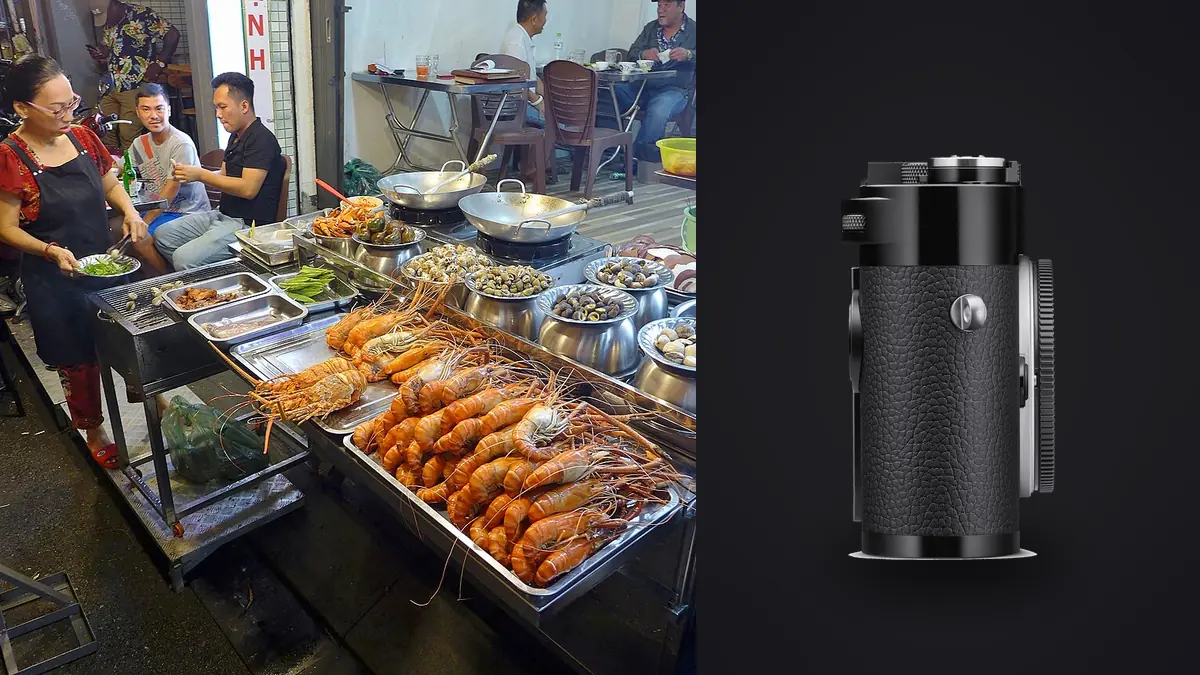
I spent three days in Porto last spring shooting nothing but market stalls, tram stops, and doorways with a Leica M11, and by the second afternoon I'd made peace with the fact that roughly one in four frames would be soft. Not blurry from motion, soft from me, guessing a focus distance a beat too early or too late. That ratio is the honest starting point for anyone considering the M11 for documentary work: it is a camera that trades autofocus certainty for a viewfinder that lets you see the world arrive before your subject does, and whether that trade is worth it depends entirely on how you shoot.
Why a rangefinder still earns its keep on the street
An optical rangefinder viewfinder shows you more than the frame. On the M11, the 0.73x finder gives you the composed rectangle with bright frame lines for whatever focal length you've mounted, but everything outside those lines is still visible, still moving, still telling you what's about to happen. A kid stepping off a curb, a hand reaching for a door, a bus about to block your angle. With an SLR-style viewfinder or an EVF, that information is gone the moment you frame up. For documentary work, where the decisive moment genuinely does arrive and leave in under a second, that peripheral awareness matters more than most spec sheets admit.
The other thing the rangefinder gives you is silence, or close to it. Set the M11 to its electronic shutter and you get true silence up to 1/16000s, no mechanical clack at all. I don't use the fully silent mode as a default (rolling shutter distortion on fast pans is real, and banding under certain LED lighting is a known issue), but having it available for a funeral procession, a courtroom hallway, or a quiet negotiation between two people who don't know they're being photographed is not a gimmick. It changes what you're willing to shoot.
The 60-megapixel sensor is a curse until it's a blessing
Leica ships the M11 with a 60-megapixel BSI sensor but lets you shoot in-camera at 60, 36, or 18 megapixels, all still saved as uncompressed DNG. For documentary and street work I shoot the 18-megapixel setting probably 70% of the time. Full resolution is for the handful of frames I already suspect are keepers, environmental portraits where I know I'll want to crop later, or work I'm shooting specifically for a print show. Everything else, the walking-and-looking, the testing-a-corner, the didn't-quite-happen frames, gets shot small because a 60-megapixel RAW file is nearly 80MB and a week of street shooting at full resolution will eat a laptop's SSD alive.
The trade-off nobody mentions enough: dropping to 18MP doesn't just save space, it changes how forgiving your focus errors look. A rangefinder focus miss that's obviously soft at 60 megapixels can read as "intentional, atmospheric" at 18. That's not a reason to get lazy with focus, but it is a reason to match your resolution setting to what the work actually needs instead of defaulting to maximum every time.
Zone focusing, in practice, at documentary apertures
Almost nobody shoots street documentary work on an M11 by focusing through the rangefinder patch for every frame. The real technique is zone focusing: pick a distance, pick an aperture that gives you enough depth of field to cover a margin of error, and let the lens do the rest while you watch the scene instead of the frame lines. With a 35mm Summicron at f/5.6 set to 3 meters, your depth of field runs from roughly 2.2 to 5 meters, which covers most across-the-street and inside-a-market distances. Open up to f/2 for low light and that zone collapses to under a meter, which is exactly when the rangefinder patch becomes mandatory again rather than optional.
This is the part of M11 ownership that either clicks for a shooter or never does. If you're coming from a camera with reliable eye-AF and you expect the M11 to replicate that experience, you'll be disappointed and probably frustrated within a week. If you're willing to think in distances and apertures the way a photojournalist did in 1975, the camera gets out of your way in a manner that autofocus systems, for all their sophistication, still don't quite manage in chaotic street scenes with lots of foreground clutter.
Handling, battery, and the parts of the spec sheet that actually matter on assignment
Body weight is 530g without a lens, which sits comfortably under most mirrorless full-frame bodies with grips and articulating screens attached. Add a 35mm Summicron and you're carrying under 900g total, light enough to have around your neck for a twelve-hour shoot day without the neck ache that comes from a longer zoom-equipped body. The thumb grip Leica sells separately is worth the money if you're shooting handheld all day; without it the M11's smooth top plate is a little too easy to fumble when you're moving fast.
Buffer depth is the M11's most honest limitation for anything resembling action. Leica quotes roughly 15 DNG frames before the buffer fills at full resolution, and in practice, shooting a fast-moving scene like a protest or a parade, you'll hit that ceiling faster than the number suggests because write speed to the internal 64GB storage (a genuinely useful addition over the M10) isn't instant. This is not a camera for sports-adjacent street work where you're firing bursts to catch a gesture. It's built for single, considered frames, which suits documentary photographers who work that way already and frustrates anyone hoping to spray-and-pray their way to a keeper.
Battery life sits around 700 shots per charge under CIPA testing, though real-world street shooting with the rear screen mostly off tends to stretch that closer to a full working day. USB-C charging means one cable does the M11, a laptop, and most other gear in a bag, which is a small but real convenience on multi-day trips.
How the M11 compares to the other cameras people actually consider for this work
Most photographers weighing an M11 for street and documentary work are cross-shopping it against a short list: the Fujifilm X100VI, the Ricoh GR III, and Leica's own Q3. Here's how they stack up on the things that matter for this specific kind of shooting, not the full spec sheet.
| Camera | Viewfinder | Quietest shutter | Body weight | RAW buffer (approx.) | Street price (new, 2026) |
|---|---|---|---|---|---|
| Leica M11 | 0.73x optical rangefinder | Electronic, silent to 1/16000s | 530g (body only) | ~15 frames | $8,995 (interchangeable lens) |
| Fujifilm X100VI | Hybrid optical/electronic | Leaf shutter, near-silent to 1/4000s mechanical | 478g | ~17 frames | $1,599 (fixed 35mm equiv.) |
| Ricoh GR III | None built-in (rear LCD) | Leaf shutter, quiet to 1/4000s | 257g | ~10 frames | $1,099 (fixed 28mm equiv.) |
| Leica Q3 | EVF (5.76m dot) | Electronic, silent to 1/40000s | 743g | ~10 frames | $5,995 (fixed 28mm) |
The GR III is the camera I recommend to anyone who says the M11 sounds intimidating and just wants to shoot street work without thinking about it. It fits in a jacket pocket and its fixed 28mm lens forces a discipline that a lot of photographers benefit from. The X100VI splits the difference nicely with a genuinely useful hybrid finder. But neither one gives you interchangeable glass, and the Q3, while beautiful, locks you to 28mm the same way the GR does. The M11's real argument is the M-mount itself: three decades of Leica and third-party glass, from a 21mm Super-Elmar for tight alleys to a 90mm Elmarit for working across a public square without closing the distance, all on one body.
What changes in the edit
A day of M11 shooting produces a different kind of take than a day with an autofocus camera. There's less true burst-mode duplication, since the buffer discourages it, but there's a specific kind of near-duplicate that rangefinder shooters generate constantly: working the same scene four or five times because the first two attempts were focus misses you couldn't fully judge through the finder in the moment. I run that whole folder through imagic's local sharpness scoring before I do anything else, because it catches the genuinely soft rangefinder misses fast, the ones that look fine on a rear LCD at the time but fall apart at 100% on a real monitor. It's local processing too, which matters when a chunk of the take is faces of people who didn't necessarily agree to end up on someone else's server.
The duplicate and burst clustering in imagic also does real work on an M11 take, even without true continuous shooting, because it groups those repeated attempts at the same composition together instead of making me scroll past all five to compare them side by side. For anyone whose workflow is bogging down at the sorting stage rather than the shooting stage, it's worth reading through how AI photo culling actually works before assuming the fix is a faster computer.
The other piece that's turned out to matter more than I expected is imagic's apply_my_style feature. I shoot a fairly consistent black-and-white documentary look, high in the midtones, blacks pulled just short of crushed, and once I'd trained that preset on a batch of my own finished edits, it started applying a reasonable first pass to new M11 takes automatically. It doesn't replace judgment on individual frames, but it means the 200-odd keepers from a market shoot get a consistent starting point instead of me manually matching tone across an afternoon's worth of light changes. If your current process is closer to opening every RAW cold, it's worth a look at general ways to speed up a photo workflow that's leaking time somewhere between the card and the export.
Frequently Asked Questions
Can you actually nail focus with a 60-megapixel sensor using only a rangefinder patch?
Yes, but expect a real learning curve, probably a few weeks of dedicated practice before your hit rate climbs above 80% at wider apertures. The sensor's resolution doesn't make focusing harder, it just makes existing misses more visible on a full-size export. Most working M11 shooters lean on zone focusing for anything under f/5.6 and reserve precise rangefinder focusing for portraits and slower-paced frames where there's time to confirm the patch.
Is the M11 too conspicuous for candid documentary work, or is that a myth?
It's smaller and quieter than most people expect once they've only seen it in photos. Next to a DSLR with a battery grip and a 70-200mm, it reads as almost nothing, a small metal box that doesn't look like "professional camera" to most bystanders. That said, it's still recognizably an expensive object in places where that matters, and the electronic silent shutter is genuinely useful for situations where even a soft mechanical click would be noticed.
Do you need Leica glass, or do adapted lenses hold up for this kind of shooting?
Plenty of working M11 shooters run older manual-focus M-mount glass, including 1970s and 1980s Leica and Voigtländer lenses, without issue, since the rangefinder coupling mechanism hasn't fundamentally changed. Adapted lenses from other mounts (M39 screw mount, older Canon rangefinder glass) work too with the right adapter, though you lose auto-aperture reporting in EXIF. For documentary work specifically, character over clinical sharpness is often the point, so older glass isn't a compromise, it's frequently the preference.
How far does the 64GB of internal storage actually get you on a full shooting day?
Shooting the way most documentary photographers actually work, mixing 18MP and 60MP DNGs depending on the frame, 64GB comfortably covers a full day without touching an SD card, often two days of moderate shooting. It's genuinely useful as a backup layer if a card fails mid-shoot, since the internal storage keeps writing regardless, but I still treat it as insurance rather than a replacement for offloading cards each night.