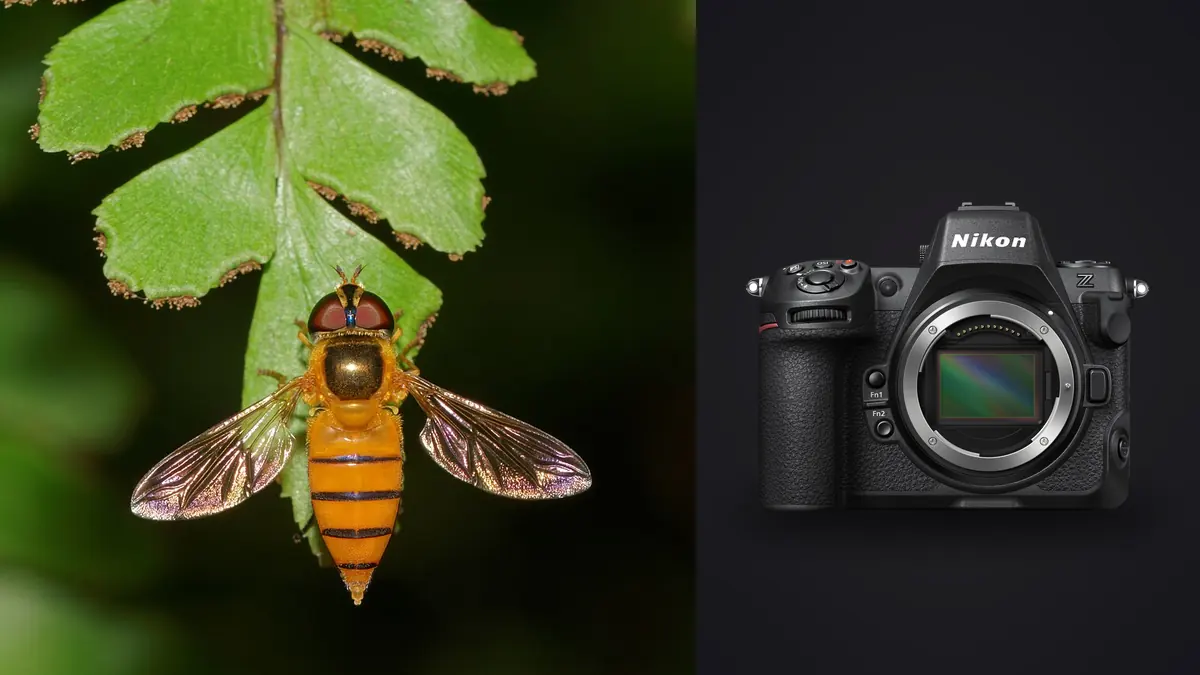
I switched to the Z8 for bird work, not bugs. The insect photography turned out to be a side effect: once I had a body with a stacked sensor and a buffer that doesn't quit, I started pointing it at jumping spiders and hoverflies during the slow hours between bird sessions. Two seasons in, it has become the camera I reach for on dew mornings more than any camera I've owned that was actually marketed for macro. That doesn't mean it's flawless for the job. Here's what actually holds up in the field, and where you're better off knowing the limits before you buy glass for it.
What the autofocus will and won't do for you
Nikon's subject detection on the Z8 covers people, birds, cats, dogs, and a handful of vehicle categories. There is no insect-specific detection mode, and I want to be upfront that some marketing chatter around this camera implies it "sees" bugs the way it sees birds. It doesn't, not reliably. Where it does work is on subjects that happen to resemble what the algorithm was actually trained for: a dragonfly perched with its head toward the lens sometimes gets picked up under bird detection because the eye-shaped mass reads similarly. Jumping spiders, with their oversized front eyes, trigger it more consistently than almost any other invertebrate I've photographed. Point it at a leaf-mimic katydid or a moth with cryptic coloring and it ignores the animal completely, no different from a much cheaper body.
For the vast majority of macro insect work I've gone back to single-point AF-S with a small focus box, or full manual focus using focus-and-rock (moving the whole camera forward and back a few millimeters rather than turning the focus ring, standard practice at high magnification since depth of field there is measured in fractions of a millimeter). What I actually rely on is the focus peaking overlay and the ability to punch the EVF magnification up for manual confirmation, not any AI subject tracking. Set your expectations on the AF before you buy: it won't nail focus on a stationary weevil for you. What it does buy you is the ability to work fast once something moves.
Where subject tracking earns its keep anyway
The one insect scenario where I lean on tracking is dragonflies and damselflies hawking over a pond. Bird detection, oddly, catches them often enough to be worth trying, probably because the wing silhouette and hover behavior overlap with small bird flight patterns the model was trained on. It's not reliable enough to be your only technique, but a burst with bird-detect active alongside a moderate aperture gives you a real shot at a sharp in-flight frame that manual focus can't touch at that reaction speed.
Frame rate and buffer depth are what actually changed for me
Insects don't hold still, and the ones that do (dew-stiffened damselflies at first light) are gone the moment the sun warms their flight muscles enough to fly. At 20fps electronic with RAW, you can burst through a dragonfly's wing-clearing sequence and land on the one frame where both wings are extended and the eyes are sharp. That used to come down to timing and luck on slower bodies. Now it's closer to a numbers game you win by shooting more, and the stacked sensor's readout speed means a wasp taking off mid-burst doesn't turn into a rolling-shutter smear the way it did on an older camera I used to run.
The buffer matters more than the spec sheet suggests. Officially it's rated for hundreds of frames on fast CFexpress cards, and what that means in practice is I've never hit a wall mid-burst chasing a bee working a lavender spike, which used to happen constantly on bodies with shallower buffers. The tradeoff is file management: a 40-minute session at 20fps produces a genuinely absurd number of frames, most of them near-duplicates of the same bee in slightly different wing positions. That's where the camera's biggest strength turns into a desk problem later, and it's worth planning for before your first real outing rather than discovering it at 11pm sorting thumbnails.
Lens choices that actually make sense here
The Z8 doesn't have a native high-magnification specialist lens in the same class as, say, a Canon MP-E 65mm. Here's what I've used and what each is actually good for.
| Lens | Max magnification | Working distance at 1:1 | Best for |
|---|---|---|---|
| Nikkor Z MC 105mm f/2.8 VR S | 1:1 | ~14cm | General insect work, handheld with VR, sharp wide open |
| Nikkor Z MC 50mm f/2.8 | 1:1 | ~4.5cm | Static subjects only, working distance too tight for skittish bugs |
| Laowa 100mm f/2.8 2X Ultra Macro (F-mount + FTZ II) | 2:1 | ~15cm | Very small subjects, manual focus only, narrow plane at 2:1 |
| AF-S 105mm f/2.8G VR Micro (older F-mount) + FTZ II | 1:1 | ~14cm | Budget entry, AF noticeably slower than native Z glass |
| Extension tubes on Z 24-70mm f/2.8 S | ~0.7:1 | Varies with tube length | Environmental macro, keeps background context |
The 105mm MC is what I'd tell most people to start with. Vibration reduction actually helps at macro distances, which surprised me the first time I used it, since conventional wisdom says VR fights you at 1:1. In practice it steadies the frame enough that handheld dew-drop shots at f/8 come out usable more often than not. The Laowa is a specialist, no autofocus at all and a narrow enough plane of focus at 2:1 to test your patience before it rewards you. I only reach for it when a subject is under about 8mm and the 105mm simply can't get close enough to fill the frame.
Diffraction is the tax nobody warns you about
At 1:1 magnification, even f/11 gives you a sliver of sharp focus across a beetle's back, and pushing to f/16 or f/22 to claw back more depth of field runs straight into diffraction softening on a 45.7MP sensor. I've run side-by-side comparisons between f/11 and f/22 on static subjects, and the resolution loss at f/22 is visible at 100% even though the extra depth of field is genuinely there. My workaround is flash, almost always: a twin flash bracket or a diffused speedlight lets me shoot at f/13 to f/16 with enough light to keep ISO low and shutter speed fast enough to freeze small movements, rather than leaning on wide apertures and ambient light alone.
For genuinely static subjects, cold spiders before sunrise, insects roosting overnight on grass stems, the Z8's focus shift shooting mode beats fighting diffraction at a single aperture. It steps focus automatically across a range you set and fires a sequence you stack afterward in software. I typically run 15 to 30 frames at f/8, which keeps every individual frame sharp, and let the stack build the depth of field instead of the aperture. A moving subject ruins the sequence instantly, so this only really works in that narrow pre-dawn window when insects are too cold to move.
Matching settings to what the insect is actually doing
Different insects call for completely different camera settings, and treating macro as one technique is the most common mistake I see people make when they first bring a fast mirrorless body into a garden.
| Subject behavior | Drive mode | AF approach | Typical settings |
|---|---|---|---|
| Dew-stilled subjects, pre-dawn | Single shot / focus shift | Manual focus, tripod | f/8, ISO 64-100, focus-stacked |
| Basking insects (warm rock, sunny leaf) | Low-speed continuous | Single-point AF-S, focus-and-rock | f/11-13, flash-assisted, ISO 200-400 |
| Foraging bees and hoverflies on flowers | High-speed continuous, 20fps | Single-point AF-C, small box | f/8-11, 1/1000s+, flash fill |
| Dragonflies hawking in flight | High-speed continuous, 20fps | Bird-detect AF-C (works intermittently) | f/6.3-8, 1/2000s, high ISO, no flash |
| Skittish subjects (fast-fleeing beetles, ants) | Pre-release capture buffer | Manual focus preset to expected distance | f/11, flash-assisted |
Pre-release capture deserves its own mention because it changes how I approach genuinely nervous subjects. The camera continuously buffers frames before you fully press the shutter, so when an ant bolts the instant you get close, you can still recover the half-second before your reaction time caught up. I didn't expect to use this feature much when I first got the camera, and now it's one of the settings I leave on by default for anything that moves fast and unpredictably.
The weight and the wet grass
The Z8 is not a light camera, and after ninety minutes crouched over a flowerbed with the 105mm attached, my arms know it. It's noticeably lighter than a Z9, which is the whole reason I chose it over the flagship for this kind of work, but it's still heavier than dedicated macro rigs built around smaller mirrorless bodies. I've taken to using a monopod with a tilting head even for handheld-feeling shots, just to take weight off during long sessions, something I never needed with the lighter APS-C setup I used a few years back.
Weather sealing has mattered more than I expected. Dew mornings mean wet grass against the lens barrel and condensation on cold metal, and two seasons of that hasn't caused a single issue. The articulating rear screen is the other underrated feature for this genre specifically: ground-level insect shots used to mean lying flat in wet grass to see through an optical viewfinder, and being able to tilt the screen down and shoot from a crouch instead has probably added years to how long I can keep doing this comfortably.
What two hours in a garden actually produces
A productive macro morning on the Z8, mixing focus-stacked static subjects with high-speed bursts on foraging bees, regularly leaves me with 2,000 to 4,000 frames. Most macro write-ups walk you through the shooting and stop there, which never matched my actual experience once I got home. The real second half of the job is finding the handful of frames worth processing out of that pile without spending an entire evening scrolling past forty near-identical shots of the same fly cleaning its legs.
I stopped doing that sorting by eye a while back and now run the card through imagic first. On a recent stack of a hoverfly mid-hover, out of a burst where a dozen frames looked identical at thumbnail size, it flagged the two where the wing tips and compound eyes were actually sharp and buried the rest in the group instead of leaving me to click through all forty. The sharpness check runs locally against the actual pixels rather than a preview, which matters at macro distances because "close enough" and "actually in focus" can be half a millimeter apart on a subject this small. It also groups the burst and stacking sequences together automatically, so what would have been a folder of thousands becomes something closer to a couple hundred groups to scan. Everything happens on the laptop itself with nothing uploaded anywhere, which is more useful than it sounds when the best dew-light mornings tend to happen somewhere with no signal at all. For more on how that kind of automated grouping actually works under the hood, this piece on AI photo culling goes into more detail than fits here.
Once I'm down to the frames worth keeping, I lean on imagic's apply_my_style preset, built from my own past edits rather than a generic macro or nature pack, to get a fast first pass across the whole batch before I fine-tune anything by hand. It's a one-time purchase rather than a subscription, which suits how I actually use it: a few intense mornings a month rather than a daily habit. Anyone whose workflow is still built around dumping every RAW into one folder and eyeballing thumbnails one at a time might find these workflow tips worth a read before their next high-volume session.
Frequently Asked Questions
Will the Z8's animal detection autofocus actually recognize insects?
Not reliably, and not by design. The detection categories are people, birds, dogs, cats, and vehicles, with nothing trained specifically on insects. Bird detection occasionally catches large-eyed or dragonfly-shaped subjects because of a visual resemblance to what the model already knows, but it's a coincidence you can exploit sometimes, not a feature you can plan a shoot around.
Is the Z8 overkill for macro insect photography compared to a cheaper body?
For static, tripod-based macro of slow or motionless subjects, yes, a cheaper body paired with a good macro lens gets you nearly identical results. The Z8 earns its price specifically on moving subjects: foraging bees, hawking dragonflies, and skittish beetles where the deep buffer and pre-release capture actually change your keeper rate in ways a slower body can't match.
What aperture should I actually use for insect macro on this sensor?
f/8 to f/13 covers most subjects for me, balancing depth of field against the diffraction softening that becomes visible at 100% by around f/16 on a sensor this dense. When one frame at those apertures isn't giving enough depth, focus shift stacking at f/8 beats stopping down further on a single exposure.
What's a realistic way to deal with the sheer number of frames a session produces?
Expect thousands of frames from any serious burst-heavy macro outing, most of them near-duplicates from continuous shooting or a stacking sequence. Running the card through a local culling tool that groups bursts and surfaces the sharpest frame in each cluster, which is the routine I've settled into with imagic, turns that pile into a review set you can actually get through in one sitting instead of a folder you avoid opening for a week.