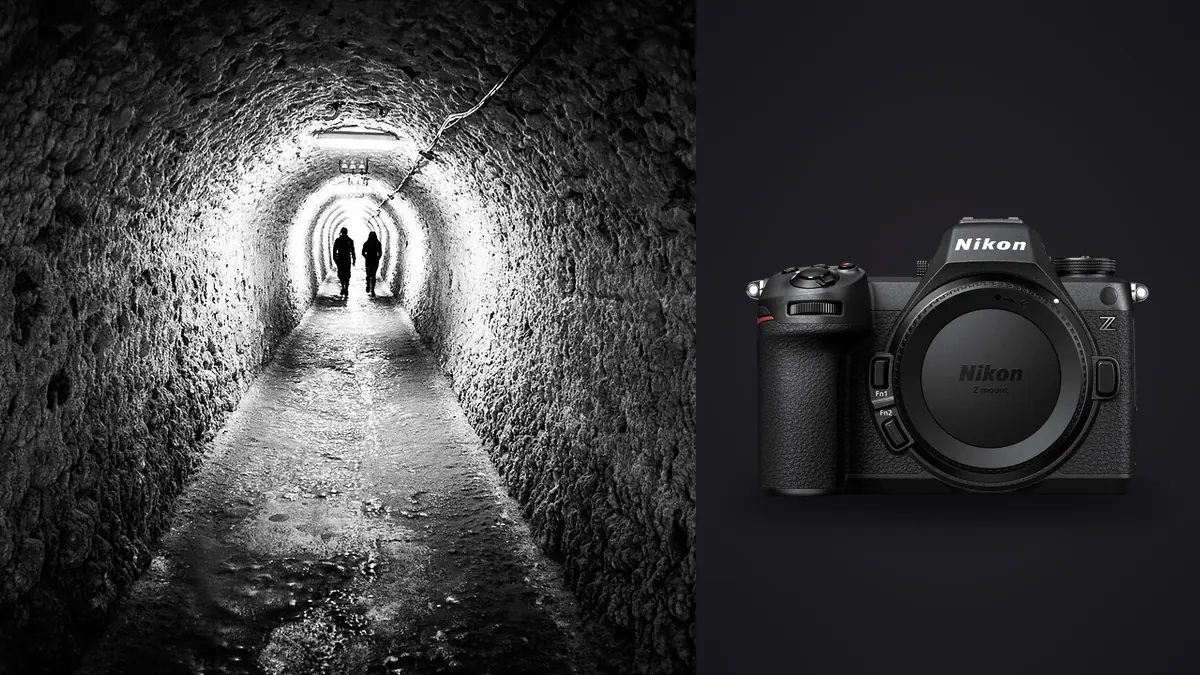
I spent most of last winter walking the same six blocks of a market district with a Nikon Z6 III slung across my chest, trying to figure out whether a full-frame mirrorless body with a grip that size could actually disappear into a crowd the way a rangefinder does. It mostly can, but not for the reasons Nikon's marketing leans on. The specs that matter for sports shooters (the 20 fps raw burst, the AI subject tracking built for eagles and race cars) turn out to be almost beside the point on the street. What matters is quieter: how the camera behaves when you're holding it at your hip, how fast the finder recovers after a shot, and whether the person you just photographed even noticed.
The sensor Nikon put in it is a genuinely good fit, almost by accident
The Z6 III uses a 24.5-megapixel partially-stacked sensor, a middle ground between the fully stacked chip in the Z8/Z9 and the conventional BSI sensor in the Z6 II. Nikon built this for speed (14 fps mechanical, up to 20 fps electronic in 12-bit raw), but the side effect that matters more for documentary work is rolling shutter suppression. Shoot through a shop window, pan with someone on a bicycle, or fire off a burst as a subject turns their head fast, and you don't get the skewed, jello-like distortion that plagues fully electronic shutters on cheaper sensors. That's the thing that actually lets you use silent shooting mode with confidence in the field, rather than as a gimmick you switch on for gallery openings and switch back off for anything that moves.
24.5 megapixels is also, frankly, the right number for this kind of work. It's enough to crop hard when you missed your framing running backward through a crowd, but the files stay small enough that a ten-hour shoot day doesn't turn into a 400GB card and a four-hour import. I've shot documentary trips on 45MP bodies and regretted every minute of the backup process afterward.
What the EVF and rear screen actually change in practice
The 5.76-million-dot viewfinder with a 4,000-nit peak brightness sounds like a spec sheet number until you're trying to compose against a white stucco wall at 1pm and the finder just doesn't wash out. That's a real, felt difference from the Z6 II, which would gray out and lose shadow detail in the same light. For documentary work shot outdoors across a full day, that matters more than almost any other single spec on this camera, because a finder you can't trust makes you second-guess exposure and focus on every frame.
The fully articulating rear screen is more of a mixed bag for this genre. It's genuinely useful for low, hip-level framing without lying on the ground, and for the odd vlog-style walk-and-talk clip if you're mixing documentary stills with video. But flipped out to the side, it's a visible tell that you're setting up a shot, which works against you if discretion is the goal. I mostly leave it closed and shoot through the finder, which also happens to save battery over a long day.
Autofocus that was built for wildlife, repurposed for people
Nikon's subject detection on the Z6 III recognizes people, and it's aggressive about locking onto the nearest face or eye in frame, which is exactly what you want when you're working fast and can't dedicate attention to placing a focus point. It also, less usefully, has a tendency to jump to whichever person is largest in frame when you're trying to hold focus on someone further back in a scene, so for layered documentary compositions (a subject in the foreground, action happening behind them) I've had better luck switching to a single-point or wide-area zone and taking manual control of exactly who gets the plane of focus.
Continuous AF-C tracking holds up well even at 14 fps mechanical shutter, and the buffer is deep enough (Nikon rates it well past 200 raw frames on a fast CFexpress card) that you can hold the shutter through an unfolding moment instead of guessing when the decisive frame will land. That's the real value of the burst speed here, not spray-and-pray, but the ability to trust that pulling the trigger a half-second early or late still gets you three or four frames around the peak.
One thing to actually turn off
Out of the box, the camera beeps and the shutter clacks at full volume in mechanical mode. Turn off the electronic beep entirely in the menu (it's not on by default for AF confirmation but it is for the self-timer and some touch functions), and get comfortable with the electronic front-curtain and fully silent shutter modes for anything indoors or close-range. The rolling shutter behavior described above is what makes that switch usable rather than risky.
How it actually stacks up against the other cameras people bring on the same kind of trip
Nobody picks a street or documentary camera in a vacuum, so here's how the Z6 III compares against two bodies that come up constantly in the same conversation, on the specific things that matter for this genre rather than a generic spec dump.
| Camera | Body weight | Viewfinder | Silent shutter usability | Realistic all-day battery | Street price (body) |
|---|---|---|---|---|---|
| Nikon Z6 III | 760 g | 5.76M-dot, 4,000 nit peak | Strong (partial stack, minimal rolling shutter) | ~450 shots realistic, better with EVF-light habits | ~$2,500 |
| Fujifilm X100VI | 521 g | Hybrid optical/electronic, smaller and dimmer | Excellent (leaf shutter, near-silent by design) | ~450 shots, but fixed 35mm-equiv lens only | ~$1,600 |
| Sony a7C II | 514 g | 2.36M-dot, noticeably smaller image | Good, but more visible rolling shutter in fast pans | ~530 shots, best in class here | ~$2,200 |
The honest takeaway from that table: the Z6 III is the heaviest and least discreet of the three by a meaningful margin, and if pure stealth is the entire brief, the X100VI's fixed lens and leaf shutter still win. What the Z6 III buys back is lens flexibility and a finder that stays usable in harsh light all day, which matters more on a multi-week documentary assignment than on a two-hour street walk.
Lenses that don't fight the point of the camera
The 24-70mm f/4 S kit lens is a mistake for this genre. It's fine glass, but it announces itself and adds bulk that undercuts everything the smaller sensor stack was supposed to buy you. What actually works:
- Nikon Z 40mm f/2 (SE): pancake-adjacent, plastic mount, genuinely tiny. Close to a 35mm field of view once you account for how most people actually frame with it. This is the lens I reach for when the goal is to look like a tourist, not a photographer.
- Nikon Z 35mm f/1.8 S: bigger and pricier, but the extra stop and better close-focus performance earns its keep indoors, in markets, in low-light interiors where documentary work often happens.
- Nikon Z 50mm f/1.8 S: for anyone doing more portrait-adjacent documentary work, isolating a single subject from a crowd rather than shooting wide environmental frames.
If budget allows only one lens, the 40mm f/2 is the honest recommendation for anyone starting out with this camera on the street. It keeps the whole kit under 900 grams and doesn't scream "this is expensive equipment" the way an f/1.4 prime does.
Cards, file sizes, and the part of the day nobody enjoys
The Z6 III's dual slots (one CFexpress Type B, one UHS-II SD) mean you can shoot raw to the fast card and JPEG backups to SD, or just run everything to CFexpress and use SD as overflow. A full day of documentary shooting, easily 1,500 to 2,500 frames if you're following a subject through an extended situation, produces raw files in the 28-35MB range each, which adds up to somewhere between 45 and 85GB depending on how trigger-happy you were.
That's the point where most people's workflow actually breaks down, not the shooting. Sorting 2,000 frames by eye at the end of a twelve-hour day is where good documentary work gets lost to fatigue, not bad judgment. This is the part of my own workflow where I stopped doing it manually. I run the day's card through imagic before I touch Lightroom at all: it scores actual sharpness and focus accuracy locally rather than trusting the in-camera thumbnail, and it clusters the inevitable burst sequences (three or four near-identical frames of someone mid-gesture) so I'm choosing between four grouped options instead of scrolling past all of them individually. Because it runs entirely offline, nothing from a shoot involving identifiable people leaves the laptop before I've decided what to do with it, which matters more on documentary work than on a landscape trip. If you want more on how that culling logic actually works under the hood, this piece breaks it down.
Battery, weather, and the parts of the spec sheet you only notice on day four
The EN-EL15c battery is rated for around 380 shots CIPA, which under-promises badly if you're mostly shooting stills and using the EVF sparingly. In practice, closer to 450-550 frames per charge is realistic for street and documentary use, and USB-C charging means a battery bank in a jacket pocket keeps you running without carrying spares. Weather sealing is properly rated this time (Nikon claims dust and drip resistance comparable to their D850), which matters more than people expect on documentary work, since a lot of the most interesting moments happen in exactly the weather that sends casual photographers indoors.
Where the Z6 III genuinely struggles for this genre
It's not a small camera, and no amount of lens choice fixes the grip depth and general presence of a full-frame mirrorless body with a battery grip's worth of heft baked into the chassis. Compared to a rangefinder or the X100VI, people notice it faster, and in some documentary contexts (protests, religious sites, situations where trust is fragile) that difference matters more than any autofocus spec. The menu system is also deep enough that changing a setting mid-shoot, silent mode toggling, AF-area mode switching, means either memorizing button custom mappings ahead of time or losing a moment while you dig through submenus. I'd strongly recommend mapping silent shutter toggle and AF-area mode to the two front function buttons before your first real shoot, not after you've missed something because of it.
A workflow that actually survives a multi-day assignment
The pattern that's worked for me: shoot raw only, cull the same evening rather than letting cards stack up (three days of backlog turns editing into archaeology), and keep a consistent starting point for color rather than re-deciding a look every single night. I built a personal preset years ago for how I want skin tones and shadow contrast to land on documentary work specifically, different from what I use for landscape or product shots, and imagic's apply_my_style feature is trained on my own past edits rather than a generic filter, so a fresh set of raws gets that same starting treatment automatically before I fine-tune anything by hand. It's not a substitute for actually editing, but it kills the fifteen minutes per session I used to spend re-establishing a baseline. For anyone trying to tighten up the back half of a shoot day generally, there's a longer rundown of workflow habits here that's worth a look alongside whatever camera you're using.
Frequently Asked Questions
Is the Nikon Z6 III too loud for candid street photography?
Not if you use the electronic or fully silent shutter modes, which the partially-stacked sensor handles without the rolling shutter smearing you'd get on an older, non-stacked electronic shutter. The mechanical shutter itself has an audible clack that's noticeably louder than a leaf-shutter compact, so for genuinely candid work, switch out of mechanical mode entirely rather than trying to muffle it.
Does the Z6 III's autofocus handle fast-moving crowds well?
Yes, subject detection tracks people reliably even in dense scenes, though it favors whichever person is largest or closest in frame. For layered compositions where you want focus on someone specific further back, switch to single-point AF rather than relying on automatic subject detection to guess your intent.
What's the best single lens to pair with the Z6 III for documentary work?
The Z 40mm f/2 SE for most people starting out, since it keeps the kit light and unobtrusive at close to a natural field of view. The 35mm f/1.8 S is the better choice if you're regularly shooting indoors or in low light, at the cost of extra size and weight.
How do I manage hundreds of near-duplicate burst shots from a documentary shoot?
Manual scrolling through thousands of frames at the end of a long day is where most editing quality gets lost to fatigue. Grouping burst sequences and scoring actual focus sharpness before you start subjective editing, which is what imagic does locally on the raw files, cuts that review down to choosing between a handful of grouped options per moment instead of judging every single frame from scratch.
Is the fully articulating screen a problem for staying discreet?
It can be, since flipping it out to the side is a visible cue that you're composing a shot. For situations where discretion matters most, shooting through the EVF with the screen closed avoids that tell and also extends battery life over a full shooting day.