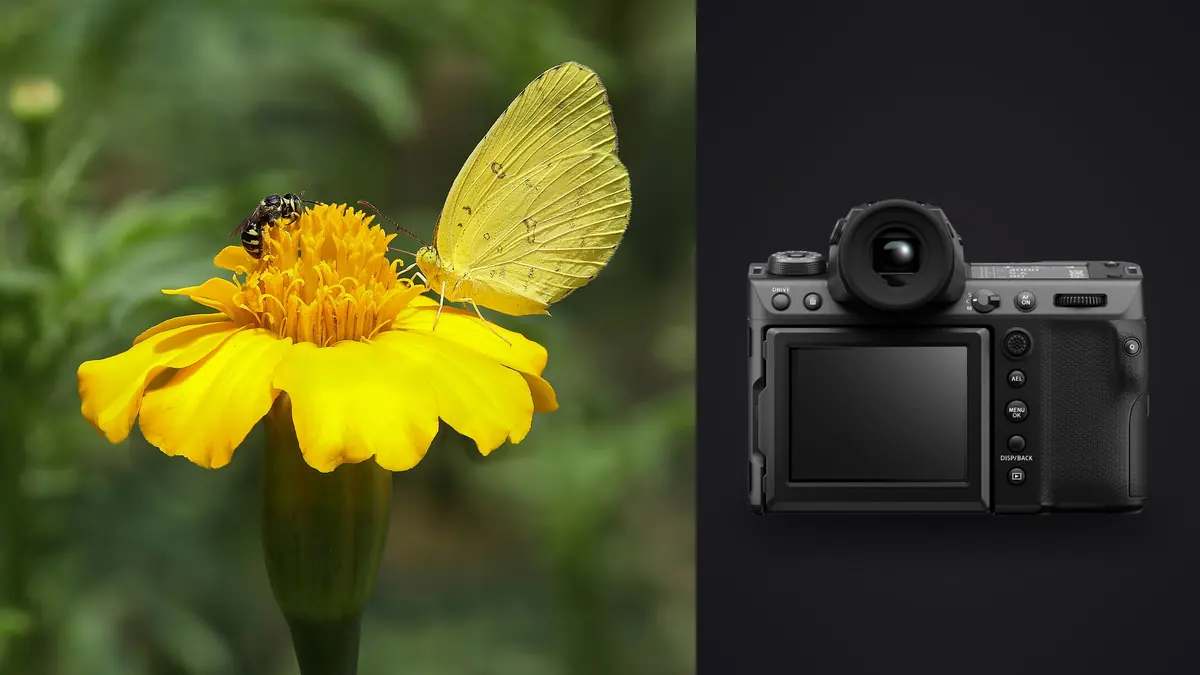
The 102-Megapixel Problem (and Opportunity) for Insect Work
The first time I put the GFX 100 II on a tiger beetle at half life-size, my initial reaction wasn't about detail. It was about math. A single raw file off this sensor averages somewhere around 110 to 130MB, and a modest 40-frame focus stack for one subject can eat past 4.5GB before you've even opened a laptop. That's the number every macro shooter coming from full-frame or APS-C needs to plan around first, because this sensor changes how you shoot and how you process, not just what the finished frame looks like.
But the resolution buys you something specific to insect work: crop room you don't get from a 24 or 45 megapixel sensor. A dragonfly filling a third of the frame at 0.35x magnification can be cropped hard in post and still hold up at a reasonable print size, which effectively extends your working magnification beyond what the lens delivers optically. I've leaned on this more than once when a robber fly wouldn't let me close the working distance any further and the choice was crop or walk away empty-handed.
Building a Real Macro Rig Around the G Mount
Fujifilm's G mount has exactly one purpose-built macro lens, the GF120mm F4 Macro R LM OIS WR, and on its own it tops out at 0.5x (half life-size). For anyone used to a native 1:1 macro prime on another system, that's a genuine limitation, not a footnote. To get closer to true life-size, you're stacking Fujifilm's own MCEX-18G WR and MCEX-45G WR extension tubes, both weather-sealed to match the lens and body so the rig stays usable in the humid, dewy conditions where insects are most cooperative.
| Setup | Approx. Magnification | Approx. Working Distance | Light Loss |
|---|---|---|---|
| GF120mm Macro alone | 0.5x (1:2) | ~24 cm | None beyond the lens's rated f/4 |
| + MCEX-18G WR | ~0.65x | ~19 cm | Under 1/3 stop |
| + MCEX-45G WR | ~0.85x | ~15 cm | Roughly 2/3 stop |
| + both tubes stacked | ~1.0-1.1x (near 1:1) | ~11-12 cm | Around 1 full stop, more with off-camera flash falloff |
Those figures are field estimates from combining tube length with the lens's own focal length, not lab measurements, and they'll shift slightly depending on your focus distance. What matters more in practice is the working distance column. At 11-12cm from a jumping spider, you're inside the range where most species notice you and either freeze or bolt, so the tightest stacked combination is really a tripod-and-patience tool for cooperative subjects rather than a walk-and-shoot setup. Worth noting too: body plus GF120mm Macro comes in close to two kilograms, which is heavy for crouching and crawling through undergrowth compared to a smaller APS-C macro rig, and it shows up as fatigue by the third hour of a low-angle session.
Autofocus on a Beetle's Eye: What Actually Works
At magnifications approaching 1:1, depth of field measures in single millimeters even stopped down to f/11, and autofocus hunts because there's almost no contrast plane for it to lock onto. My actual workflow is phase-detect AF to get roughly into position, then a switch to manual focus with peaking set to high sensitivity, and the final placement comes from rocking the camera gently forward and back rather than trying to nail focus through the ring. That's not a knock on this particular body. It's true of essentially every high-magnification macro setup regardless of brand.
Where the GFX 100 II's autofocus genuinely earns its keep is at lower magnification, say a dragonfly perched at 0.3-0.4x with real depth of field to work with. There, phase-detect AF finds the eye reliably and tracks the small sway a breeze puts through a reed stem without you babysitting focus by hand.
One caution: the animal-eye detection Fujifilm has rolled out across recent bodies wasn't trained on insect anatomy, and it shows. It reads a beetle's compound eyes and antennae inconsistently, and I've had it lock onto a leg joint instead of the head more than once. I don't rely on it for anything smaller than a large dragonfly or butterfly.
Diffraction, Aperture, and the Pixel Pitch Tax
Macro insect work almost always wants a narrow aperture for depth of field, but the GFX 100 II's pixel pitch works against you here in a way that's specific to this sensor. At roughly 3.76 microns per pixel, the airy disk from diffraction (about 10.7 microns at f/8, 14.7 at f/11, and over 21 microns by f/16, using standard visible-light estimates) already spans several pixels well before you reach the apertures most insect macro shooters actually use for adequate depth of field.
In practice this doesn't ruin anything. A 102MP file diffraction-softened at f/16 still resolves more real detail than a 24MP APS-C file shot at the same aperture, because you started with so much more information. But if you're pixel-peeping a beetle's elytra at 100%, don't be surprised to see softening at apertures that would look perfectly crisp on a smaller sensor. I generally treat f/11 as my practical ceiling for single frames and lean on focus stacking rather than stopping down further when I need more depth than that.
Flash Sync, IBIS, and Handholding at High Magnification
Once you're past 0.5x magnification, ambient light mostly stops being useful; the lens is too far stopped down and too close to the subject for available light to do much, so flash carries the exposure. The GFX 100 II's mechanical shutter syncs at around 1/125s, which is typical for this shutter class but worth knowing before you plan a twin-flash or ring-flash rig around it, since you can't lean on faster sync speeds to kill ambient the way some smaller-format bodies allow.
In-body stabilization is rated up to eight stops by Fujifilm, and it genuinely helps, but not in the way people expect at extreme magnification. It doesn't fix the fact that a live insect keeps shifting position between shots, and it won't compensate for you shifting your own distance to the subject, which changes focus more than shake does at 1:1. What it actually buys you is a steadier live view image while you're manually focusing at awkward, low-to-the-ground angles, which matters more for framing accuracy than for exposure.
Focus Bracketing: Field Reality vs. Studio Promise
The GFX 100 II's built-in focus bracketing, with adjustable step size, frame count, and interval, is a real tool but a narrow one for insects specifically. It works well on cold mornings when temperatures sit low enough that dragonflies and damselflies are still too sluggish to fly, usually somewhere under 13°C in my experience. On those mornings I'll run 15 to 25 frame stacks at small step increments and get clean results because the subject genuinely isn't moving between frames.
On a warm afternoon with an active subject, bracketing is close to useless. Any movement between frames misaligns the stack, and you end up with a folder of unusable frames instead of a composite. Past a certain point in the day I stop trying to stack altogether and shoot single frames at f/11 to f/16, accepting the depth-of-field tradeoff rather than chasing an in-camera bracket that won't align anyway.
After the Shoot: Culling 100MP Stacks Without Losing an Evening
A productive morning of stacking can leave you with 800 to 1,200 raw frames spread across 25 or 30 subjects, and going through that manually at full resolution is its own kind of fieldwork. This is the point where I lean on imagic to do a first pass locally on the same laptop I shot with, no upload required, which matters when you're at a reserve or a marsh edge with no signal worth mentioning. Its local sharpness scoring sorts each stack's frames by focus accuracy before you commit anything to stacking software, so you're not manually stepping through 40 near-identical thumbnails to find the handful that are actually usable. The duplicate and burst clustering does something similar for the safety-burst frames you shoot outside of a formal bracket sequence, grouping them so you're comparing a handful of real candidates instead of scrolling past every near-duplicate one at a time. If you haven't used an AI culling pass before a stacking session, it's worth reading through how AI photo culling works to see where it fits before your next field day.
None of this replaces judgment on which stack actually looks right once composited. It just removes the tedious first sort that used to cost me an hour before I could even open Zerene or Helicon.
Color Consistency Across a Season of Macro Sessions
Insect color is unforgiving. Iridescent beetle carapaces, damselfly blues, and the greenish cast a diffuser sometimes puts on a shot all respond differently to white balance choices, and getting a consistent look across a season of sessions shot in different light used to mean rebuilding presets by hand every few weeks as my eye drifted. I now run new imports through imagic's apply_my_style feature, which is trained on my own previously edited macro files rather than a generic preset, so it applies the color and tone decisions I've actually made on past insect work instead of a one-size-fits-all look. It's not magic, and it doesn't replace a final manual pass on the frames I'm actually going to publish, but it gets a full folder to a consistent starting point fast enough that I'm not manually white-balancing every single subject from scratch.
Where the GFX 100 II Earns Its Weight, and Where It Doesn't
For anyone producing large prints, stock work, or documentation-grade insect photography where resolution and tonal latitude actually matter, and especially for static or cooperative subjects like moths at a light sheet or torpid dragonflies on a cold morning, this camera is excellent. The 400MP pixel-shift composite mode is worth using on a tripod for a pinned specimen or a genuinely motionless subject, and the detail it recovers on wing scales and cuticle texture is well beyond what a single 102MP frame gives you.
It's a much harder sell for someone chasing fast, erratic insects handheld all day. The rig is heavy, native magnification tops out around 1:1 only once you've stacked both extension tubes, and the file sizes demand an actual workflow plan rather than just more SD cards in your bag. If your subjects are jumping spiders and robber flies that won't sit still, a lighter, higher-native-magnification system will get you more usable frames per hour in the field, even if each individual frame carries less raw information.
For context beyond the mastering fujifilm gfx 100 ii for macro insect photography guide focus in entry 50, continue with photography guide library. These resources connect the subject to a practical local review process.
Frequently Asked Questions
Does the GFX 100 II reach 1:1 magnification for insect macro?
Not with the GF120mm Macro on its own, which caps out at 0.5x. You need to stack Fujifilm's MCEX-18G WR and MCEX-45G WR extension tubes together to get close to 1:1, and doing so costs you working distance and roughly a stop of light, sometimes more once flash falloff is factored in.
Is the GFX 100 II's autofocus reliable for insects in flight?
For larger, higher-contrast subjects like dragonflies and butterflies at moderate magnification, phase-detect AF keeps up reasonably well in good light. For small, fast subjects at high magnification, depth of field is too thin for autofocus to be dependable, and manual focus with peaking is the more consistent approach.
How much storage should I plan for a day of macro insect shooting?
Budget generously. A single focus-stacked sequence for one subject can run 3 to 5GB in raw, and a productive morning covering several subjects can pass 30 to 40GB before lunch. Fast card offload and a sharpness-based triage pass before you start stacking anything saves real time later.
Is the extra resolution actually useful for subjects this small?
Yes, mainly for cropping latitude. When working distance or lens reach limits how close you can physically get to a skittish subject, cropping a 102MP frame still leaves usable detail in a way a 24MP frame simply wouldn't survive.
What aperture should I use for insect macro on this camera?
I treat f/11 as a practical ceiling for single frames given the sensor's pixel pitch and diffraction onset, and reach for focus stacking rather than stopping down past that when a subject needs more depth of field than one frame can deliver.