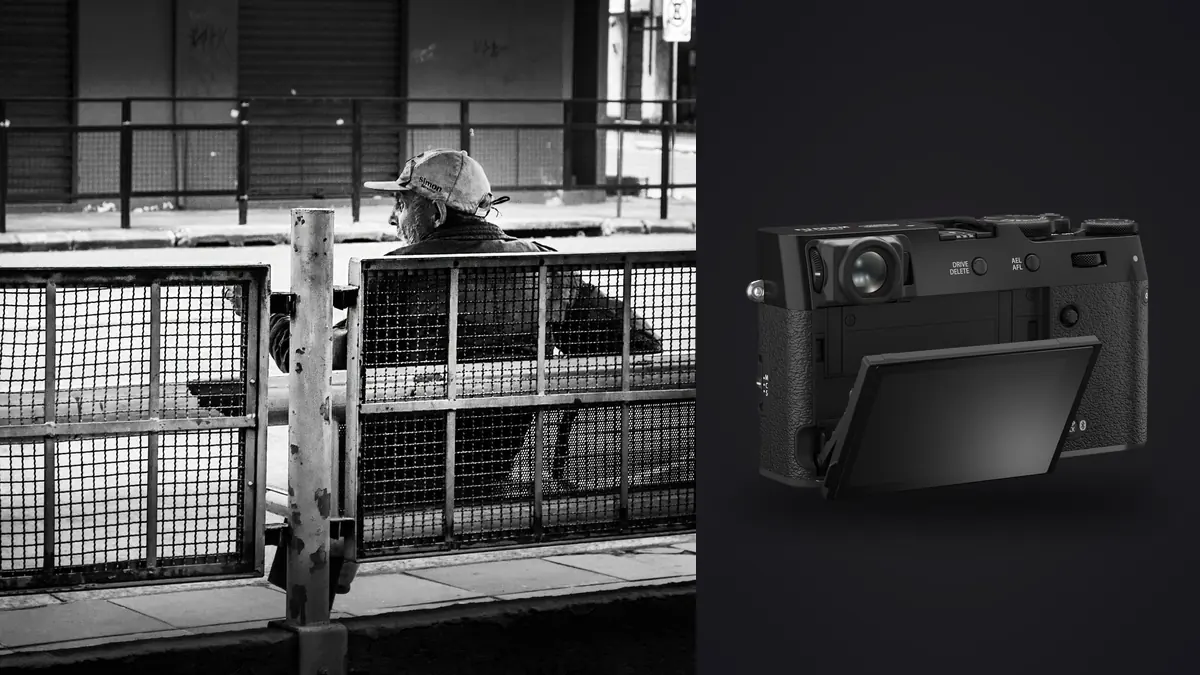
I've put close to a year of near-daily use into the Fujifilm X100VI, most of it walking markets in Valletta, back streets in Naples, and a handful of grim post-industrial towns in the north of England shooting the kind of documentary work that pays badly and demands you not be noticed. This isn't a spec-sheet rundown. It's what actually changes when you swap a mirrorless body and a 35mm prime for this camera, and where it genuinely lets you down on a day that matters.
Why a Fixed 35mm Field of View Suits This Kind of Work
The X100VI gives you one lens, a 23mm f/2 that renders roughly like a 35mm on full frame. That's not a limitation you learn to live with, it's the reason a lot of documentary photographers reach for this exact focal length in the first place. It's wide enough to hold a room, a doorway, a market stall and the person standing in front of it, but not so wide that you distort faces or need to stand absurdly close. You end up composing with your feet instead of a zoom ring, which sounds like a cliche until you notice how much faster you start reading a scene when there's no alternative focal length to fall back on.
The other thing a fixed lens does, which nobody mentions enough, is change how you're read by the people you're photographing. A body with a 70-200 hanging off it reads as "photographer, working." The X100VI, held low or at chest height, reads as someone with a compact camera on holiday. That's not a moral point about consent, you still need to know your local laws and use judgment about what you publish, but it does mean you get closer to unguarded moments before anyone reacts to the camera at all.
The Leaf Shutter Changes How You Work in Quiet Spaces
Because the lens shutter is a leaf shutter rather than a focal-plane unit, the X100VI is close to silent at anything up to about 1/2000s, and completely silent if you switch to the fully electronic shutter mode. I shoot a lot inside churches, courtrooms during recess, and small family gatherings where a mechanical clack would be genuinely rude. Being able to fire off six or seven frames of someone's expression changing during a eulogy, with zero sound, is a real working advantage over a DSLR or a mirrorless body with a mechanical-only shutter. The trade-off, which I'll get to, is that fully electronic shutter brings rolling shutter distortion into play the moment your subject is moving fast.
Crop Modes: Genuinely Useful, Not a Marketing Line
Fujifilm bundles two digital teleconverter modes into the X100VI: a 50mm-equivalent crop and a 70mm-equivalent crop, both using the center of the 40-megapixel sensor rather than any interpolation trick. I was skeptical of these before I owned the camera. On the street, they've become part of how I actually shoot, because sometimes 35mm is the wrong choice and you don't have a second lens to reach for.
| Mode | Approx. file size | What I actually use it for | Shutter floor I trust handheld |
|---|---|---|---|
| 23mm native (35mm equiv.) | ~40MP full sensor | Establishing shots, doorways, a subject inside their environment | 1/60s with IBIS engaged |
| 50mm-equivalent crop | ~20MP | A single face across a market stall, someone mid-gesture at a counter | 1/125s, the tighter frame shows shake faster |
| 70mm-equivalent crop | ~10MP | Isolating one person in a crowd from a respectful distance | 1/180s, and I want good light before I bother |
The 70mm crop is the one I use least, mostly because a 10-megapixel file starts to feel thin if you ever need to print or crop again in editing. But for a shot where getting physically closer would have killed the moment, having that reach without carrying a second lens is worth the resolution hit. The 50mm crop is the one that's earned a permanent spot on my function dial. It's close enough to a real 50mm rendering that I stopped missing my old 50mm prime within a couple of weeks.
Autofocus for Moving, Unpredictable Subjects
Documentary work rarely gives you a static subject who holds still and looks at the lens. People turn, walk into shade, get interrupted mid-sentence. The X100VI's subject-detection autofocus, which picks out people and will lock onto eyes when it has a clean view, is good in daylight and noticeably less confident the moment someone steps under an awning or into a doorway with mixed light. I've had it hunt for a full second in a dim stairwell when a DSLR with phase-detect across the whole frame wouldn't have blinked.
My actual setup for street and documentary work is back-button focus with Zone AF rather than Wide/Tracking, because Wide/Tracking on this body tends to jump to whatever has the most contrast in frame, which is often a shopfront sign rather than the person I'm trying to hold focus on. Zone AF, kept fairly small and recentered with the joystick as I walk, gives me more predictable results when I'm following one person through a crowd. It's not as sticky as what you'll get from a flagship sports body, and I don't pretend it is. For portraits and slower-moving subjects it's excellent. For a kid running through a fountain, I've missed frames I wouldn't have missed on a body built around continuous tracking.
What a Full Shooting Day Actually Looks Like
The in-body stabilization is new to this generation of X100, and it matters more than it sounds like it should. Because the leaf shutter lets me shoot silently at slower speeds without the vibration a focal-plane shutter introduces, and IBIS adds a few more stops of forgiveness on top, I'm regularly getting sharp handheld frames at 1/30s that I'd never have attempted on the X100V. That's a genuine documentary advantage in low-light interiors where you don't want to bump ISO into visible grain territory or use flash.
Battery life is the part I still haven't made peace with. Fujifilm rates the NP-W126S around 450 shots CIPA, but on a real documentary day where I'm chimping the EVF constantly, reviewing bursts, and leaving the camera on between shots because I never know when something will happen, I get closer to 280 to 320 frames before the first battery dies. I carry three now. The single SD card slot is the other thing I've made my peace with only because a second body can serve as the backup on anything irreplaceable, not because the X100VI itself gives you any redundancy. If you're shooting something that can't be reshot, that single slot is a real risk, not a footnote.
The built-in 4-stop ND filter is one of the more underrated features for this genre. Shooting f/2 in harsh midday light for that shallow, separated look usually means you're fighting your maximum shutter speed. Flipping the ND filter on from a function button, instead of digging a screw-in filter out of a bag, keeps me shooting instead of missing the moment while I fumble with glass.
Getting From a Full Card to an Edit You Can Actually Show Someone
A single afternoon of documentary shooting on this camera, especially if I'm leaning on the continuous drive modes to catch a fleeting expression, routinely leaves me with six hundred to a thousand frames. A lot of those are three or four nearly identical shots from the same half-second burst, plus duplicates from switching between the native and cropped focal lengths on the same scene while I decide which framing works. Sorting that by eye used to eat two or three hours before I'd even started color work.
This is where I stopped doing the first pass manually and started running the take through imagic. It groups those burst sequences and near-duplicate frames together instead of making me scroll past every one, and because the sharpness and focus scoring happens locally on the machine, it can tell me which frame in a six-shot burst actually landed the focus on the eyes without me pixel-peeping each one at 100 percent. If you haven't looked into how that kind of scoring actually works under the hood, this breakdown of AI photo culling covers it in more depth than I will here.
The other feature that's changed my workflow is apply_my_style. I built a documentary look over the last couple of years, mostly desaturated highlights, lifted blacks, a bit of warmth pulled back out of skin tones, and instead of rebuilding that preset by hand in every new batch, imagic learns it from a set of my own previously edited photos and applies something close to it automatically on import. It's not a substitute for finishing an edit properly, but it means the raw pass looks like my work rather than a flat file the moment it lands on the drive. For anyone trying to cut down the hours between a shoot and a usable set, these workflow tips pair well with that kind of automated first pass.
One more point that matters more in documentary work than in most other genres: a lot of what I shoot involves people who didn't sign a release and might be in a vulnerable situation, protests, labor disputes, family grief. I don't want those frames touching a server before I've decided what, if anything, gets published. Because imagic processes everything locally rather than uploading to the cloud, the culling and style pass happens without that concern ever coming up. That's not a small thing when the subject matter is sensitive.
Where It Actually Falls Short
I'd be lying if I said this camera has no real weaknesses for serious documentary work. The single card slot is the biggest one, already mentioned, and it's inexcusable at this price point for anyone shooting something irreplaceable. Weather sealing requires buying the separate adapter ring and a protective filter, roughly another 100 euros on top of the body, and without it the X100VI is not weather-resistant at all, which matters if your documentary work involves being outside in genuine weather rather than a light drizzle. And under the fully electronic shutter, rolling shutter shows up clearly on anything moving fast through frame, a cyclist, a running child, a car passing close. I've had frames with visibly skewed verticals that were unusable because I forgot to switch back to the mechanical shutter before a fast pan.
The close focus distance on the lens is also worth knowing about before you buy this camera for documentary work specifically. It's not a macro lens and doesn't pretend to be, but there's a real minimum focus distance that occasionally puts you further from a small detail, a hand, a document, a piece of evidence, than you'd like to be. The digital teleconverter modes help here more than the built-in macro setting does, in my experience.
Frequently Asked Questions
Does the leaf shutter actually help you shoot unnoticed, or is that overstated?
It's real, but it's not invisibility. At normal shutter speeds the leaf shutter is quiet enough that people two or three meters away in an ambient-noise environment, a street, a market, a busy room, generally don't register it. In a silent room, someone standing right next to you will still notice the camera moving even with zero shutter sound. It buys you discretion, not stealth.
Is the 50mm and 70mm crop mode reach enough to replace carrying a second lens?
For most of my documentary work, yes. I stopped carrying a second body with a longer prime about six months in, specifically because the 50mm crop covers the vast majority of situations where 35mm felt too wide. The 70mm crop I use rarely enough that I wouldn't call it a full replacement for actual longer glass, more of an emergency option when getting physically closer isn't possible.
How much of a liability is the single card slot on a real assignment?
Enough that a second body as backup is the sensible move on anything that can't be reshot, such as weddings, one-off events, or assignments with a client waiting on delivery. For personal street work where a lost card is annoying but not catastrophic, it's a non-issue. Treat that distinction seriously before you commit this camera to something irreplaceable.
Do I need the weatherproofing kit if I mostly shoot outdoors?
If "outdoors" means light rain, mist, or shooting near water or spray, yes, buy the adapter ring and filter. Without it the body and lens gap are genuinely exposed, and I've had a close call with a sudden downpour in Naples that would have been a real problem without the kit already fitted. If you mostly shoot dry streets and interiors, it's a lower priority purchase.