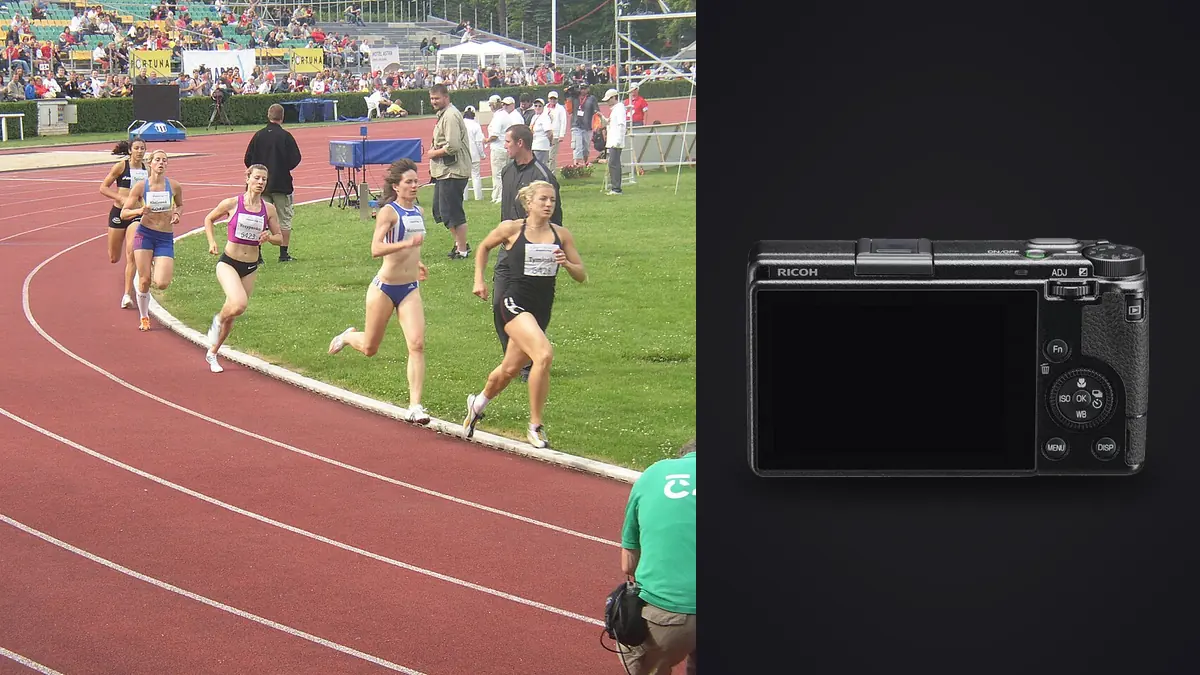
I brought a Ricoh GR IIIx to a regional track and field meet last spring, mostly out of stubbornness. I already had a body with a 70-200mm in the bag, but I wanted to see if the little APS-C compact I carry everywhere for street work could earn its keep at an actual sporting event. Short answer: it can, but not in the way most people assume when they ask "is the GR IIIx good for sports." If your mental image is a photographer machine-gunning through a 400mm lens as a sprinter crosses the line, put that image away. That is not this camera's job, and pretending otherwise will just get you a memory card full of soft, poorly framed frames.
What the GR IIIx is actually good for at a track meet is more specific, and honestly more interesting to shoot: the 40mm-equivalent field of view (26.3mm on the APS-C sensor) forces you to work close, low, and deliberate. That is a different discipline than standing on the infield with a monopod and a big zoom. This piece is about where that discipline pays off, where it flat out doesn't, and the settings and positioning that make the difference between a session of unusable throwaways and a handful of frames you'd actually print.
Why this camera fights you on fast action
Three things work against the GR IIIx the moment a sprinter leaves the blocks. First, the autofocus system leans on contrast detection and was never built to chase a subject accelerating straight at the lens; continuous AF exists (Ricoh added it via firmware a few years back) but it hunts more than a phase-detect hybrid system will, and in bright, contrasty stadium light it can lock onto the wrong plane entirely. Second, the burst rate sits around 4 frames per second in real-world use, and RAW buffer depth is shallow enough that a long burst on a fast-moving subject will stall the camera exactly when you need the next frame most. Third, there's no viewfinder unless you buy the optional external optical finder, which doesn't show focus confirmation anyway, so you're framing fast action off a rear LCD in direct sunlight more often than not.
None of that makes the camera bad. It makes it a rangefinder-style tool being asked to do a telephoto job. The GR series was built for street photography: anticipate, prefocus, shoot the decisive moment as it arrives in your frame rather than tracking it toward you. Track and field, it turns out, has plenty of moments that fit that description. Sprint starts to the finish line don't. That's the split you need to make peace with before you walk in with this camera.
Snap Focus is the whole trick
The single feature that makes the GR IIIx usable for anything action-adjacent is Snap Focus. You set a fixed focus distance, assign it to a quick-access control, and when you press the shutter the camera skips AF hunting entirely and fires at that preset distance. For a lens this wide, depth of field at f/4 or f/5.6 gives you real breathing room, easily a meter or more of usable sharpness at 4-5 meters, so you don't need laser precision on distance, just a good estimate and a subject who's going to pass through that plane.
This is exactly how street photographers use the GR for candid shots, and it maps almost perfectly onto field events where the athlete's position is predictable: the long jump takeoff board, the shot put circle, the high jump bar. You know where the action will happen before it happens. Set your focus distance to that spot, compose loosely around it, and wait. It's a completely different mental process than tracking a runner with a zoom, closer to fishing than hunting, but it produces sharp frames reliably in a way that letting the AF system chase motion never will on this body.
Event by event: what actually works
I tested this across a full meet, moving between events to see which ones the GR IIIx could realistically cover versus which ones were a waste of a lens change I didn't even have to make. Here's what I found, roughly ranked from "this camera earns its place in your bag" to "leave it in the bag and grab the long lens."
| Event | Working distance | Focus approach | Realistic keeper rate |
|---|---|---|---|
| Shot put / discus | 4-6m from the circle | Snap Focus preset to the release point | High for the release frame, low for the wind-up |
| Long jump | 2-4m from the board | Snap Focus at the board, wait for takeoff | High, position is fixed and repeatable |
| High jump | 3-5m from the bar | Snap Focus at bar distance, side angle | Moderate, arch position over the bar is a narrow window |
| 4x100/4x400 relay handoff | 2-3m from the exchange zone | Snap Focus, but subjects move laterally fast | Low, the handoff window is under a second |
| Sprint starts (100m/200m) | 3-5m from lane 1 | Snap Focus at the blocks, single frame | Moderate for the start itself, poor for the drive phase |
| Sprint finish (100m/200m) | Wide, from the stands or fence line | Continuous AF, accept the miss rate | Low, this is genuinely not the camera's event |
| Distance races (mid-pack, wide shots) | Variable, often 8m+ | Prefocus on the lane, wide environmental framing | High for atmosphere shots, not for tight faces |
The pattern is obvious once you see it laid out: anything with a fixed launch or release point is a good match. Anything that's pure lateral speed past your position, the relay exchange especially, just outruns both the lens's reach and the AF system's ability to keep up. I got exactly one usable relay handoff frame out of roughly forty attempts across a full meet, and that one was luck as much as technique.
The frames nobody talks about
What surprised me was how much of the meet's actual storytelling doesn't happen in the 100m final. Coaches gesturing instructions between heats. A pole vaulter chalking their hands before an attempt. The exhausted stagger after a 1500m. A relay team huddled around a stopwatch comparing splits. None of that needs a fast AF system or a deep buffer. It needs you close, quiet, and quick with a 40mm-equivalent frame that reads naturally, not compressed and detached the way a 300mm shot does. This is where the GR IIIx stopped feeling like a compromise and started feeling like the right tool. If your goal for the day is a set of images that captures the texture of a meet rather than a highlight reel of every athlete crossing every line, this camera is arguably better suited to that job than a telephoto rig would be.
Settings that actually held up
A few things I settled on after burning through more failed frames than I'd like to admit early in the day:
- Shutter priority at 1/1000s minimum for anything with real limb movement (jumps, throws, starts), 1/2000s if the light allowed it. Anything slower and you get motion blur on hands and feet even when the torso reads sharp.
- Aperture around f/5.6 to buy focus tolerance for Snap Focus, dropping to f/2.8 only for the low-light indoor sessions where I had no choice.
- Auto ISO capped around 3200. Past that the APS-C sensor starts showing chroma noise that's genuinely hard to recover cleanly, especially under mixed sodium-vapor and LED stadium lighting, which throws an ugly color cast in the shadows that isn't consistent frame to frame.
- JPEG+RAW, always, even though it doubles your card usage. A day like this generates hundreds of near-duplicate attempts at the same jump or throw, and having the small JPEGs to scan through quickly before committing to RAW edits saves real time later.
Sorting the mess afterward
Here's the part nobody mentions when they talk about shooting a fixed-lens compact at a live event: the volume problem. Snap Focus technique means you're firing several frames around each predicted moment because you can't be certain which one landed the sharpest hands or the cleanest expression. Across a full meet that adds up to well over a thousand frames, a huge share of which are near-identical bursts of the same jump attempt from three consecutive presses of the shutter.
I run these through imagic afterward rather than scrolling through a folder by eye, mostly because its local sharpness scoring catches the soft frames in a burst faster than I can squint at a laptop screen at 200 percent, and because it clusters the near-duplicate attempts (the three frames of the same long jump takeoff, the four almost-identical shots of a discus release) so I'm comparing four options instead of forty. For an event that generates this much redundant volume, that clustering step alone probably saves an hour of culling. It also runs entirely on-device, which matters at a venue with patchy wifi and a laptop battery you're rationing between events, since there's no upload step slowing you down before you can start picking winners.
Color consistency across a meet is its own headache. You'll shift between direct afternoon sun, deep shade under the stadium roof, and (if it runs late) sodium-vapor floodlights, sometimes within the same event. Rather than hand-grading each lighting scenario from scratch, I built an apply_my_style preset in imagic from a set of track meet edits I was already happy with, and now new imports from similar venues get a consistent starting point instead of me re-inventing a grade every single event. It's not magic, you still tweak individual frames, but it cuts the base work down considerably. If you're curious how that culling and clustering process actually works under the hood, this breakdown of AI photo culling covers the mechanics in more depth than I can here.
Is it worth carrying alongside a real telephoto?
My honest take after a full season of testing this at three different meets: yes, but as a second camera, never as your primary sports body. I keep it around my neck or in a jacket pocket while my main body with a 70-200mm does the actual event coverage, and I pull the GR IIIx out specifically for the moments the big lens can't get close enough to feel intimate for, warm-up areas, the athlete's tunnel, coaches' reactions on the infield rail. It has never once replaced the telephoto for me. It has, more than once, gotten a frame the telephoto physically couldn't, because 300mm compression flattens exactly the kind of close, candid moment this lens is built for.
If you shoot meets regularly and already own a GR IIIx for street or travel work, there's no reason to leave it home on meet day. If you're specifically shopping for a sports camera and don't already own one, this is not the camera to buy for that job; a used telephoto zoom on almost any mirrorless body will outperform it for the events that actually matter to most track photographers. For a general sense of how different culling tools handle high-volume event shoots like this one, the comparison of culling software options is worth a look before you commit to a workflow.
Frequently Asked Questions
Can the Ricoh GR IIIx actually track a sprinter down the straight?
Not reliably. The contrast-detection-leaning AF system and roughly 4fps burst with a shallow buffer aren't built for a subject closing distance at sprint speed. You'll get an occasional sharp frame through luck and shutter timing, but don't plan a shoot around it. Field events with a fixed launch point are a far better use of the camera's strengths.
What's the best autofocus approach for jumps and throws specifically?
Snap Focus, set to the distance of the takeoff board, circle, or bar. It bypasses the hunting AF entirely and fires at a preset distance, which is far more consistent than trusting continuous AF to lock onto a fast-moving limb against a busy stadium background.
Do I need the external optical viewfinder for trackside shooting?
It helps for composing quickly in bright light, but it doesn't show focus confirmation, so it won't fix the AF limitations. I'd rank it as a nice-to-have for framing speed, not a fix for the camera's core action-shooting weaknesses.
Is it worth shooting RAW for a full day at a track meet?
Yes, but pair it with JPEG so you can scan quickly for keepers before committing to RAW edits. Meets generate huge volumes of near-duplicate frames from Snap Focus bursts, and culling software like imagic that scores sharpness and clusters duplicates automatically (rather than eyeballing a grid) makes RAW-only workflows far less painful than they sound.