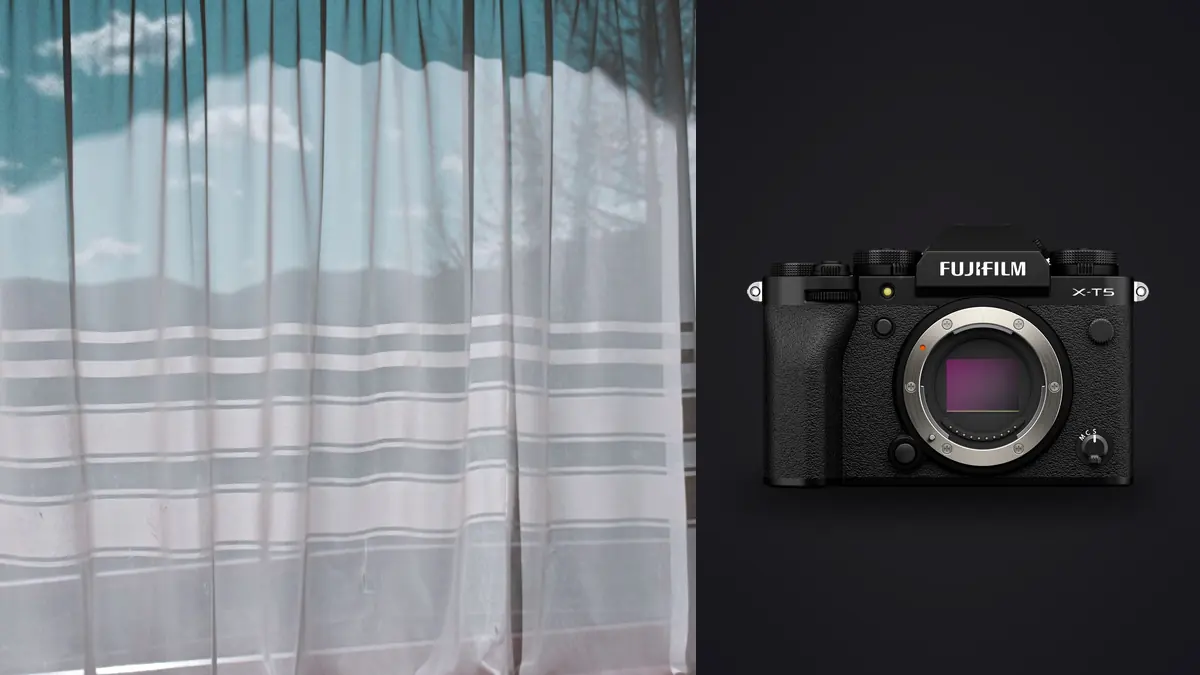
I switched my boudoir shoots from a full-frame body to the Fujifilm X-T5 about a year ago, mostly because I was tired of hauling a camera the size of a brick into hotel rooms and spare bedrooms where the subject was already nervous enough. What surprised me wasn't the image quality, which is genuinely excellent, it was how much the camera's physical presence changed the mood of a session. This isn't a spec-sheet review. It's what I've actually learned pointing this camera at people in their underwear in low-lit rooms for the better part of a year.
Why a Smaller Body Changes the Room
Boudoir and intimate portrait work is unlike almost any other genre in that your subject is acutely aware of you the entire time. A gripped full-frame DSLR with a 70-200mm hanging off it reads as clinical, even aggressive, to someone who's already anxious about being photographed in a robe. The X-T5 is small. It weighs about 557 grams with a battery and card, roughly half of what a comparable full-frame setup weighs once you add a fast portrait zoom. Clients notice this without necessarily being able to articulate why. I've had more than one person tell me, unprompted, that the camera "doesn't feel scary," which is not a technical observation but it's the one that keeps them relaxed enough to actually look natural in front of it.
The 40-megapixel X-Trans 5 HR sensor is the other half of the story, and it's a genuine step up from the older 26-megapixel Fuji bodies I used before. Cropping in on a shoulder line or a hand resting on a hip without losing detail matters more in this genre than people expect, because boudoir editing often involves reframing after the fact once you see what actually worked. The trade-off is file size. A day of shooting easily produces 25-40GB of raw files, and that adds real weight to the editing side of the job, which I'll get into later.
Dynamic range is where I had the most doubts going in, since APS-C sensors have historically lagged full frame in shadow recovery, and boudoir lighting is frequently underexposed on purpose for mood. In practice the X-T5 holds up better than I expected pushing shadows two stops in Lightroom, though I still expose slightly to the right when I can, because pulling detail out of crushed blacks on this sensor introduces more noise than I'd like once you're past ISO 3200.
Lens Choices That Actually Suit the Genre
Boudoir work has different lens priorities than headshots or weddings. You need working distance flexibility in tight bedrooms, believable skin rendering wide open, and glass that doesn't scream "camera lens" at a client already self-conscious about a big piece of glass pointed at them. Here's what I actually reach for, and why, based on real sessions rather than a spec chart.
| Lens | Full-frame equivalent | Best use in a boudoir session | Where it falls short |
|---|---|---|---|
| XF 33mm f/1.4 WR | ~50mm | Environmental frames in cramped rooms, getting the whole bed and the client in one shot without backing into a wall | Wide open it's slightly softer in the corners than the 56mm, and 50mm-equivalent perspective isn't the most flattering for close crops |
| XF 56mm f/1.2 WR | ~85mm | The workhorse. Flattering compression for face and torso shots, creamy background separation in a room with a busy backdrop | Needs about 2 meters of working distance to focus comfortably, which some smaller rooms don't have |
| XF 90mm f/2 WR | ~137mm | Detail shots (hands, jewelry, fabric texture) and tight face crops from across the room when you want distance from the subject | Nearly useless in small hotel rooms, you physically can't back up far enough |
| XF 50-140mm f/2.8 WR | ~76-213mm | Outdoor or large-studio boudoir where you want reach and can zoom instead of repositioning around the subject | Big and heavy for the genre, undermines the "small unobtrusive camera" advantage of the body |
If I had to keep exactly one lens, it's the 56mm f/1.2. The rendering at f/1.2 to f/1.8 is soft in a flattering way without turning mushy, and the compression flatters bodies without the distortion you get from anything wider shot close. The 33mm earns its keep on days when the room is genuinely small, think a guest bedroom rather than a proper studio, and you need the environmental context of rumpled sheets and window light in frame.
A note on the kit zoom
The 16-80mm f/4 that a lot of people buy as a walk-around lens is fine for scouting a location or shooting behind-the-scenes content for your own marketing, but f/4 is a real limitation indoors in ambient light, and the rendering at that aperture is noticeably more clinical than the primes above. I keep it in the bag but rarely mount it during an actual session.
Film Simulations and Skin Tone, the Part Everyone Asks About
Fuji's in-camera color science is the single biggest reason I moved to this system for portrait work, boudoir included. Skin tone is the make-or-break element of this genre far more than in landscape or street photography, and getting it close in-camera saves real time later.
Classic Chrome is too desaturated and contrasty for most boudoir work straight out of camera, it flatters editorial and documentary work better than skin. Nostalgic Neg has become my default for anything warm and intimate, it renders skin with a soft, slightly amber warmth that suits candlelit or golden-hour window light sessions without needing much correction. Eterna is worth trying if you're shooting a moodier, cooler-toned set (dark walls, minimal lighting), since it flattens contrast in a way that reads more cinematic than portrait-standard.
PRO Neg Hi is the one I'd recommend to someone starting out, since it's the closest thing Fuji makes to a "safe" portrait profile, punchy enough to not look flat but without Velvia's saturation pushing skin into orange territory. I shoot raw and pick the simulation as a starting point in post rather than baking it in, since skin tone varies enough session to session that no single profile works for everyone.
The Screen, the Shutter, and Managing the Room
The X-T5's three-way tilting screen is a point of contention among Fuji shooters who wanted a fully articulating vari-angle screen like the X-H2S has, but for this specific genre I actually prefer the tilt design. A vari-angle screen flips out to the side, and in a session where you're trying to keep things discreet and focused, having the screen swing outward toward the room (and toward whoever else might be present, an assistant, a partner) isn't ideal. The tilt screen stays in the same plane as the lens axis, which keeps the review experience contained between you and the client when you turn the camera to show them a frame.
The electronic shutter is the other underrated feature here. Boudoir sessions involve a lot of quiet, close-proximity shooting, sometimes with the client a meter away or less, and the mechanical shutter clack on a DSLR breaks the mood every single frame. Switching to fully electronic shutter on the X-T5 makes the camera essentially silent, which matters more than most gear reviews give it credit for. The one caveat is banding under certain artificial lighting (some LED panels and older tungsten fixtures), so I test a few frames at the start of a session before committing to it for the full shoot.
Battery life is a real limitation worth planning around. A session that runs two to three hours with a lot of screen review time (clients often want to see frames as you go, more so in this genre than most) will chew through a battery faster than the official CIPA rating suggests. I carry three batteries minimum and treat "camera dies mid-session" as an actual risk, not a hypothetical one.
Working the Light You're Actually Given
Most boudoir work doesn't happen in a purpose-built studio. It happens in bedrooms, hotel suites, and Airbnbs with whatever window light is available plus maybe one continuous source you brought yourself. The X-T5's in-body stabilization, rated around 7 stops depending on the lens, has let me shoot handheld at shutter speeds I wouldn't have trusted on older bodies, which matters when you're working available light at 1/60 or slower to keep ISO down.
High ISO performance is solid but not magic. I'm comfortable up to about ISO 6400 for finished images, and I'll push to 12800 for a shot I know I'm converting to black and white, where noise reads as grain rather than a flaw. Past that the X-Trans color noise pattern gets harder to clean up convincingly, and I'd rather bring a small LED panel or reflector than lean on ISO to save a dim room.
One practical habit: I shoot a lot of these sessions near a single window with sheer curtains as the main light, using a reflector on the shadow side rather than a second strobe. It keeps the gear footprint small (again, that unobtrusive-camera advantage extends to the whole lighting kit) and the results read as more natural and less "produced," which most boudoir clients actually prefer over an obviously lit studio look.
What Nobody Warns You About: The Editing Load
Here's the part that doesn't show up in camera reviews. A three-hour boudoir session at 40 megapixels per frame, shot the way most of us actually shoot (bursts during movement, multiple expression variations per pose, several outfit or lighting changes) can easily generate 1,200 to 1,800 raw files. Client delivery is usually 40 to 80 finished images. That means culling through more than 90% of what you shot, by hand, on files large enough that your editing software slows down just scrolling through them. This is the actual bottleneck in a boudoir workflow, not the shoot itself. I started running my culling pass through imagic before touching Lightroom, since it scores sharpness and focus locally on the files themselves, which matters a lot with a 40-megapixel sensor where a shot that looks sharp on a small preview can be slightly soft at full resolution. It also clusters the burst sequences and near-duplicate poses together, so instead of scrolling through eleven nearly identical frames of the same pose one at a time, I'm comparing them side by side and picking the one with the best expression in a fraction of the time.
The privacy angle matters more here than in any other genre I shoot. These are intimate images of real people, and I don't want them touching a cloud service at any point in the pipeline, culling included. imagic processes everything locally on the machine, nothing gets uploaded anywhere, which was a genuine requirement for me before I'd trust any tool with this kind of material. I also lean on the apply_my_style feature once I've hand-graded a handful of images from a session, since it learns from my own edits and applies a consistent look across the rest of the set. For boudoir specifically, where tone consistency across a gallery matters a lot (people notice if frame 12 looks warmer than frame 40), that's saved me real editing hours per session rather than building presets from scratch every time.
If you're new to building a culling workflow around a high-megabyte-per-file genre like this, it's worth reading up on how AI photo culling actually works before you commit to a pipeline, since the sharpness scoring and clustering matter differently depending on whether you're shooting bursts or single frames per pose. I'd also point anyone doing a lot of on-location work, boudoir or otherwise, toward a few practical habits in our faster photo workflow piece, several of which came directly out of sessions like the ones described here.
Frequently Asked Questions
Is the X-T5's crop sensor a real disadvantage for boudoir compared to full frame?
Less than I expected going in. The shallow depth of field difference between APS-C and full frame at equivalent framing is real but small in practice, roughly a stop, and boudoir rarely needs razor-thin focus the way, say, macro or wide-open low-light event work does. Where full frame still has an edge is extreme shadow recovery in very dark, moody setups. If you're shooting deliberately underexposed low-key work often, that's the one scenario where I'd think twice.
Which Fujifilm lens should I buy first for boudoir on the X-T5?
The XF 56mm f/1.2 WR, without much hesitation. It's the lens I use for the bulk of frames in a typical session, and the 85mm-equivalent compression is the most universally flattering focal length for the genre. Add the 33mm f/1.4 second if you regularly shoot in tight rooms where 56mm doesn't leave enough working distance.
How do I keep a boudoir session feeling private with the tilt screen?
Angle the camera so the screen faces you and the client together rather than out toward the room, and get in the habit of physically stepping beside the client (not across from them) when reviewing frames. The three-way tilt keeps the screen in the same plane as the lens, which naturally supports this compared to a vari-angle screen that can swing outward toward anyone else in the room.
What's a realistic file count and editing timeline for a boudoir session shot on the X-T5?
Expect 1,000 to 1,800 raw files for a two to three hour session if you're shooting bursts through movement and multiple expressions per pose, which most boudoir photographers do. Without a culling tool that speeds up the first pass, plan on four to six hours of editing time just to get to a shortlist, before color grading even starts. That's the number that catches new boudoir photographers off guard more than any camera setting does.