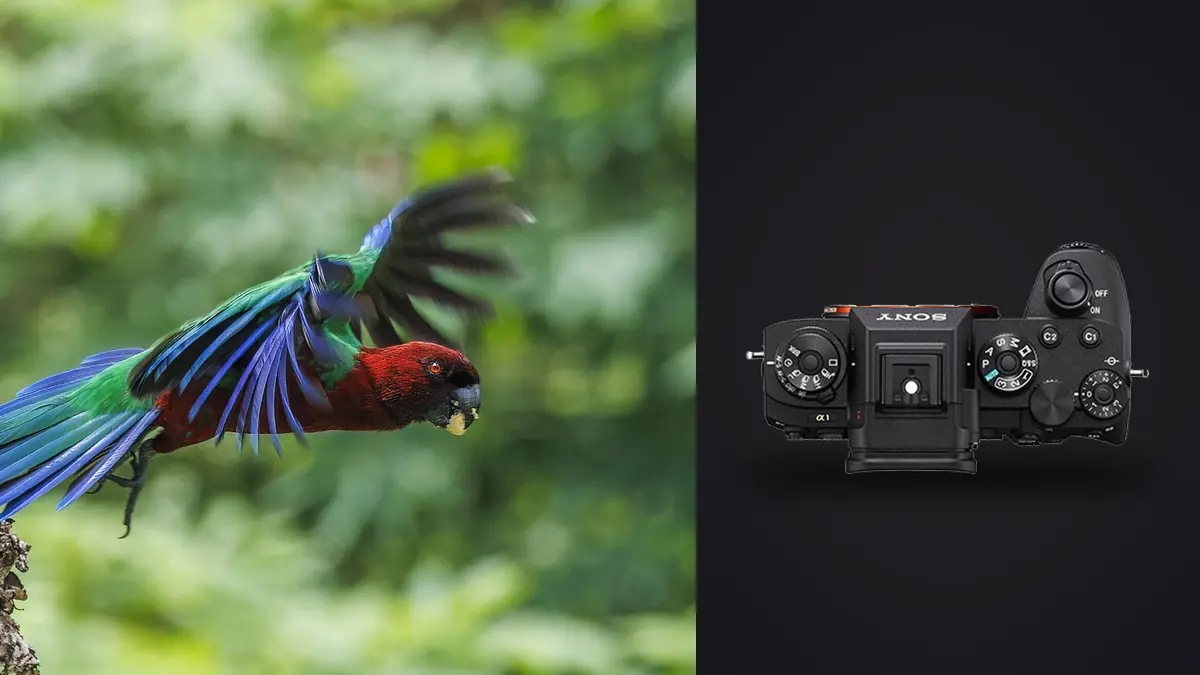
A merlin folding its wings mid-stoop crosses the frame in well under a second. Nail the focus and you have a print worth framing. Miss it and you have forty nearly identical frames of blurred feather and empty sky. The Sony A1 takes a good chunk of the luck out of that equation, but only if it's actually set up for birds in flight rather than left on whatever a wedding or a soccer match last needed. Most of what makes this camera good for raptors and shorebirds isn't the marketing headline, it's a dozen small menu decisions that either help the autofocus commit to a bird or leave it hunting the background instead.
The burst numbers that actually matter
The A1's 50.1MP stacked CMOS sensor is what makes 30fps blackout-free shooting possible without the readout smearing every fast subject into a jelly-like mess. That stacked design is the whole reason this body earns its keep for flight work: you get a continuous, uninterrupted viewfinder feed while the camera is firing, so you can actually track a bird through a turn instead of shooting blind between frames the way you would on a non-stacked sensor.
In practice I rarely leave it at the full 30fps electronic rate for general perched-bird work; it burns through storage fast and most of those extra frames between wingbeats don't add anything. But for an active flight sequence, a heron lifting off a pond edge or an osprey folding into a dive, 30fps is the difference between catching the wings at full extension and catching them half-collapsed. Sony rates the buffer at roughly 238 compressed RAW frames at the full 30fps burst with a fast CFexpress Type A card, which is close to eight seconds of continuous shooting before the camera slows down to write. Drop to a UHS-II SD card in the second slot and that buffer depth falls hard, sometimes to under a hundred frames, because the write speed simply can't keep pace with a 50MP sensor dumping data thirty times a second.
The mechanical shutter tops out at 10fps and honestly that's plenty for slower subjects like gulls riding a thermal or herons doing their unhurried wingbeat. I save 30fps electronic for genuinely fast action: falcons, terns diving, anything where the wing position changes meaningfully between frames.
Autofocus settings that actually change the keeper rate
Subject recognition versus plain Wide tracking
The A1's subject recognition AF, with Bird selected under Subject Recognition in AF, will pick out an eye on a bird against sky or foliage more reliably than generic Wide-area tracking does. It's not flawless: a bird flying directly at the lens with wings up can occasionally confuse it, and dense reed beds or chain-link fencing in front of a subject will sometimes pull focus to the foreground clutter instead. But for the common case, a raptor against open sky or a shorebird against water, Bird recognition locks on faster and holds on longer through a wing flap than manually driven tracking does.
AF Tracking Sensitivity is the setting most people leave alone and shouldn't. I run it at 5 (Responsive) for flight work so the focus commits to a new subject quickly rather than lingering on whatever it was previously tracking. That same setting would be a mistake for a bird hopping between branches with twigs crossing the frame, where a slower sensitivity avoids the focus jumping to every stick that crosses in front. There's no single correct value; it changes with the scene.
Custom buttons worth reassigning
I keep back-button focus (AF-ON) as the primary trigger and leave the shutter button to fire the drive without also re-triggering focus, which matters less on the A1 than older bodies but still avoids odd focus hunts mid-burst. More useful for BIF specifically is assigning one of the C buttons to toggle between Wide tracking and a Flexible Spot: Wide for a bird crossing open sky where nothing else competes for attention, Spot for picking a single bird out of a mixed flock or off a busy shoreline where Wide would happily lock onto whatever's biggest or closest instead of the one you actually want.
Matching a lens to the reach you actually need
Body settings only get you so far; the lens decides how much of the frame the bird fills and how fast the AF motor can react to a subject closing distance quickly. There's no universal answer here, it depends on whether you're shooting from a hide at a feeding station or hand-holding on a boat chasing terns.
| Lens | Focal length | Max aperture | Weight | Approx. street price | Where it earns its keep |
|---|---|---|---|---|---|
| FE 200-600mm f/5.6-6.3 G | 200-600mm | f/5.6-6.3 | 2,115g | ~2,000 EUR | Walk-around reach for perched and flight work without a monopod |
| FE 600mm f/4 GM OSS | 600mm | f/4 | 3,040g | ~12,000 EUR | Low-light flight shots from a hide or blind, fastest AF drive in the lineup |
| FE 400mm f/2.8 GM OSS | 400mm | f/2.8 | 2,895g | ~11,500 EUR | Fast raptors at moderate distance, pairs well with a 1.4x teleconverter |
| Sigma 150-600mm Sport (E-mount) | 150-600mm | f/5-6.3 | 2,100g | ~1,500 EUR | Budget reach, noticeably slower AF hunting against low-contrast backgrounds |
| FE 100-400mm GM + 2x TC | 200-800mm effective | f/11 effective | 1,395g (lens only) | ~2,500 EUR + ~500 EUR TC | Packable travel kit; AF slows noticeably at f/11 in dim light |
Prices above are approximate street prices, not list, and move around enough that they're worth checking against a current retailer before you budget around them. The practical takeaway from that table isn't "buy the 600mm f/4," it's that the jump from f/6.3 to f/4 buys you real AF speed and low-light margin, but at roughly six times the price and nearly a kilo more to hand-hold through a three-hour flight session. For most people starting out in BIF, the 200-600mm G is the lens that gets used the most, precisely because it's light enough to actually bring along and track a bird through a full pass without your arms giving out first.
Where the electronic shutter works against you
The stacked sensor reduces rolling shutter dramatically compared to older non-stacked bodies, but it doesn't eliminate it. At 30fps electronic, a genuinely fast-moving element within the frame, a hummingbird's wings, a propeller in the background, can still show a slight skew or banding because the sensor still reads top to bottom in a very short but non-zero window. For most birds in flight this is a non-issue; wingbeats on a heron or an eagle are slow enough relative to the readout speed that you'll never notice it. It becomes visible on the fastest wingbeat species and on anything mechanical sharing the frame.
The other place the electronic shutter bites is artificial light. Shooting at a dusk feeding station under LED lighting can introduce banding at high electronic shutter speeds that simply doesn't happen with the mechanical shutter. If you're working a location with mixed natural and artificial light near dawn or dusk, it's worth switching back to mechanical or the Anti-flicker shooting mode rather than assuming 30fps electronic is always the better choice.
Cards, battery, and the buffer wall
Slot 1 takes CFexpress Type A or SD, slot 2 is SD only. Running a CFexpress Type A card in slot 1 is what actually unlocks the buffer depth Sony quotes for 30fps bursts; drop back to SD and you'll hit the buffer wall noticeably sooner, sometimes mid-sequence on exactly the pass you wanted. I carry two CFexpress Type A cards and treat the SD slot as backup recording rather than my primary, since the price premium on CFexpress Type A is real but so is the frustration of watching the buffer counter hit zero as a peregrine folds into a stoop.
Battery life on the NP-FZ100 is rated around 430 shots CIPA through the viewfinder, and cold mornings at a wetland or coastal blind will eat into that faster than the rating suggests. A day of serious flight shooting, lots of half-pressed AF hunting while tracking, burns a battery quicker than the number implies. Two spares in an inside jacket pocket (batteries lose charge faster in the cold if left in a bag) is a habit worth building before the first real cold-weather outing, not after a battery dies mid-pass.
What a three-second burst does to your evening
Here's the part nobody mentions when they're excited about 30fps: a three-second burst of a tern diving is ninety frames of essentially the same bird in slightly different wing positions, and you'll shoot dozens of these bursts in a single outing. A morning at a good shorebird roost can easily produce three or four thousand frames, most of which are near-duplicates of the ten or fifteen actual keepers hiding among them. Scrolling through that by eye, zooming in on each frame to check whether the eye is sharp or the wingtip is clipped, is where an evening disappears.
This is the part of the workflow I've actually changed. I run flight sequences through imagic before touching Lightroom at all: its local sharpness and focus scoring flags which frames in a burst actually landed critical focus on the eye rather than the near wing or the beak tip, and its duplicate and burst clustering groups the ninety nearly-identical frames from one dive into a single stack instead of ninety separate thumbnails to click through one at a time. That alone turns a four-thousand-frame day into something you can actually cull in under an hour instead of most of an evening. If you want the mechanics of how that kind of scoring actually works rather than taking it on faith, this breakdown of how AI photo culling works covers it in more depth than I have room for here.
The other thing worth mentioning is that it runs entirely offline: everything happens on the machine, no upload queue, no waiting on a connection. That matters more than it sounds like it should when you're culling from a laptop in a hide with no signal, or on a boat between locations. Once the keepers are picked, imagic's apply_my_style feature, which learns from edits you've already made to your own past work, gets a consistent look across the surviving frames faster than manually matching white balance and exposure across a batch shot under changing light through a session. For anyone whose current bottleneck is genuinely the review pass rather than the shooting itself, these workflow tips are a reasonable next stop.
Frequently Asked Questions
Is the Sony A1 actually better for birding than the A9 III or A7R V?
The A9 III's global shutter eliminates rolling shutter entirely and it can push 120fps, which matters more for extremely erratic subjects like small songbirds at a feeder, but its 24.6MP sensor gives up a lot of cropping room compared to the A1's 50.1MP. The A7R V has more resolution again at 61MP but tops out around 10fps, which simply isn't fast enough to reliably catch peak wing position on a diving raptor. The A1 sits in the middle and for most birders that middle ground, high resolution and a genuinely fast blackout-free burst, is the more useful compromise than either extreme.
Do I need the 600mm f/4 GM or is the 200-600mm G enough?
For the vast majority of birders, the 200-600mm G is the better first lens: it's a third of the weight and roughly a sixth of the price, and modern high-ISO performance means the extra stop and a half of light the f/4 offers matters less than it used to. The 600mm f/4 earns its price when you're regularly shooting in low light from a fixed hide position where the extra weight isn't being hand-held through a moving pass.
What burst rate should I actually use for birds in flight?
Reserve 30fps electronic for genuinely fast action like a stoop or a tight aerial chase, where wing position changes meaningfully between frames. For perched birds, slower flight like gulls riding thermals, or anything under flicker-prone artificial light, the 10fps mechanical shutter avoids both the storage burn and the rare rolling-shutter artifacts on faster wingbeats.
How much card storage should I plan for a day of serious flight shooting?
A single active morning chasing flight sequences at 30fps can easily produce 150-250GB in compressed RAW, more if you're shooting uncompressed. I carry at least two 160GB CFexpress Type A cards for a full day out and treat anything less as a good way to run out of storage mid-session on the best light of the day.