
The Time Value of Faster Culling
Every claim about AI photo culling comes with vague promises about "saving time." This article gives specific numbers — measured across real shoot types, realistic volumes, and honest assumptions about how AI scoring actually helps versus where you still need human judgment.
The Baseline: Manual Culling Times
Manual culling speed depends on the photographer and the content, but these are realistic averages:
- Portrait/headshot session (consistent lighting, controlled environment): 3-5 seconds per frame at review speed
- Wedding (varied lighting, expressions, candid moments): 4-7 seconds per frame
- Sports/wildlife (burst-heavy, many blurry frames): 2-4 seconds per frame after initial fast scan
- Event photography (corporate, conferences): 3-5 seconds per frame
What imagic AI Pre-Filtering Does
imagic's AI scores sharpness, exposure, noise, composition, and detail. The first two filters (sharpness and exposure thresholds) typically eliminate 30-50% of frames from any shoot before human review begins. The remaining frames are reviewed by the photographer for editorial content — expression, decisive moment, subject connection, composition beyond what AI can assess.
Calculated Time Savings by Shoot Type
Wedding (5,000 frames, 2 hour manual cull)
- imagic AI pre-filter eliminates 40% of frames: 2,000 frames removed automatically
- Remaining 3,000 frames at 5 seconds each: 250 minutes = 4.2 hours without AI
- With AI pre-filter: 3,000 x 5 seconds = 250 min... but imagic's grouping reduces decisions per burst: effective review of ~1,800 decision points at 5 sec = 150 minutes
- Manual: 4+ hours. With imagic: 2.5 hours. Savings: ~1.5-2 hours per wedding.
Portrait Session (400 frames)
- 400 frames x 4 seconds = 27 minutes manual
- AI removes 35% (140 frames) before review
- 260 frames x 4 seconds = 17 minutes
- Savings: ~10 minutes per portrait session.
Sports Event (8,000 frames)
- Very high burst rate means many technically poor frames
- AI removes 50% (4,000 frames) via sharpness and exposure filters
- Burst grouping reduces decision points further
- Manual: 6+ hours. With imagic: 2.5-3 hours. Savings: 3-4 hours per event.
Annual Time Savings Calculation
For a photographer shooting:
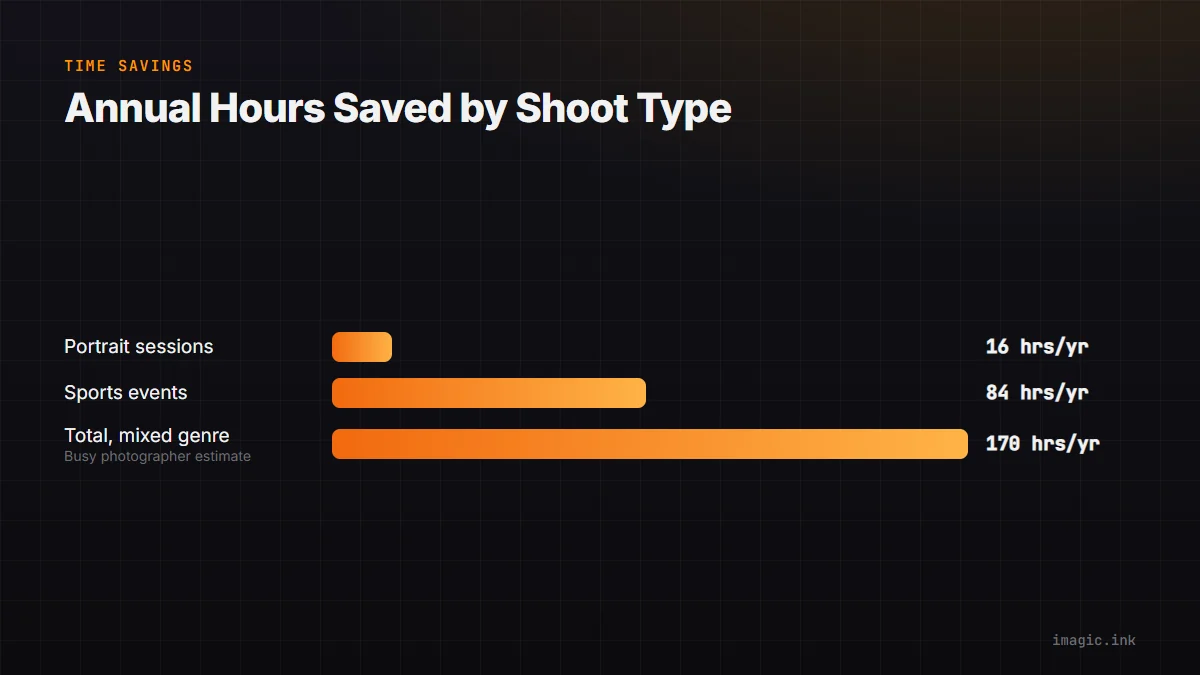
- 2 weddings/month: 3-4 hours saved/wedding x 24 = 72-96 hours/year
- 8 portrait sessions/month: 10 min/session x 96 = 960 minutes = 16 hours/year
- 2 sports events/month: 3.5 hours x 24 = 84 hours/year
Total annual time saved: 170+ hours for a busy mixed-genre photographer.
The Financial Value
At a conservative billing rate of $50/hour (photographer's time value), 170 hours saved = $8,500 of time value per year. imagic costs from EUR 19 one-time. The ROI is effectively infinite. Even at the lower end — 40-50 hours saved per year for a photographer shooting lower volumes — the economic case for AI culling is compelling at any price point below $1,000.