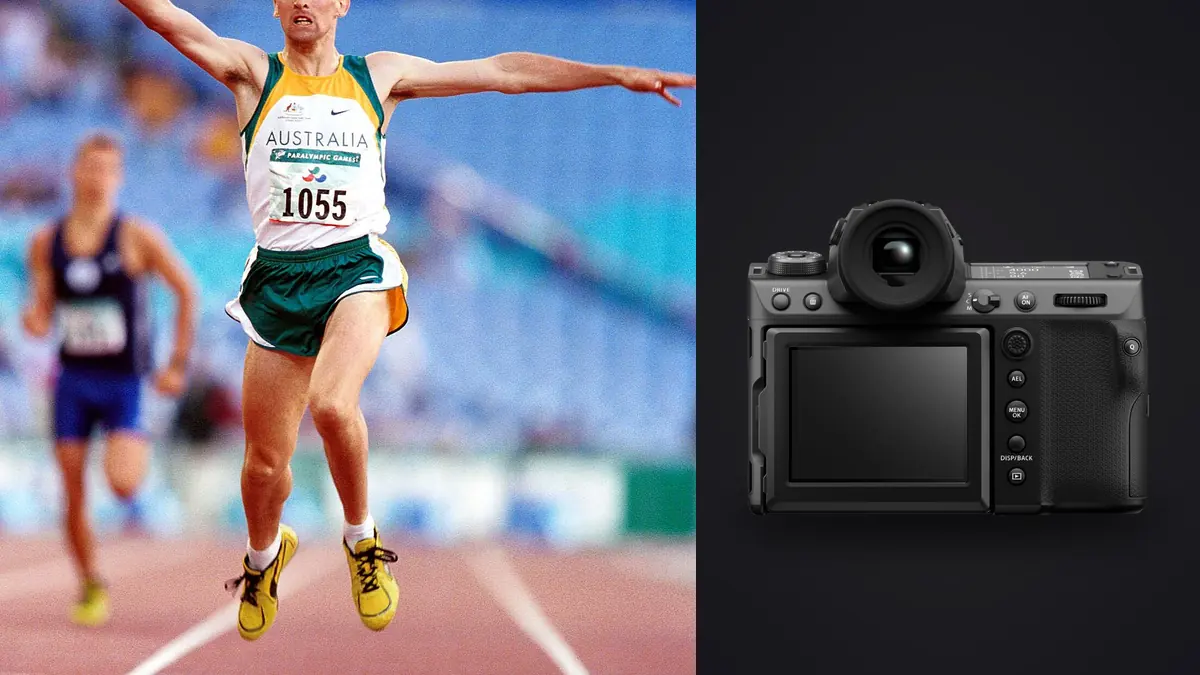
I brought a Fujifilm GFX 100 II to a regional track and field championship mostly out of stubbornness. A friend had it sitting idle after a catalogue shoot, and I wanted to see whether a 102-megapixel medium format body could survive an afternoon of sprints, jumps, and throws without turning into an expensive way to miss the moment. The short version: it can, but only if you stop treating it like the crop-sensor sports body you're used to and start shooting it like what it actually is, a resolution machine that happens to have gotten fast enough to keep up with predictable action.
This isn't a camera anyone should buy specifically for track and field. But if you already own one for portrait or landscape work and you're wondering whether it's worth lugging to a meet, or you're a meet photographer trying to decide if the extra resolution justifies the extra weight and cost, here's what actually happened when I pointed it at hurdlers and long jumpers for a full day.
Why bother with medium format at a track meet in the first place
Most track venues put photographers behind a rail, a fence, or a rope line well back from the actual competition surface. You don't get to walk up to the long jump pit or crouch at the hurdle. You shoot from a fixed position with whatever glass you brought, and you crop. A lot.
That's where the 102-megapixel sensor earns its keep. A frame that would be a tight, unusable crop on a 24 or 26-megapixel body still leaves you 20 to 30 megapixels of usable image after you punch in on a discus release or a pole vaulter clearing the bar from 80 meters away. For meet photographers who sell large prints to athletes and parents, or for federations that want billboard-sized output from an awards ceremony image, that headroom is real value, not a marketing number.
The trade-off is everything else. The GFX 100 II tops out at 8fps, its telephoto lenses are heavier and slower than their full frame equivalents, and its files are enormous. None of that makes it a bad camera. It makes it a specialist tool, and specialist tools need honest expectations.
What actually changed in the autofocus system
Fujifilm rebuilt the autofocus stack for the 100 II rather than just tuning the GFX100S's. Phase-detection coverage extends across nearly the whole frame now, and subject detection (face and eye priority for people, since there's no dedicated human-sport tracking mode the way some flagship stacked-sensor bodies advertise) locks noticeably faster than it did on the previous generation. In practice, that means a sprinter coming out of the blocks toward the camera gets picked up and held with less hunting than I expected from a medium format body.
Where it starts to show its limits is on fast lateral motion, the kind you get from a relay handoff crossing the frame at speed, or a sprinter blowing past at the finish on a tight lens. The tracking box keeps up, but it's a step behind a stacked-sensor APS-C or full frame body doing the same job. I lost focus lock on maybe one in eight attempts during a 4x100 relay exchange, which is not disastrous but is a real number worth knowing before you rely on this camera for your only coverage of a race.
Sprints versus field events: where 8fps is enough, and where it isn't
Eight frames per second sounds fine until you compare it to what a dedicated sports body does. A stacked-sensor mirrorless camera shooting 20 to 30fps gives you three or four times the number of chances to catch the exact instant a foot crosses the line or a lean happens at the tape. At 8fps, you're making a bet every time you press the shutter, because you simply have fewer frames covering the same fraction of a second.
That's a real problem for sprints and hurdles, where the decisive moment is measured in hundredths of a second and happens differently every single race. It's much less of a problem for field events. A long jumper's takeoff, a pole vaulter's peak over the bar, a shot putter's release, a high jumper's back arch over the bar: these all have a predictable window you can pre-frame and time manually, because the athlete has to be in roughly the same physical position relative to a fixed point (the board, the bar, the circle) every single attempt. I got a noticeably higher hit rate at the long jump pit and the pole vault runway than I did trying to freeze the 100m final, simply because I could anticipate where the peak moment would happen and start my burst a half second early.
My honest recommendation: bring this camera for field events and for the emotional, non-action moments around a meet (medal ceremonies, warmups, coach reactions), and bring something faster if sprints and relays are your main assignment.
The glass problem: GF telephotos aren't built for a fence line
Fujifilm's GF telephoto lineup is genuinely excellent optically, but it wasn't designed with sports shooters standing behind a rope in mind. The lenses are heavier than their full frame counterparts at similar focal lengths, the maximum apertures are slower, and because the GFX sensor is physically larger than full frame, the same focal length number gives you less reach than you'd expect. The rough multiplier is 0.79x, so a 500mm lens on the GFX behaves, in terms of framing, like roughly 395mm would on a full frame body. That caught me off guard the first time I set up at the far turn expecting full-frame-500mm reach and getting noticeably less.
| Lens | Full-frame equivalent field of view | Approx. weight | Best track use |
|---|---|---|---|
| GF 100-200mm F5.6 R LM OIS WR | ~79-158mm | ~940g | Field events shot from a close rail position, warmups, general coverage |
| GF 250mm F4 R LM OIS WR | ~198mm | ~1.4kg | Mid-field distance work; pairs well with the 1.4x teleconverter for ~350mm (~277mm equiv.) |
| GF 500mm F5.6 R LM OIS WR | ~395mm | ~1.4kg | Far-side sprints, throws from behind a safety net, anything at real distance |
None of these are cheap, and none of them are light for a full day of handheld shooting. If you're used to a 400mm f/2.8 or a 300mm f/2.8 on a full frame body, prepare for a slower maximum aperture and a real adjustment in how much subject-background separation you're used to getting. It's still there, medium format's depth of field characteristics are genuinely different, but you're working with f/4 and f/5.6 glass, not f/2.8.
Shutter speed and drive settings by event
I ended up building a rough cheat sheet over the course of the day, adjusted slightly from what I'd use on a faster body because of the buffer and burst limitations.
| Event | Shutter speed floor | Drive approach on the 100 II |
|---|---|---|
| 100m/200m sprints | 1/2000s or faster | Short, timed bursts of 1-2 seconds right at the anticipated finish; don't hold the shutter for the whole race, the buffer can't take it |
| Hurdles | 1/2000s | Pre-focus on a specific hurdle, fire a short burst as the athlete clears it rather than tracking continuously down the straight |
| Long/triple jump | 1/1600s | Lock focus on the board, single-shot or a very short burst timed to takeoff |
| Pole vault | 1/1600s | Pre-frame the bar height, fire on the ascent; this is the event where 8fps felt genuinely sufficient |
| Throws (javelin, discus, shot) | 1/1250s | Focus on the circle or the release point, single-shot timing beats spraying frames |
Mechanical shutter over electronic, every time, if there's any lateral motion in the frame. The sensor readout on a 102-megapixel chip is not instant, and I saw visible skew on a couple of electronic-shutter frames during the relay that I didn't see with the mechanical shutter engaged.
The file-size tax nobody warns you about
This is the part that actually changed my workflow more than the autofocus did. A compressed raw file off this sensor lands somewhere around 100 to 120MB. A single afternoon of track coverage, even shooting selectively the way the buffer forces you to, produced just under 400 raw files by the time the meet wrapped, which worked out to roughly 45GB from one session. That's before a second card, a second meet, or a multi-day championship.
Backing that up on-site between events, on top of just keeping the cards from filling, became its own logistics problem. And once I got home, the actual culling was the bottleneck, not the shooting. Scrolling through a dozen near-identical frames of one hurdle clearance at full 102-megapixel preview resolution in most catalog software is slow enough to make you want to skip the meet entirely next time.
This is where I leaned hard on imagic for the sort. It runs entirely on the machine, no upload queue for 100MB+ raw files before you can even start reviewing, which matters a lot when you're dealing with files this size and you don't want to wait on a slow connection at a hotel before you can start working. It clusters the burst sequences automatically, so instead of scrolling through fifteen frames of one long jump attempt one at a time, you're comparing grouped bursts and picking the sharpest frame the local focus scoring already flagged. For a shoot where the whole point of the resolution was catching the exact peak of a pole vault clearance, having something surface the technically sharpest frame in a burst without me eyeballing each one at 100% zoom saved real time. If you want the mechanics of how that scoring actually works, I wrote more on it in how AI photo culling works.
Once the keepers were picked, applying a consistent grade across a folder of stadium light, mixed shade, and late-afternoon sun images was its own chore. imagic's apply_my_style preset, trained on my own past edits rather than a generic sports LUT, got the bulk of the meet gallery to a consistent look in one pass, which left me editing exceptions instead of every single frame from scratch.
A workable meet-day approach if you're bringing this camera
A few adjustments made the day noticeably less frustrating than my first hour of shooting suggested it would be.
- Pick two or three events to actually cover well rather than trying to shoot the whole meet. The buffer and the 8fps ceiling punish spray-and-pray far more than they punish a deliberate, narrower approach.
- Use back-button focus and switch to continuous AF only during the actual approach or acceleration phase, single-shot AF the rest of the time to save battery and reduce hunting.
- Shoot compressed raw, not uncompressed. The visible quality difference is not worth the buffer and storage cost on a body that's already buffer-limited.
- Bring more storage than feels reasonable. I underestimated by roughly half.
- Mechanical shutter for anything with lateral motion, as noted above.
If storage and card-swapping logistics are already a stress point for you on meet days, it's worth reading through 10 tips for a faster photo workflow, most of it applies even more when your files are twice the size of a typical full frame raw.
Frequently Asked Questions
Is the GFX 100 II fast enough to shoot a 100m sprint from the gun to the tape?
You can cover it, but you'll get fewer usable frames of the actual race than you would from a dedicated sports body. It's better suited to a single well-timed burst at the finish than to tracking the whole 10 seconds continuously. If sprints are your primary assignment, don't make this your only camera on the day.
How much does the 0.79x crop factor actually cost you in telephoto reach?
A 500mm GF lens frames like roughly 395mm would on full frame. It's not a dramatic loss, but if you're used to full-frame-500mm reach and plan your fence-line position around that, you'll find yourself wanting to be noticeably closer than you would with a comparable full frame telephoto.
Should I shoot compressed or uncompressed raw for a full day of track coverage?
Compressed lossless raw, without much hesitation. The buffer depth and card capacity gains are meaningful and I couldn't find a practical quality difference in the final edited files, even in ones I printed large.
Is this a sensible primary body for a meet photographer, or better as a specialist add-on?
Specialist add-on, for most people. It earns its place for field events, portraits of medalists, and any shot where resolution and print size matter more than frame rate. For general meet coverage where you need to reliably nail sprints and relays, pair it with (or replace it with) a faster stacked-sensor body.