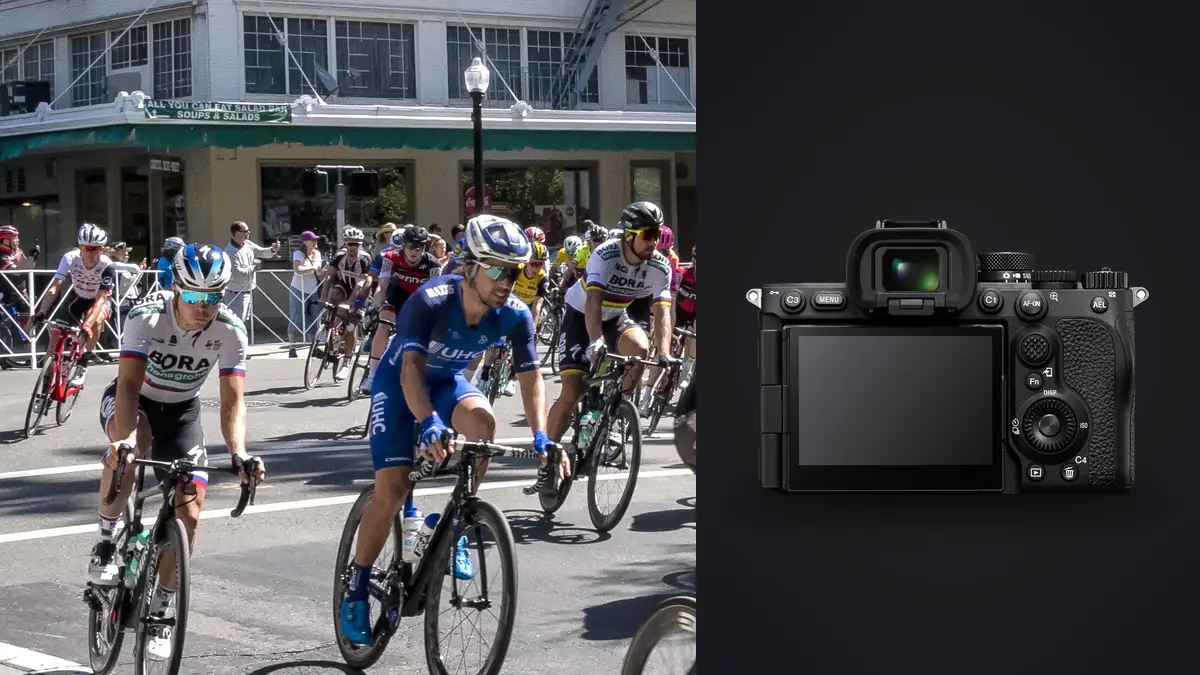
A club coach called me in April asking if I could cover the regional qualifiers at the high school track two towns over. I said yes before I checked my bag, and when I did check it, the only full-frame body sitting there that week was a Sony A7R V. I'd bought that camera for headshots and product work on a table, not for chasing 400m runners around a bend. I almost turned the job down and rented an A9 II instead. I didn't, mostly because the rental house was out of stock that weekend, and what I learned over that meet and three more since is worth writing down, because most of what gets said about this camera and sports is either "don't bother" or "it's basically an A1," and neither is quite right.
What a track meet actually demands from a body
Track is not one sport, it's six or seven happening on the same afternoon in different corners of the same facility. Sprints need fast glass and faster shutter speeds because a 100m runner covers roughly 10 meters a second at full stride. Field events like long jump and pole vault need you to predict a peak moment and hold focus through a body that's rotating in the air. Distance events are the opposite problem: hours of nothing punctuated by a pack that strings out unpredictably on the final lap. None of that is unique to any one camera, but it tells you what you're actually grading a body on: how fast it can rip through a burst, how deep that burst goes before it stalls, and whether the autofocus can find and hold a human moving across the frame at speed. Resolution barely enters into it. That's the part that should have made me nervous about bringing a 61-megapixel landscape camera to a running track, and it's the part that turned out to matter less than I expected.
The autofocus is the reason this worked at all
Sony put the same AI-based subject recognition into the A7R V that debuted on the A1, and for people specifically it's genuinely excellent. I ran it in Tracking: Expand Spot with Human subject recognition enabled for the sprints, and it held on to a runner's torso through a full 100m without me babysitting the focus point. Where it earns real credit is eye and head detection at a distance and at an angle, which is exactly what you get with track athletes leaning into a curve or crossing the frame diagonally rather than running straight at you. I lost focus lock maybe twice in a full meet, both times when a runner was briefly eclipsed by another athlete in an adjacent lane.
What the camera doesn't have is a dedicated "sports" recognition mode the way some competitors now offer for cycling or motorsport, and there's no track-specific profile, so you're relying on general human detection the whole time. For field events that worked fine. For a crowded 4x100 handoff zone with four bodies converging, it occasionally locked onto the wrong runner and I had to nudge it back with the joystick. That's a minor complaint given the price point, but it's worth knowing going in rather than discovering it mid-race.
The buffer is where the trouble starts
Here's the number nobody puts on the spec sheet in a way that means anything: at 10fps in compressed RAW with a fast CFexpress Type A card, I could hold the buffer for a bit under four seconds of continuous shooting before the rear indicator started crawling and the frame rate audibly, visibly dropped. That's enough for one clean start-to-mid-race burst on a sprint, and it's not enough if you want to also catch the finish in the same burst without lifting off the shutter and re-firing. Switch to lossless compressed RAW, which is what I actually shoot because I crop hard on some of these frames later, and that window shrinks to somewhere around two and a half seconds. Uncompressed RAW is closer to a second and a half before the buffer chokes, which for a 200m race is basically unusable as a single continuous burst.
The practical fix is the same one sports shooters have used for a decade: don't hold the shutter down for the whole race. Fire in short, deliberate bursts timed to the moments you actually want (the start, the exchange, the lean at the tape) and let the buffer clear in between. It works, but it means the A7R V punishes a lazy trigger finger far more than a body built around a stacked sensor and a bigger buffer would.
| File format | Approx. burst before buffer fills (10fps, CFexpress Type A) | Practical use at a meet |
|---|---|---|
| Compressed RAW | ~35-40 frames | One full sprint burst, tight editing on the shutter finger |
| Lossless compressed RAW | ~22-26 frames | Fine for field events, tight for a full 100m |
| Uncompressed RAW | ~14-16 frames | Not recommended for continuous sprint coverage |
| JPEG Extra Fine | 150+ frames | Deep enough to shoot loosely, but you lose RAW latitude |
Rolling shutter changes which shutter mode you should use
The A7R V's sensor is not fast to read out, and on a 61-megapixel stacked-less sensor that shows up as visible skew on anything moving quickly and horizontally across the frame in electronic shutter mode. A sprinter's legs at full stride, photographed with the silent electronic shutter while you're panning to track them, can come out subtly slanted, like the whole runner is leaning further forward than they actually were. It's not dramatic, but I noticed it on a handful of frames from lane one at the 200m, shot at a low panning angle where the motion across the sensor was fastest.
The fix is simple: use the mechanical shutter for anything involving lateral motion at speed, which on this camera still gets you the full 10fps. You lose the silence of the electronic shutter, which nobody at a track meet cares about anyway given the starter's gun and the PA system, and you get a shutter mechanism that reads the whole frame close enough to instantaneously that the skew disappears. For static or slow subjects, like a shot putter mid-release or a coach on the infield, electronic shutter is fine and I'd default to it for the quieter moments.
Glass that actually makes sense for this body
I ran two lenses for most of the meet: a 70-200mm f/2.8 GM II for the far side of the track and the field events near the stands, and a 100-400mm GM for the home straight and any sprint finish shot from the infield rail. The 70-200 is the one I'd tell someone to buy first if they're building a track kit around an A7R V, because the zoom range covers long jump, high jump, and pole vault without a lens change, and f/2.8 at 1/2500s in bright daylight still leaves enough light to keep ISO low even on overcast days.
The 100-400 earns its keep on sprints and relays where you're often shooting from a fixed spot along the fence and need reach rather than speed. I didn't miss having a 400mm f/2.8 prime, though I'd probably feel differently shooting from a media pit at a meet with actual sideline restrictions rather than a regional qualifier where I could walk the fence line freely.
61 megapixels is a strange kind of advantage here
I went into this expecting the resolution to be dead weight, three times more data than a sports shooter needs, filling cards faster and slowing everything down. It didn't turn out that way for one specific reason: track photography from open sidelines means you're often not as close as you'd like to be, and the extra resolution gave me room to crop a distant long jump landing down to a tight, print-worthy frame without it falling apart. A shot of a pole vaulter clearing the bar from 40 meters away, cropped to roughly a third of the frame, still held up as a usable 8x10 for a parent to buy afterward. On a 24-megapixel body that same crop would have started showing its limits. It doesn't offset the buffer and file-size costs entirely, but it's a real trade rather than a pure downside.
Sorting the take without losing the weekend to it
The part nobody warns you about with a 61-megapixel sensor at 10fps is what your evening looks like afterward. A single meet with four events and a handful of relays left me with just over 3,100 frames, most of them in tight bursts of near-identical shots where a runner's stride changed by inches between exposures. Going through that by eye, at full resolution, on a laptop, is not a reasonable way to spend a Sunday night.
This is where I've leaned on imagic, which I originally picked up for a big photo backlog and now use for every sports shoot. It scores sharpness and focus accuracy locally on the machine, so it can flag which frame in a six-shot burst of the same stride actually has the sharpest eyes and cleanest motion, and it groups burst sequences together so I'm reviewing clusters instead of scrolling through three thousand near-duplicates one at a time. For a shoot this size that turns an evening of squinting into something closer to forty minutes of confirming the software's picks and overriding the handful it got wrong. If you want the mechanics of how that scoring actually works rather than just taking my word for it, I wrote more on that in how AI photo culling works.
The other thing worth mentioning, because it matters more at a school track meet than at almost any other kind of shoot I do, is that this is entirely local. These are mostly photos of other people's kids. I don't love the idea of a folder of minors' faces getting uploaded to somebody's cloud server for processing, and imagic never leaves the laptop to do its scoring, which made it an easy call for this specific job in a way it might not be for other work.
Once the culling's done, I run the finalists through imagic's apply_my_style preset, trained on my own past edits, to get a consistent look across the whole set before I hand anything to the school or post a gallery for parents. Track light changes fast over three hours (you start in flat overcast and end in low sidelight), and having one edit style applied consistently saves me from a set of photos that looks like it came from four different photographers. There's a broader rundown of speeding up this kind of turnaround in 10 tips for a faster photo workflow if the culling side of this is new to you.
How it stacks up against the bodies actually built for this
I don't want to overstate the case. The A7R V is not a sports camera, and if track and field is going to be a regular part of your work rather than a one-off favor for a coach, the bodies below are worth the extra money.
| Camera | Resolution | Max continuous fps | Rolling shutter risk | Launch price (body) |
|---|---|---|---|---|
| Sony A7R V | 61MP | 10fps (mechanical or electronic) | Noticeable on fast lateral motion, e-shutter only | ~$3,900 |
| Sony A9 III | 24.6MP | 120fps (global shutter, no distortion) | None, global shutter | ~$6,000 |
| Sony A1 | 50MP | 30fps (electronic, blackout-free) | Low, faster readout than A7R V | ~$6,500 |
The A9 III in particular makes the A7R V's buffer problem look almost quaint, since a global shutter sensor with no rolling shutter penalty and 120fps changes what "catching the moment" even means. But that's a body built for one job. The A7R V is a body built for a dozen jobs that happens to be capable enough at this one, provided you shoot short bursts, favor the mechanical shutter for panning shots, and accept that you'll spend real time managing the buffer rather than holding the shutter down and hoping. For someone who already owns this camera for portraits, product work, or landscapes and gets asked to cover a meet twice a season, buying a second body just for that is hard to justify. For someone shooting track every weekend from March through June, it isn't the right tool, and I'd say so plainly rather than pretend otherwise.
Frequently Asked Questions
Can the Sony A7R V keep up with a 100m sprint without missing the key moments?
Yes, but only if you shoot in short, deliberate bursts rather than holding the shutter down for the whole race. At 10fps you get roughly two to four seconds of continuous shooting before the buffer forces a slowdown, depending on RAW format, which is enough to cover the start or the finish cleanly but not both in one unbroken burst.
Should I shoot compressed or uncompressed RAW at a track meet?
Compressed RAW gives you the deepest buffer and is the right default for anything involving continuous bursts, like sprints and relays. I switch to lossless compressed for field events where I know I'll crop hard later, since the buffer there matters less because you're firing fewer, more deliberate frames.
Do I need to buy CFexpress Type A cards, or will a fast SD card work?
A fast CFexpress Type A card meaningfully extends the buffer clearing speed compared to even the fastest UHS-II SD card, which matters most in back-to-back events where you don't get much recovery time between bursts. If you're only shooting a couple of events a season, a good UHS-II card is workable, you'll just wait longer for the buffer to clear between bursts.
What lens covers the most ground for track and field on this body?
A 70-200mm f/2.8 handles field events and the far side of the track from the stands without a lens change. If sprints and relays from the home straight are your main focus, a 100-400mm gives the reach you'll actually need over the 70-200's longer end.