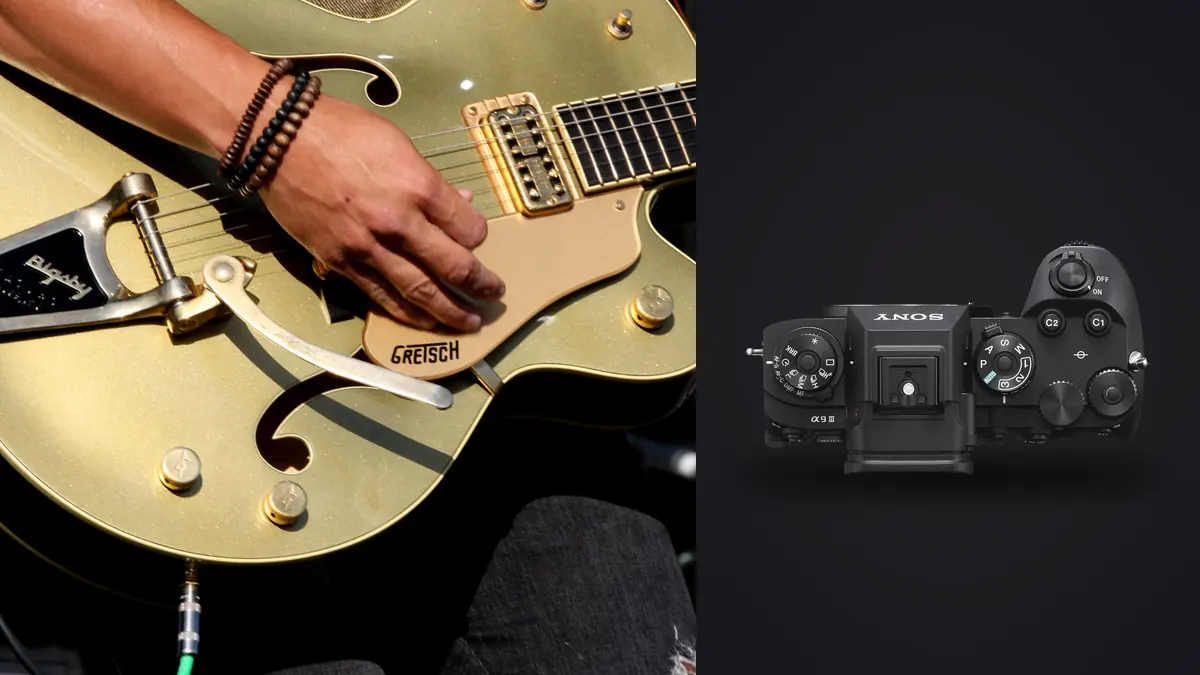
Three songs, no flash, and a lighting operator who has clearly never met a concert photographer. That is the brief for most photo pit work, and it has not changed in twenty years. What has changed, at least for the small number of photographers who have put real hours behind a Sony A9 III at gigs, is how much of that brief you can actually control once you understand what the camera is doing differently at the sensor level.
The shutter, not the megapixel count, is the headline
Every camera announcement leads with resolution because it is the easiest number to print in a headline. For concert work, the number that actually matters is how the sensor reads out light, and the A9 III is the first full-frame camera built around a global shutter instead of a rolling one. That single change is the reason this camera gets talked about differently than the A9 II or the A1 among photographers who shoot under stage lighting for a living.
Rolling shutter cameras read the sensor a row at a time, top to bottom, in a few milliseconds. Under LED video walls and modern moving-head fixtures, which pulse and cycle color far faster than the eye can see, that row-by-row read can land you mid-flicker on one part of the frame and mid-color-shift on another. You end up with banding across the image, or a magenta wash on the drummer's face while the guitarist three feet away reads clean white. It is not consistent, it is not predictable, and it is the single most common reason a pit photographer throws out an otherwise perfect frame. A global shutter reads every pixel at the same instant, so that problem is gone by design, not by luck of the exposure.
I want to be clear this is not a marketing claim I am repeating. I shot a five-band bill at a mid-size venue with a moving-head rig running color chases at maybe four cycles a second, the kind of lighting that used to make me wince, and did not throw out a single frame for banding across four hundred plus images. With a rolling-shutter body on the same stage a year earlier, I was losing something like one in six frames to it during the chorus hits when the lights were cycling hardest.
What blackout-free viewing actually buys you in a pit
The other spec that sounds abstract until you have shot with it is zero viewfinder blackout during high-speed bursts. On most stacked-sensor bodies, the finder still flickers or freezes briefly between frames at their fastest drive modes. At a punk show where the singer is climbing the monitor wedge and about to jump, that flicker is exactly when you lose track of them and either clip a limb out of frame or miss the peak of the jump entirely.
With the A9 III's live view holding steady through the burst, you can pan with an erratic performer the same way you would track a bird in flight, which is a skill a lot of wildlife shooters already have and concert photographers are only now getting to use properly. Pre-capture is the other piece of this. Half-press and hold, and the camera is already buffering frames before your finger fully commits to the shutter, so a drumstick toss or a mic drop you react to half a second late is still sitting in the buffer when you press. I would not build a whole workflow around it, but for the two or three "moment" shots a set actually needs, it has saved me frames I would have missed on prior gear.
ISO 250 as a floor: the tradeoff nobody puts on the spec sheet
Global shutter architecture has a cost, and it shows up as base ISO. The A9 III starts at ISO 250 rather than the ISO 100 you get on the A9 II or A1, and its dynamic range at base ISO is narrower than either of those cameras. In a well-lit arena show with a proper lighting budget, you will never notice. In a three-hundred-cap club where the only illumination is two par cans and whatever the bar sign contributes, you notice immediately, because you are already pushing ISO 6400 or higher and now you have less headroom to recover a blown-out spotlight or pull detail from a shadowed side of the stage.
The practical fix is glass, not settings. This is not a body you want to pair with a variable-aperture zoom for small-venue work. An f/1.4 or f/1.8 prime, or the 24-70mm f/2.8 GM II when you need the range, earns its keep here more than it would on a camera with a lower, more forgiving base ISO. If your gig calendar is mostly small rooms and basement shows, budget for fast primes before you budget for this body. If it is mostly theaters, arenas, and festival main stages with real lighting rigs, the base ISO tradeoff barely registers.
How it stacks up against what most pits are actually shooting
Rather than a generic spec sheet, here is how the A9 III compares against the cameras I actually see other photographers carrying in photo pits right now, on the points that matter for this specific job.
| Camera | Sensor readout | Banding risk under fast LED chases | EVF blackout on bursts | Burst speed pit shooters actually use |
|---|---|---|---|---|
| Sony A9 III | Global shutter | None | None | 20-30 fps (120 fps exists, rarely needed) |
| Sony A9 II | Stacked, rolling | Occasional, worst on fast color chases | Minimal but present | 20 fps |
| Sony A1 II | Stacked, rolling | Low but not zero | Minimal but present | 30 fps (crop) / 20 fps (full frame) |
| Canon R3 | Stacked, rolling | Low | Minimal but present | 30 fps |
| Nikon Z9 | Stacked, rolling | Low | Minimal but present | 20 fps (RAW) |
The banding column is the one I'd actually weigh a purchase decision on if lighting-heavy tour work is your bread and butter. Every other body on that list is good enough for arena and theater shoots. Where the A9 III separates itself is the handful of shows a year with lighting design aggressive enough to break the others.
Surviving the three-song rule without losing the file
Most pit access still runs "first three songs, no flash," which in practice gives you eight to twelve minutes before house security waves you out. During that window you are not composing carefully, you are firing bursts on every chorus hit and hoping the keeper rate holds up. The A9 III's buffer with a fast CFexpress Type A card will comfortably outlast that window even shooting compressed RAW at 20 fps continuously, which was not something I could say confidently about the A9 II without watching the buffer counter the whole time.
Dual card slots both take CFexpress Type A here (no SD fallback on either slot), which matters logistically more than technically. Type A cards are smaller and pricier than the CFexpress Type B or SD cards most photographers already own, so if you are switching from another Sony body or a different brand entirely, budget for new cards as part of the upgrade, not as an afterthought. I learned this the annoying way, showing up to a load-in with a stack of SD cards from my old kit that simply do not fit.
Lenses that earn their spot in a pit bag
For general festival and club work, the 24-70mm f/2.8 GM II covers most of a set from the barrier. For theater and arena shows where you are shooting from a fixed photo pit thirty feet back, the 70-200mm f/2.8 GM II is the one lens I would not show up without. If you know you are dealing with a small, dark room and want the base-ISO tradeoff to disappear, a 35mm f/1.4 or 50mm f/1.2 GM gives you enough light-gathering to shoot at ISO 3200 instead of ISO 12800, which is a real difference in how much you can push the file afterward.
One thing I would not spend the upgrade budget on for this specific use case is a super-telephoto. Most pits do not give you the distance to need one, and the money is better spent on a fast prime or, frankly, on extra CFexpress cards.
From a few thousand frames to a delivered gallery
A three-band bill at 20 fps bursts adds up fast. I routinely come home from a full night with four to six thousand frames, and the honest truth is that a global-shutter camera without banding to filter out actually makes the culling problem worse, not better, because a much higher percentage of your frames are technically usable and you have to make the call on composition and peak expression instead of just tossing the blurry or banded ones.
This is where I run everything through imagic before I touch Lightroom. Its local sharpness and focus scoring flags which frame in a burst actually nailed the singer's eyes versus the one a fraction of a second before or after where the head was still turning, which is a much faster first pass than scrubbing a filmstrip by eye at 1 a.m. after load-out. The duplicate and burst clustering groups those 20 fps sequences automatically, so instead of scrolling through forty nearly identical frames of a guitar solo I am looking at one representative thumbnail per cluster and only expanding the ones worth a second look. Because it processes everything locally with no cloud upload, I can do this cull in a green room or a hotel room with no venue wifi, which is most nights on tour.
The other piece I actually use is the apply_my_style preset, trained on my own past edits rather than a generic look. Tour photography lives or dies on consistency across cities, and having a starting point that already matches how I usually grade stage light saves real time when the promoter wants a gallery turned around before the band's van leaves for the next city. It is a starting point, not a substitute for actually looking at the images, but it gets me to a first pass fast. If you want a broader look at how automated culling tools handle this kind of high-volume burst shooting, this piece on how AI photo culling actually works is worth reading, and if your bottleneck is the whole night's workflow rather than just the cull, these workflow tips cover the rest of the pipeline from card to delivery.
Who this camera is actually for
If you shoot two gigs a year as a side hustle to your wedding or portrait work, the A9 III is overkill and the base ISO tradeoff will annoy you more than the global shutter helps you, since most small venues are exactly where that tradeoff bites hardest. If you are shooting three or four nights a week across clubs, theaters, and the occasional arena date with lighting designers who love a fast color chase, the banding elimination alone is worth the price difference over an A9 II for the frames it saves you from ever having to explain to an editor why a shot is unusable.
Frequently Asked Questions
Is the global shutter actually necessary, or is it solving a problem I don't have?
It depends entirely on the lighting rigs you shoot under. If your gigs are mostly static wash lighting or older tungsten rigs, you will rarely see banding on any modern stacked-sensor camera and the A9 III's advantage shrinks to blackout-free viewing and buffer depth, both nice but not transformative. If you regularly shoot under LED video walls, fast moving-head chases, or festival main stages with aggressive lighting design, banding is a real and recurring cost on other bodies, and this is the first camera that removes it structurally rather than through luck of the shutter speed.
Does the higher base ISO make this a bad choice for small, dark clubs?
Not a bad choice, but it changes what you pair it with. You lose some of the dynamic range headroom you'd get from an ISO 100 base body, so leaning on fast primes (f/1.4 to f/1.8) rather than a variable-aperture zoom matters more here than it would on an A9 II or A1. If you already own fast glass, the difference is manageable. If you are shooting a slow zoom in a dark room, you will feel the tradeoff regardless of which body you are using.
Do I need to shoot at 120 fps to get value out of this camera?
Almost never in practice. 120 fps RAW burst is more useful for a controlled dance or fashion shoot than a live show, since even the fastest performer movement doesn't need that frame rate to freeze cleanly, and files pile up brutally fast at that speed. Most working pit photographers I know sit at 20 to 30 fps for gigs and reserve the higher speeds for the rare single moment, like a drumstick toss, where pre-capture and a short high-speed burst genuinely help.
How does this compare to just buying an A9 II and saving the difference?
If your venues rarely trigger banding and you already have a workflow that catches the occasional bad frame, the A9 II remains a very capable and notably cheaper option for gig work, and the buffer, autofocus, and blackout-free viewing improvements on the A9 III are real but incremental for that use case. The upgrade earns its price specifically for photographers who are losing usable frames to banding on a regular basis, since that is the one problem the older body genuinely cannot solve no matter how you set your shutter speed.