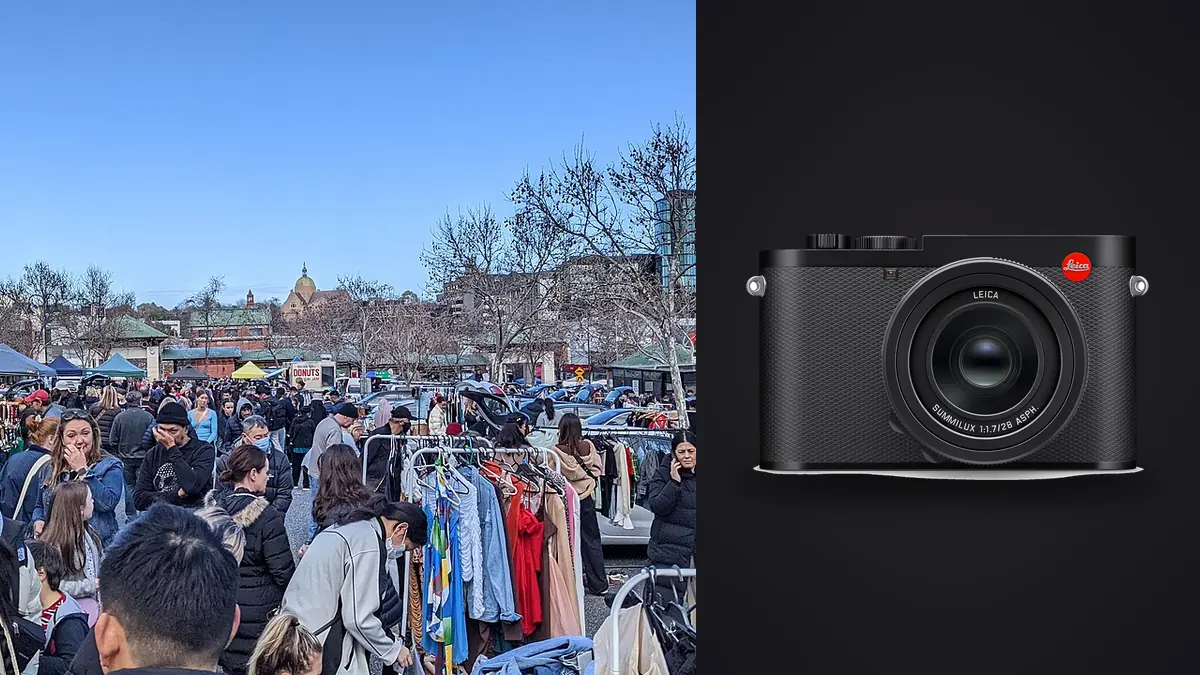
I spent four days in Lisbon last spring shooting nothing but the Leica Q3. No backup body, no second lens, just the camera and whatever pocket space I had left for spare batteries. That's the real test for a street camera, not a spec sheet comparison but whether you'd trust it alone through unpredictable light and unpredictable people for a week straight. The Q3 held up, though not entirely for the reasons I expected walking in.
Most of the discussion around this camera fixates on the 60 megapixel sensor and the redesigned autofocus, and both matter. But what actually changed how I worked was smaller than that: a tilting screen that let me shoot from the hip without guessing, crop modes that let me frame tighter without lying about what the lens was doing, and a leaf shutter quiet enough to work six feet from a stranger without announcing myself. None of that shows up cleanly in a comparison chart. It shows up in whether you get the frame.
A fixed 28mm forces a kind of honesty
People coming from a 35mm or 50mm street setup tend to find the Q3's native 28mm uncomfortably wide at first. I did too. A 28mm lens doesn't let you stand back and compress a scene the way a 50mm does, it makes you walk into it. You end up closer to your subjects than feels natural for the first few days, and closer than a lot of documentary photographers are used to being. That discomfort is the point. Josef Koudelka and Bruce Gilden both built careers on lenses that force proximity, and the Q3's 28mm Summilux does the same thing whether you like it or not.
What surprised me is how well the wide end serves documentary work specifically, as opposed to pure street photography. A protest, a market stall, a family argument spilling onto a sidewalk, these scenes usually have more going on around the main subject than a tighter lens wants to include. The 28mm keeps the surrounding context in frame: the placard behind the marcher, the second vendor haggling in the background, the neighbor watching from a doorway. That context is often what turns a decent street photo into a documentary photo that actually explains something.
Handling: the weight sits differently than the number suggests
On paper the Q3 is around 743 grams with the battery in, which sounds heavy for a fixed-lens compact next to something like a Ricoh GR IIIx. In practice it doesn't feel that way, because the weight is dense and centered rather than front-loaded like a mirrorless body with a lens hanging off it. I could carry it on a wrist strap for six or seven hours without the shoulder fatigue I get from an SL2 and a 35mm Summicron. It's a camera you can keep raised and ready between shots without your arm complaining.
The shutter you barely hear
The leaf shutter is the detail that actually changes documentary work day to day. There's no shutter slap, no mirror clunk, just a soft click that gets absorbed into street noise almost immediately. I shot a card game outside a cafe in Alfama from maybe eight feet away, twenty or thirty frames over ten minutes, and nobody at the table ever looked over. Try that with a DSLR's focal-plane shutter and you'll get noticed by frame three. It also means you can shoot wide open at f/1.7 in bright daylight without an ND filter screwed on, since the leaf shutter syncs to very fast speeds without the banding issues electronic shutters sometimes introduce under certain lighting.
Crop modes: reframing without pretending it's optical
The Q3's crop modes simulate 35mm, 50mm, 75mm and 90mm framing by cropping into the 60 megapixel sensor and showing you lines in the EVF or on the DNG preview. This is not the same as a zoom lens, and Leica doesn't pretend it is. What you're getting is a smaller slice of the same 28mm optical capture, with resolution dropping as the crop tightens. The reason this actually matters for documentary work, rather than being a gimmick, is that the file still holds real information at the wider crops. A 50mm-equivalent crop still gives you a usable file for a magazine spread or a decent print. That's not true of digital zoom on a phone or a bridge camera.
I use the crop lines mostly as a framing aid rather than committing to them. I'll set the EVF to show 50mm lines so I can pre-visualize a tighter composition, then shoot the full 28mm frame and decide in post whether the wide version or the crop tells the story better. On a couple of frames from a fish market in Setubal, the wide version included a woman laughing in the background that the 50mm crop would have cut out entirely, and that laugh made the photo. Shooting wide and deciding later cost me nothing in resolution and gave me the option.
| Crop Mode | Approx. Resolution | What It's Actually Good For | When I Skip It |
|---|---|---|---|
| 28mm (native, no crop) | ~60 MP | Full context shots, tight interiors, anything where the environment is part of the story | Never, this is the default |
| 35mm crop | ~37 MP | A slightly tighter frame that still reads naturally, good for portrait-in-environment | When the background clutter is doing real work |
| 50mm crop | ~19 MP | Isolating a single subject or gesture from a crowd scene, still enough resolution for print | Low light, since the effective aperture reach gets harder to nail focus on |
| 75mm crop | ~8 MP | Candid faces from across a square without walking in and breaking the moment | Anything meant for a large print or a magazine cover |
| 90mm crop | ~6 MP | Emergency reach when you genuinely cannot get closer | Basically always, unless there's no other option |
Autofocus finally keeps pace with the street
The Q2's contrast-detect autofocus was the one real complaint I had with that camera for fast documentary work, it hunted in low light and struggled with erratic subject movement. The Q3's hybrid phase-detection system is a genuine improvement. Eye detection locked onto a food vendor's face across a crowded stall in Lisbon's Time Out Market in a way the Q2 simply couldn't manage at that distance and that light level. It's not flawless. Dim interiors with mixed tungsten and daylight still cause the occasional hunt-and-miss, and I've had it grab a market awning instead of the person standing under it more than once.
For a lot of documentary street work I still fall back on zone focusing rather than trusting autofocus completely. The depth scale etched on the lens barrel lets you set focus manually to something like ten feet at f/8, and then anything from roughly seven to fifteen feet is acceptably sharp without the camera hunting at all. That's the old rangefinder discipline, pre-focus and wait for the subject to walk into the zone, and it still works better than autofocus in genuinely chaotic scenes, a crowd surging through a metro entrance for example, where there's no single face for the AF system to commit to.
Small things that either help you or wear on you
The Q3 dropped the Q2's manual macro-focus ring in favor of continuous focus that reaches down close without switching modes, which sounds like a minor convenience until you're photographing a hand-lettered sign or a torn poster on a wall and don't want to fumble with a barrel twist mid-scene. USB-C charging in the body is the other unglamorous win, one cable does the camera, my phone, and my laptop, which matters when you're traveling light for documentary work and don't want a bag full of proprietary chargers.
Battery life is the honest downside. CIPA rates it around 350 shots, and in practice, with the EVF on most of the day and a lot of chimping to check focus, I get closer to 250 to 300 real-world frames per charge. For a full day of documentary shooting I carry three batteries minimum. The single SD card slot is the other thing to plan around, there's no in-camera backup, so I offload cards more aggressively than I would with a dual-slot body, especially on a trip where losing a card means losing the day.
Where the Q3 sits against the other cameras I actually carry for this work
I get asked constantly whether the Q3 is worth it over a Fujifilm X100VI or a Ricoh GR IIIx for documentary street work, both of which I've shot extensively and both of which are a fraction of the price. Here's how they actually compare on the things that matter for this kind of shooting, not the full spec sheet.
| Camera | Street Price (body) | Native Focal Length | Shutter Character | Best Fit |
|---|---|---|---|---|
| Leica Q3 | ~$5,995 | 28mm f/1.7 | Near-silent leaf shutter, no slap | Long-term documentary projects where file quality and reach flexibility matter |
| Leica Q2 | ~$4,200 (used) | 28mm f/1.7 | Same leaf shutter, slower AF | Budget-conscious buyers who don't need the newer AF or tilt screen |
| Fujifilm X100VI | ~$1,600 | 35mm f/2 (APS-C) | Leaf shutter, near-silent, built-in ND | Daily-carry street work where a built-in ND and lower cost matter more than full-frame files |
| Ricoh GR IIIx | ~$1,050 | 40mm f/2.8 (APS-C) | Focal-plane shutter, audible click | Pure discretion and pocketability over image quality ceiling |
The honest answer is that the Q3 doesn't win on value, it wins on file quality and on a focal length that suits documentary context better than the X100VI's 35mm or the GR IIIx's 40mm. If your work leans toward tight portraits and quick grabs, the Fuji or the Ricoh will get you 90% of the result for a third of the price. If you need the environmental context of a true 28mm and you're printing large or licensing to publications that want resolution to spare, the Q3 earns its price in a way it doesn't for casual shooting.
What a week of Q3 files actually looks like afterward
This is the part nobody mentions in gear reviews. A week of documentary shooting on the Q3, burst-heavy because you're chasing decisive moments in crowds, generates an enormous number of 60 megapixel DNGs, often 70 to 90 megabytes each. From Lisbon I came home with just under 3,400 frames, a huge chunk of them near-duplicates from three or four frame bursts trying to catch a specific gesture or expression.
That volume is where the camera's strengths turn into a real workflow problem if you don't have a system for it. I run everything through imagic before I touch Lightroom, since its local sharpness and focus scoring will flag which frame in a six-shot burst actually has the crisp eye and which ones are a hair soft, which matters enormously on files this large where soft-focus mistakes are easy to miss on a laptop screen at 100% zoom. The duplicate and burst clustering groups those near-identical frames automatically so I'm not scrubbing through thirty visually similar shots of the same card game by hand. Because it processes everything locally on the machine rather than uploading anything, that also matters for documentary work where the subjects haven't necessarily consented to their images going anywhere before I've made an editing decision myself.
Once the culling pass is done, I lean on imagic's apply_my_style preset feature, trained on my own past edits rather than some generic filter, to get a consistent first pass across the whole set before I go in and hand-finish the frames I'm actually going to publish or submit. It's not a replacement for actual editing judgment, but it saves the tedium of re-establishing a baseline look on three thousand frames one at a time. If you want more detail on how the culling side of this actually works, I wrote about it separately in how AI photo culling works, and there's a broader rundown of speeding up the whole ingest-to-edit pipeline in 10 tips for a faster photo workflow.
Frequently Asked Questions
Is 28mm too wide for documentary street portraits with the Q3?
It's wider than most portrait-leaning street photographers are used to, but it's rarely a dealbreaker. You end up standing closer to your subject than a 35mm or 50mm would require, which changes the dynamic of the interaction (for better or worse depending on your comfort with proximity). The 50mm and 75mm crop modes give you a way to shoot tighter without carrying a second lens, though you're trading resolution to get there.
How does the Leica Q3's price actually hold up against a Fujifilm X100VI for this kind of work?
It doesn't, on pure value. The X100VI covers most documentary street scenarios at roughly a quarter of the cost, with a built-in ND filter the Q3 lacks entirely. The Q3's case is file quality, the 28mm focal length, and a leaf shutter with genuinely faster full-frame files behind it. If you're licensing images or printing large, that gap is real. If you're shooting for your own archive or social use, it's much harder to justify.
Can the Leica Q3 survive a rainy day of documentary shooting?
Leica doesn't publish an official IP rating for the Q3, and I treat it accordingly. I've shot it in light drizzle in Manchester without issue, and the body has improved gasket sealing over the Q2, but I wouldn't take it into sustained heavy rain the way I would a properly weather-sealed SL2 body. A rain cover is cheap insurance if you're planning to shoot outdoors documentary work through unpredictable weather for days at a stretch.
Is the autofocus reliable enough for fast-moving crowd scenes?
Mostly, yes, it's a real step up from the Q2. Eye and face detection lock quickly in decent light, even across a crowded market stall. It still occasionally grabs the wrong subject in low, mixed lighting or genuinely chaotic scenes with multiple moving faces. For those situations I fall back on zone focusing using the depth scale on the lens barrel, which is a more reliable approach than trusting AF in a scrum of moving people regardless of which camera you're using.