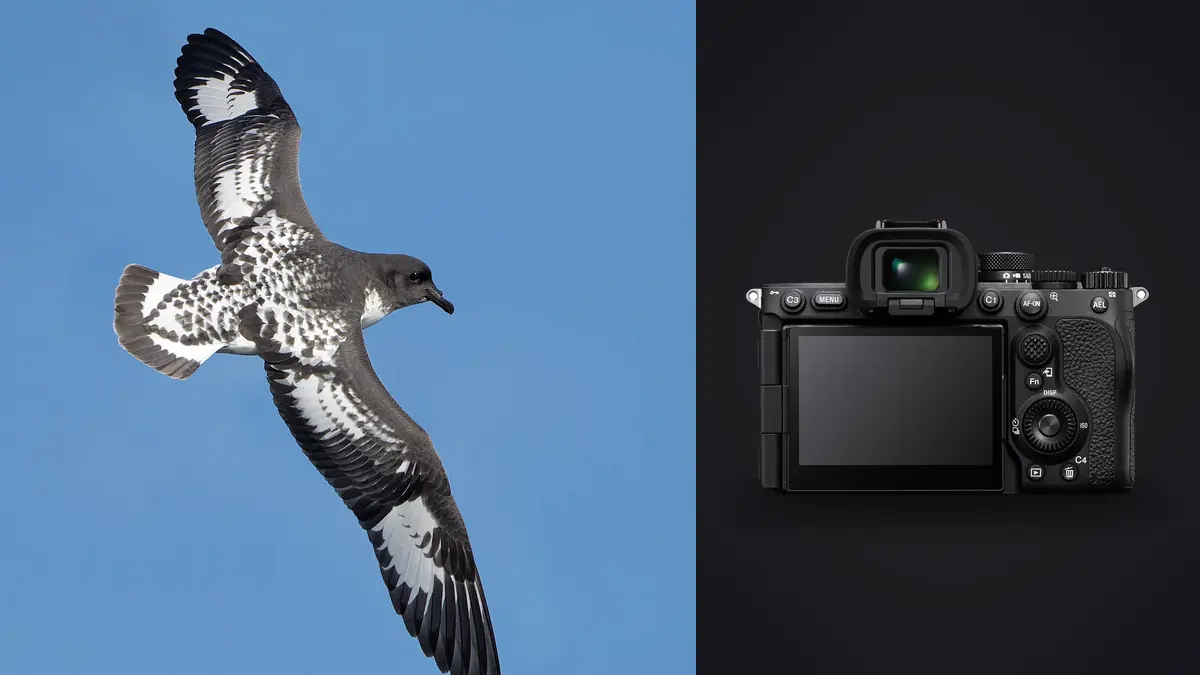
I spent three mornings in a row at a heron colony last spring trying to decide whether the Sony A7R V actually belongs in a bird-in-flight kit, or whether it is really a landscape and studio body that Sony's marketing has stretched to cover wildlife too. The short answer, after roughly 6,000 frames of herons, ospreys and one very uncooperative kingfisher, is that it belongs there conditionally. The sensor is not the same class of tool as a stacked-sensor sports body, and pretending otherwise will cost you frames. Once you understand where it actually struggles, it turns into one of the more usable high-resolution options for flight work that exists right now.
The sensor trade-off nobody puts on the box
The A7R V carries the same 61-megapixel back-illuminated sensor lineage as the A7R IV, not the stacked design Sony uses in the A1 or A9 series. That distinction matters more for birds in flight than for almost any other genre, because it changes how the camera reads out a fast-moving subject.
To hit the camera's top 10 fps you need the fully electronic (silent) shutter. The sensor readout on a non-stacked chip is slow enough that a bird crossing the frame at speed against a moving background, say you're panning to track a tern diving past a shoreline, will show a visible skew. Straight wingtips lean. Vertical elements in the background wobble. It's the same rolling-shutter artifact you'd see on a phone recording a fast pan, just less obvious because the subject usually has soft edges.
Switch to mechanical or electronic front-curtain shutter and that skew mostly disappears, but you give up frame rate, closer to 7 fps than 10. For perched birds, slow soaring raptors riding a thermal, or anything where the bird isn't crossing the frame edge to edge in under half a second, the mechanical shutter is the better default. I only reach for full electronic when I specifically need the extra two or three frames per second and I'm tracking something moving mostly toward or away from me rather than laterally, where the skew is far less visible.
Bird-detect autofocus, and where it actually breaks
The AI-driven subject recognition on this camera is genuinely good at identifying a bird's head and eye once that bird occupies a reasonable chunk of the frame, roughly the size of a golf ball held at arm's length against your monitor, as a rough working rule. Below that, at distance, on a small wader working a mudflat 40 meters out, the system starts to hunt between the bird and background clutter, and confidence markers on the tracking box will flicker.
My workaround, and this took longer to settle on than I'd like to admit, is to not fight the camera at long range. I set one custom button to bird/animal-eye tracking and a second to a plain small Zone or Spot area with no subject recognition at all. Distant, small birds get the manual zone. Once the bird is closer, or the behavior changes (a heron lifting off, an osprey folding into a dive), I switch to the eye-tracking button and let the AI take over for the part of the sequence where it actually has enough pixels on the subject to work with. Trying to force eye-AF on a speck against open sky just burns frames on a soft-focused background.
Settings I actually change before a session
Out of the box the AF-C Wide tracking sensitivity sits around the middle of its range, tuned for a subject that moves somewhat predictably. Birds don't. A gull can be flying a straight line one second and cut sideways into the wind the next, so I push tracking sensitivity toward the sticky end, closer to 5 than 3, which keeps the focus box committed to the bird through those direction changes instead of jumping to whatever crosses behind it. It costs a little responsiveness if the subject genuinely does change to something else, but for flight work that trade is worth it far more often than not.
Back-button focus is non-negotiable for how I shoot herons and ospreys specifically, because so much of the interesting behavior starts from a perch. I'll pre-focus on a bird sitting in a snag, take my thumb off the AF button, and just wait, recomposing slightly with the shutter half-press doing nothing to the focus. The moment it lifts off, one press of the thumb button re-engages tracking without the camera first re-hunting across the whole tree the way it would if focus and shutter were tied together.
I also shoot manual exposure with Auto ISO rather than any of the automatic scene modes, with the ISO ceiling set high, around 12800, for the first hour after sunrise when the light is still weak but the birds are most active, then pulled back down to 6400 once the sun is properly up. At 61 megapixels, noise shows up earlier than it did on my old 24-megapixel body, so I'd rather cap the ISO deliberately than let the camera choose and end up with grain in the shadows on a file I can't crop as aggressively as I'd planned. Last thing worth doing: assign the APS-C crop toggle to a custom button rather than leaving it buried in a menu page. Being able to punch into crop mode mid-sequence, the moment a bird that was too far away suddenly banks closer, has saved more than a few shots that a menu dive would have missed entirely.
Frame rate and buffer: the part that actually limits your day
Ten frames per second sounds competitive on paper, and it is, but a 61-megapixel RAW file is a heavy thing to move through a buffer. Shooting lossless compressed RAW at Hi+ in full-frame mode, I get somewhere in the neighborhood of 80 to 90 frames before the buffer chokes and the frame rate drops off a cliff, which at 10 fps is under nine seconds of continuous shooting. For a heron take-off sequence that's usually enough. For a prolonged osprey hunting pass where the strike could come at second four or second fourteen, it isn't, and you learn to trigger bursts in short, deliberate pulses rather than holding the shutter down and hoping.
Switching to APS-C crop mode helps in two ways at once. First, the smaller sensor readout area reduces the rolling-shutter skew even in full electronic shutter, so you can use the faster mode with less of the wobble described above. Second, the files drop to roughly 26 megapixels, which fills the buffer more slowly and gives you a longer effective burst. The trade is obvious (less resolution, tighter framing margin) but for anything already reaching the end of a long lens, the crop mode is also just extra effective focal length for free.
Card choice matters more here than on most bodies. The A7R V uses CFexpress Type A, which is a slower, more expensive standard than the Type B cards used in Sony's flagship sports bodies. Buy the fastest Type A card your budget allows, because a slow card doesn't just extend your write time after a burst, it can shorten how long the buffer holds up during one.
| Shutter / crop setting | Practical frame rate | File size | Rolling-shutter skew | Where I actually use it |
|---|---|---|---|---|
| Mechanical shutter, full frame | ~7 fps | 61 MP | Minimal | Perched birds, slow soaring, deliberate single-frame work |
| Electronic front curtain, full frame | ~8 fps | 61 MP | Low, mostly unnoticeable | Take-off and landing sequences at moderate speed |
| Fully electronic (silent), full frame | 10 fps | 61 MP | Visible on fast lateral crossers | Head-on approach shots, quiet hides where shutter noise matters |
| Fully electronic, APS-C crop | 10 fps | ~26 MP | Reduced versus full-frame e-shutter | Fast lateral flight, extra reach with existing glass |
Lenses that make sense on this body
The FE 200-600mm F5.6-6.3 G OSS is the lens I see paired with this camera most often, and for good reason: it's the affordable long option in Sony's native lineup and it resolves well enough to do the 61-megapixel sensor justice at the long end. One thing worth knowing before you buy: Sony does not list this lens as teleconverter-compatible, so don't plan on stretching it further with a 1.4x. If you need more reach than 600mm delivers, the APS-C crop trick above (giving you an effective 900mm field of view) is the more realistic path than chasing a teleconverter that isn't officially supported.
For anyone running the 400mm f/2.8 GM or 600mm f/4 GM, both officially support the 1.4x and 2x teleconverters, and the extra light-gathering makes autofocus tracking noticeably more confident in low dawn light, which is when a lot of interesting flight behavior actually happens. The trade-off is weight. A 61-megapixel sensor amplifies handheld shake more visibly than a lower-resolution body would at the same shutter speed, so I've had to be stricter with myself on minimum shutter speed than I was with previous cameras: 1/2000s or faster for small, fast-wingbeat birds like terns or swallows, 1/1600s as a floor for something as large and slow-flapping as a heron or osprey. The 8-stop in-body stabilization helps with static long-lens work, but it does nothing for subject motion blur, which is the more common failure mode in flight shots anyway.
Battery life is the other quiet cost of a heavy telephoto session. Sony rates the NP-FZ100 at roughly 530 shots on the EVF, but that figure assumes normal temperatures and a fair amount of the camera idling between frames. On a cold dawn at a wetland, with the EVF running most of the session and a lot of half-press tracking that never fires the shutter, I burn through a battery well before that number and carry three spares for a full day rather than the one or two I used to get away with on lighter bodies.
Getting from a full card back to a finished set
A single good morning at that heron colony filled a 160GB card with just under 3,000 RAW files, and at 61 megapixels each, that's not a folder you want to click through one by one in a standard catalog viewer while it renders full-resolution previews. This is where I actually rely on imagic rather than my usual editing software for the first pass. It scores sharpness locally, per file, based on actual edge contrast rather than just flagging anything the camera marked as in-focus, which matters a lot when half your keepers have the bird's eye sharp and the wingtip slightly soft from motion, and the other half are the reverse.
The burst clustering is the bigger time saver on a day like that one, honestly. A ten-second flight sequence at 10 fps is a hundred nearly identical frames, and imagic groups those automatically instead of leaving me to scroll through them manually, surfacing the two or three frames per burst actually worth a second look. It runs entirely on the laptop, no upload queue for gigabytes of RAW files over hotel wifi, which matters more with 61-megapixel originals than it ever did with my old 24-megapixel body. If you haven't looked at how that scoring approach differs from a basic focus-point overlay, our piece on how AI photo culling actually works goes into more of the mechanics.
Once the culling pass is done, I lean on imagic's apply_my_style preset to carry my usual wildlife grade (slightly cooler shadows, warmer highlights, not much else) across the whole surviving set without re-building the same adjustment from scratch for every session. It was trained on edits I'd already delivered, so it's matching a look I'd already committed to rather than guessing at one. For anyone trying to tighten up the rest of the pipeline beyond just the culling step, our broader workflow guide covers the parts of the process this article doesn't.
Frequently Asked Questions
Is the Sony A7R V too slow for serious birds-in-flight work?
Not too slow, but not effortless either. 10 fps with a fast-clearing buffer would be ideal; this camera gives you 10 fps with a buffer that empties in under ten seconds of continuous full-frame shooting. Treat it as a camera that rewards short, well-timed bursts rather than one you hold down and hope with, and it performs well. Treat it like an A9 III and you'll be frustrated by frame 90.
Should I shoot fully silent electronic shutter for flight sequences?
Only when the bird is moving mostly toward or away from you rather than crossing the frame laterally. For fast lateral flight against a busy background, the rolling-shutter skew from the non-stacked sensor becomes visible enough to ruin otherwise sharp frames. Mechanical or electronic front-curtain shutter avoids it at the cost of two to three frames per second.
Does the APS-C crop mode actually hurt image quality for distant birds?
Less than you'd expect. You're trading roughly 61 megapixels for 26, which is still a perfectly usable file size for most print and web use, and you gain both extra effective focal length and reduced rolling-shutter skew in electronic shutter mode. For subjects already at the edge of your lens's reach, it's a reasonable trade rather than a compromise.
What memory card do I actually need for this body?
Buy the fastest CFexpress Type A card you can justify. It's the only card standard this body accepts at full speed, it's slower and pricier than the Type B cards used in Sony's sports-focused bodies, and a slow card will shorten your effective buffer during a burst, not just your write-out time afterward.