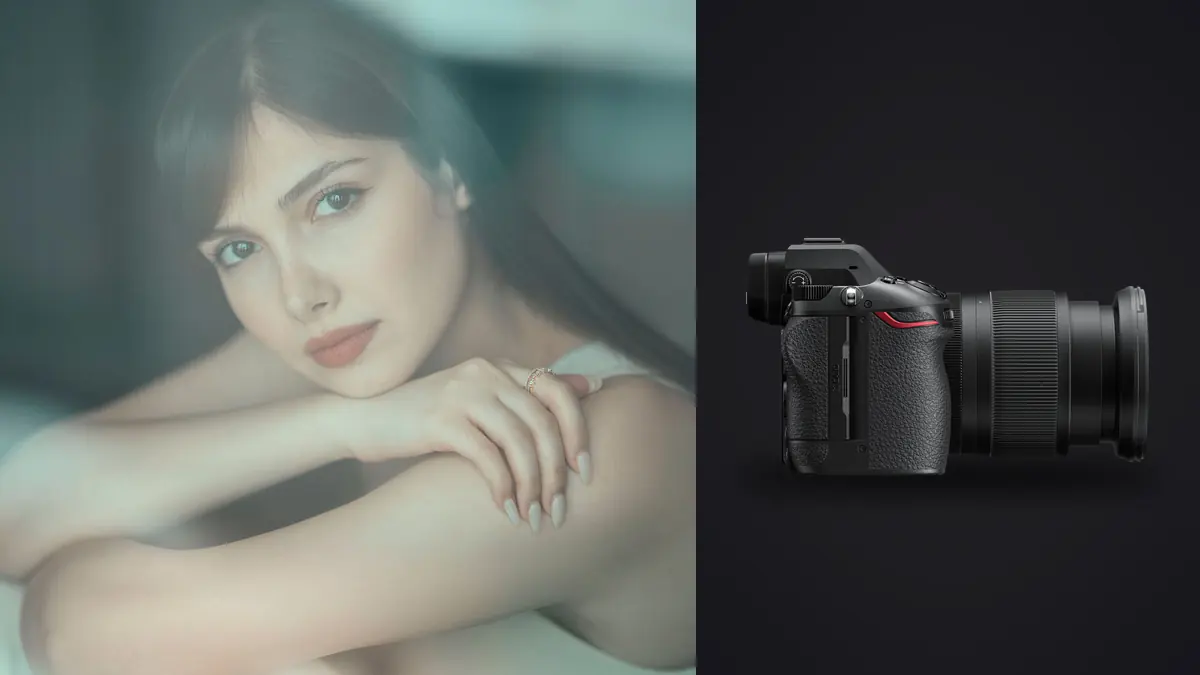
I picked up a Z6 III the week it shipped because I wanted a camera that could keep up in a dim hotel suite without sounding like a machine gun every time my subject moved. Two years later, it's still the body I reach for first, and not for the reasons most reviews lead with. Resolution and burst rate matter far less here than sensor readout speed, viewfinder brightness in a dark room, and how quiet the shutter can go without me having to think about it.
The sensor readout is the feature that actually changes how you shoot
Nikon calls the Z6 III's sensor "partially stacked," which is marketing language for a chip that reads out roughly three and a half times faster than the plain BSI sensor in the Z6 II. In practice that means almost no rolling shutter skew when a subject shifts weight or turns toward a window mid-exposure, which happens constantly in boudoir work because nobody holds a pose for more than two or three frames before adjusting. It also means the electronic shutter is finally usable as a default rather than a fallback for silence. I shoot fully electronic for probably 80% of a boudoir session now, and I stopped worrying about the warped-blind artifacts that made older mirrorless bodies unreliable in fast electronic mode.
The other quiet win is the viewfinder. At 4000 nits it stays legible in rooms lit by a single bedside lamp or a sliver of curtain-filtered window light, conditions where I used to have to boost the EVF gain and accept a grainy, laggy preview on other bodies. Being able to trust what I see through the finder in a dim room means fewer test shots, which matters a lot when the subject is self-conscious and every pause to chimp the LCD breaks the mood you spent twenty minutes building.
Shooting the light you're actually given, not the light you'd choose
Almost no boudoir client wants three strobes and a ten-foot octabox in her bedroom. Most of what I shoot is window light, a couple of continuous LED panels bounced off a wall or ceiling, and whatever practical lamps are already in the room. That means I'm living in the ISO 800 to 6400 range constantly, and the Z6 III's noise floor at those settings is clean enough that I can push exposure in post without the shadows turning to mush, which matters because boudoir shadows carry a lot of the mood and I don't want to crush them flat to hide grain.
Here's roughly what I dial in depending on the light source, based on actual sessions rather than a spec sheet:
| Light source | Typical aperture | Shutter speed | ISO range | Notes |
|---|---|---|---|---|
| North-facing window, overcast day | f/1.8-f/2.2 | 1/125-1/200 | 800-2000 | Soft, forgiving. My default for most shoots. |
| Direct afternoon sun through sheer curtain | f/2.8-f/4 | 1/250-1/500 | 100-400 | High contrast, need to watch highlight clipping on skin. |
| Single bedside lamp, room lights off | f/1.2-f/1.4 | 1/60-1/100 | 3200-6400 | IBIS carries the shutter speed; wide lens aperture does the rest. |
| Two LED panels, bounced off ceiling | f/2-f/2.8 | 1/125 | 400-1250 | Most controllable option, but least "found" looking in the gallery. |
| Golden hour, backlit through blinds | f/1.8 | 1/200-1/320 | 100-200 | Silhouette and rim-light shots live here. |
What makes that lamp-only row workable at all is the in-body stabilization. Nikon rates it up to eight stops with certain S-line lenses, and while I don't trust the marketing number literally, I can reliably hand-hold a 50mm at 1/60 or even 1/40 and get sharp frames maybe eight times out of ten, which is a real change from the Z6 II. That's the difference between asking a subject to hold dead still under a tripod-mounted setup and letting her move naturally while I follow with the camera, and the second option produces better expressions every time.
Which lenses actually earn their keep
I own five Z-mount lenses and use three of them for boudoir. The Z 50mm f/1.2 S is my most-used lens for this genre by a wide margin, not because f/1.2 is dramatically better than f/1.4 for subject separation, but because the focus breathing and rendering at close range on skin is the smoothest of anything in my bag. The Z 85mm f/1.2 S comes out for tighter, more editorial-feeling frames, usually from across the room so I'm not looming over someone in an already vulnerable setting, which matters more in this genre than people who haven't shot it tend to assume. The Z 35mm f/1.4 handles environmental shots, the ones that show the whole room, the unmade bed, the light coming through the window, that a client often wants alongside the tighter portraits.
I tried the 24-70mm f/2.8 S for a stretch to save lens changes mid-session and gave up on it after three shoots. It's an excellent lens on paper, but a zoom held up in front of someone's face reads as clinical in a way a fixed 50mm doesn't, and boudoir clients notice that difference even if they can't articulate why. If you're building a kit around this body specifically for intimate portrait work, I'd put the budget into one fast prime before a do-everything zoom.
Silence is not a nice-to-have in this genre
The mechanical shutter on the Z6 III is quieter than most DSLRs but still audible, a distinct clack that in a small bedroom is loud enough to make a nervous first-time subject flinch. Full electronic shutter drops that to nothing. I switch to it specifically for the first ten minutes of any session with a subject who's clearly anxious, because removing the sound of the camera removes one more thing reminding her she's being photographed. Once someone relaxes into the shoot I'll sometimes switch back to mechanical or electronic front curtain for flash-lit frames, since the fully electronic mode caps flash sync in a way that doesn't matter for available light but does if you're popping a single speedlight through a scrim for fill.
The tradeoff nobody mentions in spec sheets: silent shooting means you lose the audible cue that tells a nervous subject when the frame was actually taken, which occasionally means she holds an expression a beat too long waiting for a shutter sound that never comes. I've started narrating "got it" quietly after frames I like, which sounds small but noticeably changes how people move through a silent-shutter session.
What a real session actually generates, and why that's a culling problem
A typical two-hour boudoir booking with two or three outfit changes produces somewhere between 900 and 1,600 frames once you count burst sequences from movement-heavy poses. That volume is the actual bottleneck in this work, more than any camera spec. Most of those frames are near-duplicates: the same pose across a five-frame burst, differing only in whether an eye is fully open or a hand is mid-motion. Sorting that by eye alone at midnight after a shoot is how you end up delivering a gallery three weeks late.
This is where I stopped trying to cull manually and started running everything through imagic first. It groups those burst sequences and near-duplicate frames locally on my machine, no upload step, which matters a lot for this genre specifically since these are images I would never want touching a cloud server regardless of what the terms of service promised. It scores sharpness and focus within each cluster so I'm not squinting at a laptop screen at 1am trying to tell which of six nearly identical frames is actually the sharpest one on the eyes. What used to take me most of an evening now takes closer to forty minutes, and I get to spend the time I got back on the actual edit instead of the sorting. If you shoot volume-heavy sessions and haven't looked at how automated culling handles burst clustering, it's worth understanding what's actually happening under the hood before you trust it with client work.
Editing for consistent skin tone across a whole gallery
Boudoir delivery lives and dies on skin tone consistency. A gallery where frame twelve looks warm and flattering and frame thirteen looks slightly green or blotchy reads as amateur even if both frames are individually well exposed. I built out a set of edits on a handful of my strongest past sessions and used imagic's apply_my_style feature to learn from those specific edits rather than a generic preset pack, so new galleries land close to my established look on the first pass instead of needing frame-by-frame correction. It's not magic, mixed lighting sessions like the lamp-and-window combo still need manual adjustment on individual frames, but it cuts the baseline editing pass down considerably and keeps my look consistent from one session to the next.
Where the camera still falls short for this work
Battery life is the honest complaint. A two-hour session with the EVF running near-constantly at high brightness and IBIS active the whole time will eat through a battery faster than the CIPA rating suggests, and I now carry two spares as a matter of routine rather than backup. The articulating screen is also a smaller win here than in other genres, since I'm rarely shooting from odd angles that need it, though it's genuinely useful for the low, shooting-up-toward-window-light angle that shows up a lot in this kind of work. And the card door, while weather sealed well, is stiff enough that I've fumbled it more than once trying to do a quick card swap between outfit changes without breaking conversation with the subject.
Frequently Asked Questions
Is the Nikon Z6 III overkill for boudoir compared to something like the Z6 II?
Not overkill, but the upgrade is genuinely felt more in low light and available-light sessions than in studio-lit ones. If you're shooting boudoir almost entirely under strobes or consistent LED setups, the Z6 II will get you very close results for less money. The Z6 III earns its price difference specifically in mixed and dim available light, which is where most boudoir actually happens in my experience.
Do I need f/1.2 lenses for this genre, or is f/1.8 enough?
f/1.8 is enough for most sessions and will save you real money. The f/1.2 lenses earn their keep specifically in the lamp-only, room-lights-off scenario where every fraction of a stop buys you a cleaner ISO. If you're mostly shooting near a window with decent ambient light, an f/1.8 prime will do the job at a third of the cost.
How do you handle client privacy with a camera this connected to apps and cloud services?
I keep the camera's own Wi-Fi and SnapBridge features off entirely during and after boudoir sessions, and I don't run these galleries through any cloud-based culling or editing tool. Everything from the initial cull through the final edit happens on a local machine that isn't networked to anything during that process, which is a large part of why I moved my culling workflow to a tool that processes locally rather than one that requires an upload step.
What's the biggest mistake photographers make shooting boudoir with a camera like this?
Over-relying on the high ISO ceiling instead of controlling the light. The Z6 III will give you a usable file at ISO 12800, but a usable file isn't the same as a flattering one. I'd rather add one cheap continuous light bounced off a wall and shoot at ISO 1600 than lean entirely on the sensor's low-light headroom and end up with flat, grainy skin tones I have to fight in the edit.