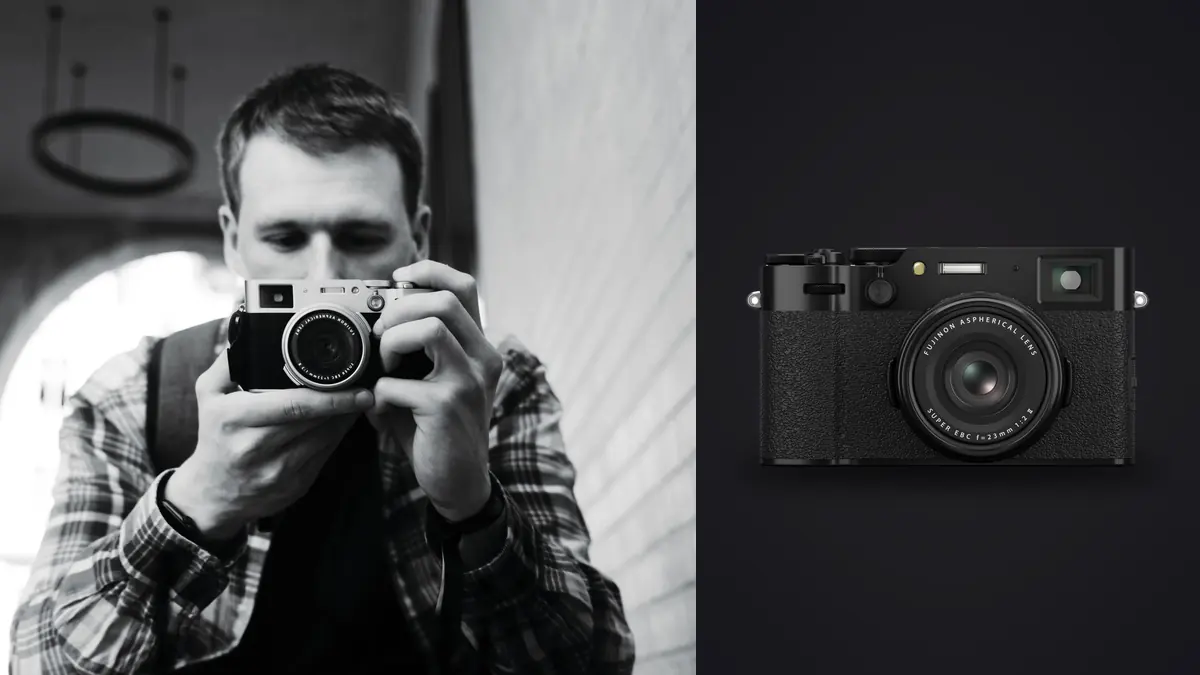
The Fujifilm X100VI and X-T5 share a 40.2-megapixel APS-C sensor generation, yet they encourage very different travel habits. The X100VI is a fixed-lens camera built around a 23mm F2 lens, approximately a 35mm-equivalent field of view. The X-T5 accepts X-mount lenses and provides two UHS-II SD card slots. One removes lens decisions and keeps the kit compact; the other lets the assignment determine focal length and adds a more flexible card strategy.
Fujifilm's official product specifications, checked on 15 August 2026, confirm the shared effective pixel count, the X100VI's fixed lens and single UHS-I-compatible slot, and the X-T5's interchangeable mount and dual UHS-II slots. Manufacturer stabilization claims are measured under stated test conditions and should not be treated as guaranteed handheld shutter speeds. The useful comparison is how each body changes movement, attention, backup, and the edit.
Decide whether one field of view is freedom or friction
The X100VI's 23mm lens frames like a moderate wide angle on APS-C. It can include context without the exaggerated edges of an ultra-wide lens, and it supports environmental portraits, markets, interiors, street layers, and everyday documentation. A fixed lens also makes packing and camera readiness simple. There is no lens-change pause, no second focal length to debate, and less equipment to expose in a busy public place.
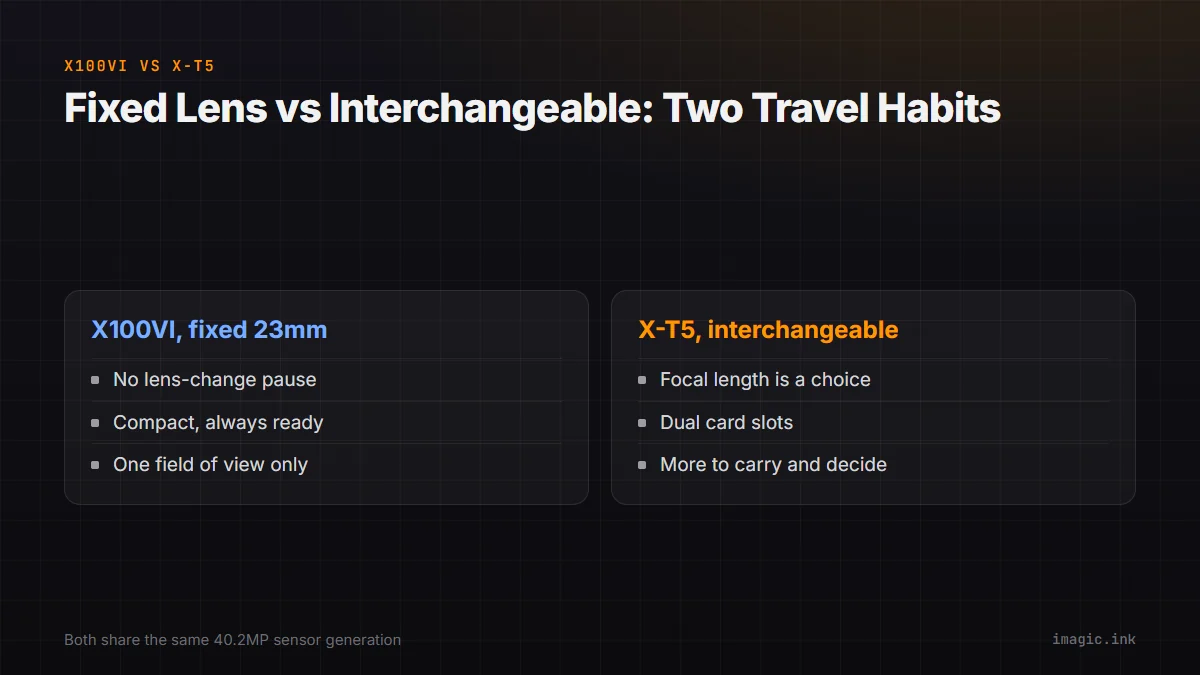
That simplicity is restrictive when the subject cannot be approached, perspective needs to change, or a scene demands optical reach. Cropping changes framing but not camera position or perspective. It also spends resolution. A distant architectural detail, compressed mountain layer, stage performance, or wildlife encounter can exceed what the fixed lens reasonably covers. Digital crop modes may help visualization and convenient output, but they do not create a longer physical lens.
The X-T5 makes focal length an explicit part of the plan. A compact prime can keep it discreet, a standard zoom can cover changing situations, and a telephoto can solve distance. The cost is a larger decision tree, more pack volume, possible lens changes, and a greater temptation to carry options that never leave the bag.
Build the kit from subject distance
List the trip's non-negotiable pictures. If they are people within conversational distance, street scenes, meals, transit, interiors, and broad travel context, the X100VI's fixed view may cover most of the brief. If they include birds, distant details, sports, compressed landscape, or formal portraits with controlled perspective, the X-T5 has the clear structural advantage.
For the X-T5, assign each lens a job. One small prime can mimic the discipline of a fixed-lens camera. A compact standard zoom can reduce lens changes when dust, rain, or crowds make them awkward. A longer lens should be packed only when the itinerary presents a recurring distant subject. Carrying three overlapping zooms for a trip centered on walking streets adds weight without necessarily adding pictures.
For the X100VI, plan physical distance and access. Ask whether stepping closer is respectful, legal, and safe. In street photography, a wider field can invite context but also clutter. In a small interior, it can be ideal. At a guarded overlook, behind a barrier, or across water, no amount of discipline replaces reach.
Compare handling in real travel conditions
A compact camera has value only if it is carried and ready. Consider how the body fits under a jacket, in a small insert, or on a strap during a full walking day. Check whether controls can be changed with the gloves, eyesight, and pace expected on the trip. A camera that is discreet in a cafe may still be awkward when a filter adapter, hood, grip, and spare accessories are attached.
The X100VI offers a hybrid viewfinder concept that can support either an optical-style view or an electronic preview, depending on working preference. The X-T5 uses an electronic viewfinder and conventional interchangeable-lens body layout. Neither approach is universally faster. The choice depends on whether the photographer values seeing beyond a frameline, previewing exposure and color, or maintaining a consistent finder experience across lenses.
Control familiarity matters more than romantic ideas about street cameras. Configure autofocus area, subject detection, shutter mode, exposure compensation, and a quick method for returning to a known state. Practice the change from a static storefront to a moving cyclist without looking at the camera. Travel produces fewer missed frames when the body disappears operationally.
Treat weather resistance as a system
Weather resistance is not waterproofing. Body seals, lens construction, adapters, filters, open doors, card changes, and handling all affect exposure to rain, dust, salt, and condensation. Fujifilm describes weather-resistant characteristics with conditions and compatible components, so check the exact official guidance for the intended configuration rather than assuming a body name protects every attachment.
The X-T5's interchangeable mount creates a vulnerable moment during a lens change. Reduce changes in blowing dust, spray, or heavy rain, and orient the mount carefully when a change is unavoidable. The X100VI removes that mount-opening risk but still has moving controls, ports, a lens mechanism, and accessories that need sensible protection. A small rain cover and dry cloth weigh less than a damaged travel day.
Condensation deserves a plan when moving between cold streets and heated interiors. Keep the camera contained while it warms gradually, and avoid opening card or battery doors while moisture can form. Salt spray should be removed according to manufacturer care guidance, not rubbed across glass or finish with a dry, gritty cloth.
Understand the card and backup difference
The X100VI records to one SD card slot with UHS-I support. A single slot is not automatically unreliable, but it does remove the option for simultaneous in-camera duplication. The X-T5's two UHS-II-compatible slots can be configured for backup, sequential capacity, or format separation according to the manual. The correct setting depends on whether redundancy, capacity, or a fast JPEG handoff matters most.
Travel backup should not depend solely on card-slot count. Copy each card to primary storage, verify it, and make an independent second copy. Keep those copies in different bags or with different responsible people when practical. Do not format a card merely because a file browser shows a folder; verify file counts and open representative RAW files first.
A one-slot camera benefits from smaller rotation sets and more frequent confirmed copies. A two-slot camera still needs off-camera backup because both cards share the same body and can be affected by loss, damage, or configuration mistakes. Card redundancy addresses one failure class, not the entire trip.
Use stabilization without confusing subject motion
Both cameras include in-body stabilization, but the practical benefit varies with lens, direction of movement, technique, and test standard. Stabilization can help keep a static wall, room, or dusk landscape steady at a slower shutter. It cannot freeze a walking subject, turning head, moving vehicle, or wind-blown fabric. For street work, shutter speed should first satisfy subject motion, then ISO and aperture can be balanced around it.
High pixel density also makes small focus and motion errors easy to inspect. Do not choose a marginal shutter speed solely because stabilization exists. Make a short sequence if a static low-light scene matters, brace carefully, and inspect at useful output size. For moving subjects, use the cadence needed to catch expression or stride without holding the shutter through unimportant seconds.
Electronic shutters can be quiet, but fast motion and artificial lighting can create distortion or banding. Mechanical operation may be the safer default in uncertain LED environments. Test a representative sign, train, fan, or straight moving edge before an important sequence.
Plan color and RAW flexibility before departure
Fujifilm film simulations can provide a coherent JPEG look and a useful preview, but they should be selected for the story rather than changed randomly at every stop. Decide whether the trip is delivering camera JPEGs, RAW files, or both. If rapid sharing matters, create a controlled recipe and test skin, foliage, mixed light, and saturated signs before relying on it.
RAW preserves more adjustment latitude, yet consistency still begins in camera. Use a stable white-balance strategy, avoid unnecessary shifts in highlight and shadow settings, and record any intentional departure. When two bodies are mixed, photograph the same neutral subject under the same light to simplify later matching.
The fixed lens can make an X100VI series feel visually unified because perspective choices stay within a narrow family. The X-T5 can produce an equally coherent set if lens changes serve a defined narrative. A gallery becomes fragmented when focal length, color, and viewpoint change without purpose, not simply because the lens can be removed.
Cull for travel sequence, not isolated technical winners
A useful travel edit includes transitions, context, details, people where permitted, establishing frames, and visual pauses. The sharpest photograph of every stop may still produce a repetitive gallery. First group similar moments, then choose the frame with the strongest relationship among gesture, background, edge control, and story. Preserve an alternate only when it offers a genuinely different crop or use.
imagic can scan a copied directory and locally analyze sharpness, exposure, closed eyes, composition, and near-duplicate or burst groups. The cull changes status without deleting original files, so automated organization can remain reversible. The desktop workflow is relevant for private offline review, and the Camera Hardware section covers other body and lens decisions.
Keep JPEG and RAW pairs associated, and do not separate a panorama or exposure sequence during the first pass. A chronological contact sheet can reveal gaps that a rating-only view hides. If the edit contains five distant facades but no street-level transition, the problem is narrative coverage rather than camera specification.
Choose based on the pictures that cannot be negotiated
The X100VI fits a trip where compactness, one familiar moderate-wide view, quiet observation, and reduced equipment decisions are priorities. It asks the photographer to solve compositions by moving, waiting, layering, or accepting that some distant subjects are outside scope. That constraint can strengthen a personal project when it is chosen consciously.
The X-T5 fits work where lens choice, dual-card options, subject distance, or assignment variety cannot be reduced to one field of view. It can still be a small street camera with one prime, then become a landscape or telephoto body when the itinerary changes. Its flexibility pays only when the chosen lenses are carried and used.
Before buying, borrow or rent the likely configuration and complete a full walking day. Include transit, a meal, rain protection, a low-light scene, card copying, RAW review, and the final output. The better body is the one that stays available while producing the non-negotiable pictures, not the one with the longer feature list.
Frequently asked questions
Can the X100VI replace an X-T5 travel kit?
Yes, when a 23mm fixed lens covers the intended subjects and one card slot fits the backup plan. It cannot replace optical reach or interchangeable-lens perspective for every itinerary.
Does the X-T5 have to be a large travel setup?
No. Pairing it with one compact prime can keep the kit restrained while preserving the option to change lenses later. Body size is only part of the carried system.
Which camera is better for quiet street photography?
Both offer discreet ways of working, subject to shutter and lighting constraints. The better choice depends on preferred finder, focal length, handling, and whether electronic-shutter artifacts are acceptable in the scene.