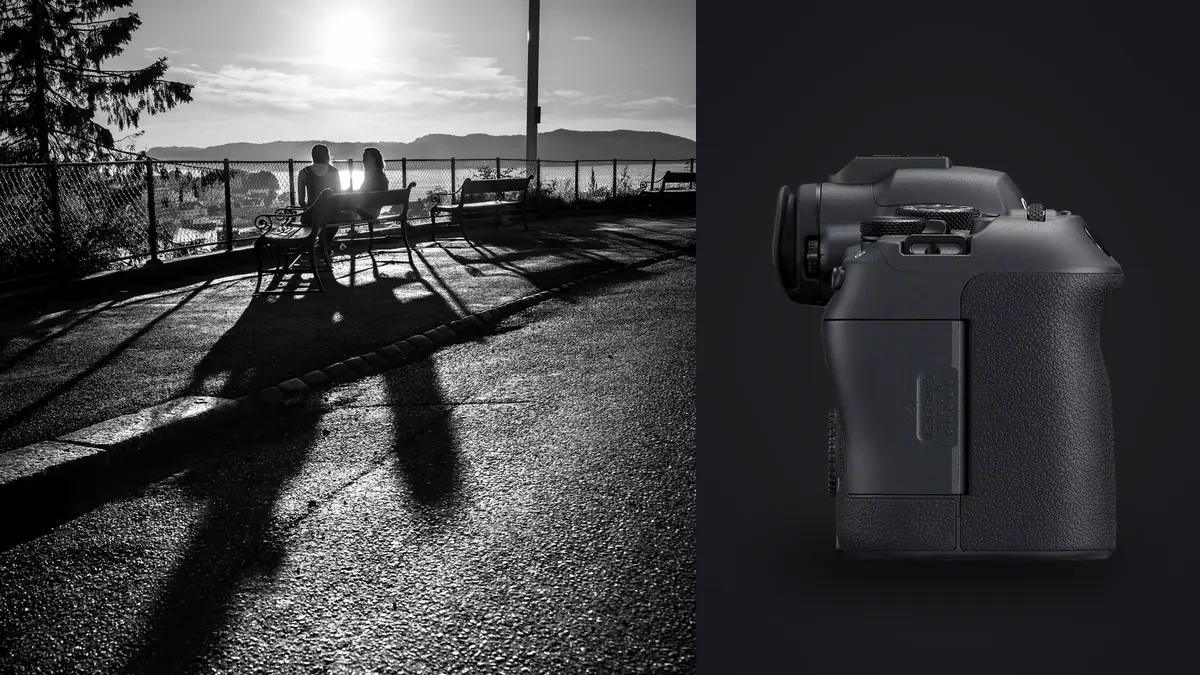
I picked up the R6 Mark II expecting a video-first hybrid that would feel like a compromise for anything I actually shoot on the street. That is not what happened. Six months of using it for street and documentary work later, it has become the camera I reach for when I do not know what the next hour is going to throw at me, which is the entire premise of street and documentary photography.
Autofocus that keeps up with a moving street
Street work punishes autofocus systems in a specific way: subjects are erratic, they cross other people, they change direction, and you often do not get a second attempt. The R6 II's Dual Pixel CMOS AF II is genuinely good at tracking a person through a crowd once you lock onto them with a half-press or back-button tap. Eye and face detection holds on surprisingly well even when a subject turns three-quarter profile or ducks behind a market stall for a second, which happens constantly if you are working a busy pedestrian street.
What actually changed my hit rate was switching from single-point AF (my old habit from a DSLR) to Whole Area AF with subject detection set to "people" and letting the camera pick the eye. I was fighting the system for years, moving a focus point around by joystick while a subject moved faster than I could react. On the R6 II, that fight mostly goes away. It is not flawless: in dense crowds with multiple faces at similar distances it will occasionally jump to the wrong person, and low-contrast subjects in flat winter light slow it down slightly. But for a body in this price range, it outperforms every mirrorless camera I owned before it.
Shutter modes and staying invisible
Documentary work often depends on not being noticed, or at least not being noticed until the moment has already happened. The R6 II gives you three real shutter options, and picking the wrong one for a given scene will cost you shots you cannot get back. Here is how I actually use each one when shooting.
| Shutter mode | Max frame rate | Sound | Rolling shutter risk | Where I use it on the street |
|---|---|---|---|---|
| Mechanical | 12 fps | Audible click, moderate volume | None | Fast panning shots, flash work, anywhere a slight click won't blow the moment (traffic noise, markets) |
| Electronic first-curtain | 12 fps | Quieter than mechanical, still audible | Low | Interiors, cafes, transit, situations where I want a middle ground without full silence |
| Fully electronic | up to 40 fps | Completely silent | Noticeable on fast horizontal motion (cyclists, passing cars) or hard panning | Close, candid faces, religious sites, funerals, courtrooms, anywhere sound would be a problem |
The rolling shutter warping in fully electronic mode is real but overstated in most online discussions. It shows up when you pan hard on a fast-moving subject, a cyclist cutting across your frame at close range being the classic case, where verticals in the background will skew. For a stationary photographer shooting people walking toward or past them at normal pace, I have never had it ruin a frame. I also keep anti-flicker shooting on by default now, because LED shop signage and modern streetlights will band your frames in electronic mode at the wrong shutter speed, and I learned that the hard way on a night market shoot in Lisbon where half a card's worth of frames came back with visible horizontal bands.
Low light without giving up the shutter speed you need
Documentary work rarely happens in good light on your schedule. In-body stabilization rated to 8 stops sounds like a marketing number until you are handholding a 50mm at 1/8s inside a dim interior and coming back with a sharp frame more often than not. That does not help you freeze a moving subject, obviously, IBIS only steadies the camera, not the person walking through your frame, but it means you can drop your ISO a stop or two on static or slow-moving scenes rather than pushing noise you will fight in the edit later.
For actual subject motion in low light, I lean on the native ISO range up to 102400, and honestly I use it. Files at ISO 6400 to 12800 clean up well with modern noise reduction, and for documentary work grain reads as authentic in a way it never does on a product shot. I treat anything past 25600 as a last resort for a shot I need rather than a shot I want to print large, but having that ceiling available has saved frames inside dimly lit shops and evening processions that I would have simply missed on older bodies.
How conspicuous is it, really
People searching for a street camera often want to hear that a given body disappears in your hands the way a Leica or a Ricoh GR does. The R6 II does not disappear. Body only it comes in around 588 grams, which is light for a full-frame mirrorless camera but still reads as "a camera" to anyone glancing your way, especially with a grip and a longer lens attached. If your priority is maximum discretion, a compact fixed-lens camera will always win that specific contest.
What the R6 II gives you instead is a size and weight you can carry on a strap for ten hours without your neck filing a complaint, combined with a vari-angle screen that lets you shoot from the hip or overhead without raising the camera to your eye at all, which does more for candid work than raw body size does. I shoot a lot of low-angle frames this way, screen tilted up, camera resting against my chest, which reads to bystanders as someone checking a phone rather than someone photographing them. Combine that with the silent electronic shutter and you get most of the discretion benefit without switching to a completely different camera system.
Lenses that actually make sense for walking all day
The RF mount's native street-appropriate lenses are still a smaller list than Canon's DSLR-era EF lineup, but the options that exist are good ones. The RF 28mm f/2.8 STM is the one I recommend first to anyone starting out on this system for street work: it is small, cheap relative to the rest of the RF lineup, and the 28mm field of view sits in that useful zone between "environmental" and "intimate" that documentary work lives in. It is not a fast lens, and in low light you will feel that f/2.8 ceiling, but paired with the IBIS and high ISO ceiling above it is rarely a real limitation.
For documentary work I default to the RF 35mm f/1.8 IS Macro STM. The extra stop over the 28mm matters indoors, the close focusing distance is genuinely useful for detail shots (hands, texture, small objects that tell part of a story), and its own image stabilization stacks with the body's IBIS for extra insurance on slow shutter speeds. If I need to work a scene from further back without losing intimacy, the RF 50mm f/1.8 covers portraits and tighter documentary moments at a price that will not stop you from also owning good glass elsewhere. On the rare day I know I will be covering a wider environment, a procession or a market from a fixed vantage point, the RF 24-105mm f/4-7.1 kit zoom rides along for its versatility even though the variable aperture is a real compromise past 50mm.
Getting through what the camera actually produces
The R6 II's 40 fps electronic burst is the feature nobody warns you about before you buy it. A single five-second decisive-moment sequence at full speed hands you 200 nearly identical frames, and multiply that across a full day covering a street festival or a documentary shoot and you can walk home with 1,500 to 2,000 exposures from a single afternoon. Dual UHS-II SD card slots mean you are not waiting on the camera to write, and I run mine as overflow so a full assignment day never risks a single point of failure on one card, but the card slots do nothing to solve the edit that's waiting for you at the end of the day.
That edit is where I actually spend most of my post-shoot time now, and it is the part of this workflow I changed the most over the past year. I run everything through imagic before I touch Lightroom. It scores sharpness and focus locally on the machine, no cloud upload involved, which matters to me on documentary work where I am sometimes photographing people in situations they would not want appearing on someone else's server before I have even made an editing decision. It also clusters burst sequences and near-duplicates automatically, so those 200-frame decisive-moment runs collapse down to the handful of genuinely different compositions worth reviewing, rather than me scrubbing through a filmstrip by eye at 11pm. Once I have picked my keepers, the apply_my_style preset (trained on my own past edits rather than a generic recipe) gets me most of the way to a consistent look across a mixed-light day before I do the finish work by hand. If you shoot in bursts the way the R6 II encourages, a culling pass built for that volume stops being optional. There is a good rundown of how that kind of automated sorting actually works at how AI photo culling works, and a broader look at trimming the whole workflow down at 10 tips for a faster photo workflow.
Frequently Asked Questions
Does the electronic shutter cause noticeable distortion when panning with a moving subject?
It can, but only in specific conditions. Fast horizontal motion close to the camera, a cyclist crossing your frame at a few meters, a car passing at speed, will show skewed verticals if you pan hard to track it in fully electronic mode. For people walking at normal pace, which is the vast majority of street photography, I have not seen it become a real problem. If you are shooting a lot of fast traffic or sports-adjacent motion on the street, switch to mechanical or electronic first-curtain for those specific frames.
Is the R6 II too big and obvious for candid street photography?
It is bigger and more visible than a compact fixed-lens camera, no argument there. But 588 grams body-only with a small prime like the RF 28mm f/2.8 attached is manageable for full days, and the vari-angle screen lets you compose without raising the camera to eye level, which does more for candid results than shaving off another 100 grams would.
What is the best first lens for street and documentary work on this camera?
Start with the RF 28mm f/2.8 STM if budget and size are the priority. Move to the RF 35mm f/1.8 IS Macro STM once you want an extra stop of light and stabilized close focusing for detail shots. Both are small enough that neither changes how the camera handles on the street.
How do I realistically get through 1,500+ frames from a single day of shooting?
Do not try to review every frame manually in Lightroom's filmstrip; it does not scale past a few hundred images without burning hours. Run a first pass through a local culling tool that scores focus and sharpness and groups burst sequences and duplicates automatically (imagic does this offline, which also matters if you are shooting sensitive documentary subjects you don't want touching a cloud server), then only open your actual keepers in your editor. That single change is what took my post-shoot workflow from a multi-hour slog to something I can finish the same evening.
Is the battery life enough for a full day of documentary shooting?
The LP-E6NH rates around 580 shots CIPA through the viewfinder, but CIPA numbers assume a lot of chimping and menu navigation that doesn't reflect how street shooters actually work. In practice I get well past that on a single battery during a normal shooting day, and I still carry a spare for anything that runs past eight or nine hours, mainly because cold weather cuts into that number faster than the spec sheet suggests.