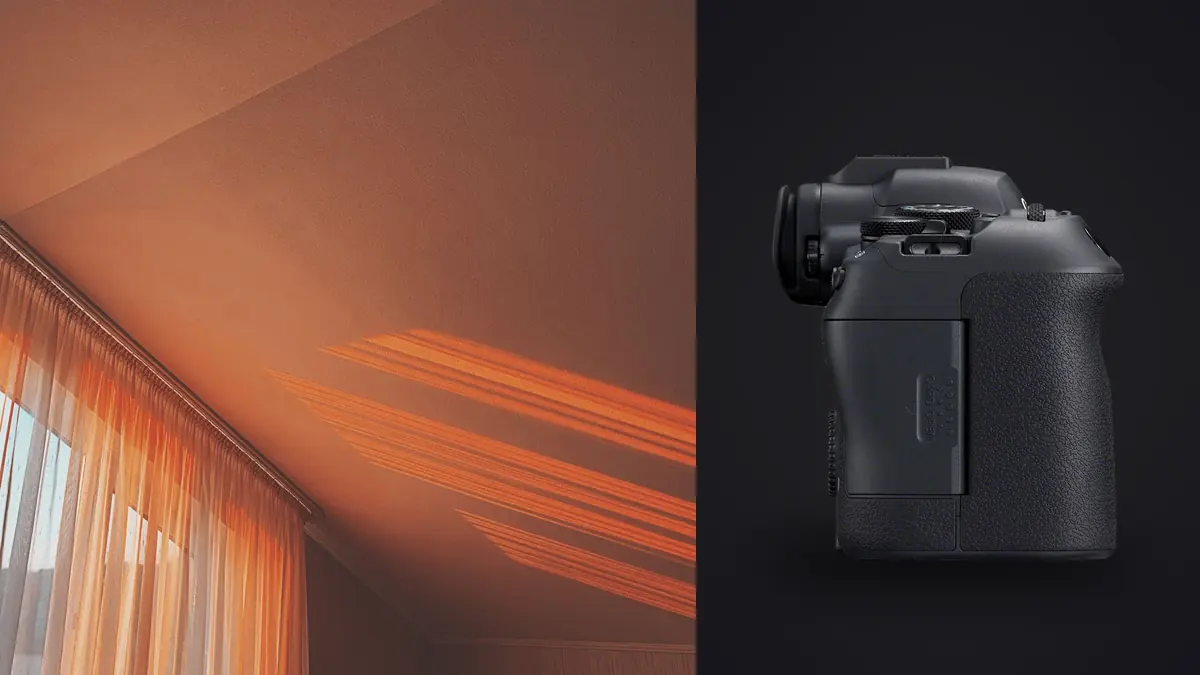
Boudoir and intimate portraiture put different demands on a camera than almost any other genre. You're usually working in a bedroom, a hotel suite, or a small studio corner with one or two light sources, not a full lighting rig. The subject is often nervous, sometimes doing this for the first time, and every mechanical click or awkward focus hunt chips away at the trust you're trying to build in the room. The Canon EOS R6 Mark II ends up being a genuinely good fit for this kind of work, not because Canon markets it that way, but because the specific combination of quiet operation, forgiving high ISO, and sticky eye detection lines up with what the genre actually needs. Here's what I've found actually matters after using it through a full season of sessions, plus where it falls short of the marketing copy.
What This Genre Actually Needs From a Body
Strip away the branding and boudoir work asks four things of a camera body: it needs to be quiet enough that the subject forgets it's there, it needs to nail focus on eyes at wide apertures where the plane of focus is a few centimeters deep, it needs to hold up in low, warm, mixed-color light without turning skin into mush, and it needs a shutter that can keep pace with a subject shifting fluidly between poses rather than holding a static mark. The R6 Mark II clears three of those four comfortably and is merely good, not great, on the fourth.
Body Settings That Actually Change the Session
Electronic shutter changes how the room feels
The R6 II's fully electronic shutter mode is genuinely silent, no faux-mechanical clack piped through a speaker, nothing. For a genre where half the job is keeping someone relaxed while they're partially or fully undressed in front of you, that matters more than most spec sheets give it credit for. I switch to electronic shutter the moment a session starts and only drop back to mechanical when there's fast movement (hair flips, fabric being pulled across frame, a subject shifting weight quickly) because the rolling shutter readout on this sensor is fast but not zero, and you can get mild skew on rapid horizontal motion under electronic shutter. For anything posed or slow-moving, which is most of a boudoir set, electronic shutter has never given me a usable artifact.
One caveat: some LED string lights and fairy lights, both popular as ambient accent lighting in this genre, flicker at frequencies that can produce banding under electronic shutter at certain shutter speeds. If the space has decorative LED strings in frame, test a burst before the real shooting starts and switch shutter speed by a stop rather than fight it in post.
Eye detection holds up, with real caveats
Dual Pixel CMOS AF II tracks eyes reliably down to f/1.2 on Canon's fastest RF glass, which is the aperture range most boudoir photographers actually shoot at for the shallow, intimate look the genre calls for. In practice the hit rate is high on straightforward poses (subject facing camera or at a mild angle, eyes visible). It gets shakier the moment hair falls across the face, a hand covers part of the frame, or the subject is looking away and you want focus to land on a cheekbone or shoulder instead. In those cases I drop out of eye-priority AF and use a single spot AF point placed manually, because the camera will otherwise keep hunting for an eye that isn't the compositional point of the shot.
In-body stabilization lets you skip the tripod
The 5-axis IBIS, rated up to 8 stops with compatible RF IS lenses, is what actually lets you work handheld in a dim bedroom lit by one window or a bedside lamp. I can hand-hold down to around 1/13s to 1/8s on static poses without visible blur from camera shake, which means the ISO doesn't have to climb as far as it would on an older body to keep shutter speed safe. That matters practically: a tripod in a small bedroom is one more obstacle between you and the subject, and it telegraphs "studio setup" in a space that's supposed to feel private. Being able to work handheld, moving around the bed or the room fluidly, keeps the session feeling like a conversation rather than a shoot.
Lens Pairings That Make Sense for This Work
Room size is the real constraint in boudoir more than in most portrait genres. You rarely get to back up fifteen feet in a hotel suite. Here's how the common RF options actually perform in that context, based on what I reach for depending on the space.
| Lens | Best use in this genre | Working distance reality | Trade-off |
|---|---|---|---|
| RF 50mm f/1.2L USM | Environmental frames that include the room, bed, and window light | Comfortable in most bedrooms, roughly 6-8 feet back | Heavy on a gimbal grip for a long handheld session, wrist fatigue by hour two |
| RF 85mm f/1.2L USM | Classic compressed portrait look, tight face and shoulder crops | Needs 10+ feet, often impossible in small rooms without shooting through a doorway | Beautiful rendering but frequently backed into a corner or hallway to get distance |
| RF 35mm f/1.8 Macro IS STM | Versatile single-lens sessions, close detail plus wider environmental | Works in almost any room, including cramped hotel bathrooms for detail shots | f/1.8 is a stop and a third slower than the L primes, more reliance on IBIS in low light |
| RF 24-70mm f/2.8L IS USM | Reframing without repositioning, useful when the subject is mid-movement | Adapts to any room size instantly | f/2.8 gives less separation than the primes, less of the signature soft falloff clients associate with this genre |
| RF 100mm f/2.8L Macro IS USM | Lace, jewelry, fabric texture, hands on skin | Needs space to back up, awkward in tight quarters | Single-purpose, most photographers only mount it for 10-15 minutes of a session |
If I could only own one lens for this genre on the R6 II, it would be the 35mm macro. It's the only one in that table that does close detail work and environmental framing without a lens swap, which matters when you're trying not to break the flow of a session by fumbling with gear.
Reading Real Light in Real Rooms
Almost no boudoir session happens under studio strobes. It's window light, a lamp, maybe one softbox if the photographer travels with a small kit. Here's roughly where I land on the R6 II across the lighting situations that come up most often.
| Light source | Typical ISO on the R6 II | Notes on settings | Color temperature note |
|---|---|---|---|
| Morning window light through sheer curtain | 400-800 | f/1.8-f/2.2 to keep enough depth for face and near shoulder both sharp | Clean, near-daylight, minimal correction needed |
| Bedside lamp, tungsten bulb | 1600-3200 | Wide open aperture almost mandatory, shutter rarely below 1/60s handheld with IBIS | Strong orange cast, sets custom white balance rather than trusting auto |
| String or fairy lights as ambient accent | 3200-6400 | Watch for flicker banding on electronic shutter, test first | Warm and inconsistent frame to frame, plan on per-image correction |
| Off-camera flash through a shoot-through umbrella | 100-200 | Flash does the work, ISO stays at base for cleanest files | Neutral, easiest file to grade of the group |
| Overcast light through north-facing window | 800-1600 | Soft and flattering but needs a reflector or the shadow side of the face goes flat | Cool, slightly blue, corrects easily |
The tungsten lamp scenario is where the R6 II earns its keep. Native ISO runs to 102400, and while I wouldn't push it that far in practice, files at ISO 3200 and even 6400 hold usable skin texture after a light noise reduction pass, which was not true of the cameras I shot this genre on five years ago. That's the difference between telling someone "we need to move closer to the window" mid-session and just letting the existing light in the room carry the shot.
What the RAW Files Actually Give You
The R6 II shoots 14-bit CR3 files with roughly 13-plus stops of dynamic range at base ISO, which is enough headroom to pull back a blown window behind a subject without the halo artifacts you'd get recovering the same highlight on an 8-bit JPEG. Canon's color science continues to render a wide range of skin tones with less of a magenta or orange cast than I've seen from some competing sensors straight out of camera, which cuts down on the amount of targeted color correction a boudoir edit usually needs. That said, mixed lighting (window plus lamp in the same frame, which happens constantly in this genre) still requires a real white balance decision per setup rather than trusting auto white balance to split the difference cleanly.
Because a single session produces a consistent look across sixty to a hundred and fifty frames, and a set should look consistent from first frame to last, I've started training imagic's apply_my_style feature on a set of my finished boudoir edits so new sessions get my skin tone and warmth treatment applied automatically as a starting point rather than rebuilding the same grade from scratch every time. It doesn't replace judgment on individual frames, but it removes the repetitive part of matching fifty images to a look I already know I want.
Culling a Session Without Losing the Client's Trust
Volume is the quiet problem in this genre. A session that runs ninety minutes and produces four to six poses per look, shot in short bursts to catch a natural expression, easily generates six hundred to a thousand frames. Most of those are near-duplicates: the same pose with a slightly different hand position, three frames apart, one of which is actually sharp. Reviewing that manually, especially material this sensitive, is slow and it's uncomfortable to have hundreds of near-identical intimate images sitting in a cloud-based culling tool waiting on someone else's servers to process them.
That's the specific reason I moved this part of my workflow to imagic rather than a cloud-based culling service: everything runs locally on my machine, nothing gets uploaded anywhere to get scored or clustered, which matters a great deal when the subject matter is this personal. The duplicate and burst clustering groups those near-identical pose sequences together automatically so I'm choosing between four frames instead of scrolling past forty, and the local sharpness scoring catches the soft-focus frames from a slightly missed eye AF lock before I waste time opening them in an editor. If you want the mechanics of how that kind of clustering actually works under the hood, this breakdown of AI photo culling covers it in more depth than I can here.
For the workflow around it, from how I structure the shot list to keep culling manageable in the first place, these workflow tips line up closely with how I actually run a session on this camera.
A Realistic Shot List and Pacing
What I've settled into after enough sessions: three to five poses per outfit or setup, four to eight frames per pose in a short burst rather than holding the shutter down, and a deliberate pause between poses to check the back screen with the subject if they want reassurance. That pacing keeps the total frame count for a full session in the six hundred range rather than the thousand-plus you get from photographers who shoot continuous high-speed bursts through the whole thing. Fewer, more intentional frames also means the culling pass afterward takes twenty minutes instead of two hours, and the client isn't waiting a week for a gallery because you're still wading through duplicates.
Frequently Asked Questions
Is the R6 Mark II's autofocus reliable enough for movement-heavy boudoir poses?
For fluid, slow movement (a subject shifting weight, turning toward or away from camera gradually) it tracks well. For quick movement like a hair flip or a fast turn, Dual Pixel AF II can lag half a beat, and I've had more keepers from anticipating the peak of the movement and firing a short burst around it than from trying to track continuously through fast motion. It's a body built more for controlled, deliberate posing than for sports-style tracking, which suits most boudoir work fine.
What ISO ceiling is realistic before skin texture starts looking noisy?
I treat ISO 6400 as my practical ceiling for delivered work. Files are usable up to that point with a light noise reduction pass in post, and skin retains real texture rather than turning waxy. Past ISO 6400 the tradeoff shows up specifically in skin, which is the one area of a boudoir image you can't afford to look artificial, so I'd rather add a lamp or open a curtain than push the sensor further.
Do I need a full lighting kit, or can available light carry a session?
For most bedroom and hotel sessions, one window plus a reflector or a single small softbox covers it, and the R6 II's high ISO performance means you're not forced into flash just to get a workable shutter speed. I still carry one small off-camera flash for the handful of rooms with no usable window (interior bathrooms, north-facing rooms in winter), but it stays in the bag more sessions than it comes out.
How many frames should I expect to cull down from a typical intimate session?
From roughly six hundred to a thousand raw frames, most photographers I know deliver somewhere between forty and eighty final images. The gap between those numbers is almost entirely burst duplicates and focus misses, which is exactly the part of the process worth automating rather than doing by eye at 100% zoom for two hours. Getting the culling pass efficient is less about the camera and more about having a clustering step that groups near-identical frames before you start judging expressions one by one.