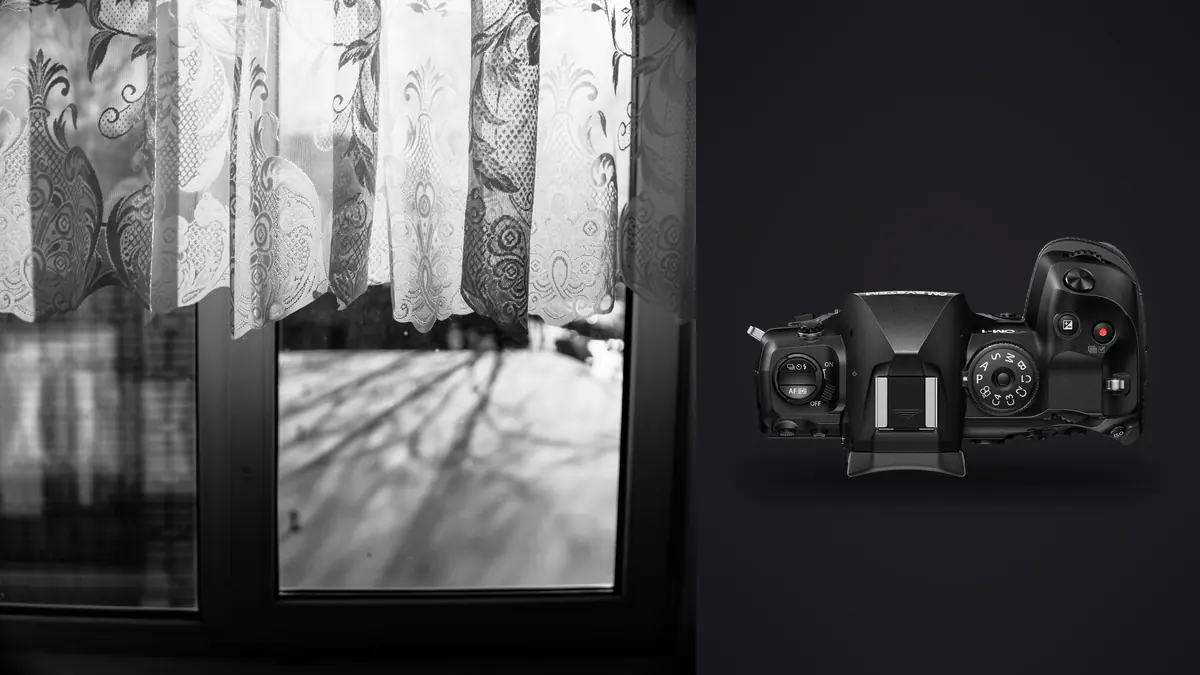
I did not expect to end up shooting boudoir on a Micro Four Thirds body. For years the assumption in that corner of the industry was simple: full frame or don't bother, because the genre lives and dies on shallow depth of field and buttery skin rendering. Then I tried a boudoir-style portrait session with a borrowed OM System OM-1 Mark II and a 45mm f/1.2 PRO, and I spent the first twenty minutes of that shoot quietly revising my assumptions. The camera is not a natural fit for every intimate portrait photographer, and I want to be upfront about where it struggles. But there are specific, practical reasons it keeps turning up in boudoir studios, and most of them have nothing to do with the spec sheet arguments people usually have about this body.
Why a small sensor keeps showing up in a genre obsessed with shallow focus
Boudoir photographers talk about bokeh the way landscape photographers talk about dynamic range: constantly, and often past the point of usefulness. The OM-1 Mark II carries a 20.4MP stacked BSI sensor at the Micro Four Thirds size, which means a 2x crop relative to full frame. Paired with the 45mm f/1.2 PRO, you get a field of view close to a 90mm lens and a depth of field that behaves more like f/2.4 would on a full-frame body. That is a real trade-off. If your entire style depends on a subject's eyes being tack sharp while their shoulder dissolves into cream, you will need to shoot that 45mm closer to wide open and work harder on separation with light and background distance than you would with a full-frame 85mm f/1.2.
What the smaller sensor buys back is something boudoir sets need more than landscape or wildlife work does: forgiveness. In a bedroom or a hotel suite with maybe eight feet of working distance, a full-frame 85mm at f/1.4 can leave you with one eye sharp and the other soft on anything but a dead-on angle. The OM-1 Mark II's extra depth of field at a given aperture means a three-quarter pose with the client's face turned slightly away still holds focus across both eyes more often. I stopped chasing pixel-level bokeh on this system and started using the aperture ring for exposure and separation control instead of as the only tool for isolating a subject. It changes how you compose, not just how you expose.
Autofocus that has to track more than motion
Most autofocus marketing is built around sports and wildlife: fast subjects, unpredictable paths, tracking a bird against a cluttered background. Boudoir does not need any of that. What it needs is a system that holds focus on a face and eye through small, slow, continuous movement: a shifting weight, a hand moving through hair, a slow exhale that drops the shoulders half an inch. The OM-1 Mark II's subject detection AF, built on the same deep-learning core introduced with the original OM-1 but tuned with a broader training set for the Mark II, handles human eye detection well in this kind of low-velocity, high-nuance movement. It rarely hunts, and it rarely locks onto the wrong eye when a subject turns her head mid-pose, which used to be one of my most common technical rejects with older contrast-detect systems.
Where it is less impressive is in dim, single-source lighting with strong contrast, which describes a large share of boudoir sets built around one continuous LED panel or a single window. Autofocus confidence drops in that scenario on every camera I have used, this one included, and I have had more luck switching to a single small AF point placed directly on the near eye than trusting the full subject-detection area in very moody light. It is a minor workflow adjustment, not a dealbreaker, but it is worth knowing before your first low-light session rather than discovering it mid-shoot.
Working with the light boudoir sets actually use
Boudoir lighting is rarely a three-light studio setup. More often it is one continuous source, sometimes window light alone, deliberately kept soft and directional because harsh multi-light setups tend to flatten the intimacy the genre is selling. That means high ISO performance and clean shadow recovery matter more here than in most portrait work. OM Digital Solutions revised the noise reduction algorithm for the Mark II over the original OM-1 without changing the sensor itself, and the difference is visible in shadow-heavy frames pulled up in post. ISO 3200 files hold detail in dark fabric and hair that the original OM-1 tended to smear into mush. I still would not push this body past ISO 6400 for boudoir work if I had a full-frame alternative sitting in the bag, but for available-light work under one softbox or a north-facing window, it holds up better than its sensor size would suggest.
In-body stabilization is the quieter win here. Sync IS with the 45mm f/1.2 PRO gets you well past seven stops in real use, which means handheld shutter speeds down around a quarter second are usable for static poses. That matters on a boudoir set specifically because a tripod changes the energy of the room. Clients relax more when the photographer is moving around them, adjusting angle and distance on the fly, rather than locked behind a tripod leg. Being able to drop shutter speed and skip the tripod without motion blur risk on every third frame is a genuine creative advantage, not just a technical one.
The lens question: three primes for three different rooms
OM System's f/1.2 PRO trio (17mm, 25mm, and 45mm) covers most boudoir scenarios, but they are not interchangeable in practice. I have used all three across different sets and they solve different problems.
| Lens | Full-frame equivalent field of view | Best use on a boudoir set | Where it struggles |
|---|---|---|---|
| 17mm f/1.2 PRO | ~34mm | Tight hotel rooms and small apartments where you physically cannot back up; environmental frames that include the bed, the window, and the subject together | Close-in facial features distort if you get closer than about five feet; not flattering for tight headshots |
| 25mm f/1.2 PRO | ~50mm | Full-length and three-quarter poses in a normal bedroom, walking shots, most of the "getting ready" and candid-style frames | Needs real working distance for flattering close portraits, which many rented boudoir suites do not have |
| 45mm f/1.2 PRO | ~90mm | Close facial portraits, detail shots (hands, jewelry, fabric texture), compressed backgrounds against string lights or window bokeh | Requires eight-plus feet of working distance for full-body framing, which small rooms rarely offer |
My actual kit for a typical two-hour boudoir session is the 25mm as the workhorse and the 45mm for the last twenty minutes, once the subject is relaxed and I want tighter, more intimate crops. I rarely reach for the 17mm on boudoir work specifically, though I keep it in the bag for suites with genuinely tight quarters, like a small ensuite bathroom scene with a clawfoot tub.
Color out of camera, and what I actually do about it
I will say this plainly because most gear reviews dance around it: OM System's out-of-camera color science, inherited from the Olympus color engine, does not render caucasian skin tones as warmly or as flatteringly as Fujifilm or Canon do straight out of the box. Mid-tones can lean slightly green-yellow under mixed LED and daylight, and I have had to correct for it on every boudoir set I have shot with this body. It is not a dealbreaker, but if you are used to Fuji's skin tone film simulations or Canon's warmer default rendering, expect an extra correction pass rather than a "close enough, ship it" JPEG.
In practice this means my actual workflow leans harder on post-processing consistency than it would with a body whose native color already matches my style. I built a corrected preset from a handful of edits I was happy with, then used the apply_my_style feature in imagic to apply that same tonal correction and skin warmth adjustment across an entire shoot automatically, rather than manually rebalancing white balance and hue on every single frame. For a genre where consistency across sixty delivered images matters as much as any single hero shot, having that correction baked into a repeatable, offline process rather than redone by hand each time has saved real editing hours. If you are building a full color grading approach from scratch, our guide to photo color grading covers the fundamentals in more depth than I can here.
The part nobody mentions: what a boudoir shoot does to your card and your evening
A two-hour boudoir session with a client who is nervous at the start and relaxed by the end generates an enormous number of near-duplicate frames. Clients shift through micro-variations of the same pose for thirty seconds at a time while you fire off six or eight frames looking for the one where the expression and the light and the hand position all land together. By the end of a session I am routinely looking at 1,800 to 2,500 RAW files, and maybe 60 to 90 of them get delivered.
That ratio is where the camera stops being the interesting part of the story and the culling process takes over. Sorting that volume by eye, frame by frame, at the end of a long shoot day is where most of my early boudoir editing hours went. I now run the take through imagic before I open anything in an editor. Its local sharpness and focus scoring flags which frame in each burst actually has the crisp eye, which matters enormously in a genre where soft focus reads as a mistake rather than a stylistic choice, and its duplicate and burst clustering groups those thirty-second pose sequences together instead of leaving me to scroll past twenty near-identical thumbnails one at a time. Because boudoir and intimate portrait material is about as sensitive as photography gets, the fact that this processing runs entirely on my own machine with no cloud upload step is not a nice-to-have for me, it is close to a non-negotiable requirement, and it is one of the main reasons I stuck with this workflow after that first borrowed-camera shoot. If you want the mechanics of how that scoring actually works, we cover it in more detail in how AI photo culling works.
Frequently Asked Questions
Is the OM-1 Mark II's smaller sensor actually a problem for boudoir work?
It is a trade-off rather than a flat downside. You lose some of the razor-thin background separation full-frame f/1.2 glass delivers, but you gain more forgiving depth of field on close, angled faces, which is genuinely useful in tight rooms where you cannot always shoot dead-on. Photographers who build their entire style around extreme background blur will feel the difference more than those who lean on posing, light, and composition for separation.
Do I need all three f/1.2 PRO primes to shoot boudoir with this system?
No. The 25mm covers the majority of a typical session on its own. The 45mm is worth adding once budget allows, mainly for tight facial portraits and detail shots. The 17mm is a specialty tool for unusually small spaces rather than a core boudoir lens.
How do you handle client privacy when culling and editing this kind of material?
Everything stays local from card to delivery. I import to a local drive, run culling and scoring through imagic with no cloud upload step, and edit natively on my machine. For material this personal, avoiding any cloud-based culling or AI tool that requires uploading files, even briefly, is a hard line for me, and it should be for anyone shooting this genre professionally.
Does the color science issue mean I should avoid this camera for skin tones entirely?
Not necessarily, but budget time for it. Build a correction you're happy with once, then apply it consistently rather than relying on the default JPEG rendering or manually rebalancing every image. A repeatable preset workflow closes most of the gap between this body's native color and what Fuji or Canon shooters get by default.