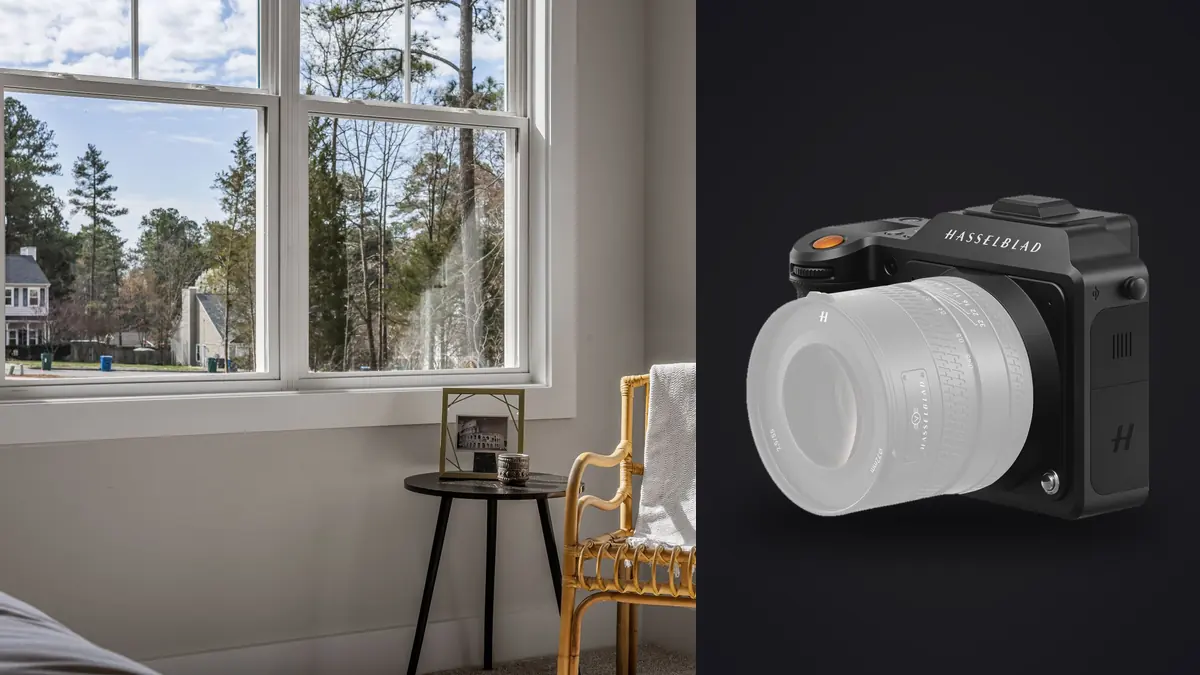
A client asked for large-format prints from her boudoir session last spring, the kind she wanted framed at 30 inches on a bedroom wall, not just a slideshow on a phone. That request is really what pushed me toward the Hasselblad X2D 100C for a genre I'd always shot on full-frame mirrorless. I went in expecting the medium-format "look" everyone talks about and came out with a much longer list of practical adjustments than I anticipated. This is that list, written after four sessions with the camera in actual bedrooms, hotel suites, and one very awkwardly lit Airbnb with blackout curtains that weren't quite blackout.
What the sensor size actually buys you
The X2D 100C carries a 43.8 x 32.9mm BSI CMOS sensor at 100 megapixels, noticeably larger than the 35mm sensors most portrait photographers are used to. In practice, on a boudoir set, that shows up in two places more than any other. First, depth of field falls off differently: at f/2.5 on the 90V, the transition from in-focus skin to soft background has a roundness to it that full-frame lenses at similar framing don't quite replicate, even wide open. Second, and more useful day to day, the 16-bit files hold an enormous amount of shadow and highlight information at once. Boudoir sessions live and die by window light, sheer fabric, dark lingerie against pale skin, and backlit hair, all high-contrast situations. I've pulled detail out of near-black sheet folds three stops under while the skin two feet away was still recoverable, in the same frame, without banding. That dynamic range matters more here than it would shooting, say, a well-lit studio headshot, because intimate portraiture leans hard on natural or minimally modified light to keep the mood unposed.
The autofocus trade-off nobody puts in the brochure
Here's the part that gets glossed over in every glowing first-look video: the X2D 100C's autofocus is contrast-detection only, single-point or a modest AF area, no continuous eye tracking, no reliable subject following through movement. Coming from a mirrorless body with aggressive eye-AF, this is a real adjustment, and boudoir work involves more small movement than people expect: a shift of weight, a breath, hair falling across a shoulder mid-pose. My workaround was slowing the whole rhythm down. I focus-and-recompose on the near eye, hold, and fire three to five frames per pose instead of one, because the AF confirmation on this body is trustworthy but the model's micro-movement between the confirmation beep and the shutter isn't always zero. That means I walk away from every session with several hundred frames that are 90 percent identical, and picking the genuinely sharp one from a cluster of five near-duplicates by eye, at 100 megapixels, on a laptop screen, is slow and easy to get wrong. This is where I started leaning on imagic's local sharpness scoring to flag the actual sharpest frame in each micro-burst instead of squinting at zoomed crops of five files that all look fine at thumbnail size. It runs on the machine, nothing leaves the laptop, which matters more here than on any other genre I shoot.
Lenses that actually earned their place in the bag
I own four XCD lenses at this point and use two of them constantly for this kind of work. Here's how they've actually performed on set, not on a spec sheet.
| Lens | Max aperture | Full-frame equivalent feel | Where it earns its keep |
|---|---|---|---|
| XCD 38V | f/2.5 | ~30mm | Getting-ready shots, robe-and-window environmental frames, tight rooms where 55mm can't back up far enough |
| XCD 55V | f/2.5 | ~44mm | Walk-around default, natural perspective for full-body poses without distortion at the edges |
| XCD 80mm f/1.9 | f/1.9 | ~63mm | The workhorse for close three-quarter frames and low-light bedroom scenes; widest aperture in the line |
| XCD 90V | f/2.5 | ~71mm | Tight headshots and detail work from a comfortable, less intrusive distance |
If I had to keep one, it's the 80mm f/1.9. It's the only lens in the current XCD lineup fast enough to matter in a curtained bedroom at 5pm in November, and the extra third of a stop over the 55V or 90V adds up when you're not using strobes. The 38V gets pulled out for maybe one in five sessions, mostly when a client wants a wider "getting dressed" narrative shot alongside the tighter portrait work.
Shutter silence and why it changes how a session feels
The X2D 100C runs a fully electronic shutter with no mechanical curtain at all, and the newer sensor revision added a full-frame global readout, which means no rolling-shutter skew even on quick movement and no audible click between frames. In most photography that's a nice-to-have. In boudoir and intimate portrait work it changes the room. There's no mechanical clack punctuating every frame, no reminder every second that a machine is watching. Clients who are already nervous about being photographed in this context relax faster when the only sound in the room is you talking them through posing, not a shutter. I didn't expect to care about this going in, and it's turned out to be one of the bigger quality-of-life differences over my old full-frame body. The global shutter also means I can sync a single off-camera strobe at any shutter speed up to the camera's ceiling, which is handy for the sessions where I want to slightly underexpose bright window light and add a soft fill from the side without hunting for a leaf-shutter lens.
The file-size tax nobody warns you about
A compressed 3FR RAW off this sensor lands around 100 to 130MB per frame, depending on scene complexity. That number sounds abstract until you do the math on an actual session.
| Frames captured | Approx. total on card | Practical note |
|---|---|---|
| 150 (tight, curated shoot) | ~16-20GB | Fits comfortably alongside other work on the body's internal 1TB SSD |
| 400 (typical two-hour session, multiple outfits) | ~44-52GB | Needs an offload to a laptop or drive before you shoot again that day |
| 700+ (long session with reshoots for AF misses) | ~77-90GB | Plan a two-card rotation; don't rely on internal storage alone as your only copy |
Because the AF workflow described earlier pushes frame counts up (five shots per pose instead of one), a session that would produce 150 frames on a faster-focusing body regularly produces 400 to 500 here. That's a lot of nearly identical 100MP files to sort through by hand, and for boudoir clients specifically, the files are also the most sensitive thing on the drive. Don't run these through a cloud culling service, full stop, since subjects will often ask directly whether their images ever touch a server they don't control. Processing everything locally, with nothing uploaded anywhere, isn't a nice feature for this genre, it's close to a requirement, and it's the main reason imagic ended up in my workflow instead of a browser-based alternative: the duplicate and burst clustering groups those five-frame clusters automatically so I'm reviewing maybe 90 groups instead of 450 individual files, entirely offline.
Color and getting the retouching consistent
Hasselblad's Natural Colour Solution is genuinely a selling point here, not marketing filler. Skin tones across a range of undertones come out of the file closer to correct than any camera color profile I've used, with less initial correction needed before the real retouching begins. That said, boudoir retouching has its own quiet rules: skin needs to stay skin, not plastic, shadows under a collarbone or along a hip need to hold their shape, and a client's specific coloring from one session to the next should look consistent if she books again. Doing that by hand on every one of 300 to 400 selected frames from a session is the part of this job that eats an entire weekend. I've started training a personal preset on my own previously edited files with imagic's apply_my_style feature, so the tonal and skin-retouching decisions I'd otherwise repeat frame by frame get applied automatically as a first pass, and I spend my actual editing time on the dozen hero images instead of on getting every one of four hundred frames to a baseline.
Handling it through a real session
At roughly 895g body-only, and closer to 1.3kg with the 80mm attached, the X2D 100C isn't heavy compared to a pro DSLR, but a two-hour handheld boudoir session with a lot of low-angle and overhead shooting adds up in the wrist and shoulder by the end. In-body stabilization is rated up to seven stops and it holds up well enough that I've shot handheld at 1/15s in dim bedroom light without visible shake, which matters because a tripod in an intimate session usually adds distance and formality you don't want. The tilting rear screen gets used constantly for low-angle floor shots and shooting from a chair, more than the viewfinder does once a session is underway. I generally keep ISO capped around 3200 on this sensor; past that the files still clean up fine but you start losing some of the tonal smoothness that's the whole reason to shoot medium format in the first place.
Frequently Asked Questions
Is the X2D 100C's autofocus reliable enough for boudoir and intimate portrait work?
It's reliable for single, deliberate frames, but it isn't built for tracking movement. Plan on a focus-and-recompose workflow with multiple frames per pose rather than relying on the camera to follow small shifts in the model. Photographers coming from mirrorless bodies with aggressive eye-AF should expect a slower shooting pace, not a worse result once the technique adjusts.
Which XCD lens should I buy first if I mostly shoot boudoir?
The 80mm f/1.9 is the strongest single choice. It's the fastest aperture in the current XCD line, covers a natural portrait focal length, and does the most work in the low, warm bedroom and hotel-room light that defines most intimate sessions. Add the 55V second for wider environmental frames.
How much storage should I actually plan for a full session?
Budget close to 100GB for a longer session with multiple outfit changes and reshoots, even though a tightly curated shoot might land closer to 20GB. The gap comes almost entirely from shooting several frames per pose to compensate for single-point AF, so plan card rotation and backup around that reality rather than the file count you'd expect from a faster-focusing camera.
Is the X2D 100C overkill, or too expensive, for boudoir specifically compared to full-frame?
If large prints are part of what you sell, the resolution and tonal range justify the cost more in boudoir than in most other genres, because skin rendering and dynamic range in mixed window light are exactly where this sensor separates itself. If your clients mainly want digital galleries at web resolution, a fast full-frame body with better tracking AF will get you through sessions faster for meaningfully less money.
None of this makes the X2D 100C the obvious choice for every boudoir photographer. It rewards a slower, more deliberate way of working and punishes anyone expecting it to behave like a sports body. But for the specific combination this genre needs, skin tone accuracy, dynamic range in difficult window light, and a shutter that doesn't announce itself, it's earned a permanent spot in my bag despite the autofocus compromises. If you want to see how the culling and retouching side of this workflow actually holds up against other tools, our photo culling software comparison covers that ground, and how AI photo culling works goes deeper into the sharpness-scoring approach mentioned above.