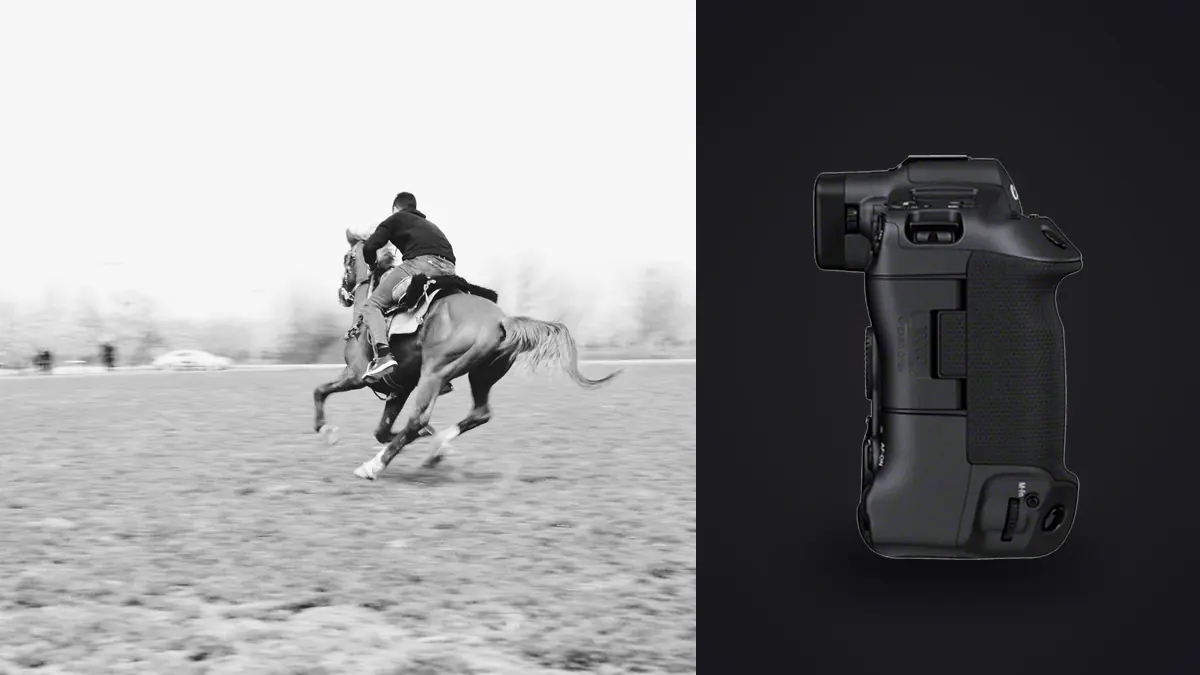
I picked up the Canon EOS R3 for a regional track and field season expecting the eye-controlled autofocus to be a gimmick I'd switch off after a meet or two. Two seasons later it's still on, and it's the single feature I'd have the hardest time giving up if I went back to a standard mirrorless body. That's not the whole story though. A track meet is a strange shooting environment: sprinters clear 100m in under 11 seconds, javelin and discus happen on the infield at the same time as heats on the oval, and long jump runway light shifts every twenty minutes as the sun moves across the stands. The R3 was built with exactly this kind of chaos in mind, and after two seasons of prelims, finals, and a couple of state-level meets, I've got a clear sense of where it earns its price tag and where it doesn't.
The stacked sensor is the whole point for track
The R3 uses a 24.1MP stacked, back-illuminated CMOS sensor paired with dual DIGIC X processors, and for track and field that combination matters more than the resolution number does. Stacked sensors read out much faster than conventional ones, which is what lets the R3 shoot a fully electronic, silent shutter at up to 30fps without the rolling shutter skew that ruins panning shots on cheaper electronic-shutter cameras. I've shot 200m turns with a full pan at 1/1600s in electronic mode and the lane lines stay straight. Try that on a body with a slower sensor readout and the lines lean, the runner's legs smear into a diagonal blur that has nothing to do with actual motion.
Mechanical shutter tops out at 12fps, which is still plenty for most field events, but I default to electronic for sprints and relay exchanges specifically because of the silence. Standing trackside with a 400mm lens, a mechanical shutter clattering through a 100m final is the kind of noise that gets you dirty looks from the timing officials, and at some indoor meets it's genuinely disruptive during the starting blocks sequence. Silent electronic shooting solved that problem completely.
Eye Control AF: what it actually does at a meet
Eye Control AF isn't new to Canon, it's a revival of a feature from the EOS-3 film body from the late 90s, but the digital version reads your eye position through infrared sensors in the viewfinder and moves the active AF point to wherever you're looking. For track work, this means I can pre-frame a lane for a sprinter coming out of the blocks, then as they move I just look at where I want focus and the point follows, without my thumb touching the joystick. On a body without it, tracking a single lane through a staggered start means either trusting subject-detection AF to pick the right runner out of eight (it doesn't always) or riding the joystick manually while also trying to hold a pan.
The catch is calibration. Eye Control AF needs you to run through Canon's calibration routine, and it needs re-calibrating if you switch eyecups, if your glasses change, or honestly if you've just had a long day and your eye position drifts. I keep three calibration profiles saved: one for sunglasses, one without, and one for when I'm shooting from a slight downward angle off the infield stands. Skip the calibration discipline and the feature genuinely gets worse than useless, it'll actively drag focus to the wrong athlete. Maintain it and it's the fastest way I've found to track a specific competitor through a crowded frame.
Frame rate, buffer, and what actually fills a card
Here's where the math gets real. A compressed RAW (CR3) file off the R3 lands around 25 to 30MB depending on scene detail. At 30fps electronic shutter, that's roughly 800MB of data per second hitting the card. I shoot with a CFexpress Type B card in the primary slot for exactly this reason. In practice I can run bursts past four seconds (120-plus frames) through a full sprint finish without the buffer choking and the frame rate dropping. Drop down to SD UHS-II only, which is what the second slot takes, and that number falls hard, more like a second and a half of full-speed shooting before the camera throttles back while it catches up writing to the card.
For track specifically, I've settled on a rhythm: burst through the start, ease off during the middle of a 400m or 800m where nothing decisive is happening, then burst again for the last 15 meters and the lean at the tape. That discipline matters less for buffer management on this body than it did on my old camera, but it still matters for what happens after the meet, because 30fps for four seconds is 120 nearly-identical frames of one finish, and someone (usually me, at midnight) has to sort through them.
Shutter modes compared for a meet day
| Shutter Mode | Max FPS | Rolling Shutter Risk | Best Use at a Meet |
|---|---|---|---|
| Mechanical | 12 fps | None | Field events, flash sync, podium/awards shots |
| Electronic 1st curtain | 12 fps | Low | Long jump and pole vault approach, quieter than full mechanical |
| Full electronic (silent) | 30 fps | Very low (stacked sensor) | 100m/200m finishes, relay exchanges, indoor starts |
| Full electronic, low-speed | Up to 15 fps | Very low | Distance races where you want less to sort through later |
Glass for the different disciplines
Track and field isn't one shooting distance, and I've ended up rotating between three RF lenses depending on what's happening that hour. The R3's RF mount and native AF motors mean none of these hunt noticeably even in the low light of an evening session, which wasn't always true with adapted EF glass on earlier mirrorless bodies.
| Event Type | Typical Shooting Distance | Lens I Reach For | Why |
|---|---|---|---|
| Sprints (100m/200m), finish line | 15-40m, often compressed head-on | RF 100-500mm f/4.5-7.1L IS USM | Reach for a tight finish-line frame without standing on the track |
| Field events (long jump, high jump) | 8-20m | RF 70-200mm f/2.8L IS USM | Fast aperture for late-evening sessions, quick to reframe as athletes shift position |
| Distance events, backstretch action | 60-120m | RF 100-500mm at full reach, occasionally with 1.4x extender | Only real option for the far side of a 400m oval from the infield |
| Throws (shot put, discus, javelin) | 10-35m | RF 70-200mm f/2.8L IS USM | Versatile enough to catch both the wind-up and the release without a lens swap |
| Environmental / team, medal ceremonies | 3-10m | RF 24-70mm f/2.8L IS USM | Wide enough for context, still sharp wide open |
If I had to keep exactly one lens on the R3 for a full meet, it would be the RF 100-500mm. It doesn't have the constant f/2.8 aperture of the 70-200, so backstretch shots at dusk get noisy, but the reach covers both ends of an oval from a single infield position, and the R3's high-ISO performance (usable well past ISO 6400 for web and small-print use) covers for the variable aperture more than I expected it to.
Subject detection and why it defaults wrong for track
Canon's subject-detection AF on the R3 covers people, animals, and vehicles, with a sub-mode for eyes, faces, heads, or bodies within the "people" category. For track and field this mostly means leaving it on People with Eye/Face priority, but it's worth knowing where it struggles: dense field-event crowds (multiple athletes warming up in frame during long jump) can confuse which subject gets priority, and it occasionally locks onto a coach or official standing near the action instead of the competing athlete. This is one more reason Eye Control AF earns its keep here, because I can override the detection's guess just by looking at the right person, rather than tapping through a menu of detected faces mid-action.
Handling the volume afterward
The uncomfortable truth about a 30fps stacked-sensor body is that it solves the capture problem and hands you a much bigger sorting problem. A single finals session, four hours, maybe fifteen events I actually cared about, regularly leaves me with 4,000 to 6,000 frames by the time the last relay wraps up. Multiply that by a full outdoor season and you're looking at tens of thousands of nearly-identical sprint-finish bursts sitting in a folder.
This is the part of the workflow where imagic actually changed how I shoot, not just how I edit. It runs local sharpness and focus scoring on every frame the moment I import a card, so instead of scrubbing through 120 frames of one finish by eye, I get the sharpest handful surfaced first. If you want the mechanics of how that scoring actually works rather than just the marketing version, this breakdown of how AI photo culling works covers the underlying approach in more depth than I will here.
The other piece that matters specifically for a 30fps body is duplicate and burst clustering. imagic groups those rapid-fire sequences together instead of showing you 120 separate thumbnails, so a finish-line burst becomes one cluster with the standout frame flagged, and I only drop into the full sequence if the flagged frame has a closed eye or a blocked bib number. It's a small thing on paper but it's the difference between a 45-minute cull after a meet and a three-hour one.
Because everything runs locally on my laptop rather than uploading to a cloud service, I've also stopped worrying about where images of teenage athletes end up while I'm processing them, which matters more at youth and high school meets than it did when I was shooting adult club racing. That's not a small consideration for anyone shooting scholastic sports regularly.
Once the culling pass is done, I lean on imagic's apply_my_style feature, which trains a preset off my own past edits rather than a generic filter pack. I built mine from a season's worth of finish-line and field-event edits, so it already leans toward the warmer skin tones and slightly punched-up track surface color I'd apply manually anyway, and it gets me to a consistent look across an entire meet's photo gallery in a fraction of the time. If your bottleneck after a shoot is less about culling and more about the general edit-and-export grind, these workflow speed tips are worth a look alongside whatever culling tool you're using.
Battery, weather sealing, and the parts nobody asks about
The R3 uses the LP-E19 battery, the same one Canon's 1D X line has used for years, and it shows. A single charge got me through a morning prelim block and an afternoon finals session without a swap, more than 3,000 frames across both. That's a real advantage at an all-day meet where there's rarely a convenient outlet near the infield. The integrated vertical grip means there's no add-on battery grip to fumble with either, which matters when you're jogging down the backstretch trying to reposition before the next heat starts.
Weather sealing has been tested more than I'd like. A May meet with sideways rain for the last two events didn't slow the body down at all, though I did keep a rain sleeve on the 100-500mm because the front element on that lens isn't as well protected as the body itself. Dust from the long jump pit is a bigger practical concern than most reviews mention: shooting low-angle approach shots means you're occasionally getting sand kicked toward the camera, and I wipe the front element down between jumpers more than I'd like to admit.
Indoor track: the other half of the season
Indoor facilities bring their own problems that outdoor meets mostly avoid. Arena lighting is frequently fluorescent or older LED fixtures that flicker at a rate your shutter can catch mid-cycle, producing visibly darker or color-shifted frames scattered through a burst. The R3's anti-flicker detection helps here, timing the shutter to fire at the brightest point in the light's cycle, and I noticed a real drop in banded or underexposed frames once I turned it on for indoor sessions. ISO performance also gets pushed harder indoors since tracks are typically under 300 lux even in well-lit facilities, and I regularly sit between ISO 4000 and ISO 8000 for indoor 200m and 400m events. The stacked sensor's noise characteristics hold up reasonably well through that range, noticeably better than the DSLR I used for indoor seasons five years ago, though I still shoot RAW exclusively indoors specifically to have the latitude to pull shadows back afterward.
Where it falls short
I don't want to oversell this. 24.1MP is on the lower side for a body at this price point, and if your business depends on selling large prints of distance events shot at 400mm-plus and then cropped further in post, you'll feel the resolution ceiling faster than you would with a higher-megapixel body. The R3 also isn't cheap, and CFexpress cards add a real cost on top of the body if you don't already own them. And Eye Control AF, for as much as I've praised it, has a learning curve that some shooters never get comfortable with. I've watched other photographers at meets try it for one event, get a string of missed-focus frames because they didn't run the calibration properly, and shelve it entirely. That's a real cost if you don't have patience for the setup.
Frequently Asked Questions
Does Eye Control AF actually track a sprinter through the whole frame?
It tracks where your eye is looking within the viewfinder, so it's really tracking your gaze rather than the runner directly. Combined with subject-detection AF picking up the person nearest your gaze point, it works well for following a single lane through a race as long as the calibration is current. It doesn't replace good panning technique, it just removes the need to also drive the AF point manually while you pan.
Is 24 megapixels enough for cropping distant field events?
For web use and standard print sizes, yes, comfortably. A 24MP frame gives you room to crop a discus or javelin release down to about half the frame and still have enough resolution for a reasonable print. Where it gets tight is if you're regularly cropping distance-event shots taken at 500mm down further still, because you're combining optical reach limits with a moderate megapixel count. Shooters coming from a 45MP body will notice the difference immediately in that specific scenario.
Do I need CFexpress, or will SD UHS-II keep up during a meet?
For anything beyond short mechanical-shutter bursts, get CFexpress. SD UHS-II simply can't write fast enough to sustain 30fps electronic shooting for more than a second or two before the buffer forces a slowdown, and track finishes are exactly the moment you don't want that to happen. I keep the SD slot for JPEG backup or overflow only.
How does the R3 handle indoor track lighting compared to outdoor meets?
The anti-flicker function makes a real difference under fluorescent and older LED arena lighting, cutting down on the banded or underexposed frames that scattered through my bursts before I turned it on. You'll still push ISO noticeably higher indoors, typically into the 4000-8000 range for fast events, and I'd budget extra time in post for noise handling on indoor sets regardless of which camera you're shooting.