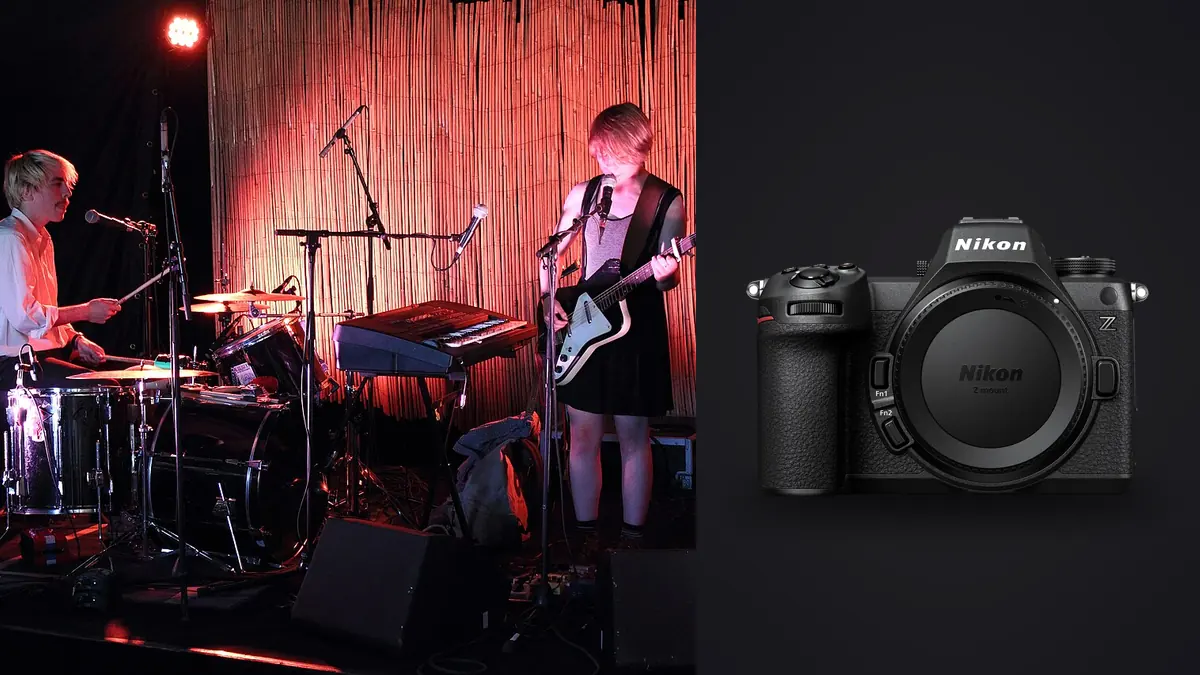
I've shot enough three-song, no-flash sets to know that a camera either earns its place in the pit or it gets left in the bag for the next tour. The Nikon Z6 III has stayed in mine for a full year now, through basement clubs with a single blue wash and arena shows where the lighting rig changes faster than I can react to it. This isn't a spec sheet rundown. It's what actually matters when you're jammed against a barricade with two other shooters, the security guard is already counting down your three songs, and the singer just walked into a spotlight that's about to blow out three stops brighter than the rest of the stage.
What changes the moment you're back in the pit
Coming from a Z6 II, the first thing I noticed wasn't the megapixel count (24.5MP on both, so nothing changes there). It was the viewfinder. The Z6 III's EVF refreshes at up to 120fps and doesn't black out between frames the way older EVFs do mid-burst. When a drummer's sticks are moving faster than you can consciously track, that blackout is the difference between following the motion and losing it entirely. With the Z6 III I can hold a moving subject in frame through a ten-frame burst and actually see what's happening the whole time, not guess at it.
The second thing is how the camera behaves at ISO 6400 and above, which for most club shows is your baseline, not your ceiling. More on that below, but the short version is that files hold shadow detail and skin tone in a way the Z6 II's sensor didn't, even though the pixel count is identical.
The partially-stacked sensor, and why the "jello" problem mostly went away
Nikon calls the Z6 III's sensor "partially stacked," which is marketing shorthand for a sensor with faster readout circuitry than a conventional design, though not the full stacked architecture of the Z9 or Z8. In practice this means the rolling shutter skew you get from a fully electronic, silent shutter is much better controlled. On the Z6 II, shooting silent through a guitarist swinging the neck of a Les Paul during a solo would sometimes skew the whole instrument at an angle that wasn't there a moment before. On the Z6 III, I've mostly stopped noticing it during normal stage movement. It's not gone entirely (nothing short of a global shutter kills rolling shutter completely), but for concert work, where a lot of venues flatly ban mechanical shutter noise during quieter songs, being able to trust the electronic shutter through an entire set changes how I shoot.
Flicker from the venue's own lighting rig
A separate issue is banding from LED stage lighting, which flickers at a frequency your shutter speed can catch as dark bands across the frame, usually worse the faster your shutter speed runs. The Z6 III's flicker reduction shooting mode helps here, and there's a manual high-frequency flicker reduction control tucked into the shooting menu that lets you fine-tune against a specific venue's rig. I test it in the first thirty seconds of a set: fire a few frames at my working shutter speed, chimp the LCD, and if I see banding I cycle through the flicker settings until it clears. It doesn't catch everything (some cheaper venue LED washes flicker at frequencies the camera can't fully compensate for), but it's saved more frames than it's missed.
Autofocus when the light won't stay still
The Z6 III inherited its subject detection system from the Z8 and Z9, which means eye and face detection for people, not just a general face box. In a strobe-heavy set where the singer is lit for maybe a third of the time and backlit or in silhouette the rest, that subject tracking is what keeps the lock instead of hunting every time a beam swings across the stage. Nikon rates the AF sensitivity down to around minus 10 EV with a fast lens attached, and while I don't take manufacturer low-light AF numbers at face value, I can say the camera keeps focus lock on a singer walking from a spotlight into near total darkness at the front of the stage more reliably than any Nikon body I've used before it.
Where it still struggles: hard backlighting straight into the lens (haze machines plus a single spotlight behind the performer will occasionally cause the AF to hunt), and extremely fast horizontal movement across a wide stage at telephoto focal lengths, where 3D tracking sometimes grabs a mic stand or another band member instead of your intended subject. I've learned to switch to a smaller AF area in those specific situations rather than trusting wide-area tracking to sort it out on its own.
How far you can actually push the ISO
Native range runs ISO 100 to 64000, expandable further, but the useful ceiling for delivered work is narrower than that number suggests. For editorial or press use where the client is looking at a laptop screen, you can go up to ISO 12800 without much hesitation. Above that, chroma noise in the reds (concert lighting loves saturated red and magenta washes) starts to need real work in post, and by ISO 25600 I'm shooting knowing I'll convert a chunk of that set to black and white rather than fight color noise. That's roughly a stop and a half better than what felt comfortable to use from the Z6 II, and on a night with a single dim wash and no spotlight, a stop and a half is the difference between a shutter speed that freezes a snare hit and one that doesn't.
Settings I actually start with, by venue type
Every room lies to your light meter differently. This is roughly what I dial in before the first song, then adjust from there once I see how the rig behaves.
| Venue and lighting | Starting ISO | Shutter speed | Aperture | AF area mode |
|---|---|---|---|---|
| Small club, single colored wash plus haze | 6400 | 1/250s | f/1.8 to f/2 | Wide-area AF (S), Subject: People |
| Arena, moving spotlights and strobes | 3200 to 12800, rides constantly | 1/500s minimum | f/2.8 | 3D-tracking, Subject: People |
| Outdoor festival, sunset into full dark | 400 at sunset, climbing to 6400 by full dark | 1/1000s early, 1/320s late | f/2.8 to f/4 | Wide-area AF (S) |
| Seated theater, warm tungsten, minimal movement | 1600 | 1/160s | f/2 | Single-point AF |
The arena row is the one that trips people up most. Spotlight-and-strobe rigs can swing five or six stops of exposure across a single chorus, which is why I ride ISO manually on the front dial rather than trusting Auto ISO to keep pace with a follow spot snapping on and off.
What's actually in the bag
For a one-body pit kit I carry the 50mm f/1.2 S and the 70-200mm f/2.8 S, and swap to the 24-70mm f/2.8 S if I know I'll only get barricade access with no chance to move around. The 85mm f/1.2 S is gorgeous for isolating a singer against a busy backdrop, but it's heavy enough that a full set of handheld shooting at f/1.2 leaves my wrist sore, so it stays home unless I know I've got a seated position. In-body stabilization doesn't do much for freezing a performer's motion (nothing does that except shutter speed), but it earns its keep between songs, when I'm handholding at 1/60s to grab wide crowd shots or stage-wide establishing frames while the next song's intro plays.
Buffer, cards, and not missing the chorus
Dual slots (CFexpress Type B and UHS-II SD) mean I run the CFexpress card for RAW capture and the SD as a JPEG backup that occasionally saves a show when a CFexpress card decides to die mid-set, which has happened to me exactly once and was enough to change how I configure every card slot since. At 20fps electronic with 14-bit RAW, the buffer holds up far longer than the Z6 II ever did, deep enough that I can burst through most of a chorus without the frame rate stalling. The tradeoff is obvious the moment the set ends: three songs at even moderate burst discipline produces 800 to 1,200 RAW files, and a chorus-length burst on a big moment can eat 60 frames by itself, most of them within a fraction of a second of each other.
Getting from card to delivery when the venue has no signal
Basement venues and arena bowels are notoriously bad for connectivity, and press deadlines don't care. I've filed from a loading dock with zero bars more times than I'd like. This is where working entirely offline stops being a nice-to-have and becomes the only option: I pull the card straight into imagic on my laptop between sets and let it score sharpness locally, no upload, no waiting on a signal that isn't coming. Out of a 60-frame burst of a drummer mid-fill, sharpness scoring surfaces the two or three frames that are actually in focus instead of me squinting at thumbnails on a tiny screen backstage, and the burst clustering groups the near-identical frames from a held pose so I'm not scrolling past forty copies of the same guitar strum looking for the one with the best expression. That's the part of the workflow that used to eat the most time after a show, and it's the part that changed the most for me. For more on how automated culling actually decides what's sharp versus what's soft, I wrote about the mechanics in how AI photo culling works.
The color side is its own problem on a multi-venue tour. One night is a blue-washed club, the next is a warm tungsten theater, and the night after that is a festival mainstage under white LED PAR cans. Rather than rebuilding a grade from scratch every morning, I trained imagic's apply_my_style preset on a set of shows I'd already graded the way I like them (slightly desaturated skin tones, punchy but not clipped highlights on the spotlight), and it gets new sets most of the way to that look automatically before I go in and fix the handful of frames each venue's lighting throws off. It's not a substitute for actually looking at every photo, but it means the baseline grade isn't starting from zero every single night. If you're trying to shave time out of the whole shoot-to-delivery chain rather than just the culling step, I put together a broader rundown of where that time actually goes in ten ways to speed up a photo workflow.
Where the Z6 III still asks something of you
It's not a perfect pit camera. 24.5MP means less cropping room than a 45MP body if you're stuck at the back of an arena floor without a long lens, and a heavily cropped frame from a far-off angle will look softer than the tight ones from up front. Battery life takes a real hit in cold outdoor festival sets when you're chimping the EVF constantly between songs, and I carry two spares for any show longer than ninety minutes. And the deep buffer is a blessing right up until you get greedy: hold a 20fps burst through an entire extended guitar solo and you will eventually feel the camera slow while it clears to card, usually at the exact moment something worth shooting happens right next to it.
Frequently Asked Questions
Is the Nikon Z6 III fast enough for photo pit chaos at a festival barricade?
Yes, for the vast majority of festival pit situations. Twenty frames per second in electronic shutter with a buffer deep enough to hold through a chorus covers almost everything short of a photographer shooting an entire song non-stop at full burst, which nobody's card or wrist actually wants to do anyway.
What ISO can you realistically push the Z6 III to for concert work?
Client work can be delivered up to ISO 12800 without reservation. Beyond that it's usable but starts asking for noise reduction, and in heavily saturated red or magenta stage light, some color noise cleanup specifically in the reds. The native ceiling is 64000, but that's a last-resort setting, not a working one.
Does the electronic shutter cause banding under concert LED lighting?
It can, depending on the venue's specific lighting rig and your chosen shutter speed. The built-in flicker reduction mode and the manual high-frequency flicker control catch most of it, but I still test a few frames at the start of every set before committing to electronic shutter for the whole night.
Is one body with two lenses enough for a typical three-song pit set?
For most club and theater gigs, yes. A 50mm f/1.2 or 24-70mm f/2.8 covers wide stage shots and the 70-200mm f/2.8 handles tighter portraits from the barricade. Arena and festival work where you can't move closer sometimes wants a second body so you're not swapping lenses mid-song and missing the moment.