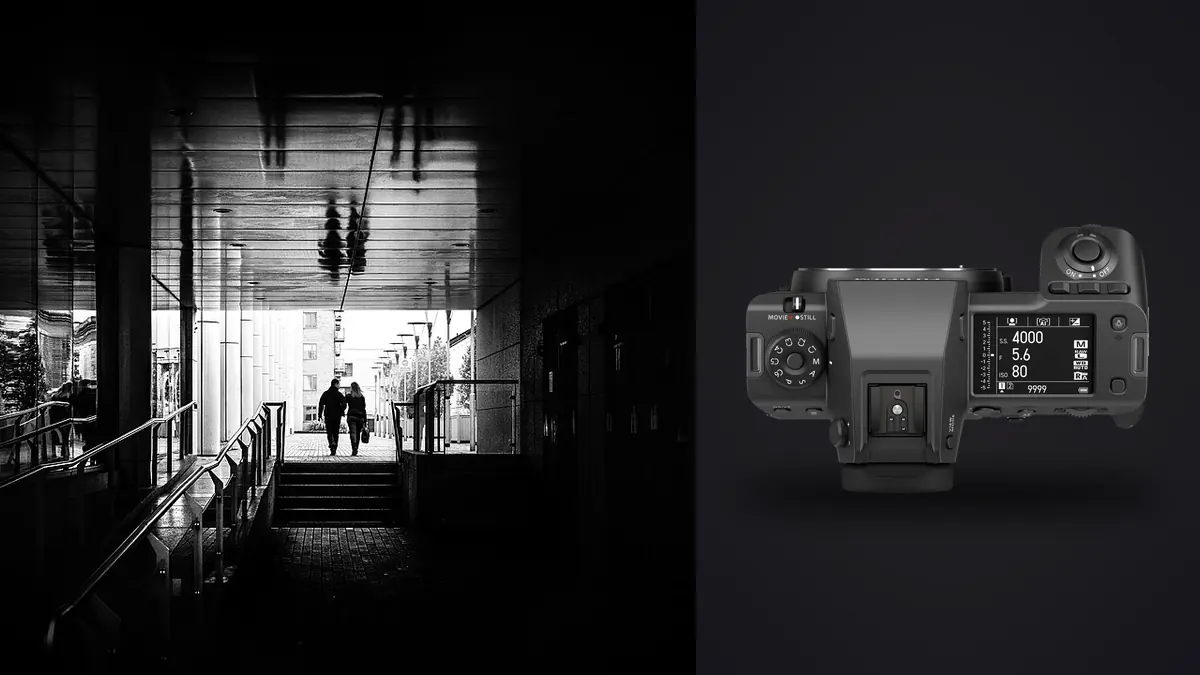
Medium format and street photography are not supposed to go together. One tradition prizes discretion, speed, and the ability to disappear into a crowd. The other has historically meant tripods, studio strobes, and a body the size of a lunchbox. So when I started carrying a Fujifilm GFX 100 II through market days, protests, and back alleys for a documentary project, I expected to hate it within a week. I did not. I did, however, learn exactly where it earns its keep and exactly where it gets in the way, and those two lists are the reason this piece exists.
Why carry a medium format body onto a sidewalk at all
The obvious counter-argument is that a 102-megapixel sensor is wasted on a genre built around grabbed moments and imperfect framing. That argument holds up right until you're standing in a shaft of window light with a market vendor backlit against an open doorway, blacks crushing on one side of the frame and highlights blowing on the other. The GFX 100 II's larger sensor (43.8 x 32.9mm, noticeably bigger than full frame) gives you real recoverable range in that kind of light, the sort of scene that a smaller sensor forces you to choose a side on. For documentary work where you often can't ask anyone to hold still while you bracket exposures, that latitude changes what you're willing to attempt.
The second argument, and the one that actually convinced me, is reframing after the fact. Street and documentary photographers crop more than they admit. A 102MP file gives you room to punch in on a gesture, straighten a horizon that was never level because you were moving, or pull a portrait out of a wider environmental frame, all without the image falling apart at print size. On a 24MP body that kind of cropping is a last resort. On this camera it's a legitimate part of the process.
Handling and discretion in real conditions
Here's where the compromises start. The GFX 100 II body alone weighs about 1,030g, and paired with the GF55mm f/1.7 (the closest thing this system has to a nimble street lens) you're carrying roughly 1.5kg around your neck for a full day. Compare that to a Fujifilm X100VI at 478g or a Leica Q3 at 743g, and the difference is not subtle after eight hours on foot. My shoulder noticed on day one.
Size matters for discretion too, and it matters more than weight. The GFX body with a lens attached is simply not a small object. People notice it. In documentary contexts where you're trying to build trust with a subject over repeat visits, that visibility can work against you the first few times, though I found it flips into an advantage once people know who you are and what the "big camera" is for; it starts to signal seriousness rather than surveillance. For anonymous street work where you want to be invisible in a crowd, it's a real handicap and I wouldn't pretend otherwise.
The electronic shutter is fully silent, which matters more here than it would on a sports body. In a quiet room, a courtroom hallway, a wake, situations where a mechanical shutter clack is genuinely disruptive, being able to shoot without sound is not a gimmick, it's the difference between getting the frame and not being allowed back in the room. The mechanical shutter, by contrast, has a distinct and fairly loud clunk that carries in a quiet space, so know which mode you're in before you press the button.
Autofocus that (mostly) keeps up with a moving street
The original GFX 100 had contrast-detect AF propped up by phase-detect assistance, and it showed: subjects walking toward camera at any pace would hunt. The GFX 100 II moved to a proper phase-detect system covering nearly the whole sensor, with the subject-detection algorithms Fujifilm has been refining across its X-series bodies (human eye and face, plus animal and vehicle modes) ported over. In practice, that means a person walking at a normal pace across the frame gets tracked reliably, and eye detection locks on close-range candid portraits without much hunting.
It is not a sports camera. Someone jogging or a cyclist weaving through traffic will occasionally throw the tracking off, and the buffer clears slowly enough after a burst that you don't want to be trigger-happy the way you might on a smaller-sensor body built for speed. Rolling shutter is also worth knowing about if you shoot electronic-only: fast horizontal motion (a car, a hand swinging into frame) can skew, and some LED-lit interiors will band under the electronic shutter's read-out speed. For walking-pace documentary work, none of this is a dealbreaker. For anything faster, it's a real limitation you should test before you rely on it.
The file problem nobody warns you about
A day of documentary shooting on this camera generates an amount of data that catches people off guard the first time. Uncompressed 102MP raw files run 200MB or more each; even the lossless-compressed raw option, which is what I shoot by default, lands around 100-130MB per frame. Shoot a wedding-style documentary day with any real volume of bursts and you can walk away with 400-600GB on a single card, before you've touched a single edit.
That volume changes how culling has to work. Scrolling through hundreds of near-duplicate frames at full 102MP resolution in a general-purpose editor is genuinely slow, and it's the stage where most of my time used to disappear. This is the part of the workflow where I lean on imagic: it runs the sharpness and focus scoring locally on the machine, so it can chew through a folder of GFX raws and flag the genuinely sharp frame out of a burst without me pixel-peeping each one, and because everything happens on-device rather than through a cloud upload, I'm not sending documentary subjects' faces (sometimes in sensitive situations, sometimes people who explicitly asked not to be shared before consent was sorted) to a third-party server just to find out which frame is in focus. The duplicate and burst clustering also earns its keep specifically with this camera, since the file sizes make manually comparing five nearly-identical frames a genuinely tedious task rather than a quick glance.
How it stacks up against other cameras people actually consider for this work
I get asked fairly often whether the GFX 100 II is a reasonable alternative to the more traditional street cameras, so here's how the numbers actually compare, not the marketing versions.
| Camera | Sensor | Resolution | Body weight | Max burst | Native ISO | Approx. body price |
|---|---|---|---|---|---|---|
| Fujifilm GFX 100 II | 43.8 x 32.9mm medium format | 102MP | 1,030g | 8 fps | 80-12800 | $7,499 |
| Fujifilm X100VI | APS-C | 40MP | 478g | 11 fps | 125-12800 | $1,599 |
| Leica Q3 | Full frame | 60MP | 743g | 15 fps | 50-100000 | $5,995 |
| Sony a7CR | Full frame | 61MP | 515g | 8 fps | 100-32000 | $2,998 |
The honest read of that table: the GFX 100 II wins on dynamic range and file latitude, loses on weight, burst speed, and price, and sits in an odd middle ground on resolution where the X100VI and the Q3 have both closed most of the gap that used to justify medium format for a still-life shooter, let alone a street photographer. You're not choosing this camera because the spec sheet says it's the best street tool. You're choosing it because you specifically want the color science and tonal range for a project that's more documentary essay than fast-reaction street snapshot.
Lens choices that actually suit the pace of documentary work
The GFX system's crop factor relative to full frame is about 0.79x, so focal lengths translate a bit differently than people expect. The GF55mm f/1.7 (roughly a 43mm full-frame equivalent) has become my default; it's fast enough for available-light interiors and close enough to a natural angle of view that portraits don't look distorted. The GF80mm f/1.7 (about 63mm equivalent) is the one I reach for when I want compression and separation for a tighter portrait, though it's less forgiving in cramped spaces. For genuine walk-around documentary coverage where you can't predict the next frame, the GF35-70mm f/4.5-5.6 zoom is the pragmatic choice, even though the variable aperture costs you stops in low light that the primes don't. None of the current GF lenses are what I'd call small, so lens choice here is really a question of which compromise you want, not which one avoids compromise entirely.
Color, film simulations, and matching a personal look across a shoot
One thing this camera genuinely does better than most: the in-camera film simulations (Provia as a neutral base, Classic Chrome for a desaturated documentary look, Acros for black and white) give you a strong starting point straight out of camera, which matters when you're handing edits to a client or publication on a tight turnaround. But film simulations are still a starting point, not a finished edit, and getting a consistent look across a shoot with 400 selects is its own job. That's the other place imagic fits into my workflow: I trained its apply_my_style feature on a batch of my own previously graded documentary work, so once the culling pass is done, the shortlist gets a first pass in something close to my actual grading habits instead of a generic preset, and I'm doing manual adjustments on the outliers rather than every single frame. If you haven't built a personal color process yet, it's worth reading through a general framework for it before you try to encode your own style; the guide to photo color grading covers the fundamentals I'd start from.
Where it genuinely falls short
I don't want to oversell this. Battery life is rated around 540 shots CIPA and I routinely see less in cold weather or with the EVF running constantly, so a second battery is not optional for a full documentary day. The mechanical shutter sound rules out certain quiet-room situations that a leaf-shutter rangefinder handles without a thought. Buffer depth, while much improved over the original GFX 100, still empties slower than a sports-oriented body when you're shooting long bursts of 102MP compressed raw. And at $7,499 for the body alone, before a single lens, this is not a camera you buy to try street photography. It's a camera you buy because you already know you want its specific tonal character for a specific kind of long-form documentary project, and you're willing to carry the extra weight and cost to get it.
A workable field-to-edit routine
The routine that's worked for me over several months: shoot lossless-compressed raw rather than uncompressed (the quality difference is not visible in practice and it roughly halves file size), cull the same evening rather than letting a backlog build (the files are too large to let a week of shooting pile up untouched), and keep the culling pass entirely local and offline, both because 100+GB folders don't want to move through a slow upload and because a lot of documentary subject matter shouldn't be leaving your machine at all. In practical terms that means dumping the card straight into imagic before I even open a browser tab, letting the sharpness scoring and burst clustering do the first sort while I eat dinner, then coming back to a folder that's already a fraction of its original size. If your current process still involves manually clicking through every burst, it's worth comparing how much time a dedicated culling pass actually saves; the piece on faster photo workflow habits has a few adjustments that apply regardless of which camera produced the files.
Frequently Asked Questions
Is the GFX 100 II fast enough to actually catch decisive moments on the street?
For walking-pace subjects and typical street scenes, yes, the phase-detect autofocus and 8fps burst are enough to catch a gesture or an expression reliably. For fast, erratic motion (running, cycling, sports-adjacent action) it will miss more often than a camera built specifically for speed. Match your expectations to the kind of documentary work you're actually doing rather than assuming it behaves like a Sony a9-class body.
Does the file size actually matter if I have a big enough hard drive?
Storage capacity isn't the bottleneck, review time is. Culling a folder of 100+MB raw files by eye, frame by frame, at full resolution is noticeably slower than doing the same with 24MP files, and it adds up fast across a multi-day shoot. This is less a storage problem and more a reason to lean on software that can score sharpness and cluster bursts automatically rather than doing it manually.
Can I get away with one lens for a full documentary project?
The GF55mm f/1.7 covers most situations reasonably well and is the lens I'd pick if forced to choose one, but you'll feel its limits in tight interiors and at a distance. If the project allows for two lenses, pairing it with the GF80mm f/1.7 for tighter portraits covers the range most documentary work actually needs without carrying the whole system.
Is medium format overkill compared to a full-frame camera for this kind of work?
For pure street photography where speed and invisibility matter most, yes, a smaller full-frame or APS-C body is usually the more practical tool. Medium format earns its place specifically for documentary projects where dynamic range, print size, or a particular tonal character matter as much as the moment itself, and where you have the time and physical tolerance to carry the extra weight for it.