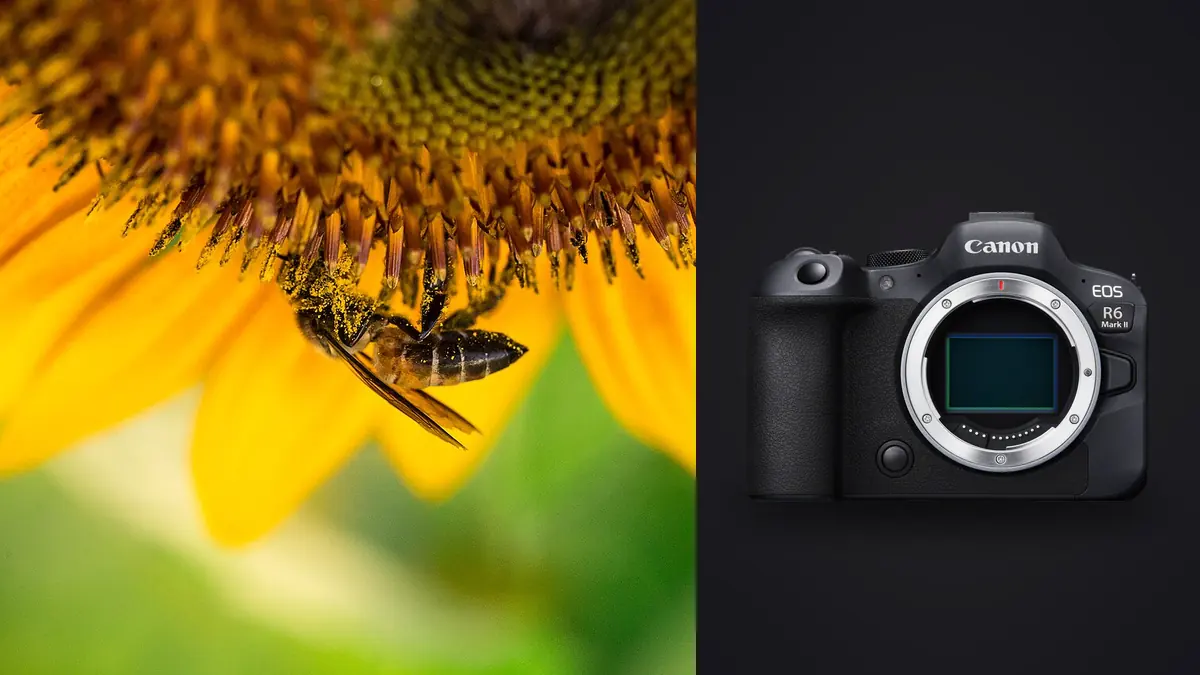
I spent three mornings in a row this spring lying on wet grass next to an irrigation ditch, chasing a pair of damselflies that would not sit still for more than four seconds at a stretch. By the third morning I had a much clearer opinion of what the Canon EOS R6 Mark II is actually good at for insect macro work, and what it merely tolerates. This isn't a spec sheet rewrite. It's what changed in my keeper rate once I stopped shooting the R6 II like a landscape body and started shooting it like a camera built for a genre that punishes hesitation.
What the Sensor and Readout Speed Actually Give You
The R6 Mark II's 24.2 megapixel full-frame sensor is not the resolution flagship in Canon's own lineup, and for insect work that matters more than people admit. A dragonfly filling maybe a fifth of the frame at 1x magnification leaves you cropping hard in post, and 24MP runs out of room faster than the R5's 45MP does. What the R6 II trades for that is a genuinely fast sensor readout: up to 40fps in electronic shutter mode, 12fps mechanical. For anything that startles at the click of a mirror-less shutter (and most insects do, even without a mirror slapping), that speed is the difference between catching a mantis mid head-turn and catching an empty leaf.
The catch is rolling shutter. At 40fps electronic, fast wing motion (bee wings, hoverfly wings, a dragonfly taking off) can smear or skew in a way mechanical shutter won't. I shoot electronic for stationary or slow-crawling subjects where I want silence and speed, and I switch back to mechanical the moment wings start moving, even at the cost of a lower frame rate.
Lenses That Actually Get Used for This
The R6 II body doesn't do insect macro on its own, obviously, and the lens choice changes the whole experience more than any menu setting does. Here's how the options I've actually used stack up against each other in the field, not on a spec sheet.
| Lens | Max magnification | Working distance at max mag | Autofocus | Best for |
|---|---|---|---|---|
| RF 100mm F2.8L Macro IS USM | 1.4x | ~135mm | Fast USM AF | General insect work, anything that moves |
| Laowa 100mm f/2.8 2X Ultra Macro APO (RF native) | 2x | ~150mm | Manual only | Mid-range extreme detail, slower subjects |
| Canon MP-E 65mm f/2.8 1-5x (EF, adapted) | 5x | ~40mm | Manual only | Compound eyes, scale detail, tripod/rail work |
| RF 24mm Macro IS STM | 0.5x | ~85mm | Fast AF | Habitat/context shots, not frame-filling macro |
The RF 100mm L is the one that lives on the camera. It autofocuses fast enough to track a bee moving across a flower head, it's weather sealed to match the body, and 1.4x is enough magnification for the vast majority of insect subjects without forcing you onto a rail. The MP-E 65mm is a different animal entirely: no autofocus at all, no image stabilization, and a working distance so short at 5x that you're basically photographing anything that will tolerate the lens hood a few centimeters from its face. It's the lens I bring specifically for jumping spider eyes and beetle mandibles, never for a general session, because handholding it is genuinely difficult and most of my usable frames from it come off a focus rail.
Autofocus: Where It Helps and Where I Stop Trusting It
The R6 II's Dual Pixel CMOS AF II covers 1053 AF zones and does subject detection for people, animals, and vehicles, but insects aren't one of the trained categories the way birds or dogs are. Point it at a dragonfly and it will sometimes lock on using general contrast detection, and sometimes it won't find anything to grab at all, particularly against a busy background of leaves. I stopped relying on eye-detect AF for insects months ago. What I use instead is a single small AF point, moved with the joystick, paired with back-button focus so a half-press of the shutter doesn't hunt and lose the frame I already had focused.
At true macro magnifications (past about 0.7x) autofocus starts to work against you anyway, because depth of field gets so thin that the camera's AF system is hunting across a plane that's a millimeter or two deep. Past 1x I focus manually almost every time, using focus peaking on the rear screen, and let the lens or my own body sway do the fine work of finding the plane I want sharp.
On the stabilization side, the R6 II's coordinated IS is rated up to 8 stops with compatible lenses, and it's genuinely useful for steadying the viewfinder while you compose at 1x magnification handheld. But once you're locked onto a subject at high magnification, camera shake stops being your main source of blur, subject sway does (a bee shifting its weight on a stem, wind moving a leaf a millimeter). IBIS doesn't fix that, and no amount of stops rating will.
Dialing In Focus Bracketing
This is the feature that actually changed my insect photography, more than any AF setting. The R6 II has focus bracketing built into the shooting menu: number of shots, focus increment (1 to 8), and exposure smoothing to compensate for the aperture shift that happens as focus moves through a stack. The camera captures the sequence; it does not merge it. You still need Photoshop, Helicon Focus, or Zerene Stacker afterward to combine the frames into one deep-focus image.
What I've settled on for different subjects, after a lot of wasted stacks that either didn't cover enough depth or captured way more frames than I needed:
| Subject | Shots | Focus increment | Notes |
|---|---|---|---|
| Moth or butterfly, wings closed, side profile | 15-20 | 3 | Need coverage from antennae to trailing wing edge |
| Bee or fly on a flower, slight wind sway | 8-12 | 5 | Keep the burst short, the subject won't hold still long |
| Dragonfly, full body, perched | 25-30 | 2 | Long body at 1x needs many thin slices |
| Jumping spider face and eyes | 10-15 | 2 | Tiny target, fine increments matter more than count |
A wind-sensitive subject like a bee on a flower will often ruin a 25-shot stack halfway through when the flower shifts. I'd rather bracket a slightly shorter set that fully misses stacking cleanly than lose the whole sequence to motion between frame 4 and frame 5. Static subjects like a resting moth on bark get the long, patient treatment because nothing's going to move.
Aperture, Shutter, and ISO in the Actual Field
Handheld macro at 1x forces you into a corner: you want enough aperture (f/8 to f/14 in my experience) to get any usable depth of field, but stopping down that far at macro magnification eats light fast, and diffraction starts softening detail past about f/13 on this sensor. I compensate with shutter speed compromises I wouldn't make in other genres: 1/200s to 1/320s handheld with the lens IS engaged for anything not actively flying, and I lean on the R6 II's clean ISO performance up to about 3200 to make that exposure work rather than dropping shutter speed further and fighting hand-shake on top of subject sway.
For anything airborne, I raise shutter speed to 1/1000s or faster and accept a shallower aperture, because a sharp wing at f/5.6 beats a technically deeper but motion-blurred frame at f/11. A small diffused flash or LED panel earns its keep here far more than it does in other kinds of photography, since it lets you close the aperture down without pushing ISO into territory where fine hair and scale detail on an insect starts to smear.
Battery, Cards, and the Volume Problem
A single morning of insect macro with regular focus-bracketed stacks burns through frames at a rate most other genres don't produce. Twenty subjects, each with an 8 to 30-shot bracket plus a handful of safety single frames, adds up to well over a thousand images before lunch. The LP-E6NH keeps up reasonably well (Canon's own rating hovers around 580 shots through the viewfinder, and live view on the rear screen for critical macro focusing drains it faster than that), but I still carry a spare on any full-day session, and dual UHS-II card slots mean I'm not stuck reshooting a morning because one card filled or failed.
The bigger problem isn't the camera, it's what happens when you get home with a card full of near-duplicate bracket sequences. This is where I stopped trying to sort things manually. I run the card through imagic before I open Photoshop at all. Its duplicate and burst clustering groups each bracket sequence together instead of handing me thirty flat thumbnails that all look identical at a glance, and the local sharpness scoring flags which frame in a stack (or which single frame in a burst of a moving bee) is actually the sharpest, which matters a lot when you're deciding what to feed into a stacking program versus what to discard outright. It all runs locally on the laptop I bring into the field, no upload required, which matters when I'm shooting somewhere with no signal at all.
From Card to Finished Set
Once the stacks are grouped and the sharpest frames are flagged, the actual editing on insect macro tends to be repetitive in a useful way: similar white balance corrections for outdoor shade, similar clarity and micro-contrast pushes to bring out texture on chitin and wing veins. After grading enough of these sessions the same way, I use imagic's apply_my_style feature, which learns from edits I've already made rather than a generic preset pack, to apply that look automatically to a fresh batch before I do the finishing touches by hand. It's saved me the most time on days with more than a few hundred keepers, which insect macro produces more often than most other subjects I shoot. If your culling process is still the bottleneck rather than your shooting, it's worth reading through a few workflow adjustments that apply directly to high-volume field days like this.
Frequently Asked Questions
Does the R6 Mark II autofocus reliably on dragonflies and bees?
Reliably enough for slow, crawling subjects against a clean background, less reliably against foliage or for anything under about 0.7x magnification where autofocus hunting outpaces the depth of field you're working with. I treat it as a starting point and switch to manual focus with peaking once I'm framed close.
Is adapting the MP-E 65mm to RF worth it on this body?
If you specifically want 3x to 5x magnification for eyes and scale detail, yes, and the adapter works fine mechanically. But it's a specialist tool, fully manual, no stabilization, and best used on a focus rail rather than handheld. I wouldn't buy it as a first or only macro lens for this camera.
What aperture should I actually be shooting for full-body insect shots?
f/8 to f/11 is my usual range for a single frame with reasonable depth. Past f/13 or so, diffraction softening on this sensor starts costing you more sharpness than the extra depth of field gains you, which is part of why focus bracketing is worth the extra setup time for anything with real body length.
How many bracketed frames should I actually bring home per subject?
Enough to cover the depth you need at your chosen increment, and no more. Overshooting a stack on a subject that might move just increases the odds the sequence gets ruined partway through. I'd rather nail a tight 10-shot bracket than lose a 30-shot one to a gust of wind at frame 18.