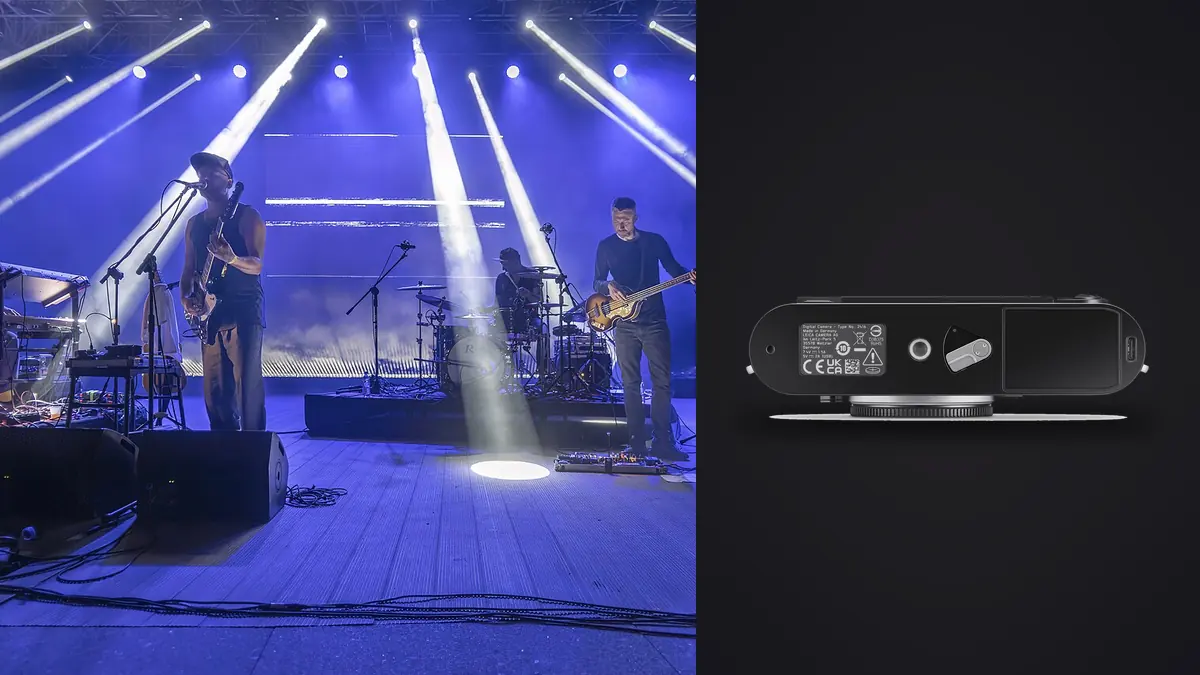
The first time I brought a Leica M11 into a 300-capacity club instead of my usual DSLR body, the sound engineer noticed before anyone in the band did. No mirror slap, no motor drive rattling off eight frames between songs, just the soft click of a mechanical shutter that got lost under the bassline. That's the honest case for the M11 in live music work: it is not the fastest tool in the pit, and it will not autofocus on a drummer's sticks mid-swing, but for photographers who work small rooms, quiet sets, or festivals where the photo pass says no motorized advance near the stage, it does something almost nothing else on the market does as well.
Why a Rangefinder Body at All in a Photo Pit
Every pit photographer has stood next to someone carrying two pro bodies with grips and 70-200mm zooms, and felt slightly ridiculous holding a camera that weighs about as much as one of their lenses. The M11 body is around 530g, no grip, no protruding zoom barrel. Over a three-hour bill with four support acts, that weight difference matters more than it sounds like it would on paper. My shoulder knows the difference by the third band.
The bigger reason I reach for it, though, is the shutter. Most pits enforce the "first three songs, no flash" rule, but plenty of smaller venues and seated acoustic shows add their own restriction on top: no visible or audible camera noise past the front row. A mirrorless body in silent electronic mode gets you there too, but the M11's mechanical shutter is already quiet enough that I've shot unplugged sets from the second row without anyone in the first three rows turning around. That's not a spec sheet advantage. That's the difference between getting invited back to shoot a venue's residency series or not.
The Three-Song Rule Doesn't Care What Camera You Brought
Whatever body you're using, you get roughly nine to twelve minutes before security waves you out of the pit. With a fast-burst mirrorless camera, the instinct is to hold the shutter down and sort it out later. The M11 tops out around 4.5 frames per second and the buffer is not built for spray-and-pray, so it forces a different habit: watch the singer's phrasing, anticipate the beat where they lean into the mic, and take the shot deliberately. I've found this actually improves my hit rate on peak-moment expression shots, because I'm not scrolling through 40 near-identical frames afterward trying to find the one where the mouth isn't mid-word.
Manual Focus When the Subject Won't Hold Still
This is where most people assume the M11 is a bad idea for concert work, and honestly, for a thrashing four-piece punk band with a drummer who won't stay behind the kit, it can be. Rangefinder focusing rewards subjects who move in a predictable arc more than subjects who move erratically. A vocalist rooted at a mic stand, a guitarist anchored near a pedal board, a pianist seated at a bench: these are workable. A drummer mid-fill or a frontman leaping off a monitor wedge is a different problem entirely, and I've missed plenty of those frames simply because the focus patch didn't lock in time.
What actually works is zone focusing rather than chasing the rangefinder patch for every frame. At f/2.8 and roughly 3 meters, you've got enough depth of field to cover a singer swaying a half step in either direction without refocusing every shot. I preset that distance on the lens barrel before the song starts, watch the frame line, and only correct focus when someone steps noticeably closer or further from the mic. Wide open at f/1.4 on the 35mm, that margin shrinks to almost nothing, so I only shoot that wide for a subject standing still, like a between-song moment where someone's tuning a guitar under a single spotlight.
For anyone shooting fast Leica glass like a 75mm Noctilux at f/1.25, I'd genuinely recommend the Visoflex 2 electronic viewfinder attachment. It adds focus peaking on top of the traditional rangefinder patch, and at apertures that thin, peaking catches misses the patch alone won't. It's an extra accessory to carry and it does slow down your eye-to-viewfinder speed slightly, but for headliner sets where I want a handful of genuinely tight, wide-open frames, it's worth the tradeoff.
ISO, Shutter Choice, and the Sensor's Real Ceiling
The M11's sensor runs a native ISO floor of 64 and climbs to 50000 on paper, but the number that matters for club work is where the files still hold up under a heavy edit. In my experience that's somewhere around ISO 6400 to 12500 depending on how much of the frame sits in shadow. Push past that under mixed tungsten and cheap LED stage washes and you start losing shadow detail exactly where a musician's face usually is, since stage lighting design tends to spotlight from above and leave everything below the jaw underexposed.
Shutter choice matters more than people expect at small venues. Cheap LED stage lighting flickers at frequencies the electronic shutter can catch as visible banding across the frame, especially at faster electronic shutter speeds. I default to the mechanical shutter for anything lit by a rig I don't recognize, and only switch to full electronic silent mode when the room genuinely demands total silence and the lighting is steady enough (older tungsten fresnels, for instance) that banding isn't a risk. It's a tradeoff between silence and reliability, and I make that call venue by venue rather than picking one mode and leaving it.
The 14-bit DNG files do give real recovery room on the highlight side, which matters a lot under a single hard spotlight. I've pulled back detail from a vocalist's face that looked almost fully blown on the rear screen, simply because the actual sensor data underneath had more information than the JPEG preview suggested. That's saved more shots than raw high-ISO performance has, honestly.
Triple Resolution Mode and Getting Through a Three-Hour Bill
One feature that actually changes how I work a multi-band night is the M11's triple resolution DNG capture, which lets you shoot at the full 60MP or step down to 36MP or 18MP without swapping cards or changing any other setting. I don't use one setting all night. Support acts I'm covering loosely get the smaller file size so I'm not burning card space and buffer depth on a band whose photos might never get used. The headliner, where a label or the band's own team might want a large print or a poster crop later, gets full resolution.
| Resolution mode | Approx. file size (DNG) | Frames before buffer noticeably slows | When I actually use it |
|---|---|---|---|
| L-DNG (60MP) | ~75-95MB | Roughly 10-14 frames in a fast run | Headliner set, close-up portraits, anything I might print or crop hard |
| M-DNG (36MP) | ~45-60MB | Roughly 18-22 frames | Mid-bill support act, wide stage shots, general coverage |
| S-DNG (18MP) | ~20-28MB | Rarely hits a real slowdown in a normal set | Opener I'm covering loosely, or a long acoustic set where I'm shooting sparingly anyway |
Those buffer numbers are field observations from my own cards and shooting style, not a lab test, but they're consistent enough that I plan around them. At full resolution, I know I get roughly a dozen usable frames in a quick run before the camera visibly pauses to write, which is plenty for the deliberate, zone-focused shooting style the rangefinder already encourages. It's a poor match for someone trying to burst through a mosh pit crowd-surf moment, but that was never really this camera's job.
Lenses That Actually Earn Their Place in a Pit
With no zoom option in the M-mount lineup, every lens choice is a decision about where you'll physically stand, made before the song starts rather than adjusted mid-shot. My rotation for most bills is a 35mm Summilux for wide stage context and full-band shots from the rail, a 50mm APO-Summicron for the workhorse mid-distance portrait, and a 75mm Noctilux when I want a genuinely tight face shot from further back, whether that's the far end of the pit or the sound desk on a bigger stage.
The lack of a zoom is a real limitation for pit work, where you often only get those first three songs and no second chance to reposition once security moves you. I've learned to pick my lens for the set based on the stage layout during soundcheck rather than guessing, because switching lenses mid-song in a packed pit costs you shots. It's a slower, more deliberate way to shoot than a 24-70mm zoom gives you, and it's not for everyone covering four bands in one night on a tight deadline.
The Cull After Load-Out
A full bill with an opener, two support acts, and a headliner easily produces 600 to 1000+ frames by the time you're driving home, and at 60MP those L-DNG files add up to a genuinely large folder fast. Going through that many manual-focus rangefinder shots by eye, at full resolution, looking for the ones where focus actually landed, is the part of this workflow nobody romanticizes.
This is where I lean on imagic rather than scrubbing through Lightroom's grid view for an hour. Its local sharpness scoring is particularly useful with rangefinder files specifically, because it flags the near-misses, the frames where focus landed just behind the eyes instead of on them, which are easy to miss on a laptop screen at 100% zoom when you're tired at 1am. The duplicate and burst clustering also helps on the handful of moments where I did hold the shutter down, grouping those near-identical frames so I'm choosing between three similar shots instead of scrolling past all of them individually. Because the whole process runs locally with no cloud upload, I'm also not uploading a band's unreleased stage setup or backstage shots anywhere before I've had a chance to review what's actually going out. For more on how that local scoring approach compares to manually eyeballing a folder, there's a breakdown at how AI photo culling works.
Keeping a Consistent Look Across a Set Shot Under Changing Light
Stage lighting rarely stays consistent through a set. A band might open under cool white washes, shift to warm ambers for a ballad, then finish under a saturated red or blue for the closer. Delivered as a gallery to the band or their label, wildly inconsistent color temperature from song to song reads as sloppy even though it's really just the venue's lighting designer doing their job.
I built out an apply_my_style preset in imagic from a batch of concert edits I was already happy with, and running a night's new take through it gives me a consistent starting grade before I go song by song and correct for whatever that particular lighting cue actually needs. It's not a substitute for finishing the real standout frames by hand in Lightroom or Capture One, but it saves me from re-deriving my own baseline look from scratch on every single import. If color consistency across mixed lighting is something you're still figuring out, the guide to photo color grading covers the underlying logic in more depth than I can here.
What I'd Tell Someone Considering This for Live Work
The M11 is not the right camera for someone shooting a festival main stage where the brief is "get everything," or for anyone who needs continuous autofocus tracking a drummer's sticks or a crowd-surfer overhead. For that work, a modern mirrorless body with real subject tracking will out-shoot it every time, and I still reach for one when that's the assignment.
Where the M11 genuinely earns its keep is smaller rooms, seated shows, jazz sets, singer-songwriter bills, and any gig where discretion and quiet actually change what you're allowed to shoot. The body and a couple of fast primes is not a cheap way into concert photography, and the manual-focus miss rate is real even once you've got zone focusing down. But because that miss rate is real, having a culling process that's fast and doesn't depend on staring at every frame at full zoom matters more with this camera than with most, and it's one of the reasons a local, one-time-purchase tool like imagic fits this workflow better than something that expects you to upload a full night's shoot to review it.
Frequently Asked Questions
Can the M11's rangefinder actually keep up with a singer moving around a small stage?
For predictable movement, someone swaying near a fixed mic stand or working a small radius around a piano, yes, especially with zone focusing set up before the song starts. For a frontman who's constantly changing distance from you, expect a real miss rate, and lean toward a smaller aperture like f/2.8 or f/4 to buy yourself more depth of field margin.
Is the electronic shutter actually silent enough for an acoustic or unplugged set?
In full electronic mode, yes, it's silent in the literal sense that there's no shutter sound at all. The tradeoff is that cheap or older LED stage lighting can introduce visible banding at electronic shutter speeds, so I test a few frames early in the set before committing to it for the whole show, and fall back to the quiet-but-not-silent mechanical shutter if banding shows up.
How much storage should I bring for a full night covering multiple bands?
If you're shooting a mix of resolution modes the way I described above rather than full 60MP for every band, a 128GB card comfortably covers a four-band bill with room to spare. If you're shooting everything at full L-DNG resolution all night, budget closer to 256GB, since those files run 75-95MB each and add up fast once you're a few hundred frames in.
Do I need the Visoflex viewfinder attachment, or is the optical rangefinder enough?
For most of a normal set at f/2.8 or narrower, the standard rangefinder patch is enough. It's specifically wide-open work with something like an f/1.25 lens, where the margin for error is razor thin, that the Visoflex's focus peaking earns its keep. If your lens lineup rarely goes wider than f/2, you can probably skip it and save the weight.