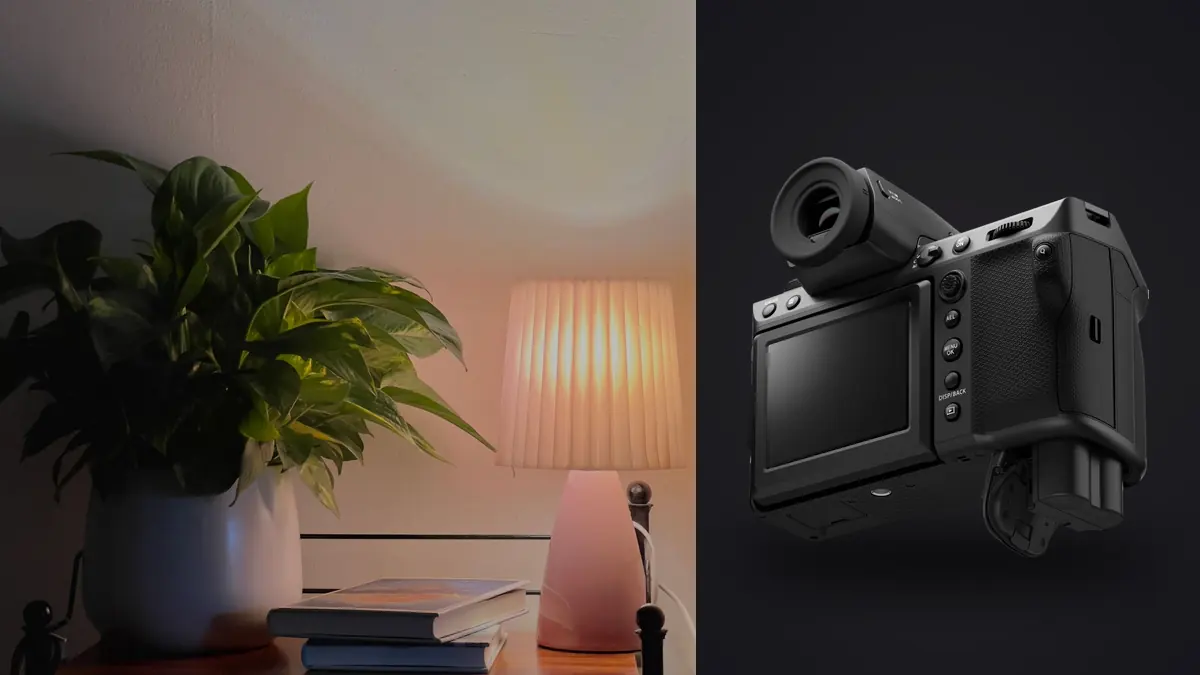
The first time you bring a Fujifilm GFX 100 II into a bedroom instead of a studio, it is easy to underestimate how much the camera itself will change the session. Boudoir and intimate portrait work lives or dies on trust, pacing, and the quality of skin rendering, and a 102-megapixel medium format body touches all three in ways a full-frame kit doesn't. This isn't a spec sheet. It's what actually happens when you shoot this genre with this camera, from the moment you walk into a hotel suite with a bag full of GF glass to the moment you're sorting four hundred RAW files at midnight.
Why Medium Format Changes How You Shoot Intimate Work
The GFX 100 II's sensor is physically larger than full-frame, which means the same aperture produces a different look. Shoot the GF80mmF1.7 wide open and you get a depth-of-field character closer to a full-frame 63mm at f/1.3, with a falloff that wraps around a shoulder or a collarbone instead of slicing it off in a hard line. For boudoir specifically, that gentler transition zone matters. Skin doesn't go from sharp to mush in one plane, it eases out, and clients who are nervous about being photographed at all tend to relax when they see proof frames that look soft and considered rather than clinical.
There's also the matter of tonal range. Fuji rates the sensor at roughly 14 stops of dynamic range, and in practice that shows up most in situations photographers in this genre deal with constantly: a client backlit by a single window, half her face in shadow, the sheets blown out behind her. On a smaller sensor you're choosing which part to sacrifice. On the GFX 100 II you usually don't have to, and that changes how boldly you can place a subject relative to a light source instead of chasing flat, safe lighting because the sensor can't hold both ends.
The tradeoff is file weight. A single compressed RAW runs 100 to 120MB depending on scene complexity, and if you lean on the pixel-shift multi-shot mode to build a 400-megapixel composite for a print client, you're looking at gigabytes per frame. I'll come back to what that does to a working RAW pipeline, because it's the part nobody mentions in the marketing copy.
Lenses That Actually Earn Their Place in the Bag
You don't need six GF lenses for this genre. In two years of shooting intimate portraiture with this system I've settled on three that cover almost everything, plus the kit zoom for days when I need to move fast between wide environmental frames and tighter details without a lens change.
| Lens | 35mm-equivalent field of view | Max aperture | Where it earns its keep in a boudoir session |
|---|---|---|---|
| GF63mmF2.8 R WR | ~50mm | f/2.8 | The "walk in the door" lens. Natural perspective for full-length and three-quarter frames in a normal bedroom without distortion at the edges. |
| GF80mmF1.7 R WR | ~63mm | f/1.7 | The workhorse for close, intimate framing. Wide open it separates the subject from a cluttered background (hotel headboards, patterned wallpaper) without needing a clean set. |
| GF110mmF2 R LM WR | ~87mm | f/2 | Compression for flattering angles and detail crops (hands, jewelry, fabric texture). Needs 8-10 feet of working room, which rules it out in cramped hotel rooms. |
| GF35-70mmF4.5-5.6 WR | ~28-55mm | f/4.5-5.6 | The bundled kit zoom. Slower glass, but useful for scouting a new location fast and shooting wider environmental context before switching to primes. |
The 80mm is the one I reach for most. At f/1.7 on this sensor the rendering is close enough to a fast full-frame 50mm that clients who've seen "boudoir photos" before recognize the look, but the files hold up to heavy cropping later, which matters when a client wants an 8x10 print of a detail you shot as part of a wider frame.
Exposure and Focus Settings That Hold Up in a Bedroom, Not a Studio
Most boudoir work doesn't happen in a controlled studio. It happens in a client's bedroom, a rented Airbnb, or a hotel suite with mismatched lamps and one usable window. The GFX 100 II's autofocus system, which Fujifilm rebuilt around a stacked sensor for this body, is noticeably faster at face and eye detection than the original GFX 100, and it holds onto an eye through hair, through a raised arm, through the kind of movement that used to force manual focus fallback on earlier medium format bodies. I still miss the occasional frame in low, warm lamp light where contrast is thin, so I've gotten in the habit of shooting a burst of three to five frames on any pose that matters rather than trusting a single shutter press. That habit alone accounts for the bulk of the file count problem I'll get into below.
For available-light sessions I typically sit between ISO 800 and ISO 3200. The sensor stays usable well past that, but grain starts interacting with skin retouching in ways I'd rather avoid at the editing stage, so I'd rather open a lens or drag a shutter speed down to 1/60 with the in-body stabilization doing the work than push ISO past 4000. The stabilization is rated to roughly 8 stops depending on the lens, and handheld at 1/30 with the 63mm is genuinely usable, which matters when you don't want to set up a tripod in someone's bedroom and make the whole thing feel more like a shoot and less like a private moment.
One setting I changed after my first few sessions: I switched the mechanical shutter off in favor of the fully electronic option whenever light allows. It's near silent, and for this genre specifically, the absence of a shutter clack changes the energy in the room. Clients who are already self-conscious relax measurably when the camera stops announcing every frame.
Keeping the Client Comfortable While You Work
The camera's four-axis tilting rear screen turns out to matter more here than in most genres. Boudoir clients want to see how they look, often mid-session, and being able to angle the screen toward them without breaking the pose or making them get up is a small thing that changes the pace of a shoot. Showing a client two or three frames early on, almost always ones where the lighting and expression worked, does more for the rest of the session than any amount of verbal reassurance.
Leaf-shutter GF lenses (the 110mm and a few others in the line) sync with flash up to 1/2000, which is a genuine advantage if you're mixing a single softbox with ambient window light and want to keep skies or windows from blowing out behind a subject. In practice though, most intimate portrait sessions work well with continuous LED panels or just window light rather than flash. A flash popping in someone's face during an already vulnerable session tends to work against the mood you're trying to build, so save strobes for sessions where the subject specifically wants a punchier, more editorial look.
What 102 Megapixels Does to Your RAW Workflow
Here's the part that doesn't show up in camera reviews. A three-hour boudoir session shot the way I described above, bursts of three to five frames per pose across maybe fifteen setups, easily produces 350-500 RAW files at 100+ MB each. That's 40-60GB from a single client before you've opened a single image. Multiply that by a few sessions a week and you have a storage and culling problem that full-frame shooters simply don't face at the same scale.
There's a second layer specific to this genre: these are some of the most sensitive images a client will ever hand a photographer. Uploading hundreds of intimate RAW files to a cloud culling service, even briefly, is a liability worth avoiding, and it's a question people are right to ask. This is where I've leaned on imagic for the culling pass. It processes everything locally on my machine, no upload step at all, which matters as much for the trust of the people photographed as for my own peace of mind when I'm sorting sensitive files. It also handles the burst problem directly: instead of me scrubbing through five near-identical frames from every pose deciding which eye is sharpest, its local sharpness and focus scoring flags the strongest frame in each burst and clusters the near-duplicates so I'm reviewing fifteen groups instead of eighty individual files.
The other piece that's saved real editing time is the apply_my_style preset feature. I trained it on a set of my previously finished boudoir edits, warm skin tones, lifted shadows, a specific desaturation on the highlights, and now a fresh set of culled RAWs gets a first pass that already looks close to my finished style before I touch a slider. For a genre where consistent, flattering skin tone across dozens of frames is the whole point, that head start matters more than it would on, say, a landscape set.
If you're comparing culling tools for this kind of volume, it's worth reading through how AI photo culling actually works before picking one, since the sharpness-scoring approach matters more when every frame has a face and eyes are the thing that has to be sharp.
Color, Skin Tone, and Film Simulations in Post
The GFX 100 II shoots 16-bit RAW, which gives noticeably more room to push midtone skin values before banding shows up, something I've run into on 14-bit full-frame files when pushing a heavier warm grade. I generally start grading from a baseline close to Fuji's Astia simulation rather than the punchier Velvia, since Astia's softer contrast curve and muted saturation sit closer to what boudoir portraits tend to need: warm, flattering, not oversaturated. From there it's mostly targeted adjustments, pulling a touch of magenta out of shadow areas where mixed lamp and window light creates a color cast, and lifting the black point slightly so skin in shadow doesn't go muddy.
Because the base files are large, I do the bulk of retouching at a downsampled working resolution and only flatten back to full size for final delivery or print files. If you haven't settled on a grading approach for skin-heavy work, the piece on color grading fundamentals covers the tonal separation techniques I use as a starting point before any genre-specific adjustments.
Frequently Asked Questions
Is the GFX 100 II too bulky for a moving, close-quarters boudoir session?
It's heavier than a full-frame body, especially paired with the 110mm, and you'll feel it after a three-hour session shooting handheld. In practice it hasn't slowed me down in tight rooms because the tilting screen and fast AF let me shoot from low or awkward angles without needing to bring my eye to the viewfinder every time, which is often the bigger constraint in a small bedroom than the camera's actual weight.
Do you need studio flash, or is window light enough for intimate portraits with this camera?
For most sessions, window light plus a reflector or a single continuous LED panel is enough given how the sensor holds dynamic range and performs at moderate ISO. Reserve flash for sessions that call for a more editorial, higher-contrast look, or when the location has genuinely poor natural light, like a windowless hotel room.
How much storage should I actually budget per session?
Plan for 40-60GB of RAW files from a typical three-hour session shot with the burst habit described above, more if you use pixel-shift for any frames. I keep a dedicated culling pass as the first step after import specifically to cut that number down before it hits long-term storage, rather than archiving everything and sorting later.
Does the smaller crop factor of the GF mount change how intimate portraits actually look compared to full-frame?
Yes, in a way that's easy to underestimate before you've shot it. The roughly 0.79x crop factor means a given focal length and aperture combination produces a shallower, more gradual depth-of-field transition than the same numbers on full-frame. For this genre that translates into softer background separation without needing to shoot at very wide apertures, which in turn keeps more of the face in acceptably sharp focus even at f/2.8 or f/4.
Was It Worth Switching for This Genre
For boudoir and intimate portraiture specifically, yes, and it's less about resolution bragging rights than about the combination of dynamic range, tonal depth, and the quieter, less clinical way the camera behaves in a bedroom. The cost is real: bigger files, heavier bodies and lenses, and a RAW pipeline that punishes anyone still culling by eye. If you're already shooting this genre on full-frame and considering the jump, budget time to rebuild your culling workflow around the file sizes before you budget for the camera itself, since that's the part that actually determines whether the extra resolution helps you or just buries you in storage. Photographers weighing the switch might also want to look at how different culling tools compare on large medium format files specifically, since not every tool handles 100MB+ RAWs at the same speed.