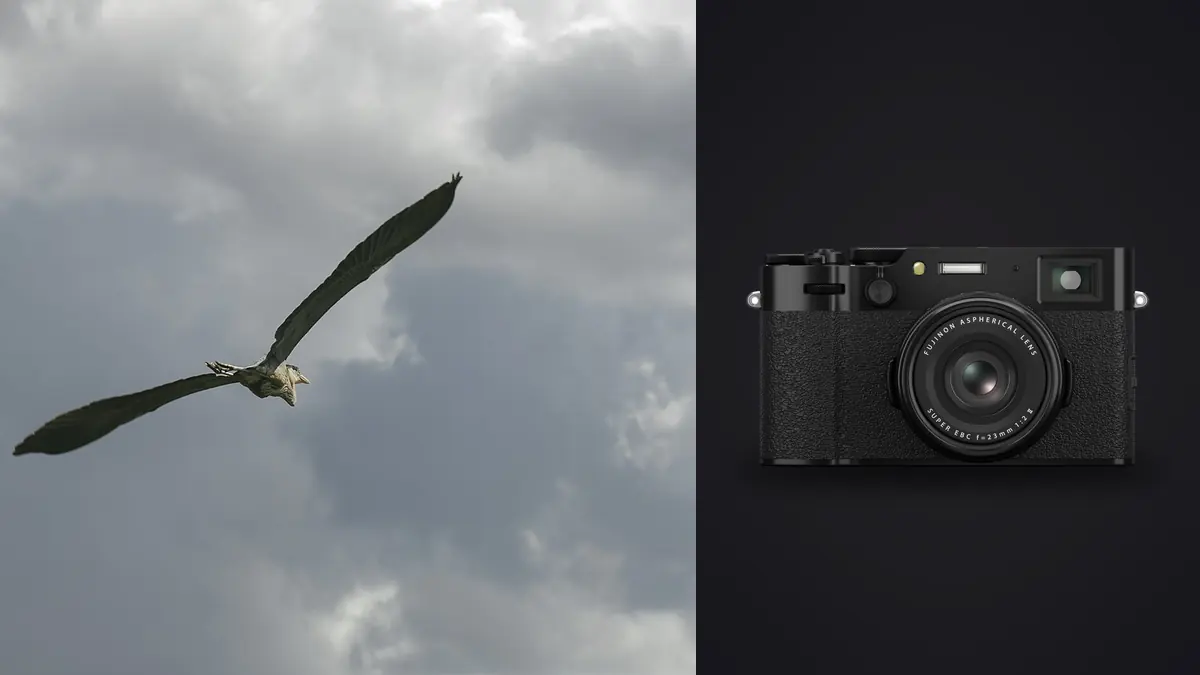
A 35mm Prime Is a Strange Choice for Bird Photography, and I Tried It Anyway
Someone in a camera forum asked me last month whether the Fujifilm X100VI could "do birding," because they already owned one for street work and didn't want to buy a second system. My honest first answer was no, not in the way most people mean when they say birding. Then I actually took the thing out to a reservoir for three mornings and revised that answer to a more useful "sometimes, and only if you change what you're trying to get."
The X100VI is built around a fixed 23mm f/2 lens, which on the APS-C sensor works out to roughly a 35mm field of view in full-frame terms. That is a documentary focal length. It is what Cartier-Bresson-adjacent photographers use to shoot a market stall or a doorway conversation, not what anyone uses to isolate a kingfisher on a branch forty meters away. There is no zoom ring. There is no telephoto option. If you are coming from a bridge camera with a 600mm-equivalent reach, or a DSLR with a 100-400mm lens on it, the X100VI will feel like showing up to a rifle range with a pocketknife.
So this article is not going to pretend the X100VI is a secret wildlife weapon. It isn't. Instead I want to walk through exactly what it can and can't do for birds, with real numbers instead of vague reassurance, because I think that's more useful than another "hidden gem" post that sends you home disappointed.
What "Reach" Actually Means on This Camera
The X100VI carries the 40.2-megapixel X-Trans CMOS 5 HR sensor, the same sensor family as the X-T5 and X-H2, paired with the X-Processor 5. That resolution is the entire reason this camera is even worth discussing for birds. A 40-megapixel file gives you room to crop hard after the fact, which partially compensates for having no telephoto glass. Partially. Not fully.
The Digital Teleconverter Isn't a Zoom
Fujifilm includes a Digital Teleconverter mode on the X100VI that simulates 50mm and 70mm equivalent framing. It's worth understanding what this actually does before you rely on it in the field: it crops the sensor output and reduces the exported resolution accordingly, it does not add optical magnification. The lens element never moves. If you shoot JPEG with the teleconverter engaged at 70mm-equivalent, you're getting a smaller file cropped from the same optical information a 23mm shot would have captured. If you shoot RAW instead and crop yourself in post, you get the identical framing with more control over exactly where the crop lands, plus the option to back off if the crop was too aggressive. I stopped using the in-camera teleconverter within about an hour of testing it, because there's no scenario where doing the crop blind in-camera beats doing it deliberately afterward with the full file in front of you.
What that means practically is that your real "reach" on this camera is a function of two things: how many pixels the sensor puts on your subject at native 23mm, and how much of that you're willing to throw away in post to get a tighter frame. Here's what that looks like at distances you'll actually encounter with birds:
| Scenario | Distance | Subject size | Approx. pixel width on subject | Realistic outcome |
|---|---|---|---|---|
| Gull cruising overhead at a harbor | 10 m | 1.2 m wingspan | ~900 px | Solid crop for web or social, wingtip detail holds together |
| Grey heron flying past over open water | 25 m | 1.8 m wingspan | ~540 px | Recognizable species shot, soft if you pixel-peep at 100% |
| Songbird working a garden feeder | 4 m | 0.15 m body length | ~280 px | Usable for a small print if the background is clean |
| Raptor circling a valley thermal | 60 m | 1.6 m wingspan | ~200 px | Species-ID record shot only, not a frame for the wall |
Those pixel counts come from the sensor's native 7,728-pixel width and the horizontal angle of view of a 35mm-equivalent lens, so treat them as a working approximation rather than a lab measurement. The pattern that matters is the trend: once a bird is more than about fifteen meters out, you're in record-shot territory, not portrait territory, no matter how you crop it afterward.
Autofocus Will Find the Bird. Whether You Can Frame It Fast Enough Is the Real Problem
Fujifilm's subject detection AF, inherited from the X-H2 and X-T5 processing pipeline, includes a dedicated Bird recognition mode, and it works better than I expected on a camera this size. Point it at a heron standing in reeds and it locks onto the eye reliably, tracks head turns, and holds focus through a reasonable amount of foliage clutter. That part of the system is not the bottleneck.
The bottleneck is that a 35mm-equivalent field of view is enormous compared to what bird photographers are used to composing in. A bird in flight crossing your frame at 15 meters covers that field of view in under a second, and because the subject only occupies a small fraction of the frame to begin with, your composition margin for error is tiny. With a 400mm lens you're tracking a bird that already fills a third of your viewfinder, so a little panning drift is forgivable. With the X100VI's native lens, a little drift and the bird is gone, or reduced to twenty pixels in the corner. Subject detection AF genuinely helps here because it will grab the bird the instant it enters frame rather than hunting, but it can't fix bad panning, and bad panning is the dominant failure mode with this focal length.
Shutter Speed, Drive Rate, and the Built-In ND Filter
The X100VI uses a leaf shutter, which tops out around 1/4000s mechanically and extends to roughly 1/180,000s electronically. For freezing a bird's wingbeat you want at least 1/2000s, ideally 1/3200s or faster for smaller, quicker-wingbeat species like swallows or terns, and the X100VI has no trouble hitting that even wide open at f/2 in good light.
Drive speed is where compromises show up. Continuous shooting tops out around 11fps on the mechanical shutter, and up to roughly 20fps on the electronic shutter if you accept a sensor crop and the rolling shutter skew that comes with fast-moving subjects and an electronic readout. For comparison, dedicated action cameras built for this kind of work often run higher sustained buffer depths at similar frame rates, so expect the buffer to fill faster on the X100VI during long bursts, especially shooting RAW at 40 megapixels a frame.
One feature that's genuinely useful and rarely mentioned in the context of wildlife is the built-in 4-stop neutral density filter. Birds tend to be most active in bright, harsh midday light around water, exactly when you'd otherwise be forced to stop down past f/5.6 or so to avoid overexposure at your fastest shutter speed. The internal ND lets you keep the aperture open near f/2 or f/2.8 in full sun without an external filter, which matters more than it sounds like it should when you're trying to separate a bird from a busy background at a focal length that already isn't doing you many favors on subject isolation.
In-Body Stabilization Doesn't Do What You Might Assume
The X100VI is the first camera in this lineup with in-body image stabilization, rated around 6 stops by Fujifilm's CIPA testing. That's a real improvement for handheld low-light work and for video, but be clear about what IBIS does and doesn't help with here: it compensates for camera shake during exposure, not for subject motion. A heron holding still at dusk benefits enormously from IBIS, letting you shoot a stop or two slower than you otherwise could. A heron flapping past at speed does not benefit from IBIS at all, because the blur you're fighting there is the bird moving, not the camera moving, and only shutter speed fixes that.
Where This Setup Actually Earns Its Keep
Birds in Their Habitat, Not Birds as the Whole Frame
The one genre where a 35mm-equivalent lens has an advantage over a telephoto is environmental wildlife photography, showing a bird small in its landscape rather than filling the frame. A flock of waders working a tideline at low light, a heron as a silhouette against a wide reed bed and setting sun, gulls scattered across a harbor with boats and nets in the background. Telephoto lenses compress and isolate; a wide prime includes context, and for storytelling images rather than field-guide portraits, that context is often the more interesting picture. I've gotten more usable frames out of the X100VI treating birds as one element in a wider scene than I have trying to make it behave like a telephoto substitute.
Birds That Come to You
Urban and semi-tame species change the math entirely. Gulls that have learned to beg at a harbor wall, ducks and swans on a park pond used to people, pigeons and starlings in a plaza. When the working distance drops to three or four meters instead of twenty-five, the pixel-on-subject numbers from the table above flip in your favor and the X100VI's compact, unintimidating body becomes an asset rather than a liability, since birds habituated to people tend to spook less at a small rangefinder-style camera than at a person holding what looks like a bazooka.
Weather Sealing Has a Catch Most Buyers Miss
The X100VI is rated weather resistant, but only once you've fitted the optional AR-X100 adapter ring and a protective filter over the front element. Straight out of the box, with nothing screwed onto that filter thread, the seal at the lens is incomplete and Fujifilm doesn't claim weather resistance for that configuration. If you're planning dawn sessions near water where mist, spray, and condensation are a given, budget for that ring and filter before you're standing at a reservoir edge in September fog wondering why the manual's weather claims don't seem to apply to your setup. It's a small thing, but it's the kind of detail that only shows up after you've already gotten the camera wet.
Dealing With the Volume of Frames Afterward
Whatever the hit rate looks like with this focal length, you end up shooting a lot to compensate. Chasing a heron across a lake at 35mm-equivalent means firing longer bursts and more of them, because you're relying partly on luck for the bird to be close enough and the composition to land, rather than tracking it tight in a telephoto viewfinder the whole time. That produces the same practical problem every wildlife photographer runs into regardless of gear: hundreds of near-identical frames from a single flyby, most of them slightly soft or slightly mistimed, a handful actually sharp.
I've been running those sessions through imagic afterward rather than scrubbing through them by eye. It clusters the burst sequences automatically so you're comparing five candidate frames from one pass instead of forty, and its sharpness scoring is genuinely useful here because focus on a small, fast-moving subject is exactly where your own eyes get unreliable staring at a laptop screen at 11pm. Everything runs locally on the machine, nothing gets uploaded anywhere, which matters to me mostly because a day of RAW files from a 40-megapixel sensor is a lot of data I'd rather not push through a slow upload before I can even start editing.
Once the culling pass is done, the apply_my_style feature is worth setting up if you shoot a consistent look for these environmental bird shots, since it applies a preset trained on your own past edits rather than a generic filter, so a season's worth of harbor and reservoir images ends up graded consistently without redoing the same tonal decisions on every single flyby sequence. If you haven't looked at how AI-assisted culling actually works under the hood, this breakdown of AI photo culling covers the sharpness and duplicate detection logic in more depth than I have room for here.
My Honest Take on Buying One for This Purpose
If bird photography, and birds in flight specifically, is the main reason you're considering a camera purchase, the X100VI is not the tool. A used APS-C body with a 100-400mm zoom will outperform it for actual reach in every measurable way, for less money in a lot of cases. But if you already own an X100VI for street, travel, or documentary work and you're wondering whether it's worth carrying on a morning walk near water, the answer is yes, with the caveat that you should go in expecting environmental and habituated-bird shots rather than tight flight portraits. Treat the 40-megapixel sensor as your safety margin for cropping, keep the digital teleconverter turned off and crop RAW files yourself instead, and lean into the wide field of view as a strength for context shots rather than fighting it as a weakness. A few workflow habits from general wildlife shooting carry over regardless of focal length, and these faster workflow habits apply whether you're running a 600mm lens or a fixed 23mm.
Frequently Asked Questions
Can the X100VI's digital teleconverter actually get me close enough for birds in flight?
Not meaningfully. The 50mm and 70mm equivalent settings are in-camera crops of the same optical information the lens already captured, so they don't add real reach, and using them in JPEG mode locks in a resolution loss you can't undo. Shooting RAW at native 23mm and cropping afterward gives you the same result with more flexibility, which is why I'd skip the feature entirely for this use case.
Does the built-in Bird subject detection mode work as well as it does on Fujifilm's larger bodies?
Yes, the detection and eye-tracking behavior is effectively the same algorithm carried over from the X-H2 and X-T5, since they share the same processor. The limitation isn't the autofocus system, it's the fixed wide field of view making it hard to keep a fast-moving bird in frame long enough for that tracking to matter.
Is the X100VI weatherproof enough for shooting at a reservoir or coastline at dawn?
Only with the optional AR-X100 adapter ring and a protective filter attached to the front of the lens. Without that accessory the seal around the lens mount is incomplete, so budget for it separately if you're planning regular sessions near water, mist, or spray.
Should I buy an X100VI specifically for wildlife and birding, or is it only useful if I already own one?
If wildlife and birds in flight are your primary subject, buy a telephoto-capable APS-C or full-frame body instead, it will beat the X100VI on every reach-related metric. The X100VI earns its place here as a lightweight second camera for photographers who already shoot street or travel work and want environmental, in-context wildlife images on the side, not as a dedicated birding purchase.