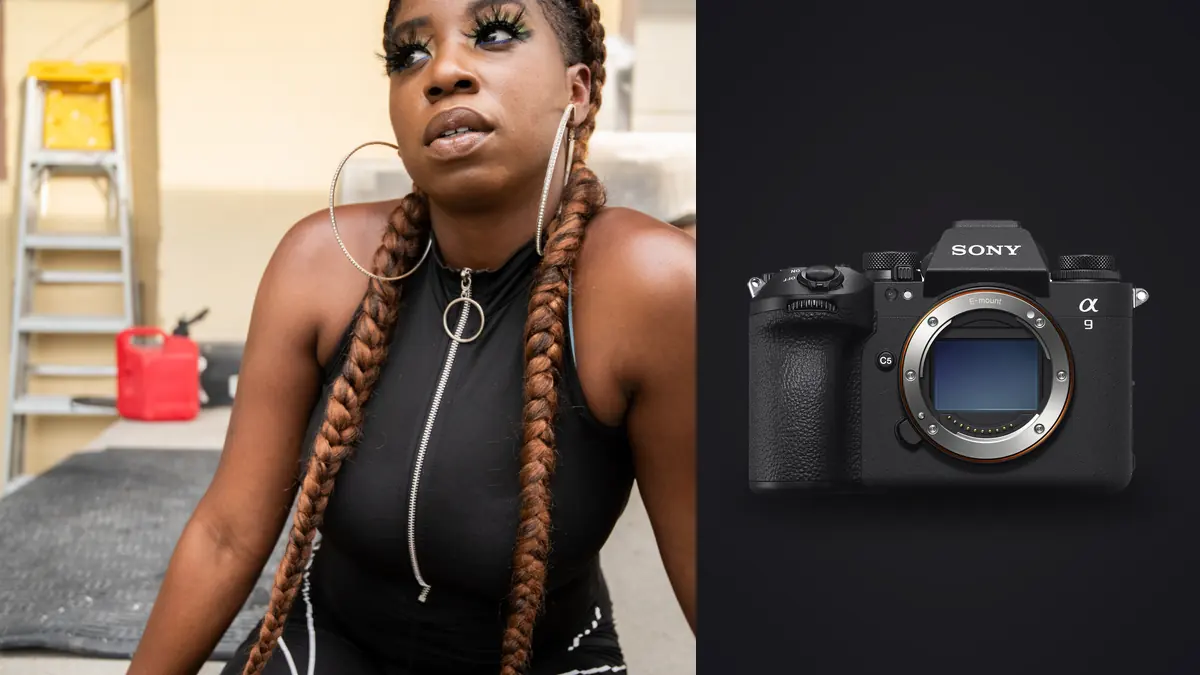
I got talked into renting a Sony A9 III for a lookbook-style shoot I almost skipped. Six looks, one model, a rooftop location with terrible midday light, and a goal of "movement, not standing there." My usual body for that kind of shooting is an A7R IV, and I nearly stuck with it out of habit. I'm glad I didn't, because the reasons the A9 III is marketed at sports shooters turned out to be exactly the reasons it made that shoot easier, just not for the reasons I expected going in.
This isn't a spec sheet rewrite. It's what changed on set, what didn't matter as much as I thought it would, and where the camera actively worked against me on a fashion shoot it wasn't really designed for.
The Global Shutter Is the Real Story, Not the Frame Rate
Everyone talks about 120fps when the A9 III comes up, and for a lookbook that number is mostly theater. What actually changed my results is the global shutter itself: zero rolling shutter, and flash sync at any shutter speed up to 1/80000s instead of the usual 1/200 or 1/250 ceiling most flash-sync-limited bodies impose.
On the rooftop, that meant I could run a single Profoto B10 as fill at 1/2000s and still knock the sky down to something moody instead of blown-out white. With a normal mechanical or electronic-first-curtain shutter, I'd have needed a big battery pack, an ND filter stack, or HSS mode eating two stops of flash power I didn't have to spare. With the A9 III, sync speed just isn't a variable anymore. That's a genuinely different way to light outdoor fashion work, not an incremental upgrade.
The rolling shutter elimination matters more than people give it credit for too. Fabric movement, whip pans as the model turns, hair flicks under a hairdryer rig, all the things art directors ask for on a "give me energy" brief used to come with a tax: skewed verticals, jello-like warping on anything moving fast in frame. That artifact is just gone. There was no need to explain why the coat hem looked like it was made of rubber in frame 340 of a burst.
120fps Sounds Great Until You're the One Culling It
Here's the part nobody mentions in the marketing copy: shooting bursts at 30, 60, or 120fps on a fashion set generates an amount of near-duplicate material that is genuinely hard to deal with by hand. A single 2-second burst at 120fps is 240 frames of a model doing more or less the same thing, blinking in slightly different spots, with maybe four or five frames that actually nail the moment the fabric caught the light right. Picture roughly 3,400 frames across a rooftop session, which for six looks is a lot even by fashion standards, and it's a direct consequence of leaning on the buffer instead of timing your shutter release the way you would with a slower body. That's the trade you're making. The camera removes the excuse to miss a moment, but it replaces careful timing with a much bigger sorting problem afterward.
This is where I've changed my actual workflow, not just my camera bag. I run everything through imagic before I touch Lightroom now, mostly because its focus scoring is done locally against the actual pixel data rather than eyeballing a thumbnail grid, and it clusters burst sequences so I'm picking a best-of-five instead of scrolling past 235 nearly identical frames looking for the one where the model's expression landed. For a camera that can produce 3,000+ frames in an afternoon, that step isn't a nice-to-have, it's the difference between delivering on time and pulling an all-nighter.
24.6 Megapixels: Enough, But Barely for Some Deliverables
This is where the A9 III shows its sports-camera lineage and where I'd push back on anyone recommending it as a default fashion body. 24.6MP is fine for social crops, fine for a lookbook PDF, fine for most web catalog use. It gets uncomfortable fast if the client wants a tight crop from a full-body shot blown up for a large-format in-store print, or if your art director likes to crop square out of a wide frame after the fact. If the deliverables are digital-first, as with that rooftop session, it isn't an issue. On a catalog job with heavy print requirements, I would reach for something like the A7R V instead and eat the flash sync limitations, because resolution headroom matters more than shutter speed there. The A9 III isn't a universal fashion camera, it's a specific-problem camera: fast-moving subjects, awkward lighting constraints, tight timelines with a small crew. If your lookbook work is mostly static poses in a controlled studio, you're paying for capability you won't use.
Where the Resolution Trade Actually Bites
The place I noticed it most wasn't the hero shots, it was the detail crops you end up wanting after the fact: a close-up of a shoe, a zoom on stitching or a logo placement. Those needs surface after the shoot, when you can't go back and reshoot tighter, and 24.6MP gives you a lot less room to satisfy them than 50MP does. I started deliberately shooting a handful of dedicated detail frames per look specifically because I knew I couldn't crop my way there later.
Camera Comparison for Lookbook and Catalog Work
I keep getting asked how the A9 III actually stacks up against the other bodies I rotate through for commercial fashion work, so here's the honest comparison based on what I've shot on all four, not spec-sheet numbers alone.
| Camera | Resolution | Max flash sync | Rolling shutter risk | Best fit for lookbook work |
|---|---|---|---|---|
| Sony A9 III | 24.6MP | 1/80000s (global shutter) | None | Movement-heavy, outdoor flash-fill, tight deadlines |
| Sony A7R V | 61MP | 1/250s (mechanical) | Low | Studio, print-heavy catalog, detail crops |
| Sony A1 | 50.1MP | 1/400s (mechanical) | Moderate at 30fps electronic | Hybrid: motion and resolution, higher budget |
| Canon EOS R3 | 24.1MP | 1/180s (mechanical), 1/8000s HSS | Low | Fast-paced editorial, existing Canon glass |
The A7R V wins on any job where the client is going to crop hard or print large. The A1 splits the difference at a price that's honestly close enough to the A9 III that I'd think hard before choosing speed over resolution unless motion is the actual brief. The R3 is the closest thing to a direct competitor for what the A9 III does, but you're back to needing high-speed sync or ND filters to get flash sync above 1/180s, which was the exact problem the A9 III solved for me on that rooftop.
Lenses That Actually Earn Their Place on This Body
A fast body doesn't matter much if your glass can't keep up with subject tracking at speed. Three lenses do almost all the work on a shoot like that with the A9 III:
- FE 85mm F1.4 GM II , the obvious portrait choice, but the newer GM II autofocus motor is noticeably faster to reacquire eye AF after a model turns her head quickly, which happens constantly when you're shooting for "energy."
- FE 24-70mm F2.8 GM II , my walk-around for anything where I'm working close to the subject and need to reframe fast between poses without a lens change eating time I don't have.
- FE 70-200mm F2.8 GM II , for full-length shots where I want subject separation from a busy background, especially outdoors where I can't always control what's behind the model.
I'd skip the big primes like the 50mm F1.2 GM on this body unless you genuinely need the shallowest depth of field possible. It's a gorgeous lens, but its AF motor isn't tuned for the kind of continuous tracking the A9 III is built to exploit, so you're carrying weight the sensor's speed can't fully use.
What the Workflow Looks Like After the Shoot
The shoot-day advantage of a global shutter body evaporates fast if your post-shoot pipeline can't keep pace with the file count it produces. My routine now, specifically built around high-burst bodies like this one, looks like:
- Dump both CFexpress Type A cards the same night, never wait until morning when you're tired and more likely to skip a backup step.
- Run the full take through imagic's local focus and sharpness scoring before opening anything in Lightroom. It flags soft frames from the false-positive "in focus at 120fps" problem, where the AF system tracked correctly but the model's own micro-movement between frames still cost sharpness.
- Let the burst clustering group near-duplicate sequences so I'm reviewing maybe 400 grouped selections instead of 3,400 individual frames.
- Apply a first-pass style using imagic's apply_my_style preset, which is trained on my own past edits rather than a generic filter, so the lookbook has a consistent look before I get into per-image tweaks.
- Because all of that runs locally with no cloud upload step, unreleased wardrobe or an unannounced collection never passes through a third-party server before the brand has cleared it publicly, which matters more on fashion work than most other genres given how strict some client NDAs are about pre-release imagery.
That last point isn't a small thing on commercial fashion jobs. Some commercial contracts explicitly restrict where image files can be transmitted before the client approves final selects, and a cloud-based culling tool puts you in an awkward position if you're not paying close attention to where your files actually go during processing. Working through the actual take (not preset thumbnails) also makes better use of the wide dynamic range the sensor captures, since the software is scoring against full resolution data rather than a compressed preview. If you're curious how automated culling actually scores sharpness rather than just guessing from thumbnails, it's worth reading through how AI photo culling works before you commit a whole shoot's workflow to it.
I also tightened my on-set habits to cut the volume problem at the source rather than just managing it afterward. Shooting shorter bursts (1-1.5 seconds instead of holding the shutter through an entire pose change) cut my frame count by close to 40% on the second job without losing any moments that mattered. Small discipline changes like that pair well with faster software; neither one alone solves the volume problem a 120fps body creates. There's a broader set of habits like this in our faster photo workflow guide if burst discipline is something you're still figuring out.
Where I'd Steer You Away From This Camera
If your lookbook work is mostly static studio poses with a single strobe and no client demand for print-large crops, the A9 III's price tag (body-only list sits around $5,999, and CFexpress Type A cards aren't cheap either) buys you speed and flash sync range you won't touch. A7R V or even a used A7R IV would serve that brief better and leave budget for lighting gear instead. The A9 III earns its keep specifically on jobs with movement, awkward outdoor lighting, or genuinely tight timelines where reshoots aren't an option. Match the camera to the actual brief, not the spec sheet.
Frequently Asked Questions
Does the Sony A9 III's global shutter actually change how I light a fashion shoot outdoors?
Yes, in a way that's easy to underestimate until you've used it. Flash sync isn't capped at a mechanical shutter limit anymore, so you can run a small strobe or speedlight as fill against bright ambient light without needing high-speed sync mode or an ND filter to cut ambient exposure. That gave me back roughly two stops of usable flash power on a job where I was already underpowered for the location.
Is 24.6 megapixels really a limitation for commercial lookbook work?
For most digital deliverables, no. It becomes a real constraint the moment a client asks for tight detail crops after the shoot, or the images are going into large-format print. If your contract includes those deliverables, plan around it by shooting dedicated detail frames on set rather than relying on cropping the hero shots later.
How do I manage the sheer volume of files a 120fps body produces on a fashion job?
Shoot shorter, more deliberate bursts instead of holding the shutter through entire pose sequences, and run captures through local culling software immediately rather than letting them pile up across a multi-day job. Grouping near-duplicate frames and scoring sharpness locally cuts the manual review time down from hours to something closer to twenty minutes per few hundred frames.
Is the Sony A9 III worth it over an A1 or A7R V for fashion specifically, not sports?
Only if the brief actually involves motion, awkward flash-sync constraints, or unpredictable timing where the buffer and tracking genuinely save you a reshoot. If the work is controlled studio poses with static lighting, the resolution advantage of the A7R V or A1 is usually worth more to a fashion client than shutter speed you won't use.