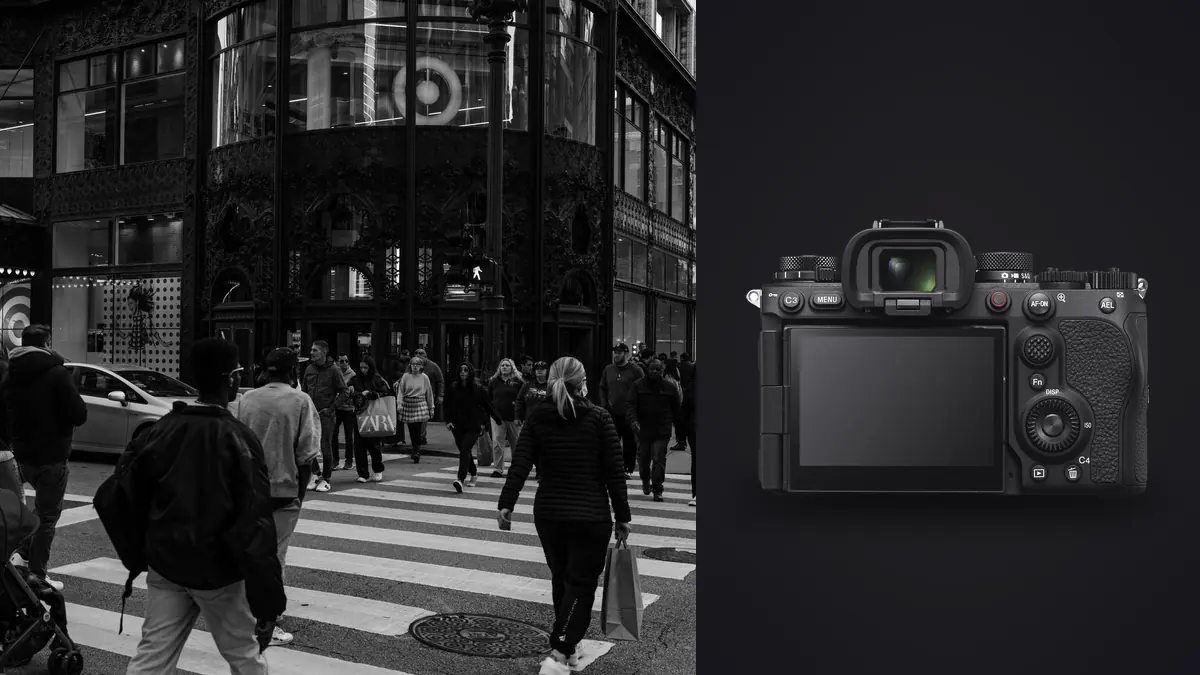
The Sony A9 III can record decisive street moments with very little mechanical interruption, and its global shutter removes the line-by-line readout skew associated with rolling shutters. Those capabilities do not decide which photographs are truthful, necessary, or respectful. A documentary folder may contain repeated gestures, bystanders, sensitive locations, and captions that carry more risk than any technical defect.
This RAW Workflow keeps ARW sequences in chronological context, treats automated quality signals as aids rather than editorial verdicts, and connects image selection to caption evidence and publication purpose. It also creates a clean separation between private source material, working edits, and public derivatives.
Record chronology without turning every moment into a burst
Set the camera clock accurately and synchronize any audio recorder or second body used for notes. Chronology can establish what happened before and after a frame, which people were present, and whether two images belong to the same interaction. Preserve that order at least through the first editorial pass.
Use short sequences when gesture genuinely evolves, such as a cyclist crossing layered traffic or two people reacting to each other. Use single frames for static observations and quiet transitions. A fast camera can generate many alternatives, but an excessive burst may change subject behavior, fill storage, and make later review less attentive.
When silent electronic operation is appropriate, remember that silence does not remove ethical obligations or venue rules. Avoid photographing where consent or safety requires restraint. The absence of shutter noise should not become a reason to ignore a person's clear objection or a protected situation.
Choose an ARW and reference-JPEG policy
Record ARW when tonal latitude and later interpretation matter. An accompanying JPEG can preserve the camera's monochrome or color preview and may help a rapid edit, but it should be labeled as a reference rather than mistaken for the only original. Keep the capture format stable within a project unless a change is documented.
Hold white balance where a sequence shares one light. Auto white balance may respond differently as a colored bus, sign, or jacket enters the frame, making adjacent photographs appear to have been made under changing conditions. A stable RAW baseline reveals what actually changed in the scene.
The global shutter avoids rolling geometry, but pulsed artificial light can still change brightness or color from one exposure to another. Review sequences under LED signs, transit lighting, and indoor fixtures for variation. Do not claim that every electronic-light artifact is impossible merely because the sensor exposes globally.
Make verified copies before adding editorial meaning
Copy every card into a card-specific originals folder, confirm expected counts and readable files, then create another verified copy on separate storage. Preserve original names and capture order until clocks and duplicate cards have been reconciled. Do not begin by moving apparent rejects out of sequence.
Create separate areas for untouched ARW sources, private review, caption research, working masters, public selects, and delivered exports. A frame can be technically strong yet remain private because it exposes an identity, address, medical event, child, or vulnerable person. File state must express more than aesthetic preference.
Use neutral project codes in working paths. Exact locations and personal names belong in access-controlled notes when they are necessary. Public metadata should contain only information that is accurate, relevant, and safe to disclose.
Cull technical failures while preserving event context
Review a chronological contact sheet before magnifying individual frames. Identify encounters, transitions, and repeated compositions. Mark obvious accidents, then inspect the intended focal area, exposure, and motion. A technically imperfect frame may be the only evidence of an important action; route it to a documentary exception state rather than forcing it into the same portfolio rating.
imagic supports ARW and can analyze sharpness, exposure, closed eyes, composition, and near-duplicate groups locally. Culling sets statuses and never deletes original files. Its burst grouping is useful for comparison, but it cannot know whether two almost identical frames show materially different expressions, signs, or relationships.
Review grouped sequences before accepting one representative. A half-step can reveal a face, remove an identifying address, or align elements in a way that changes interpretation. If a score looks visibly wrong, check whether it is stale. Reselection re-ranks stored values; it does not analyze the pixels again.
Apply a documentary edit, not only a quality sort
Define the story question and intended audience. Then select images that establish place, introduce subjects, show action, reveal consequence, and provide transition or closure. Avoid constructing a false chronology from similar scenes made at unrelated times. Captions should disclose when an image is illustrative rather than part of the central event.
Look for harmful repetition. A set of ten confrontational expressions can distort an otherwise calm event, while a sequence of only picturesque frames can remove genuine tension. Compare the contact sheet with field notes and include necessary context even when it is visually quieter.
Composition decisions can affect privacy. A wider crop may expose an address or uninvolved bystander; a tight crop may remove context that makes the scene understandable. Keep the full ARW and make the publication crop as a reversible instruction. Record why any major contextual element was removed.
Develop tone without rewriting the light
Begin with profile, lens correction, white balance, and exposure. Establish baselines by location and light source rather than syncing one treatment across an entire day. Street scenes move between sun, shade, transit interiors, and mixed artificial light, each requiring separate judgment.
Recover highlights and shadows only to the point that they remain credible. Opening every silhouette can reveal noise and unintended detail; crushing every shadow can erase information. Use color contrast carefully around warning signs, skin, emergency lights, and brand colors because those elements may carry documentary meaning.
Monochrome conversion should serve the project rather than conceal difficult color. Keep a color-capable RAW master and record the black-and-white treatment non-destructively. If a learned personal style is used in imagic, verify that an actual style profile exists and inspect every frame afterward. A style does not override factual color requirements.
Verify captions, identity, and metadata
Separate what the photograph shows from what field notes or sources claim. Verify names, locations, event titles, and chronology through appropriate records. Do not infer occupation, relationship, emotion, nationality, or guilt from appearance. If identity is unknown, write a precise visual description instead of guessing.
Review embedded GPS, camera serial, copyright, contact, and caption fields before publication. Remove exact coordinates when they expose a home, refuge, protest participant, or sensitive site. Retain private source notes only for as long as the editorial and legal basis allows.
The Workflow and Editing section offers related process guidance, and the desktop application page describes local file handling. No software can decide whether publication is proportionate, so that judgment remains with the photographer and editor.
Export public derivatives and preserve private sources
Create output recipes for the actual recipient: web JPEG, publication JPEG, print TIFF, or another agreed format. Set dimensions, color profile, quality, naming, and sharpening deliberately. Inspect every exported file for crop, orientation, tonal blocks, metadata, and accidental inclusion of a private frame.
Build the delivery directory from an approved manifest, not from a broad rating filter. Export to a confirmed location, compare file count and names, then generate a checksum or transfer record where the assignment requires it. Keep public derivatives separate from unredacted masters.
Archive original ARW files, card manifests, contact sheets, captions, consent or access notes, adjustments, and delivered outputs under the agreed retention policy. A later challenge should be answerable without altering the source or relying on memory.
Redact only with a documented editorial reason
A public frame may require a face, license plate, address, screen, or document to be obscured. Keep the unredacted ARW in a restricted source area and create the redaction as a separate, reversible working version. Record what was changed and why. Cropping may be sufficient, but it can also remove context, so compare the safety benefit with the editorial cost.
Do not treat redaction as a guarantee of anonymity. Clothing, location, tattoos, companions, time, and caption details can identify a person even when a face is hidden. Review the complete package from the perspective of someone familiar with the event, and seek appropriate editorial or legal guidance when consequences are significant.
Generative replacement is especially risky in documentary work because it can invent visual facts. imagic does not provide generative fill. If another application is used to obscure sensitive content, choose a method that clearly removes or masks information without fabricating a plausible scene, and retain the original and edit record.
Use a delayed contact-sheet review when the deadline permits
An immediate edit is influenced by the excitement and expectations of the encounter. After the first deadline-safe selection, return to a chronological contact sheet and examine quieter transitions, repeated motifs, and frames that complicate the initial interpretation. This second pass can improve balance without pretending that emotional distance creates perfect objectivity.
Compare the final sequence with the total coverage. Count how often particular people, neighborhoods, gestures, or conflicts appear. The count is not a fairness formula, but it can reveal accidental overrepresentation. Replace redundant pictures with context where the story becomes narrower than the witnessed event.
Keep both the rapid and considered edits when they served different legitimate deadlines. Label them clearly, record which version was delivered, and avoid silently substituting a later file under the same name after publication.
End the delayed review with a negative check: identify frames that could mislead when separated from their sequence. A gesture caught between movements, a sign held by an unrelated person, or an expression paired with the wrong caption can acquire a false meaning in isolation. Remove such files from publication or supply the context needed to interpret them. Preserve the source sequence privately so the editorial decision remains auditable.
Review cropping across the complete essay as well. Alternating tight and wide views can create rhythm, but repeated close crops may detach people from the conditions the story is meant to document. Keep enough environmental evidence to support the captions and avoid using empty space merely as decoration.
Frequently asked questions
Does the Sony A9 III global shutter remove every lighting problem?
No. It removes rolling readout skew, but pulsed lights can still vary in brightness or color between exposures. Review artificial-light sequences and choose settings appropriate to the source.
Can AI decide whether a street photograph is ethical to publish?
No. Technical scoring cannot assess consent, vulnerability, public interest, safety, or narrative fairness. Those decisions require informed human editorial judgment.
Should private source frames be cropped and overwritten?
No. Keep the ARW source intact and store publication crops as reversible edits or separate derivatives. That preserves context while allowing a safer public version.