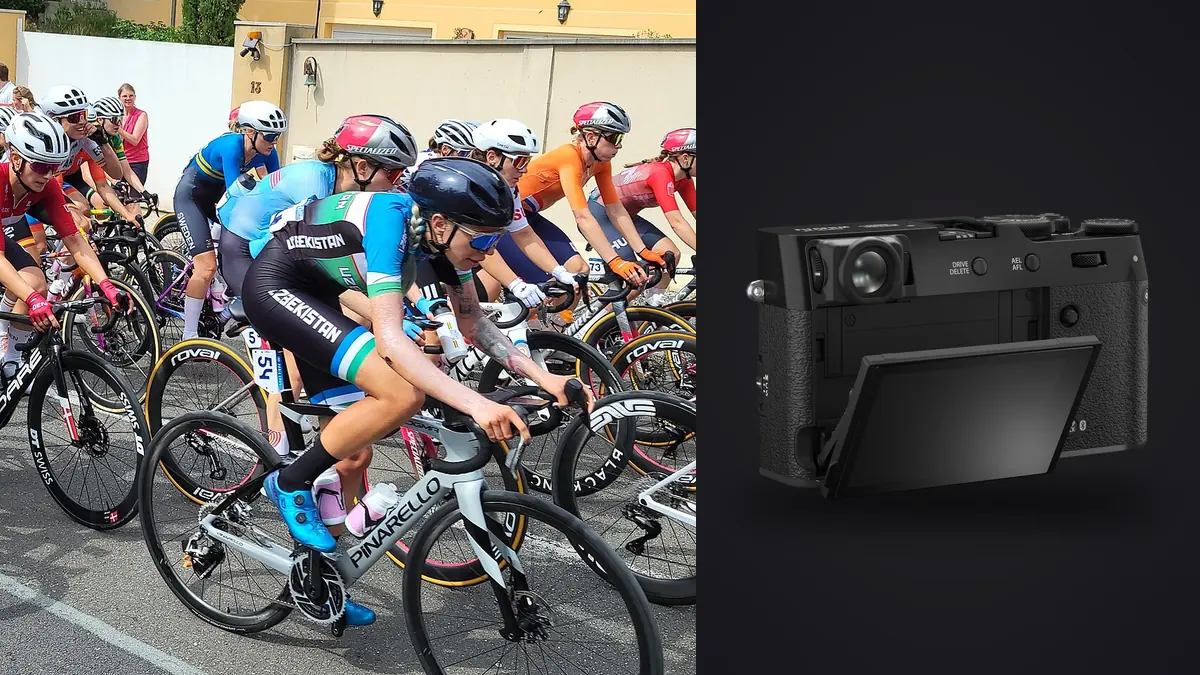
The Fujifilm X100VI has a fixed 23mm F2 lens with a field of view similar to 35mm on full frame. That can make energetic environmental sports photographs from close access, but it cannot become a long lens when the credential is outside the rail or at the soundboard. Location is therefore the main lens decision.
This Lens and Location Guide identifies sports and positions where the fixed view can work: warm-up, close finish areas, training, pits and paddocks, courtside context, athlete portraits, and community events. It also marks the limits. The camera should not be forced into distant coverage or unsafe proximity merely because it is compact.
Start with the fixed field of view
Fujifilm's official specification identifies the built-in 23mm F2 lens and its approximate 35mm-equivalent view. That moderate-wide angle includes environment while requiring the photographer to be relatively close for a large athlete in frame.
Digital crop guides can preview tighter framing, but they do not add optical reach or change perspective. The captured subject remains the same size from the same position, with output options depending on the selected mode. Cropping cannot remove haze or restore distant detail.
Preview the field of view from every proposed location. If the required action remains small from the authorized boundary, use a different camera and lens or change the assignment to environmental coverage.
Choose sports that permit close, safe access
Training sessions, warm-up, community events, athlete arrivals, workshops, and controlled practice may provide positions where a moderate-wide lens works. Formal competition often restricts photographers farther away. Permission and safety determine suitability before the sport's visual appeal.
Close access should never mean entering a runoff, lane, court, landing area, track, trail, or equipment path. Ask the organizer where the camera can remain and how athletes move after the visible action. A finish line is followed by deceleration space.
Use the environment deliberately. Show teammates, officials, venue, weather, lane markings, or audience relationship. If the background adds nothing, the fixed lens may be the wrong tool for that location.
Use community events and training for complete stories
Community races, school sports, club training, and workshops can provide lawful close positions, but permission and safeguarding still matter. Confirm organizer policy for minors, changing areas, medical situations, and publication. The compact camera should support agreed access, not bypass it.
The fixed view can cover registration, preparation, coaching, equipment, start, near action, recovery, and celebration as a connected sequence. Plan those locations around the event route. A broad story can be stronger than one distant action frame the lens cannot resolve.
Identify where athletes slow naturally and where the photographer can stand without interfering. Avoid placing a camera at a blind corner, finish runoff, or training drill boundary. Ask coaches or officials before moving between stations.
Plan track coverage around near positions
From an approved close finish or curve position, the X100VI can show a runner with lanes, competitors, and venue context. Frame wider than the expected peak because the subject can cross quickly and the lens cannot zoom out. Keep the complete body and runoff visible when needed.
Warm-up and call areas may provide environmental portraits and preparation details, subject to access and consent. Do not photograph private medical treatment or vulnerable moments merely because the camera is nearby. Follow event media policy.
Jumps and throws usually require more distance or strict sector boundaries. The fixed lens may suit a wide view of the venue or athlete before and after the attempt, not the isolated action. Accept that limitation.
Use courtside positions for environment and transition
At a small court with explicit permission, the 35mm-equivalent view can show player, lines, teammates, and audience. It may work for inbound plays, benches, celebrations, and wide action near the photographer. It will not isolate the far end like a telephoto.
Remain behind barriers and outside referee, player, and ball paths. A compact camera is still a hard object that can cause injury. Never extend an arm or step onto the playing surface for a closer frame.
Indoor lighting can flicker or create bands with electronic capture. Test shutter times under the installed fixtures and use current Fujifilm guidance for shutter and flicker options. Keep a fallback mode confirmed before competition.
Use the camera for pits, paddocks, and preparation
Motorsport and cycling preparation areas can provide close environmental frames of athletes, mechanics, equipment, and team interaction when credentialed. The fixed view suits relationships and process better than distant on-track action. Learn restricted zones and vehicle movement.
Engines, bikes, cables, tools, and staff create hazards. Follow marshal and team instructions, wear required protection, and keep the camera strap controlled. Do not back into a live lane while framing.
Reflective bodywork, visors, and artificial light can reveal the photographer and create flare. Change angle and inspect the full frame. A polarizer may alter some reflections but cannot replace safe position or permission.
Plan athlete portraits around working distance
The fixed lens can make environmental portraits that show the track, gym, equipment, or team setting. Keep enough distance to avoid exaggerated hands, knees, or facial features, then include background with purpose. A digital crop can tighten the result without changing perspective.
Use a marked position and a short time window that respects warm-up, recovery, and schedule. Do not delay training or ask an exhausted athlete to repeat unsafe movement. Confirm consent and intended use.
For tight headshots or compressed full-length portraits, another lens system may be more suitable. The X100VI is strongest when the place contributes to the portrait.
Use foreground and panning deliberately
A moderate-wide lens can place a moving subject against a broad venue, but it also shows every rail, cone, spectator, and sign. Precompose where these elements create direction. Avoid using foreground that blocks limbs or safety information.
A slower exposure and smooth pan can separate a cyclist or runner from the setting. Stabilization can reduce some camera movement, but subject rendering follows shutter time and the pan. Practice at a lawful ordinary session and compare the complete frame.
For a frozen moment, choose shutter time from the fastest meaningful movement. The camera's compactness does not stop hands, wheels, hair, or feet. Diagnose motion separately from focus.
Plan backgrounds and light from a fixed camera line
Because lens framing cannot change optically, small position changes matter. Move laterally within the approved area to place the athlete against open track, a crowd, a dark tunnel, or clear sky. Do not move closer when a safer side step solves the background.
Track sun and shadow through the timetable. A near location may put faces in shade or create backlight. Decide whether atmosphere or identification matters, then select a position and exposure starting point.
Saturated uniforms and electronic boards can clip individual channels. Inspect representative files rather than relying only on the combined histogram. Keep white balance consistent within a sequence when editorial color matters.
Use compact handling without claiming invisibility
The X100VI may be less bulky than a large sports kit, but athletes and spectators can still see the lens and photographer. Work openly, display credentials, and respect requests. Do not use camera size to bypass venue policy.
Secure the camera with a wrist or short strap that cannot enter the field of play. Confirm the lens can extend freely before powering on. Keep controls protected in a pocket or bag and check the active drive, focus, crop, and shutter state after carrying.
Disable unnecessary sounds and lights where permitted, but retain visible recording and storage warnings. Silent capture can change technical behavior and does not make photography ethically neutral.
Prepare weather and a backup role
Use compatible protection for rain and dust without blocking the lens movement, controls, microphone openings, or heat paths. A fixed lens reduces lens changes but does not remove the need to keep the front element clean. Check for drops during breaks.
Carry charged batteries and known compatible media, and keep exposed cards separate. Test the interval between sequences and any power arrangement without making a speed promise. Outdoor events can change duration and access unexpectedly.
Bring another camera with appropriate reach when isolated action is mandatory. A backup should cover the frame the fixed lens cannot, not merely duplicate the environmental role. If the X100VI is the only camera, define the deliverable honestly around close context.
Build a fixed-lens sequence plan
Because the lens cannot change, vary picture scale through safe position, subject timing, orientation, and the relationship between foreground and background. Alternate a broad establishing frame, a close permitted interaction, a detail within focus range, and a transition. Do not fill the edit with repeated horizontal full figures from one mark.
Use a second approved camera position only when the timetable allows a safe move. Note which action will be missed during transit and decide whether the change adds enough visual value. Remaining in one strong position is often better than arriving late at several.
Keep the crop guide and aspect ratio consistent within a sequence unless the output requires a change. Record any digital crop state so later review does not mistake a framing mode for a different optical lens.
Use a position-to-fit matrix
| Sports position | X100VI fit | Reason |
|---|---|---|
| Warm-up or preparation area | Strong with permission | Close context and human interaction |
| Approved near finish | Possible | Environmental action with safe runoff |
| Small courtside position | Possible | Near action and venue relationship |
| Distant field boundary | Weak | Fixed view cannot create telephoto reach |
| Athlete environmental portrait | Strong | Moderate-wide context supports the subject |
Confirm each fit from the exact approved mark. A venue that changes the boundary can change the camera's role completely.
Review RAF files by location and action phase
After verified copies, imagic can scan Fujifilm RAF files and analyze them locally. It scores technical qualities and groups similar frames; culling changes status and keeps originals intact. Use event and position notes to preserve context.
Human review must compare body position, expression, venue relationship, obstructions, safety context, and caption accuracy. If a score appears outdated, check freshness and reanalyze stale files; reselecting only ranks stored values.
The desktop overview explains local and non-destructive review, while the workflow and editing guides cover related delivery systems. Keep the fixed-lens limits visible during selection rather than grading the files as failed telephoto images.
Frequently Asked Questions
Can the X100VI replace a telephoto sports camera?
No. Its fixed moderate-wide view suits close environmental coverage, not isolated distant action. Use another system when the required position demands reach.
Are digital crop modes the same as changing lenses?
No. They preview or record a tighter crop but do not change perspective, optical reach, or subject detail from a fixed camera position.
Where is the X100VI most useful at a sports event?
It is strongest in approved close positions such as warm-up, preparation, environmental portraits, celebration, and near action where the venue belongs in the frame.