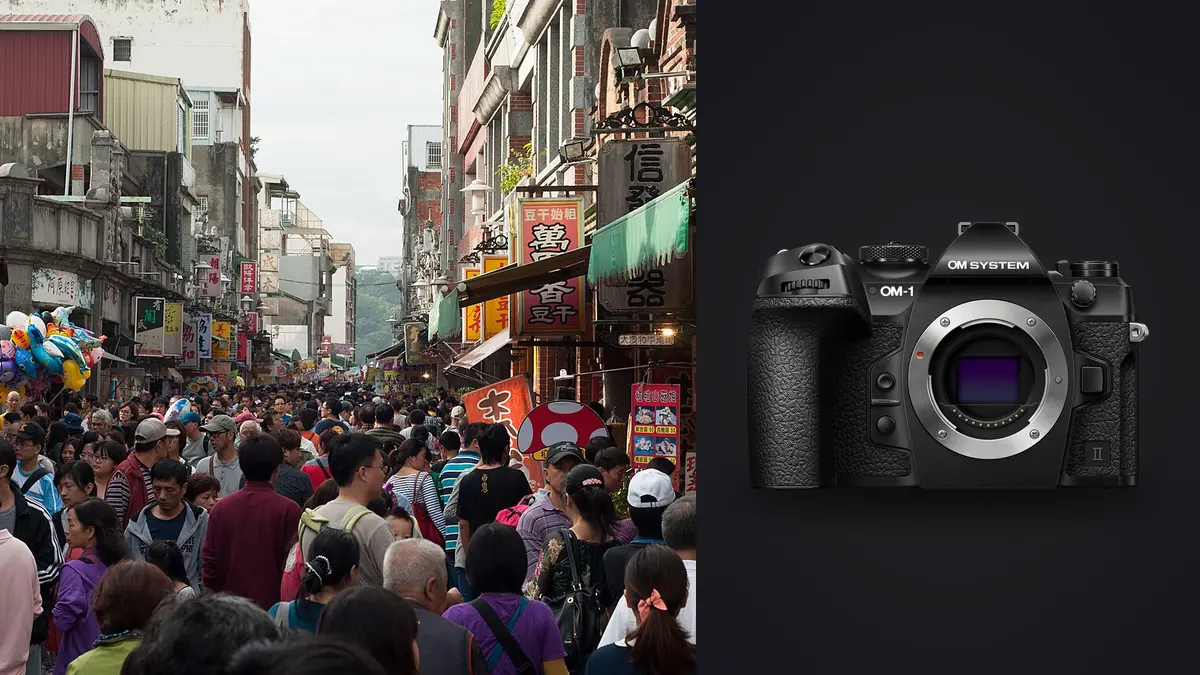
I spent four days shooting a market renovation story with an OM System OM-1 Mark II slung across one shoulder and nothing else in the bag but two primes and a rain cover I never had to use. That's not a small detail for documentary work. When the whole kit weighs less than a bag of sugar, you stop thinking about the camera and start thinking about the story, which is the entire point of carrying it.
This isn't a spec-sheet review. Plenty of sites will list the sensor resolution and the burst rate and leave it there. What I want to cover is narrower and more useful if you actually shoot people on the street or follow a subject through a day: how the body handles when you're moving, what the autofocus does with unpredictable human subjects, where the Micro Four Thirds sensor helps and where it costs you, and what happens to your evening when you sit down with three thousand frames from a single afternoon.
Why the Sensor Size Argument Misses the Point for This Genre
Every conversation about the OM-1 Mark II eventually circles back to the sensor. It's a 20.4-megapixel stacked BSI Four Thirds sensor, smaller than APS-C, much smaller than full frame. For landscape photographers chasing dynamic range or wedding shooters who need shallow depth of field in dim reception halls, that's a real limitation and I won't pretend otherwise.
For street and documentary work the calculus is different. You're rarely trying to melt a background into mush behind a subject; you usually want enough depth of field to keep a foreground gesture and a background detail both legible, because the relationship between the two is often the actual photograph. A Four Thirds sensor at f/2.8 gives you roughly the depth of field a full-frame body gives you at f/5.6, which in practice means you can shoot wider open for a faster shutter speed in flat daylight without throwing away the environmental context that makes documentary work read as documentary work rather than portraiture.
The real cost shows up after dark. Base ISO files are clean and the sensor holds up fine through ISO 3200. Past ISO 6400, especially in mixed tungsten and neon lighting like a night market or a bar interior, you start to see chroma noise creep into shadow areas that a full-frame body would still render smoothly. If your documentary work leans heavily nocturnal, this camera will ask more of your noise reduction workflow than a Sony a7 IV or a Nikon Z6 III would.
Handling a Body That Disappears in Your Hand
At 599 grams for the body, the OM-1 Mark II sits somewhere between "serious tool" and "doesn't announce itself." Paired with the 17mm f/1.8 (34mm equivalent), the whole rig comes in under 900 grams. I've carried it for ten-hour days without the shoulder ache that a full-frame body with an equivalent zoom produces by mid-afternoon. For documentary assignments where you're on your feet from sunrise call time to a dinner scene, that weight difference compounds hour over hour in a way spec sheets don't communicate.
The grip is deep enough that one-handed shooting at a low angle, crouching to catch a kid's eye line or shooting from the hip through a crowd, stays stable. The joystick for AF point selection is positioned well for thumb access without moving your eye off the viewfinder, which matters more than it sounds like it should when you're trying to reposition focus mid-sequence on a subject who just turned their head.
Weather Sealing You'll Actually Use
The IP53 rating isn't a marketing number here, it's a working feature. I shot through two downpours during that Valletta assignment with no cover on the camera, just wiped the front element between bursts. Documentary work doesn't pause for weather, and a body that lets you keep shooting through a squall without babying it is worth more on assignment than another stop of dynamic range would be.
Autofocus in Situations Nobody Poses For
Subject detection autofocus was built with wildlife and sports in mind first, birds, planes, vehicles, and then human detection was folded in. For street work the human detection mode is genuinely useful but not in the way the marketing implies. It's tuned to lock onto a face when one is available, clean and confident, similar to what most modern mirrorless bodies do now.
The more interesting case is when a face isn't available, which is most of street photography. Someone's back is to you, or they're half-turned, or they're a silhouette against a bright doorway. In those situations I found myself relying on all-target tracking with a single starting point rather than trusting the subject-detection algorithm, because it occasionally hunts for a face that isn't there instead of locking onto the nearest coherent shape. Once you accept that human detection is a face-finder rather than a general "find my subject" mode, it stops being frustrating and becomes one more tool you deploy selectively.
Pro Capture is where this body earns its keep for decisive-moment work. Half-press the shutter and the camera buffers frames continuously; a full press retrieves up to 70 frames from before you actually committed. For a kid jumping a puddle or a pigeon flushing off a market stall, that buffer has saved compositions I would have missed by the usual fraction of a second it takes a human finger to react to a human eye.
Lens Pairings That Actually Hold Up on the Street
The lens you put on this body matters more for discretion and speed than the body itself does. Here's what I've actually carried and what each one is good for in practice, not on paper.
| Lens | 35mm Equivalent | Weight | Best For | Where It Struggles |
|---|---|---|---|---|
| M.Zuiko 17mm f/1.8 | 34mm | 120g | All-day carry, environmental portraits, tight streets | Not wide enough for cramped interiors |
| M.Zuiko 25mm f/1.8 | 50mm | 137g | Natural perspective, one-subject documentary moments | Feels tight in crowded market scenes |
| M.Zuiko 12-40mm f/2.8 II | 24-80mm | 382g | Assignments needing framing flexibility over a full day | Zoom noise and size reduce discretion |
| M.Zuiko 12-100mm f/4 IS | 24-200mm | 561g | One-lens travel documentary, reach for distant candids | Slower aperture hurts after dusk |
My honest recommendation for pure street work is the 17mm. It's close enough to the classic 35mm documentary field of view that you can pre-focus by habit, small enough that people genuinely don't register it as a "serious camera," and fast enough at f/1.8 to keep shutter speeds reasonable into early evening. The 12-40mm earns its place on assignments where you need to go from an establishing wide shot to a tighter detail shot without changing lenses mid-scene, which happens constantly on actual documentary jobs even though street purists tend to pretend it doesn't.
Where This Camera Loses to Full Frame, and Where That Stops Mattering
I want to be specific about this rather than hand-wavy. Dynamic range at base ISO on the OM-1 Mark II runs around 12.5 stops measured, which is roughly a stop and a half behind what you'd get from a current full-frame sensor like the one in the Sony a7 IV. In harsh midday sun with deep shadow under an awning and a blown-out sky behind it, a full-frame file gives you more room to pull shadow detail back without banding.
Where it stops mattering: documentary work is rarely about recovering four stops of shadow in post. It's about being present, being fast, and not missing the moment because you were swapping a heavy lens or because your arm gave out at hour eight. I'd rather have a slightly noisier file of the moment that actually happened than a technically cleaner file of the moment I missed because I was carrying a body twice the weight.
| Body | Weight (body only) | Usable High ISO Ceiling | Burst w/ AF-C | Street Discretion |
|---|---|---|---|---|
| OM System OM-1 Mark II | 599g | ~ISO 6400 | 50fps (electronic) | High, small silhouette |
| Fujifilm X-T5 | 557g | ~ISO 8000 | 15fps (mechanical) | High, retro styling draws some looks |
| Fujifilm X100VI | 521g | ~ISO 8000 | 20fps (electronic) | Very high, fixed lens reads as "not serious" |
| Sony a7 IV | 658g | ~ISO 12800 | 10fps (mechanical) | Moderate, larger with any fast lens attached |
The X100VI wins on pure discretion because a fixed-lens compact reads as a tourist camera to most passersby, which is genuinely valuable for candid work. But it can't touch the OM-1 Mark II's autofocus tracking or burst depth when a scene turns dynamic, and you're stuck with one focal length for the day. The trade-off is real in both directions, not a simple upgrade path.
Silent Shooting and the Ethics of Not Being Noticed
The fully electronic shutter drops the mechanical clack entirely, up to 1/32000 second if you need it, though I rarely go past 1/8000 in daylight street work. Shooting silently changes how people around you behave, and it's worth being honest about the ethical weight of that rather than treating it as a pure feature win. A silent shutter means subjects don't flinch or reset their posture at the sound of a frame being taken, which gets you more natural documentary moments. It also means people genuinely don't know they've been photographed, which is a responsibility as much as a capability. I default to mechanical shutter for anything involving a recognizable, approachable subject and save full silent shooting for wide environmental frames where individuals aren't the identifiable focus.
One technical caveat: the electronic shutter can produce rolling shutter skew on fast horizontal motion, like someone cycling quickly across your frame. It's subtle at normal street pace but visible if you're panning with a fast subject, so I switch back to mechanical (10fps ceiling) whenever I know motion blur or skew would ruin the shot.
Bringing Home the Files: Culling a Week of Burst-Heavy Shooting
This is the part nobody warns you about before you buy a body with a 50fps buffer and Pro Capture. A single afternoon of market shooting with Pro Capture engaged regularly produces two to three thousand frames, and a huge number of them are functionally identical, three or four near-duplicate versions of the same gesture a fraction of a second apart. Scrolling through that manually after a twelve-hour shooting day is where documentary photographers burn out on their own workflow.
This is where I switched to running my culling pass through imagic rather than eyeballing every frame in a folder. It clusters near-duplicate bursts, which is exactly what Pro Capture output needs, so instead of comparing frame 412 against frame 413 against frame 414 by eye, you're looking at one representative grouping and picking the sharpest, best-timed frame from each cluster. It also scores focus and sharpness locally on the machine, which matters to me because a lot of my documentary work involves people who haven't consented to having their faces uploaded anywhere, and the whole pass runs without the files leaving my laptop. If you're curious about the mechanics behind that kind of automated sort, we've written more on how AI photo culling actually works under the hood.
The other piece that's saved me real time on multi-day assignments is training a custom preset off my own previously graded work using imagic's apply_my_style feature. Documentary series need visual consistency across days and lighting conditions, and manually matching grade decisions from day one to day four used to eat an hour I didn't have. Feeding it a folder of my own finished edits and letting it apply that same tonal decision-making to new frames gets me to a consistent first pass much faster, and I still go in and hand-adjust individual frames afterward rather than trusting it blind.
A Realistic Culling Workflow for This Camera
What's worked for me on repeated shoots: import and cluster first, delete obvious misses (eyes closed, subject fully obscured, motion blur you didn't intend) at the cluster level rather than frame by frame, then do a second pass picking the single best frame out of each surviving cluster. Only after that do I open individual frames for grading. Trying to grade before culling, which I did on my first few Pro Capture-heavy shoots, meant re-grading frames I ultimately threw away, which is wasted time you don't get back on a deadline.
Frequently Asked Questions
Is the OM-1 Mark II too small a sensor for professional documentary work?
No, but it changes what you optimize for. You get more depth of field at a given aperture, smaller and lighter glass, and a body that survives weather without a cover. You give up some dynamic range and top-end high ISO cleanliness compared to full frame. For assignment work where mobility and stamina across a long day matter more than pulling four stops of shadow detail in post, the trade leans in the OM-1 Mark II's favor.
How does Pro Capture actually change street photography in practice?
It removes reaction-time lag from the equation. The camera is always buffering frames the moment you half-press the shutter, so a full press retrieves frames from slightly before you consciously reacted. For unpredictable street moments, a dog shaking off water, a subject's expression changing mid-sentence, it catches timing a manual trigger finger physically can't.
What's the biggest workflow problem this camera creates that a slower camera doesn't?
Volume. High burst rates and Pro Capture generate far more near-duplicate frames per shoot than a traditional single-shot street workflow does, which means your culling step becomes the actual bottleneck in getting a set of photos edited and delivered, not the shooting itself.
Should I bring a zoom or stick to primes for a documentary assignment on this body?
Depends on the assignment's pace. Pure candid street work rewards primes because you learn one field of view and can pre-focus by muscle memory. Assignment documentary work that moves between wide establishing shots and tight details in the same scene, a wedding-adjacent event, a protest, a workshop, benefits from the 12-40mm f/2.8's flexibility even though it costs you some discretion and hand comfort over a full day.