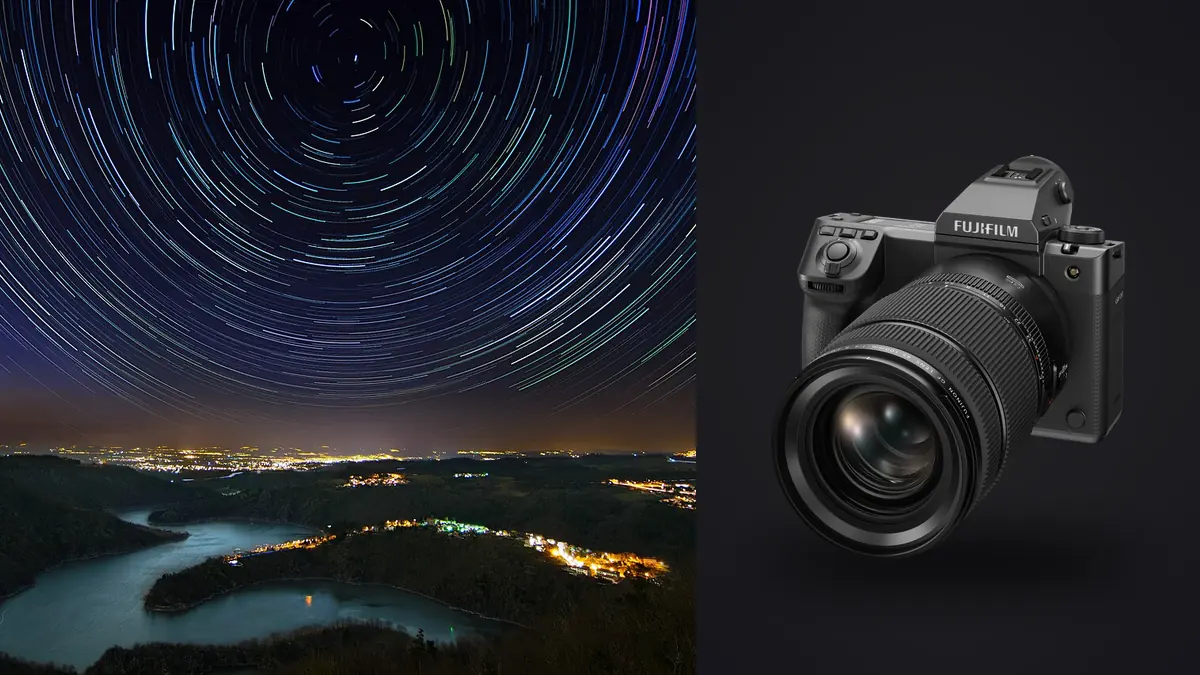
I took the GFX 100 II out to the high desert near Torrey, Utah for three nights last October specifically to answer a question I'd been putting off: does a 102-megapixel medium format sensor actually make sense for stacked Milky Way work, or is it a studio and landscape tool that I was trying to force into a job it wasn't built for. The short answer is that it works, but not in the way the spec sheet implies, and getting there meant unlearning a few habits from years of shooting full-frame astro rigs.
\n\nThe Resolution Is Not the Hard Part
\nEveryone who talks about the GFX 100 II and astrophotography in the same sentence leads with the sensor: 43.8 x 32.9mm, backside-illuminated, 102 megapixels, native ISO 80 to 12800 with expansion down to 40 and up to 102400. On paper that's a lot of real estate for gathering starlight, and the read noise numbers Fujifilm publishes for the X-Processor 5 pairing are genuinely better than the first-generation GFX 100. None of that is the bottleneck.
\nThe bottleneck is glass. Fujifilm's G-mount lineup was designed around portrait and landscape work, and it shows the moment you go looking for a fast wide prime. The widest option is the GF20-35mmF4 R WR, and after that you're choosing between the GF23mmF4 R LM WR and a handful of slower primes. There is nothing in the GF catalog that resembles a 14mm f/1.8 or even a 20mm f/1.4 the way full-frame mirrorless systems have. If you're coming from a Sony a7S or a Nikon Z8 with a fast wide prime, the aperture gap is the first thing that will frustrate you, and it's why single-frame Milky Way shots on this body tend to look thinner than the sensor's reputation suggests.
\nStacking is the workaround. Instead of one exposure at f/1.4 doing the work, you're combining twenty or forty exposures at f/4 to build up the same signal, and the sensor's low read noise actually helps here because it means each individual sub contributes more usable signal relative to the noise floor than it would on a noisier sensor. It's a different math problem than a fast-lens full-frame setup, but it isn't a worse one, provided you accept that a single night out here means hundreds of frames instead of a few dozen.
\n\nWhat the GF Lenses Actually Give You
\nBecause the sensor is larger than full-frame, the crop factor works in your favor for framing even though it hurts you on aperture. Roughly 0.79x means a 23mm lens frames like an 18mm would on a full-frame body, which is a genuinely useful wide field for Milky Way arcs. But the \"effective aperture\" for depth of field and light-gathering per unit of sensor works out favorably too, since a T/4 lens on this format behaves closer to f/3.2 in full-frame terms. It's a small break, and it doesn't erase the gap versus a dedicated fast astro lens, but it's worth knowing before you write the system off entirely.
\nHere's what I measured in the field as the point where pinpoint stars started showing visible elongation at 100% crop on the 102-megapixel files, shooting untracked. These are working numbers from actual nights out, not a formula pulled from a spec sheet, and your mileage will vary by a second or two depending on where in the frame you're checking (corners always fail first on the zoom).
\n\n| GF Lens | Full-frame equivalent | Max aperture | Effective aperture (equiv.) | Safe single-sub time, untracked |
|---|---|---|---|---|
| GF20-35mmF4 R WR (at 20mm) | ~16mm | f/4 | ~f/3.2 | ~9 sec |
| GF23mmF4 R LM WR | ~18mm | f/4 | ~f/3.2 | ~8 sec |
| GF30mmF5.6 T/S | ~24mm | f/5.6 | ~f/4.4 | ~11 sec (manual focus only) |
| GF45mmF2.8 R WR | ~36mm | f/2.8 | ~f/2.2 | ~5 sec |
| GF50mmF3.5 R LM WR | ~40mm | f/3.5 | ~f/2.8 | ~4-5 sec |
The GF20-35mm ends up being the workhorse for wide-field stacking, not because it's fast, but because it's the only realistic option for a genuinely wide sky and it holds up reasonably well in the corners by f/5.6 if you're willing to stop down half a stop from wide open. The tilt-shift 30mm is an odd inclusion here, since nobody buys it for astro, but it's sharp enough wide open on-axis that I've used it for smaller star fields when I wanted the extra reach and didn't need corner-to-corner performance.
\n\nGetting the Rig Ready Before Dark
\nA few things about this body matter more once the sun goes down than they do during the day. The 5-axis IBIS rated to 8 stops is irrelevant here, since you'll have it off and the camera on a tripod or tracker for anything longer than a handheld test shot. What matters more is weight. A GFX 100 II with the GF20-35mm and a battery grip pushes past 1.6kg, and if you're mounting it on a star tracker like a Sky-Watcher Star Adventurer GTi or an iOptron SkyGuider Pro, you need to check the payload rating carefully. I run mine near the upper end of the tracker's rated capacity, which means vibration settling time after each slew becomes a real consideration, not an afterthought.
\nFocus is the other thing that trips people up. There's no dedicated star-focus assist mode, so you're using manual focus with focus peaking and the magnified live view on a bright star (I use Vega or Sirius depending on the season), dialed all the way in until the peaking highlights collapse to the tightest possible dot. Do this fresh every time you change lenses or the temperature swings more than a few degrees, because G-mount lenses will drift focus as the barrel contracts in the cold. I lost most of a session at Torrey to exactly this before I started re-checking focus every hour.
\nBattery life is the last practical constraint. The NP-W235 is rated around 540 shots CIPA, but that number assumes normal shooting, not hours of live view with focus peaking active plus an interval timer firing every ten seconds. In practice I get through two to three hours of active stacking before I need a swap, so a spare battery or the vertical grip isn't optional for a full night, it's required.
\n\nDialing In Capture Settings
\nMy baseline for a stacking session at Torrey settled on ISO 3200, f/4 on the 20-35mm at the 20mm end, and 8-second subs using the in-camera interval timer set to fire continuously with a one-second gap between frames. I shot 60 to 80 light frames per composition, plus a dozen dark frames captured with the lens cap on at the same ISO, shutter speed, and ambient temperature right after the light sequence (temperature-matched darks matter more than people think, since the sensor's thermal noise pattern shifts as the night cools).
\nLong exposure noise reduction stays off. The camera's built-in NR doubles your exposure time by shooting a dark frame after every light frame internally, which is redundant once you're doing dark frame subtraction in software yourself, and it cuts your effective frame rate in half for no benefit. I also disable any in-camera sharpening and shoot uncompressed RAF rather than the compressed option, since the extra file size is worth avoiding any compression artifacts in the shadow detail you'll be stretching hard later.
\nOne setting worth flagging specifically for this body: the electronic shutter option will get you to faster frame intervals, but I've seen banding show up in star fields under certain LED-lit horizons (a nearby ranch's yard light, in my case) that the mechanical shutter didn't produce. If your site has any artificial light pollution nearby, test both shutter modes before committing to a full sequence.
\n\nThe File Management Problem Nobody Warns You About
\nAn 8-second, 60-frame sequence at 102 megapixels in uncompressed RAF produces something like 12 to 14GB of data before you've even started on darks, flats, or a second composition. Across three nights I came home with just over 1,100 raw files and roughly 340GB on two CFexpress cards. That volume changes how you approach culling entirely, because scrolling through a folder that size in a standard RAW viewer is its own multi-hour tax on your time before you've stacked a single image, and it's a version of the same triage problem I've written about for faster general shoot workflows in these ten workflow tips, just scaled up by a factor of ten in file count and size.
\nThis is where I've started running the card through imagic before touching any stacking software. It processes everything locally on my laptop rather than pushing 340GB up to a cloud service, which matters both for the file sizes involved and because I'd rather not wait on an upload for files I'm not going to publish anywhere. The sharpness scoring is genuinely useful for the non-astro frames mixed into the same card (test shots while dialing in focus, the handful of frames where a slew vibration blurred the stars, or a truck's headlights sweeping through a subframe), and the burst and duplicate clustering groups my near-identical focus test shots so I'm not manually comparing forty nearly-identical frames of the same star field to find the one where focus peaking actually locked correctly. It's not doing anything astronomy-specific, it's just fast triage on files that would otherwise eat an evening, and it's the same local-scoring approach I lean on for regular shoots (more on that general workflow in how AI photo culling actually works).
\nThe actual light frames destined for stacking, I still keep as a full untouched set. Stacking software wants every sub in the sequence regardless of individual sharpness, since even a slightly soft frame adds signal. The culling pass is really about the surrounding chaff: the calibration shots, the accidental double-presses, the frames where wind moved the tripod. On a normal daytime shoot that chaff might be five percent of the take. On a three-night astro trip with an interval timer running continuously, it was closer to twenty percent once you count every focus check and test exposure.
\n\nStacking Software and the RAF Problem
\nFujifilm's RAF format is not universally well supported in astro stacking tools, and a 102-megapixel file makes any compatibility gap worse because it's more likely to simply time out or crash a program that technically \"supports\" RAF but was tested against 24-megapixel APS-C files.
\n\n| Software | Reads .RAF natively | Handles 100MP+ files | Platform | Field note |
|---|---|---|---|---|
| Sequator | Partial, older profile | Struggles, best pre-converted | Windows only | Free, but I convert to TIFF first or it stalls |
| DeepSkyStacker | No reliable support | Needs 16-bit TIFF input | Windows | Old but stable once fed converted files |
| Starry Landscape Stacker | No | Yes, with TIFF input | macOS only | Best for sky-plus-foreground blends |
| PixInsight | Yes, via RAF module | Yes, but slow to load | Windows/Mac/Linux | Steep learning curve, best results once you know it |
| Siril | Yes (libraw-based) | Yes | Windows/Mac/Linux | My default now, free and actively maintained |
I switched to Siril for GFX work after Sequator choked repeatedly on the file sizes, and the difference in reliability alone was worth the slightly steeper interface. If you're set on Sequator because you already know it, batch-convert your RAF files to 16-bit TIFF through Fujifilm's own X RAW Studio or Adobe DNG Converter first. It adds a step, but it saves you from a stacking run failing at 2am after forty minutes of processing.
\n\nWhat Happens After the Stack
\nOnce Siril has produced a stacked, calibrated image, the actual editing is closer to normal landscape post-production than specialized astro processing, at least for the wide-field Milky Way work I do (deep-sky object imaging with narrowband filters is a different discipline entirely and not what this body is built for). I do a curves stretch to bring out the core detail, selective noise reduction on the sky separate from any foreground, and color balance to pull the warm and cool dust lanes apart without oversaturating.
\nBecause I shoot the same handful of compositions repeatedly across different trips (arch silhouettes, ridgelines, the occasional cabin), I built an apply_my_style preset in imagic from a batch of stacks I was already happy with, and it's saved real time on the color and contrast pass across new sessions. It's not doing anything the stacking software couldn't in theory, it's just replicating the specific look I land on manually after twenty minutes of adjustment, applied automatically on import so I'm starting from something close to final rather than a flat stretched TIFF every time.
\nOne caution: don't apply heavy sharpening as part of a batch preset to stacked astro files. Stars are small, bright points, and aggressive sharpening designed for landscape textures will produce halos around every star in the frame almost instantly. I keep sharpening out of the automated pass entirely and handle it manually, selectively, only on the final export.
\n\nFrequently Asked Questions
\n\nDo I actually need a star tracker for this camera, or can I get away with stacking untracked frames?
\nYou can stack untracked frames successfully, and most of what I described above was untracked, but the 102-megapixel sensor is unforgiving about it. Star trailing that would be invisible on a 24-megapixel crop becomes obvious at 100%, so your safe exposure window per sub is shorter than you'd expect from a lower-resolution body with the same lens. A tracker buys you longer subs and fewer total frames for the same signal, which is worth the extra setup time if you're doing this more than occasionally.
\n\nWhich GF lens should I actually buy if astro is a priority alongside everything else I shoot?
\nThe GF20-35mmF4 R WR is the honest answer if wide-field Milky Way work matters to you, simply because nothing wider or faster exists in the native lineup. If you already own the GF23mmF4, it's a perfectly usable second option and slightly sharper in the corners at matched apertures, just less wide. I wouldn't buy either lens for astro alone, but if you're shooting landscapes during the day and stars at night, the 20-35mm covers both jobs reasonably well.
\n\nWhy do my stacked files look softer than a single well-focused test frame?
\nUsually it's a mix of slight frame-to-frame misalignment from wind or tracker drift being smoothed out across the stack, plus the stacking algorithm itself averaging out some fine detail as part of noise reduction. Check your darks are temperature-matched and your alignment star count in Siril or PixInsight is high enough (I aim for at least 200 detected stars per frame for reliable registration); a low star count usually means the alignment pass is doing a worse job than you'd expect, which shows up as softness in the final stack.
\n\nCan I run a full stacking session without bringing a laptop into the field?
\nYes. The in-camera interval timer handles the entire capture sequence on its own, dark frames included if you shoot those as a second manual sequence with the lens cap on. I don't bring a laptop out to the site at all anymore; the cards come home, and the culling and stacking happen the next day. The only thing you lose by skipping a laptop in the field is real-time histogram checking across the sequence, so I do a manual test exposure first and check exposure on the rear screen before starting the full interval run.