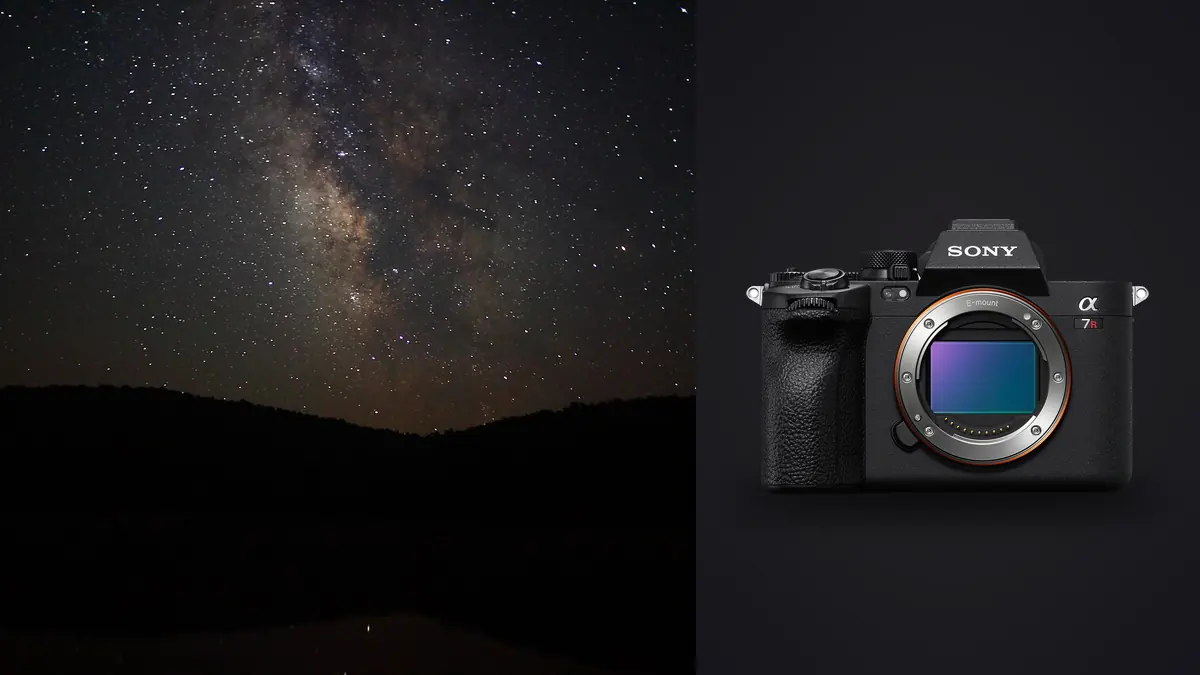
I took the A7R V out to shoot the Milky Way core over a limestone ridge in June, set up a 60-frame stack, and came home with 5.4GB of raw files from that one composition alone. That number is really the whole story of star stacking with this camera. The A7R V is a fantastic sensor for the job, but the 61 megapixels that make it so good at resolving faint dust lanes also mean every single frame is enormous, every focus error is more visible than it would be on a 24MP body, and the review process afterward takes longer than the shoot itself unless you plan for it. This is what I've actually learned running this camera through a season of stacked star shots, not a spec-sheet rundown.
Why 61 megapixels cuts both ways
More pixels means smaller photosites, and smaller photosites mean each one is collecting less light before it clips or falls into noise. On paper that should make the A7R V worse at high ISO than something like the A7S III. In practice, when you're stacking dozens of frames, the extra resolution buys you something the pixel-peeping ISO comparisons don't capture: downsampling. Stack 60 frames and then resize the output down to a more reasonable print resolution, and the noise averages out while the resolution advantage over a lower-megapixel sensor partially survives. I've compared stacked outputs from the A7R V against a friend's A7 IV shooting the same field the same night, and the A7R V file held finer detail in the star clusters after both were downsampled to match. It just needed more frames to get there, and more patience during culling.
The flip side is that focus tolerance gets tighter as resolution climbs. On a 24MP body, a star that's very slightly out of focus might still read as an acceptably tight point at normal viewing sizes. On the A7R V, the same small focus miss shows up as a visible halo or a soft blob the moment you zoom past 50%, and it will drag your stack's overall sharpness down if even a handful of the 60 frames going into it are affected. This is the single biggest practical difference between shooting astro on this body versus something lower resolution: you have to check focus more rigorously, more often, across more frames.
Getting the single-frame exposure right before you stack anything
Stacking software is not a fix for a badly exposed base frame. Every quirk in your individual subs, trailing, noise, chromatic fringing on bright stars, gets carried into the final stack and often gets amplified rather than smoothed out. So the real work happens before you ever open stacking software, at the point where you're deciding how long a single exposure can run before stars start to elongate.
I stopped trusting the old "500 rule" the day I checked stars at 100% on the A7R V and saw visible trailing on a supposedly safe 10-second exposure at 24mm. The pixel density here punishes any exposure-time rule that was designed around lower-resolution sensors. These are the numbers I've actually settled on shooting this body in the field, checked against the rear screen at full zoom rather than derived from a formula:
| Lens / focal length | Longest single exposure before visible trailing (untracked) | ISO I run at that shutter speed | Typical subs per stack |
|---|---|---|---|
| Sony 14mm f/1.8 GM | 8 sec | 3200-4000 | 40-60 |
| Sony 20mm f/1.8 G | 6 sec | 4000-5000 | 50-70 |
| Sony 24mm f/1.4 GM | 5 sec | 5000-6400 | 60-90 |
| Sigma 35mm f/1.4 DG DN | 3-4 sec | 6400-8000 | 80-120 |
Notice the pattern: the tighter the field of view, the shorter the safe exposure and the higher the ISO has to climb to compensate, which is exactly why longer lenses on this sensor practically demand a star tracker if you want a clean stack without pushing ISO into territory where color noise starts eating the fainter nebulosity. Wide primes like the 14mm GM are genuinely forgiving here and are what I reach for on any night I'm shooting handheld-tripod, no tracker.
Tracked vs untracked, and what it costs you in frame count
Put a Move Shoot Move or a Star Adventurer GTi under the camera and those exposure limits stop applying, at least for the sky. I've run 25-second single subs tracked at 24mm without any trailing, which means I need roughly a third of the frames to reach the same total integration time as an untracked session. Fewer, longer subs at lower ISO produce a cleaner stack and a much smaller working folder. The tradeoff is that the foreground now streaks unless you shoot it separately and blend it in later, so a tracked session on this camera usually means two distinct sets of files per composition rather than one, which somewhat cancels out the storage savings from needing fewer sky frames.
The number nobody warns you about: what stacking actually does to your card and your evening
A7R V raw files run around 60 to 65MB compressed, closer to 90MB if you shoot lossless compressed like I do for anything I might push hard in post, and past 120MB if you go fully uncompressed. Multiply that by 60 to 100 subs per composition, then by however many compositions you actually shoot in one night out under dark sky, and you're routinely coming home with 20 to 40GB from a single outing. That's before you've shot any wide establishing frames, any foreground exposures, or any test shots while you dialed in focus.
The part that actually eats your evening isn't the shooting, it's going through that pile afterward. Somewhere in every batch of 80 subs there are a handful where a gust moved the tripod a fraction, where a plane or satellite streaked through, where someone two ridges over swept a headlamp across the frame, or where focus drifted because the lens barrel contracted slightly in the cold over the course of forty minutes. Scrolling through 80 nearly identical thumbnails at 2am, trying to spot which three are the problem, is genuinely one of the least enjoyable parts of this hobby.
This is the actual reason I moved my astro culling into imagic rather than doing it in whatever raw browser I happened to be in. Because it clusters visually similar bursts instead of listing every sub as its own tile, a 90-frame star stack lands in the grid as one group I can flip through quickly rather than ninety separate rows competing for attention, and because the sharpness scoring runs on local pixel-level contrast rather than a rough histogram check, it actually catches the specific problem astro stacks have: a handful of frames where the stars themselves went soft while everything else in the composition looks fine at a glance. I've had it flag a run of frames where focus had crept half a turn from thermal drift, something I'd missed by eye scrolling through the same set the night before. And since it's processing everything locally, not uploading anything, that matters more for astro trips than for most other kinds of shooting, because I'm usually somewhere with zero signal, let alone a data connection worth uploading 30GB over.
What I actually keep and what I throw away
Not every sub needs to survive the cull, and being too precious about "just in case" frames is how you end up with a raw archive that never gets touched again. My rule of thumb: any sub with visible trailing gets cut immediately, any sub where a light source crossed the frame gets cut, and anything that's more than about a third of a stop darker than the rest of the run (usually meaning a thin cloud drifted through) gets pulled unless the whole night was thin and hazy, in which case I'd rather reshoot on a clearer night than fight it in the stack.
Stacking software: what actually pairs well with this camera's files
For Milky Way and landscape-astro composites where the foreground stays sharp and the sky gets tracked separately, I use Sequator most nights. It's free, Windows-only, and handles the sky/foreground blend without much fuss, though it can struggle if there's a lot of foreground detail right at the horizon where the two masks meet. Starry Landscape Stacker does a similar job on the Mac side and, in my experience, handles that horizon blend a little more gracefully, at the cost of being a paid tool. For pure deep-sky work off a tracker, no foreground at all, DeepSkyStacker is still the workhorse for the free tier, and PixInsight is what I reach for once a target is worth the extra hours of manual calibration, though its learning curve is steep enough that I don't recommend it as anyone's first stacking software.
One setting that trips people up on Sony bodies specifically: long exposure noise reduction. Leave it off for your light frames. LENR doubles your exposure time by shooting a matching dark frame after every single sub, which on a 90-frame session means doubling your time under a mosquito cloud for no benefit, since proper stacking software wants you to shoot a smaller batch of dedicated dark frames separately and apply them across the whole set, not one dark per light.
Two things specific to this camera worth knowing before you rely on it
First, Sony's long-exposure star-eater processing has genuinely improved on the A7R V compared to earlier bodies, but I'd still tell anyone new to this camera to test it themselves rather than take my word for it: shoot a tight star field at your planned exposure length, zoom to 100%, and look for stars that seem unnaturally soft or slightly smeared compared to their neighbors, particularly in exposures at or above roughly 4 seconds. It's subtle enough now that I don't build a workaround into my process anymore, but subtle isn't the same as gone.
Second, Pixel Shift Multi Shooting is not for the sky. It's designed to composite several frames shot a pixel apart to resolve extra detail and eliminate demosaicing artifacts, and stars move between those frames just like everything else does, so you'll get smeared, broken star points if you try it on a night sky exposure. Where it is genuinely useful is on the static foreground of an astro-landscape composite: shoot your foreground rock formation or treeline with pixel shift while the sky is still bright enough for a fast base exposure, then blend that maximum-detail foreground against your tracked, stacked sky later. It's a nice trick, but it only works because the foreground isn't moving.
Cold, batteries, and the practical stuff nobody puts in the spec sheet
The NP-FZ100 batteries lose real capacity below freezing, and a night that would normally get me through 400-plus frames on a warm evening can tap out closer to 250 when it's near zero Celsius. I carry at least two spares against my body to keep them warm and swap in the cold one only when it's actually in the camera. For anything tracked and long, I've switched to running the camera off USB-PD power through the multi-port so battery capacity stops being the limiting factor on how long a session can run.
The articulating screen is more useful for astro than it gets credit for. Pointed near zenith, a fixed screen means either lying on the ground or shooting blind, and the A7R V's screen tilts and swings enough to frame comfortably at almost any angle the sky throws at you. Combined with focus magnification on a bright star (I usually pick something in the 1st or 2nd magnitude range to focus on, then leave the lens taped so it can't drift), getting critical focus takes maybe thirty seconds once you've done it a few times.
Once the stack is done: matching it to the rest of the trip
A stacked and blended astro composite usually comes out of stacking software as a flat TIFF that needs a real edit pass, contrast, color balance on the sky gradient, sometimes a curves pull on the Milky Way core. On a multi-composition night I end up with several of these plus a batch of wide establishing shots and foreground frames from the same trip, and getting a consistent look across all of them by hand, one at a time, is slow. I run imagic's apply_my_style preset over the batch once I've picked my keepers. Because it's trained on my own past edits rather than a generic astro preset, it gets my usual white balance and contrast choices close enough on the first pass that I'm mostly doing small local adjustments afterward instead of rebuilding the look from scratch on every file. It's not a replacement for actually editing the hero shot from a trip by hand, but for the secondary frames it saves a genuine amount of time. If you want more on how that kind of AI-assisted culling actually scores frames under the hood, I wrote about that separately in how AI photo culling works.
If astro is just one piece of a broader night's shooting and you're trying to get through the backlog faster in general, most of what applies to normal event or travel culling applies here too, just with the added wrinkle of star-specific sharpness checks. I've got a more general rundown of that in 10 tips for a faster photo workflow.
Frequently Asked Questions
Does the extra resolution on the A7R V actually improve stacked star detail, or is it just more noise to average out?
Both, honestly. At the single-frame level, high ISO noise on the A7R V is a bit more visible than on a lower-megapixel body because each photosite is smaller and collecting less light. Once you stack enough frames and downsample the result, though, the resolution advantage partially survives while the noise averages down, so the final output does hold finer detail in star clusters and dust lanes than an equivalent stack from a 24MP sensor, provided you shot enough subs to actually benefit from the averaging. Fewer than 20 or 30 frames and you're mostly just carrying the extra file size without earning the detail payoff.
Do I need a star tracker for this camera, or is untracked stacking good enough?
Untracked is genuinely fine for wide-field Milky Way work, especially with a fast lens under 20mm, and it's how I shoot most nights simply because setting up a tracker and doing a polar alignment adds fifteen minutes I don't always have before the core is in position. Once you're reaching for anything longer than about 24mm, or you want a tighter, cleaner deep-sky target rather than a wide landscape composition, the exposure limits get short enough that a tracker stops being optional if you want a genuinely clean result at low ISO.
Is the in-body stabilization any use for astrophotography on the A7R V?
Not for the actual exposures, no. IBIS is built to counteract handheld shake during exposures short enough to hand-hold, and every astro exposure worth stacking is on a tripod at a shutter speed far outside what stabilization is designed to compensate for. In fact I turn it off entirely on a tripod, since on some Sony bodies an active stabilization unit with nothing to correct for can introduce a very faint vibration of its own into a long static exposure. Where the 5-axis system does help is composing and manually focusing at odd angles before you lock the tripod down, since a stabilized live view is a lot easier to judge focus through.
How many subs should I actually be shooting for one composition?
For an untracked wide Milky Way shot at a fast aperture, 40 to 60 frames gets you a genuinely clean result. For a tracked, longer-lens deep-sky target, I'd rather have 20 to 30 longer subs at low ISO than 100 short ones, since the noise characteristics of fewer, cleaner frames tend to stack better than a huge pile of noisier ones. There's a point of diminishing returns past roughly 100 frames on this camera where the improvement in the final stack gets marginal but the file management burden keeps growing linearly, and that's usually where I stop.