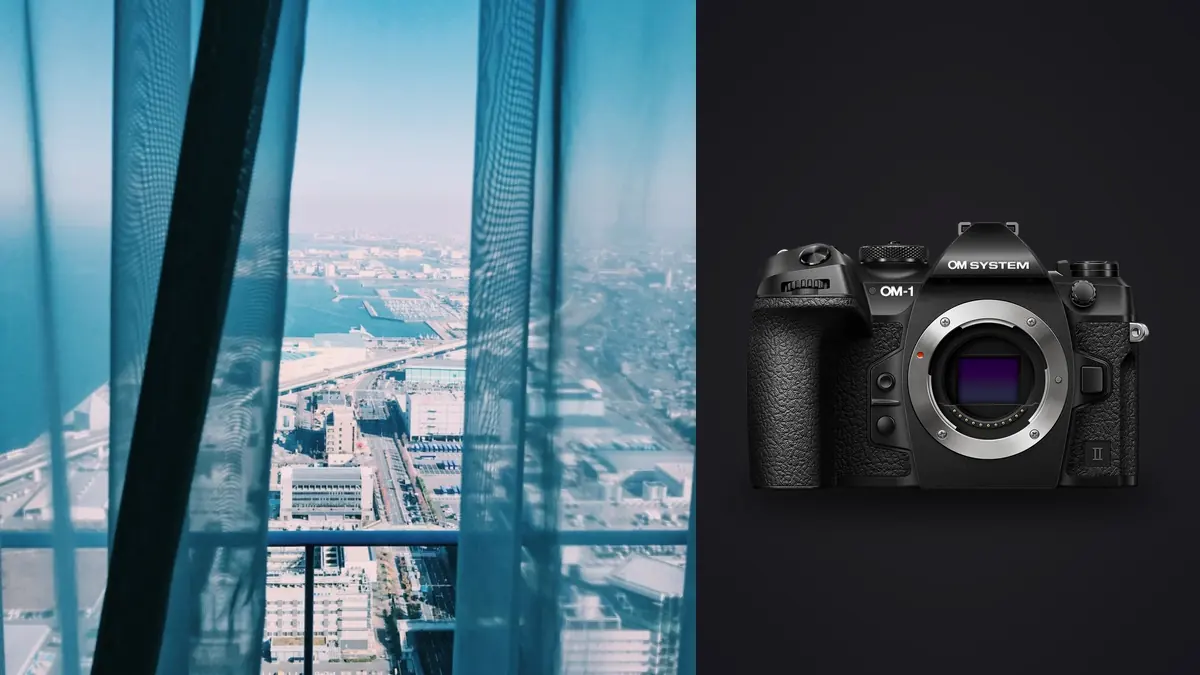
Boudoir work asks different questions of a camera than most photography does. Nobody in that room cares about dynamic range charts on a review site. They care about whether you can move quietly, whether the light stays soft and specific instead of clinical, and whether the session ends with both of you trusting that the pictures got made well and will be handled carefully afterward. I get asked fairly often whether the OM System OM-1 Mark II is a sensible body to build an intimate portrait business around, usually by photographers who already own a Micro Four Thirds kit from travel or event work and don't want to rebuy an entire system in a bigger mount. Short answer: yes, with a few real caveats worth walking through instead of glossing over.
The sensor size question, answered honestly
The OM-1 Mark II uses the same class of sensor Micro Four Thirds has shipped for a while now, a 20.4-megapixel stacked BSI Live MOS chip with a physical area about a quarter that of a full-frame sensor. That two-times crop factor changes two things that matter for this genre specifically: field of view and depth of field. A 45mm lens behaves like a 90mm would on full frame, which is a genuinely good boudoir focal length, tight enough to compress a small room and flatter proportions without forcing you to work uncomfortably close to someone. The part people complain about is depth of field. Shoot the 45mm PRO at f/1.2 and the background separation reads closer to what an f/2.4 lens produces on a full-frame body, not the razor-thin sliver of focus the number on the barrel implies.
In practice I've come around to seeing that as a point in its favor for this specific genre rather than a flaw. Boudoir sessions happen at close working distances, often under two meters, and a true f/1.2 full-frame lens at that range can leave you with a focal plane so thin that an eye is sharp while a collarbone six inches further back has already gone soft. For a genre where hands, a jawline, and a shoulder line all sit together in the same frame, the extra depth of field the smaller sensor gives you at a wide aperture keeps more of what actually matters acceptably sharp. You do lose some of that creamy full-frame falloff in a large room with a busy far background, which matters more in a spacious hotel suite than in a bedroom where the backdrop is six feet away and going soft either way.
Lens pairing, and why the list is shorter than people expect
OM System's PRO f/1.2 primes are the reason a lot of portrait shooters land on this system in the first place. The 45mm f/1.2 PRO is the one I reach for most on a session, a familiar 90mm-equivalent angle with rendering that holds its own against far more expensive full-frame glass. The 25mm f/1.2 PRO (a 50mm equivalent) earns its keep for two-thirds and full-length frames in a room too small to back up further, which describes most actual bedrooms and hotel rooms I've worked in rather than the airy studio spaces gear photos are usually shot in. The 17mm f/1.2 PRO (34mm equivalent) is the one I use least for the intimate frames themselves but most for behind-the-scenes and getting-ready shots, the environmental context a lot of boudoir packages sell alongside the main gallery.
If a client wants full coverage from a single lens because swapping glass mid-session breaks the mood, the 12-40mm f/2.8 PRO II covers a usable range at the cost of a stop and a half of light against the primes, which is a real trade-off in a dim bedroom lit by one window and a lamp. I keep one in the bag as a backup, not as the main tool.
Working a bedroom without a flash
Most intimate sessions I shoot lean on window light, sometimes a single continuous LED panel bounced off a wall or ceiling, and nothing that pops or fires audibly. A flash going off in a small bedroom breaks the mood fast, and clients who are already a little nervous about being photographed this way notice it immediately, every time. This is where the OM-1 Mark II's in-body stabilization does real work. OM System rates it at up to 8.5 stops when a compatible PRO lens is paired through their Sync IS system, and while I'm not running a stopwatch on that number, handheld shutter speeds down around a quarter or even half a second at reasonable apertures turn out to be usable far more often than they have any right to be. That buys you a genuinely flash-free session in rooms most cameras would push you toward either a tripod or a much higher ISO than you'd want.
The mechanical shutter itself is unremarkable, about what you'd expect from a body in this class. Switch to the fully silent electronic shutter and it disappears completely, and that matters more in this genre than in almost anything else I shoot. There's no click marking each frame, no audible cue that a picture just got taken of someone in a vulnerable moment. Sitters tend to appreciate that, once they realize partway through the session that they've stopped hearing the camera altogether.
The Mark II also pushed the burst ceiling well past the original OM-1, over 50 frames per second in electronic shutter with continuous autofocus still tracking, and higher again if you're willing to give up AF tracking between frames. That's genuinely useful for catching real movement, hair settling, fabric shifting, a laugh that wasn't posed for. It also means a single ninety-minute session can leave you with several thousand frames that are ninety percent near-duplicates of each other. That volume is exactly the kind of problem AI-assisted culling exists to solve, and it comes up more in this genre than in almost any other kind of shoot I do.
How it actually compares for this specific kind of work
Spec sheets don't tell you much about what matters in a client's bedroom. The table below is built around the factors that actually change how a boudoir session goes, not a generic feature checklist.
| Factor | OM-1 Mark II (Micro Four Thirds) | Typical full-frame body | Typical APS-C body |
|---|---|---|---|
| Sensor crop factor | 2.0x | 1.0x | 1.5x |
| Effective DOF of an f/1.2 prime at ~1.5m working distance | Reads like roughly f/2.4 | True f/1.2, very thin | Reads like roughly f/1.8 |
| Body weight, body only | ~599g | 650-750g typical | 460-560g typical |
| Mechanical shutter sound | Moderate, unremarkable | Moderate to noticeable | Often quiet, some leaf-shutter options |
| Fully silent shutter option | Yes, electronic | Common on newer models | Common on newer models |
| Comfortable ISO ceiling in dim window light | ~ISO 3200-6400 | ~ISO 6400-12800 | ~ISO 3200-6400 |
| Rated IBIS (body + compatible lens) | Up to 8.5 stops | Varies, roughly 5-8 stops | Varies, roughly 5-7 stops |
| Weather sealing | IP53 rated | Varies by model | Varies by model |
Nothing in that table crowns an outright winner. It just shows the actual trade you're making: more forgiving depth of field and a lighter kit against a narrower high-ISO ceiling. Which side of that trade matters more depends entirely on whether you're shooting in tight rooms with mixed close-up framing (where the OM-1 Mark II's extra depth of field helps) or dim, cavernous suites where you need every bit of full-frame's low-light headroom.
What happens after the shutter closes
A boudoir session that produces four or five thousand frames across a couple of outfit changes is not unusual with a burst rate like this, and sorting that by eye is where a lot of photographers lose an evening they don't have to spare. I run everything through imagic afterward specifically because it clusters bursts and near-duplicate frames on my own laptop and scores sharpness and focus without me tagging a single image by hand first. None of that touches the cloud to happen. For this genre that isn't a nice-to-have, it's close to a requirement. Nobody hiring a boudoir photographer wants to hear that their session got routed through someone else's server for processing, no matter how reputable that service claims to be.
The other place it earns its spot in the workflow is grading. Skin tone consistency across a session shot partly by window light and partly under a warm lamp is genuinely fiddly work (there's a longer breakdown of the general approach in our color grading guide if you want the fundamentals). I built a preset in imagic's apply_my_style feature off a batch of edits I was already happy with, so new sessions pick up my usual warmth and skin rendering as a starting point instead of me re-deriving the look from scratch every time. It's trained on my own past edits rather than a preset pack someone else sells, which matters here because a mismatched color grade shows up on skin in a way it never does on a landscape.
Where I'd think twice
IP53 weather sealing is largely wasted on a genre that happens almost entirely indoors. It's a real asset if part of your business includes destination intimate sessions, a private pool deck, a cabin porch at dawn, a robe walk through wet grass, but if your calendar is all bedrooms and hotel suites, you're paying for weatherproofing you'll never actually test. Battery life is also modest on paper, official ratings sit in the low five hundreds of frames per charge, and a session that runs long with a lot of chimping between setups can burn through one battery faster than a full day of event work would. I carry two as a rule now, not because I've run one dry mid-session, but because running one dry mid-session on this kind of shoot is a genuinely bad moment to have.
Street price has settled somewhere in the low two thousands for the body alone, which puts it close to some full-frame bodies with larger sensors and, for some shooters, a more familiar depth-of-field feel. The case for the OM-1 Mark II specifically isn't that it's cheaper. It's that the whole kit, body plus two or three PRO primes, stays light enough to carry into a private home in one small bag, which matters more in this genre than in almost any other kind of portrait work I do. Nobody wants to watch you unpack a rolling case in their bedroom.
Frequently Asked Questions
Does the smaller sensor actually hurt the boudoir look, or is that overstated?
It's overstated as a blanket claim. You get more depth of field at a given aperture than a full-frame shooter would expect, which costs you some background blur in large rooms but gives you back consistent sharpness across a face, a hand, and a shoulder at close working distance, something full-frame f/1.2 glass genuinely struggles with in this genre. Net, it's a different look rather than a worse one.
Which lens should be the first purchase for this kind of session?
The 45mm f/1.2 PRO, without much hesitation. It covers the classic tight portrait framing most boudoir galleries are built around, and the equivalent field of view (roughly 90mm) is forgiving of small rooms in a way longer full-frame portrait lenses aren't. Add the 25mm f/1.2 PRO once you need wider framing for full-length or environmental shots in the same space.
Is it actually quiet enough for a bedroom or hotel-room session?
Switched to the electronic shutter, yes, it's silent. The mechanical shutter is unremarkable rather than loud, but for anything genuinely close and intimate I default to electronic shutter for the whole session rather than switching back and forth.
How should I handle subject privacy when culling and editing thousands of intimate frames?
Keep the whole pipeline local. Culling software that uploads frames to a cloud service for processing is a real risk in this genre regardless of how the provider markets its security, and it's not a risk most clients would consent to if you asked plainly. I run culling and grading through imagic precisely because the sharpness scoring, burst clustering, and editing all happen on the machine in front of me, with nothing leaving the laptop to get the work done, and I'd recommend the same standard whatever tool you land on.