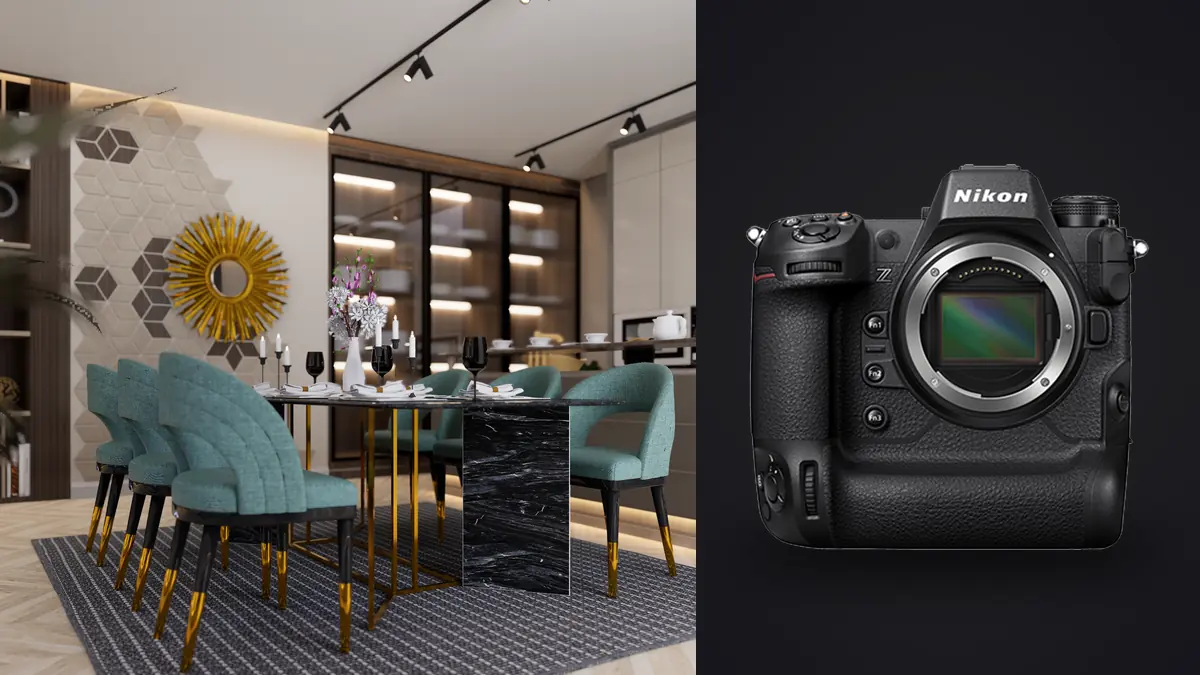
A dependable Nikon Z9 architectural and interior design photography RAW Workflow starts with the finished photographs, not with a software preset. The intended sequence, crop, viewing size, color treatment, and deadline determine which files deserve protection and how much latitude the RAW master must retain. This guide follows that exact RAW Workflow from capture through backup, selection, development, quality control, and export.
The Z9 uses a 45.7 megapixel stacked full-frame sensor, an electronic-only shutter, and two matching CFexpress Type B or XQD slots. It records 14-bit NEF with lossless and High Efficiency choices. The resolution and matched media suit detailed interiors, but electronic capture still requires a banding check under artificial light. That identity matters because a sound architectural and interior design photography process uses the camera's real strengths while respecting its practical limits. It does not treat a high frame rate, large sensor, subject detector, or compact body as a guarantee of a useful photograph. Every stage should preserve enough evidence to reverse a choice without confusing a derivative file with the original.
Define the result before selecting a RAW option
Write a deliverable note for the Nikon Z9 assignment before formatting cards. Include the number of final images, likely aspect ratios, largest reproduction size, color space, file type, naming rules, and whether the client expects individual frames or a visual sequence. For architectural and interior design photography, add the editorial tests that matter but cannot be inferred from sharpness alone. Those may include gesture, subject identity, continuity, atmosphere, product accuracy, privacy, or the relationship between adjacent frames.
Choose NEF as the Nikon Z9 master when the architectural and interior design photography brief needs recoverable white balance, careful highlight handling, or substantial tonal work. A simultaneous JPEG can help with reference and rapid communication, but it should not silently replace the RAW source. Test the selected compression option in the actual processor before a paid assignment. Smaller files are useful only when their compatibility, bit depth, and editing behavior remain suitable for the delivery.
| File role | Purpose | Rule |
|---|---|---|
| NEF master | Maximum reversible editing latitude | Preserve unchanged |
| Review JPEG | Fast comparison and communication | Mark as a derivative |
| Working edit | Adjustment decisions and versions | Keep linked to the master |
| Delivery file | Client or publication use | Export to a written specification |
Configure capture around the subject, not the menu
Level the Z9 on a rigid support, use a low practical ISO, and expose for important windows, fixtures, and pale finishes. Test LEDs and screens for bands before committing to a room. Make one NEF when the range fits, bracket only when a merge is required, and lock focus, white balance, aperture, and framing through every component.
Place focus to cover the important foreground furniture and distant structure rather than defaulting to infinity. Use magnified view on a fine edge and make a focus-shift sequence only when one aperture cannot cover the required depth. Avoid stopping down farther than necessary, since diffraction reduces the benefit of the Z9 resolution.
Make a controlled test under the expected light and inspect it at full resolution. Check the intended plane of focus, subject movement, fine texture, bright channels, dark transitions, and any repeated light source that could band under an electronic shutter. Stabilization can reduce camera movement, but it cannot stop a moving subject. Likewise, subject recognition can assist acquisition, but the photographer still chooses the relevant subject and decisive instant in a Nikon Z9 architectural and interior design photography frame.
Give the lens, position, and light distinct jobs
Use a rectilinear Z wide-angle lens and keep the camera level when verticals should remain parallel. Step back before choosing an extreme focal length if the property permits it. A perspective-control lens through a compatible arrangement can reduce correction, but its movement and edge quality should be tested before the assignment.
Create a neutral color reference for the Nikon Z9 architectural and interior design photography set whenever the lighting permits it. Photograph a gray target or known neutral under each materially different source, then leave the reference in the same folder as the affected images. A reference is a starting point, not an instruction to remove every intentional color cast. It helps distinguish a camera or processing shift from the actual character of the scene.
Protect important Nikon Z9 highlights using the histogram and channel warnings rather than LCD brightness alone. In architectural and interior design photography, a pale garment, reflective surface, spotlight, white structure, or bright sky can clip in one channel before the overall preview looks damaged. RAW offers adjustment latitude, but a fully clipped channel contains no texture for the processor to recover.
Preserve sequence identity on the cards
Configure the two Z9 CFexpress or XQD slots for simultaneous NEF recording when redundancy is required. Matching slot types simplify card roles, but the selected cards still need verified sustained performance. Start a new sequence for every room, viewpoint, exposure bracket, and focus shift, and use a slate to distinguish components from ordinary alternatives.
JOB_CODE/
  01_CAMERA_ORIGINALS/
    NIKON_Z9_CARD_001/
  02_VERIFIED_BACKUP/
  03_REVIEW/
  04_WORKING_EDITS/
  05_EXPORT/
  06_DELIVERY_NOTES/
Copy the complete card structure into a uniquely named folder. Do not scatter files from several cards into one directory until duplicate filenames, camera clocks, and sequence boundaries have been checked. If two bodies are involved, synchronize their clocks before capture and retain a camera identifier in the folder or filename. This makes a Nikon Z9 architectural and interior design photography sequence traceable after sorting changes the display order.
Verify two copies before culling
Copy the Nikon Z9 architectural and interior design photography originals to a working drive, create an independent second copy, and verify both before returning media to circulation. A folder that appears in a file browser is not proof that every byte arrived. Use a copy tool with verification or generate checksums, then spot-open files from the destination. Keep the two copies on separate devices, and move one away from the working system when the risk of loss justifies it.
imagic supports Nikon NEF files for local Z9 culling and RAW development. It does not merge brackets, panoramas, or focus-shift sequences, so preserve all components and perform assembly in dedicated software before returning a compatible derivative to the finishing workflow.
Cull technical failures before editorial alternatives
Begin the Nikon Z9 architectural and interior design photography review at sequence level. Group frames made from the same action, pose, focus bracket, lighting setup, or composition, then compare within each group. Reject obvious accidents first: unintended releases, blocked frames, irrecoverable clipping, focus on the wrong plane, severe motion that has no expressive purpose, and duplicates with no independent value. Do not delete at this stage. A reject status is reversible and keeps the original available for audit.
Inspect Z9 architecture groups for level geometry, corner detail, window texture, reflections, moving curtains, people, screens, styling continuity, and complete bracket coverage. Select a functional set that explains circulation, material, scale, and detail as well as hero views. Reject a beautiful angle when it misrepresents the space or omits a required feature.
imagic can assess sharpness, exposure, closed eyes, and composition while grouping bursts and near-duplicates locally on Windows or macOS. For this Nikon Z9 architectural and interior design photography set, treat those results as a structured review aid. The photographer remains responsible for factual importance, consent, narrative, styling accuracy, and any intentional departure from technical perfection. Culling changes status rather than deleting the camera original.
Develop the RAW master in a repeatable order
Open NEF files with the chosen camera profile and lens correction, then establish one white balance and exposure baseline per lighting state. Correct perspective before the final crop and inspect stretched corners. Recover windows only to a believable level, keeping fixtures luminous and interiors dimensional instead of flattening every tone into the middle.
Separate daylight, practical lamps, and LEDs into local zones only after choosing a credible global balance. Keep designed wall, wood, fabric, and metal colors recognizable while preserving intentional warmth. Compare adjoining rooms and alternate views so the same finish does not change color across the delivered set.
Apply global corrections to the Nikon Z9 architectural and interior design photography files before local ones. A practical order is camera profile, white balance, exposure, highlight and shadow placement, tone curve, color, lens correction, noise treatment, and capture sharpening. This prevents a local mask from compensating for a global error. Recheck earlier controls after a major exposure or profile change because the apparent need for saturation, contrast, or noise reduction may disappear.
Judge sharpening for the Nikon Z9 architectural and interior design photography file at an appropriate magnification, and separate capture sharpening from output sharpening. Its fine detail can invite aggressive settings that emphasize pores, dust, foliage edges, fabric texture, or noise more than the subject. Noise reduction should address objectionable noise without erasing the small structures that make this photograph credible. Inspect both a critical detail and a smooth tonal area before synchronizing settings.
Keep composite and special captures honest
Exposure brackets and focus-shift runs solve different limits and should not be multiplied automatically. Preserve every Z9 component NEF, record the mode, and merge in suitable software. Check railings, window frames, repeated patterns, foliage, screens, and light edges for ghosting or alignment errors before treating the composite as a master.
Batch by lighting group, then inspect exceptions
Create Nikon Z9 adjustment groups from real architectural and interior design photography capture conditions, not from the whole card. Useful boundaries include a lighting change, lens change, room, set, stage act, weather shift, subject distance, or exposure strategy. Choose a representative frame from the middle of each group, establish a neutral baseline, and synchronize only controls that should genuinely match. Crop, healing, aggressive highlight recovery, and subject-specific masks usually need individual review.
After synchronizing the Nikon Z9 architectural and interior design photography group, inspect the first, middle, and last image plus every keeper with a different histogram. This catches drift from changing light, flash recycling, passing clouds, stage LEDs, or a shifted subject position. A learned style can provide continuity when it has been trained from the photographer's own edits, but it should follow technical normalization rather than conceal inconsistent exposure or white balance.
Export for the destination and verify the files
Export corrected architecture masters with the crop margin required by the designer or publication, then create separate listing, web, and print versions. Verify verticals, door proportions, repeated lines, ceiling gradients, and corners after resizing. A mathematically straight frame should still look spatially believable.
Set output dimensions, color space, bit depth, compression, metadata, and naming from the written brief. JPEG is suitable for many web and gallery deliveries, while TIFF can preserve more information for a downstream print or retouching stage. Do not enlarge, strip metadata, watermark, or sharpen by habit. Each choice should answer a delivery requirement for the Nikon Z9 architectural and interior design photography project.
For more context around the Nikon Z9 architectural and interior design photography process, the desktop workflow explains local culling and non-destructive editing. The single-photo web editor is useful for a quick derivative edit, while more selection and finishing systems appear in the Camera Hardware blog collection. The job's own written requirements still take priority over a general reference.
Use a capture-to-delivery checklist
- Brief: record subject priorities, sequence needs, crop, output, and privacy limits.
- Capture: confirm NEF, shutter behavior, focus method, white balance reference, and highlight margin.
- Media: label cards or internal storage and keep exposed media physically distinct.
- Ingest: preserve card structure, record counts, and verify two independent copies.
- Group: keep bursts, brackets, poses, and lighting changes visible as sequences.
- Cull: separate technical rejection from editorial selection and retain reversible statuses.
- Develop: normalize globally, synchronize by condition, and inspect exceptions.
- Special work: preserve every component of a stack, bracket, composite, or merge.
- Export: render to the destination specification and inspect files outside the editor.
- Archive: keep camera masters, adjustment records, approvals, and the export recipe.
Frequently asked questions
Should every Nikon Z9 architectural and interior design photography frame be recorded as RAW?
For Nikon Z9 architectural and interior design photography, RAW is appropriate when the job needs maximum correction latitude or a durable editing master. A JPEG-only choice can be reasonable for a tightly controlled, immediate use, but it should be deliberate and tested against the actual destination.
Can automated scoring choose the final architectural and interior design photography story?
No. In a Nikon Z9 architectural and interior design photography review, scoring and duplicate grouping can narrow technical choices, but they do not know which subject, gesture, garment, play, species behavior, or spatial relationship matters to the brief. Final selection remains an editorial decision.
When is the Nikon Z9 RAW Workflow finished?
The Nikon Z9 architectural and interior design photography workflow is finished when approved files have been exported to specification, opened and checked, delivered through a verified copy, and archived with their masters and adjustment records. Finishing the edit without verifying derivatives leaves the workflow incomplete.