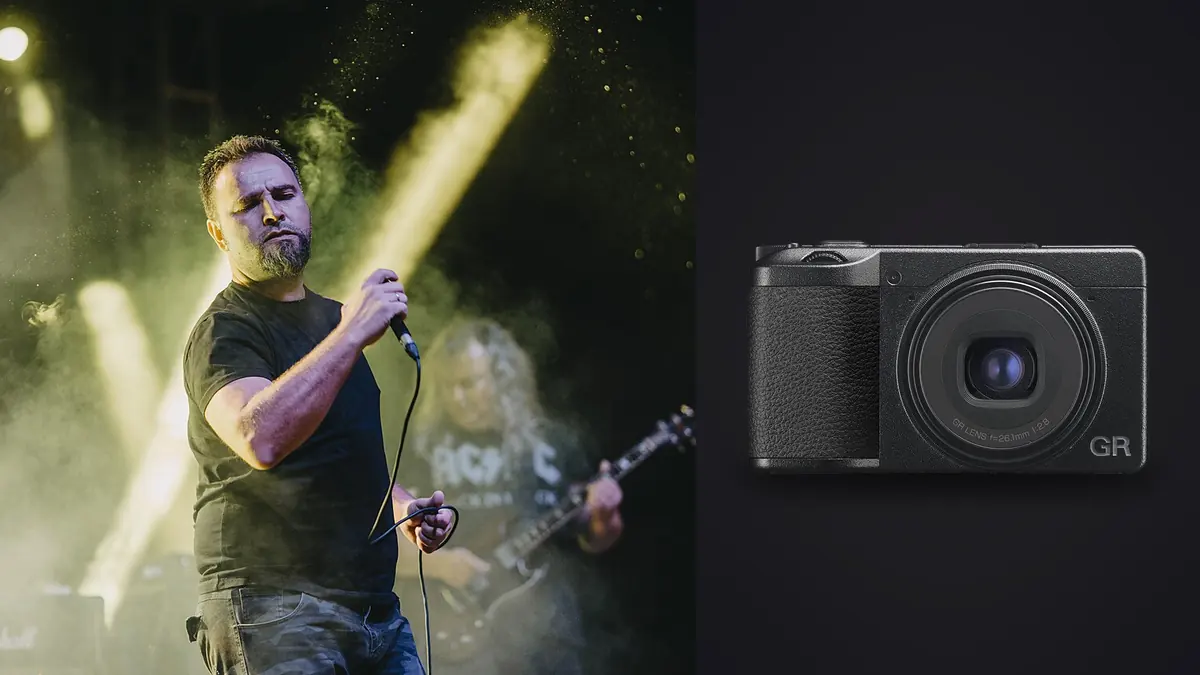
Why a Fixed 40mm Compact Even Makes Sense at a Show
The first time I brought a Ricoh GR IIIx to a gig, it was because I was tired of carrying a second body. I'd been shooting a mid-size venue with a mirrorless camera and a 70-200mm for the stage, and I wanted something in a jacket pocket for the crowd, the merch table, the smokers' alley behind the club where the support act was warming up. The GR IIIx wasn't supposed to be the main camera that night. By the second set it was the only one I was reaching for.
That's the case for the GR IIIx at live music: it's not a substitute for a fast telephoto zoom in a photo pit, and treating it like one will disappoint you. What it does is let you work close, quietly, and fast, in situations where a bigger camera changes how people around you behave. Support slots, in-store acoustic sessions, backstage corridors, festival campsites at 2am. Its APS-C sensor and fixed 26.1mm lens (a 40mm field of view once you account for the crop factor) sit in an odd but useful spot: wider than a classic 50mm normal lens, tighter than the 28-35mm most street shooters reach for, and small enough that nobody in a packed room clocks you as "the photographer."
This piece is about what actually happens when you point that specific lens and that specific autofocus system at a stage under moving colored light, and what to do about the parts that don't work the way you'd want.
What 40mm Actually Buys You From the Crowd or the Wings
A 40mm equivalent is a documentary length, not a stage-isolation length. From the barrier at a small club, 40mm gets you the singer's upper body and maybe the guitarist beside them, not a tight face-filling frame. From the side of the stage, standing where a support photographer is usually allowed to stand, it's closer to right: you get the performer, their instrument, and enough of the stage to show scale, which is often a more useful photo for a band's social feed than a cropped headshot anyway.
The GR IIIx has two digital crop modes built in, giving you framing equivalent to roughly 50mm and 71mm without touching a menu deep enough to slow you down. They're genuinely handy for tightening a frame on the fly, but they cost real resolution: the 50mm crop cuts you down to a file that's fine for web and small prints, and the 71mm crop drops you into territory where you're better off cropping a touch in post from the full frame if you have any doubt about needing the wider shot too. My habit is to shoot native 40mm for anything with movement and only switch to the crop lines when the subject is genuinely static, a soundcheck, a between-song pause, an acoustic breakdown where nobody's moving.
What this means practically: if your job is chasing the singer's expression in tight close-up all night, this is the wrong camera. If your job is telling the story of the room, the crowd's hands in the air, the drummer's kit lit by a single gobo, the guitarist's pedal board between his feet, 40mm is doing exactly what you want.
Autofocus Under Moving Gel Light Is the Real Weak Point
The GR IIIx uses contrast-detection autofocus, and contrast detection wants stable, evenly lit contrast to lock onto. A stage under a moving wash of red, then blue, then a strobe hit, is close to the worst-case scenario for that kind of system. In a small venue with a single static wash you'll get workable hit rates. The moment a moving-head fixture starts sweeping the stage or the lighting operator drops to near-black between songs, the lens will hunt, and it hunts audibly and visibly, racking through its full focus travel before giving up.
The fix isn't a firmware trick, it's a technique change: Snap Focus. Set a fixed distance (I run 2.5m for barrier-height club shooting, 5m when I'm working from the side of a slightly bigger stage), stop the aperture down to f/4 or f/5.6 if the ISO budget allows it, and let depth of field do the work autofocus can't. You lose the ability to isolate a subject with shallow depth of field, but you gain a camera that fires the instant you press the shutter instead of the half-second (or more) it takes contrast AF to hunt through darkness and settle, if it settles at all. One thing that catches people out: the GR IIIx has a dedicated macro AF mode toggled by a switch on the body, and if you bump it by accident in a dark room while adjusting your grip, the lens starts hunting for close-focus subjects that aren't there. Check that switch before every set, not just before the night.
Shutter Speed, ISO, and the Trade-Off Nobody Tells You About
Freezing a singer's head mid-shake or a drummer's stick at the top of a hit needs something close to 1/320s or faster. Getting there at a small venue with a single key light means running ISO higher than most people expect from a 24-megapixel APS-C sensor, and the GR IIIx's f/2.8 maximum aperture doesn't give you the same light-gathering cushion as an f/1.4 prime on an interchangeable-lens body. The built-in three-axis shake reduction helps you hold a slower shutter without camera-shake blur, but it does nothing for a moving performer, so don't let a steady-looking image on the rear screen fool you into shooting slower than the subject needs.
Here's roughly how I set up depending on the room, based on venues I've actually shot with this camera over the past year:
| Venue Type | Typical ISO Range | Shutter Floor | AF Approach |
|---|---|---|---|
| Small club, single wash, low ceiling | ISO 3200-6400 | 1/250s | Snap Focus at 2.5m, f/4 |
| Mid-size theater, moving gel lights | ISO 1600-4000 | 1/320s | Snap Focus at 4-5m, f/4 |
| Outdoor festival, daylight set | ISO 100-400 | 1/500s | Continuous AF works fine here |
| Outdoor festival, night set with LED wall | ISO 800-3200 | 1/320s | Snap Focus, watch for LED banding |
| Seated acoustic or jazz set | ISO 1600-3200 | 1/125s | Continuous AF, subject barely moves |
Push much past ISO 6400 in DNG and you start losing color detail in shadow areas that even careful noise reduction in post can't fully bring back. I'd rather come home with a slightly noisier frame that's sharp than a clean one that's soft, so on a genuinely dark stage I'll bias toward shutter speed over noise every time.
The Silent Shutter Is Great, Until It Isn't
Switch the GR IIIx to its fully electronic, silent shutter mode and it becomes a camera you can shoot next to a seated audience during a hushed acoustic number without a single head turning. That's a real advantage over any camera with a mechanical curtain, and it's the reason the GR IIIx has quietly become a favorite for photographers covering intimate listening-room shows, in-store performances, and spoken-word sets where a mechanical clack would be genuinely rude.
The catch is rolling shutter and LED banding. Electronic shutters read the sensor line by line rather than all at once, and a lot of stage lighting, especially LED walls and PWM-dimmed moving-head fixtures, flickers faster than the eye sees but not faster than a rolling readout can catch. At certain shutter speeds you'll get dark horizontal bands across the frame that weren't visible to you in the room. There's no in-camera anti-flicker sync on this body the way there is on some higher-end sports cameras, so the workaround is trial and error: shoot a test frame at your intended shutter speed as soon as you're set up under any LED-heavy rig, check it at 100% zoom on the rear screen, and nudge the shutter speed up or down slightly if you see banding. It's a five-second check that saves you from finding out at 1am when you're editing that half your favorite frames from the headline set have stripes through them.
Battery, Buffer, and Getting Through Three Bands
The DB-110 battery is rated around 200 shots by CIPA standard, and in real concert use, where you're chimping the screen constantly to check exposure and focus in the dark, I get closer to 150 usable frames before the camera starts warning me. For a three-band bill that's not enough on one charge. I carry two spare batteries and top up the third via USB-C from a power bank between sets, which the GR IIIx supports without complaint. The single UHS-I SD slot is the other thing to plan around: there's no backup card writing simultaneously, so if a card fails mid-show you've lost that set. I offload to my phone via the Ricoh app during the changeover between bands whenever the venue's signal or my patience allows it, just as insurance.
Buffer depth matters more than people expect at gigs, because the instinct in a good moment is to hold the shutter down. Firing a burst of DNG frames on the GR IIIx fills the buffer faster than JPEG, and the write-out pause that follows is exactly when the next great expression happens. I've learned to fire short 3-4 frame bursts at the peak of a movement rather than holding down the shutter through an entire chorus.
Sorting a Night's Worth of Frames Without Losing a Day to It
A three-band night with this camera, even shooting conservatively, leaves me with 600 to 900 DNG files by the time I get home, a decent chunk of them near-duplicates from those short bursts and a fair number soft from missed Snap Focus distances in the dark. This is where I stopped trying to review everything in a normal catalog app and started running the folder through imagic before it ever touches Lightroom. It scores sharpness locally on the actual files, so instead of scrubbing through eight nearly identical frames of a guitarist mid-strum by eye, it groups that burst and flags which frame actually has crisp focus on the hands or face. That alone probably saves me forty minutes a show.
Because the culling runs entirely on my own machine with nothing uploaded anywhere, it also matters for backstage and pre-release material, photos that are under embargo until a band or label decides to post them. Not having those files pass through a cloud service before they've even been culled is one less thing to think about on a tour photography gig where confidentiality is part of the job. If you're weighing tools for this kind of workflow, our breakdown of how AI photo culling actually works covers the mechanics in more depth than I can here.
The other feature I lean on is apply_my_style, which learns from edits I've already delivered and applies a consistent starting grade to new batches. Concert lighting swings wildly between venues, but I've settled on a look I want my live photos to share (deep blacks, slightly desaturated skin tones under colored gels), and having that applied automatically as a first pass across a fresh set of imports means I'm fine-tuning individual frames instead of rebuilding a grade from zero at 1am after a three-hour show.
Where This Camera Wins and Where It Genuinely Doesn't
If your job is the assigned photo pit at a large venue or festival, shooting the first three songs from behind the barrier with a wire pass around your neck, the GR IIIx is the wrong tool, not because the image quality can't hold up but because most pit accreditation explicitly requires an interchangeable-lens camera, and because you need the reach a fixed 40mm simply doesn't have from that distance. A 70-200mm on a mirrorless body is still the standard kit for that job and there's no getting around it.
Where the GR IIIx earns its place is everywhere around the edges of that job: backstage documentation, support-slot coverage where you can stand close, tour diary and behind-the-scenes work, and any small-venue gig where a big camera would change the room's energy. I now treat it as the camera I bring when the assignment is "cover the night," not "cover the headliner's set from the pit," and on those nights it's rarely left in the bag.
Frequently Asked Questions
Can I bring the Ricoh GR IIIx into a professional photo pit?
Usually not for an accredited pit slot at a mid-size or large venue. Most photo passes specify an interchangeable-lens camera and a "no video" restriction that in practice assumes a mirrorless or DSLR body, and pit staff have turned photographers away for showing up with a fixed-lens compact. It's fine for smaller club shows without formal accreditation, or for any position outside the official pit.
Is a 40mm-equivalent lens actually long enough to shoot a live show?
From the barrier of a small club, yes, it gives you performer-plus-context framing that works well for social and press use. From further back in a bigger room, no, you'll be cropping heavily or settling for wide environmental shots rather than tight performance images. The built-in 50mm and 71mm crop modes help but cost resolution, so I treat them as a fallback rather than a first choice.
How much does autofocus hunting really cost me under stage lighting?
In a dim, single-wash small venue, contrast AF will often find focus within a fraction of a second, workable but not fast enough for split-second expressions. Under moving colored gels or near-blackout gaps between songs, it can hunt for a full second or longer and sometimes fail to lock at all. Switching to Snap Focus with a preset distance and a smaller aperture avoids the hunt entirely and is what I use for anything with real movement.
Should I shoot RAW or JPEG for a night of live music with this camera?
RAW (DNG). Concert lighting shifts wildly in color temperature from song to song, and having the full sensor data to correct white balance and pull back highlight clipping from a spotlight is worth the extra card space and the slightly slower buffer clearing. I only shoot JPEG on this camera for quick same-night social posts where I've already got the RAW backup.