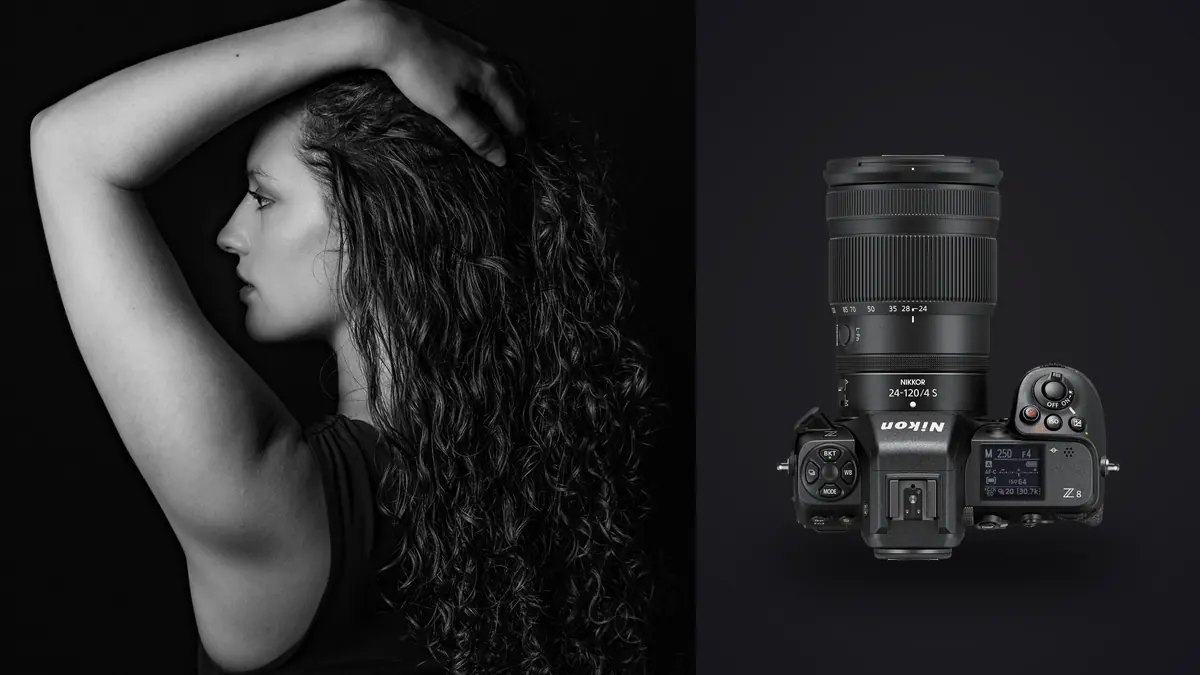
Boudoir work often happens in rooms that were never built for photography. A guest bedroom with one north-facing window, a hotel suite with beige walls and a lamp that runs warm, a small studio room barely big enough to fit a bed and a reflector stand at the same time. The camera I carry into those rooms has to do more than take sharp pictures. It has to let me move around a nervous subject without the whole process feeling clinical, and it has to keep up when the best moment of the session lasts about a second and a half. I've been shooting the Nikon Z8 for this genre specifically for a little over a year now, after years on a D850 and a brief stint with a Z6, and there are a handful of things about this body that changed how I actually work in the room, separate from anything you'd read on a spec sheet.
Staying mobile instead of locking down a position
In a room the size of most bedrooms, you don't get the luxury of standing in one spot and directing your subject to move through your composition. You're the one moving, constantly, shifting from a low angle at the foot of the bed to standing on a chair to catch something from above, all while trying not to trip over a light stand. The Z8's in-body stabilization is rated for meaningful stops of correction depending on the lens, and in practice that means I can shoot handheld at 1/60s or slower with a 50mm or 85mm prime and still get a clean frame, which lets me stay off the tripod for almost the entire session. A tripod in a small room is a liability anyway. It anchors you to one composition and it gives a nervous subject something rigid and mechanical to perform for instead of someone moving naturally around them.
The tilting rear screen gets more use in this genre than people expect. It's not a fully articulating screen, so it won't flip out for a straight-on selfie-style check, but for the low, foot-of-the-bed angles and the occasional shot taken from a step stool near the ceiling, being able to tilt it up or down and shoot from the hip without pressing my eye to the viewfinder keeps me physically lower and less imposing in the room. I use it more here than I ever did shooting landscapes or events with the same body.
Framing a small room without a wide lens doing the work
The instinct with a cramped space is to reach for something wide, 24mm or wider, to fit the whole scene in. I almost never do that for boudoir work, because a wide lens close to a subject distorts the body in ways that are unflattering at best and genuinely upsetting to the subject at worst. Instead I work with a tighter kit than the room seems to allow, and I let the room's limits shape the composition rather than fighting them with glass.
| Lens | Working distance for a waist-up frame | Working distance for a tight detail shot | Where it earns its spot in the bag |
|---|---|---|---|
| 35mm f/1.4 | ~5-6 ft | Not ideal under 3 ft, edges distort | Full-room environmental frames, showing the space itself |
| 50mm f/1.2 | ~4-5 ft | ~2 ft, still usable | The lens I leave on most of a session, natural perspective |
| 85mm f/1.2 | ~7-8 ft, tight in small rooms | ~3-4 ft | Compression for flattering, close-cropped portraits when I have the room to back up |
| 105mm f/1.4 | Often can't fit waist-up in an 11x13 ft room | ~4-5 ft | Detail and texture shots, jewelry, hands, fabric, rarely the whole body |
The 85mm is the one people are surprised I don't use more. It's a beautiful lens, but in a genuinely small bedroom you often can't back up far enough to use it for anything but a tight crop, and backing into a wall to squeeze out another two feet isn't worth the compromise it puts on your own footing and mobility. The 50mm stays on the camera for the bulk of a shoot for exactly that reason: it works at the distances a small room actually gives you.
Reading the light instead of fully controlling it
A lot of this genre gets shot with intentionally uneven light: a window as the only real source, maybe a single warm lamp or a string of fairy lights doing almost nothing except adding a catchlight and a mood cue. That's a hard scenario for a camera's metering to get right on its own, and I don't fight it by trying to flatten the light with fill flash, which changes the whole feel of the room the moment it fires. I meter for the skin, usually spot metering on the brightest part of the face or shoulder catching the window light, and let everything else in the frame fall where it falls.
The Z8's dynamic range gives me real room to work with that decision afterward. If I've exposed correctly for skin and the far side of the room goes darker than I'd like, there's enough shadow detail sitting in the RAW file that I can lift it selectively in post without it turning to mud or introducing banding, which was a bigger risk on older sensors I've used. Highlight recovery near a bright window is a little less forgiving, so my habit is to underexpose slightly rather than risk blowing out skin near the light source, since I can pull shadows up far more cleanly than I can rebuild blown highlights.
Base ISO on this body is 64, which I use whenever there's enough window light to support it, usually earlier in the day. Once the sun drops and I'm working off a single lamp, I'll push into the 1600-4000 range without much hesitation. Noise at those settings is fine-grained rather than blotchy, which matters specifically for skin, where anything blocky or colored in the noise reads immediately as a flaw in a way it wouldn't in a shadowed corner of a landscape shot.
Autofocus with almost no room for error
Shooting at f/1.2 to f/1.8 through most of a session means the plane of focus is thin enough that a subject shifting their weight or turning their head a few degrees can take an eye out of focus between when the AF locks and when the shutter actually fires. Eye detection on the Z8 has held up well for me even in dim rooms and even when the eye is a small part of a wider frame, and more importantly it tracks through the small, constant adjustments a person makes when they're not used to holding a pose. I keep focus and shutter separated with back-button AF so I can lock, watch for the right micro-expression, and fire without the camera re-hunting on a half-press.
What actually changed my keeper rate wasn't the AF alone, it was the buffer. Firing a burst of six or eight frames as someone settles into a pose, rather than trying to time a single shutter press, means the "right" frame, eyes open, expression genuine, nothing soft, usually exists somewhere in that burst even if I couldn't have picked the exact moment in advance. The tradeoff is obvious: a 90-minute session now regularly produces 600 to 900 RAW files, most of them near-duplicates of a small number of actual poses.
Getting through the take without losing the afternoon
That volume is the real cost of shooting this way, and it's the part that doesn't show up when people talk about camera gear. Nobody wants to spend three hours after a two-hour session scrubbing through nearly identical frames trying to spot which one has the sharpest eyes. This is where I stopped doing that manually and started running the card through imagic before I open an editor at all. It scores focus and sharpness locally on the files themselves, so within a burst of eight frames of the same pose it surfaces the one where the eye is actually crisp rather than the one a fraction of a second before or after where focus was still settling, which matters enormously when your depth of field is measured in centimeters. It also groups those bursts together automatically instead of leaving me to scroll past forty near-identical thumbnails one at a time, so I'm reviewing clusters of real choices rather than a wall of duplicates. If you want the mechanics of how that kind of sorting actually works under the hood, this breakdown of AI photo culling covers it in more depth than I will here.
The part I don't compromise on is where that processing happens. Everything imagic does runs locally on my machine, nothing gets uploaded anywhere to be scored or sorted. Given the nature of the images and how much trust a subject is placing in the photographer by the time the shoot starts, not routing that content through a cloud service isn't a preference, it's close to a baseline requirement I hold the whole workflow to. It's one of the reasons I moved off a cloud-based culling tool I used briefly a couple of years ago, regardless of how well it scored frames.
Keeping color consistent from window light to lamp light
A single session can legitimately move through three different light sources: daylight through a window early on, a warm continuous lamp as the afternoon fades, and sometimes a deliberately moody, near-monochrome low-light sequence near the end. Grading those consistently so a delivery gallery doesn't look like three different photographers shot it is its own skill, separate from anything the camera does. I trained imagic's apply_my_style feature on a set of my own previously finished boudoir edits, and running a new take through it now gets every image to a consistent starting point built from my own past decisions rather than a generic filter, before I go in and adjust individual frames by hand. It's saved me from the specific problem of a gallery drifting warm in one section and cool in another because I graded it across two separate evenings and my eye had adjusted differently each time.
For anyone building out their own approach to that kind of consistency rather than taking my workflow as gospel, I'd point toward general resources on the process itself rather than a single tool's preset pack, and a few workflow habits worth adopting cover some of the groundwork that makes any grading step faster regardless of what software you land on.
Frequently Asked Questions
Is the Z8 too much camera for a genre that's mostly delivered as web-sized images?
If every delivery is a small web gallery and nothing gets printed large, the resolution is genuinely more than you need, and a lighter body would save you file size and culling time with no real loss. Where the extra resolution pays off is album work and any crop-heavy editing, since a tight crop on a 45.7-megapixel file still holds up printed, while the same crop from a 24-megapixel body starts showing softness. I print enough album spreads that I keep the resolution; if you don't, it's a reasonable thing to trade away for a smaller, cheaper body.
How many usable frames should I expect from a burst during a single pose?
Out of a burst of six to eight frames on a held pose, I typically get two or three that are genuinely sharp on the eyes and free of motion blur, and usually one of those also has the best expression. That ratio is why culling by hand is so slow in this genre specifically: you're not looking for the one obviously good frame in a set of clearly bad ones, you're comparing several nearly-identical, nearly-good frames against each other.
Do I need to carry a second body into a small session?
For a one-room shoot I don't bother. A lens change takes ten seconds and I'd rather keep the room simple and uncluttered than manage two bodies on straps in a space that's already tight. A second body makes sense for weddings and events where a missed moment can't be redone; in a controlled boudoir session, if a frame doesn't work, you can simply ask for the pose again, which isn't true in most other genres.
Does shooting mostly wide open at f/1.2 to f/1.8 actually matter, or is it more about the light?
Both matter, but if I had to pick one, the light placement does more work than the aperture. A well-placed window or a single warm lamp at the right angle will make an image feel intimate at f/4 just as easily as at f/1.4. The wide aperture buys you subject separation and a softer background, which is a real aesthetic choice, but it also costs you focus margin, and in a genre where your subject is rarely holding perfectly still, that tradeoff is worth thinking about deliberately rather than defaulting to the widest setting a lens offers.