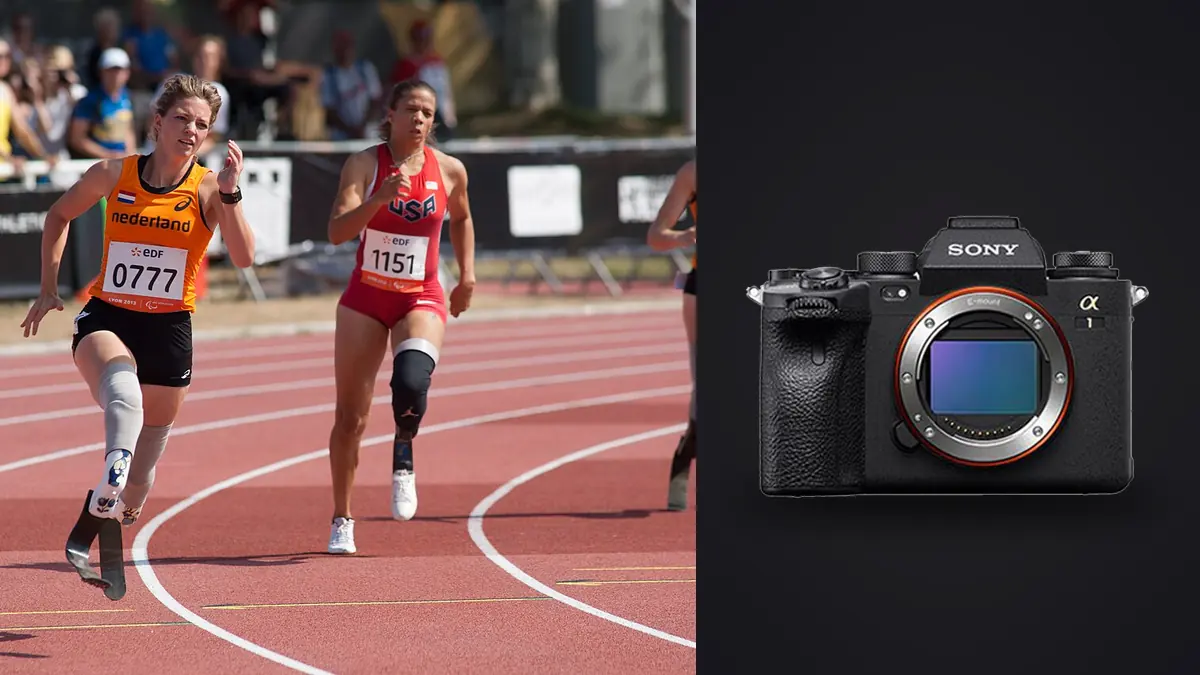
I spent most of last spring on the infield rail at regional meets with a Sony A1 on a monopod, alternating between the 100m final on the back straight and whatever was happening in the long jump pit thirty yards away. The A1 gets sold as the camera that does everything well, and track and field is one of the few genres that actually tests that claim end to end in a single afternoon: sprint starts need a fast, honest autofocus lock in under a second, distance races need a buffer that doesn't quit halfway through the bell lap, and field events need an AF system that can tell the difference between an athlete and the three officials standing next to the sand pit. None of that shows up on a spec sheet the way megapixel counts do.
The readout speed nobody prints on the box
The A1's 50.1MP stacked sensor scans fast enough for 30fps blackout-free shooting, but it is not a global shutter, so it still has a readout window, generally quoted somewhere around 1/200 to 1/240 of a second depending on mode. For most track work that's a non-issue. For hard horizontal pans following a sprinter at full stride with a long lens, it can show up as a subtle skew, verticals in the background leaning slightly, a lane line that isn't quite straight. I didn't notice it until I pulled a 400mm pan of a 200m runner into full screen and saw the finish-line gantry behind him tilted by a couple of degrees.
My workaround is boring but it works: I shoot pans with the mechanical shutter at 10fps rather than the 30fps electronic mode, and I save the silent 30fps burst for shots where I'm mostly stationary, holding on the blocks at the start or locked onto the bar during pole vault. You give up frame rate on the pans, but you're less likely to hand a client a photo with a bent scoreboard in the background. If you never pixel-peep your backgrounds this won't matter to you, but it's the kind of thing that gets noticed in a large print.
Buffer math for a full session, not just one race
A 100m final lasts under 11 seconds, so buffer depth almost never bites you there even at 30fps. Where it actually matters is when you're covering a whole session and holding the shutter down through a slow start, a false start recall, a restart, and then the actual race, or when you're shooting a distance final where you keep the burst running through a whole lap because you don't want to miss a lead change. Here's roughly what I've clocked with an A1 body running firmware from earlier this year, using a fast CFexpress Type A card versus a good UHS-II SD card in the same slot:
| File format, 30fps e-shutter | Approx. frames before buffer fills | Clear time, CFexpress Type A | Clear time, UHS-II SD |
|---|---|---|---|
| Compressed RAW (14-bit) | roughly 220-240 frames | ~9-11 sec | ~20-24 sec |
| Lossless compressed RAW | roughly 150-165 frames | ~12-14 sec | ~28-32 sec |
| Uncompressed RAW | roughly 90-100 frames | ~15-18 sec | 40+ sec |
| Extra-fine JPEG only | roughly 380-400 frames | ~6-8 sec | ~14-16 sec |
Those numbers move around with card age, in-body temperature, and whether you've also got the card writing a JPEG copy simultaneously, so treat them as ballpark rather than gospel. The practical takeaway is that lossless compressed RAW is the sweet spot for a full day of track: you get real editing latitude, and the buffer holds long enough to cover a false start plus the actual gun without you lifting your finger. I keep uncompressed RAW for the handful of shots I know are going to be printed large, usually the podium moment, and shoot everything else lossless compressed.
Put your fastest card in slot 1. The A1 will clear the buffer using whichever card is faster when both are recording, and if you've got a slower SD card doing simultaneous backup in slot 2, it can drag the effective clearing speed down. I run CFexpress Type A primary, SD UHS-II as backup only, not simultaneous RAW+RAW.
AF settings I actually change between events
The A1's Real-time Tracking with human recognition is genuinely good, but "good" doesn't mean "set once and forget it" across a meet that has six different disciplines happening in the same twenty minutes.
For sprints and hurdles, I run Wide autofocus area with human pose/eye recognition on, tracking sensitivity turned up toward the responsive end. Runners in adjacent lanes cross each other's path constantly and I'd rather the camera jump to whoever's closest and sharpest than hang onto a runner who's fallen behind and out of my intended frame.
For field events against a crowded background, especially high jump and pole vault where there's a bar, a mat, officials, and often spectators leaning over a barrier all in the same zone, Wide tracking regularly locks onto the wrong person. I switch to Zone AF or Spot S and place it manually on the athlete before the approach starts. It's slower to set up but it stops the camera from confidently nailing focus on a coach standing behind the bar instead of the jumper clearing it.
For relay handoffs, I stay in Wide with tracking but drop the AF transfer sensitivity down a notch. Two runners occupy the frame during the exchange and I don't want the camera snapping its focus point to the incoming runner the instant they enter frame, before the baton has actually changed hands. A slightly slower transfer means the system holds on the outgoing runner a beat longer, which is usually the more useful frame anyway.
Lens choices that match where you're actually standing
Most of my track kit decisions come down to where credentialing lets me stand, not what I'd pick in an ideal world. From the infield rail close to the sprint lanes, a 70-200mm f2.8 GM II covers the start and gets you tight by the finish without needing a monopod. From further back, either up in the stands or positioned near the field event runways, a 400mm f2.8 GM or a 300mm f2.8 earns its weight, and I'll add a 1.4x teleconverter for events on the far side of the track where even 400mm leaves you cropping hard in post. A 200-600mm G is the value option here: it's slower to acquire focus than the fixed super-telephotos and the AF hunts a little more in low light under stadium floodlights, but for a photographer who isn't shooting every weekend it covers an enormous range of distances for a fraction of the cost of a 400mm prime.
One thing I'd flag for anyone renting glass for a single meet: don't assume the 100-400mm GM is a like-for-like substitute for the 200-600mm just because the focal ranges overlap. The 100-400 focuses noticeably faster and handles low indoor light better, which matters if you're covering an indoor season meet under artificial light, but you lose 200mm of reach at the long end, which matters a lot at a big outdoor stadium where you might be sixty or eighty meters from the far turn.
What a day of shooting actually leaves you with
A full meet at 30fps produces a genuinely absurd number of files. A single sprint final held for three seconds either side of the gun is ninety frames. Multiply that across heats, semis, a final, four field events running concurrently, and a couple of relays, and you can walk away from an afternoon with five or six thousand frames, most of which are near-duplicates of each other separated by a hundredth of a second.
This is where the editing side of the job either eats your evening or doesn't. I run the take through imagic before I open anything in an editor, mostly because it does its sharpness and focus scoring locally on the machine, no upload queue, which matters at a lot of track facilities where the wifi is unreliable or nonexistent. It groups the burst sequences from each race so I'm looking at clusters of near-identical frames rather than scrubbing through all ninety individually, and I pick the one or two sharpest per cluster instead of eyeballing focus on every single frame at 100%. If you want the mechanics behind how that kind of local sharpness scoring actually works, this piece on how AI photo culling works goes into it in more depth than I will here.
The other piece that's saved me real time is the apply_my_style preset. I trained it on a season's worth of previously graded meet photos, mostly outdoor daylight with the specific color cast our local track's red surface and blue infield throw into every frame, and now a fresh batch of a few hundred images from a new meet gets a first pass that's already close to how I'd have graded it by hand. I still go through and adjust individual frames, particularly anything shot under mixed stadium lighting, but I'm not starting every image from a flat baseline. For anyone shooting high volume on a weekly basis, cutting that first grading pass down is a bigger time saver than any single camera setting covered above. There's a broader rundown of workflow shortcuts like this in this piece on getting through a shoot faster, if the culling side is where your evenings are actually disappearing.
Frequently Asked Questions
Is 30fps actually usable for a whole race, or does the buffer run out mid-sprint?
For anything under about eight seconds of continuous firing, meaning basically any sprint or hurdle race, buffer depth isn't a real concern even in uncompressed RAW. It becomes relevant in longer continuous bursts, a slow-loading blocks sequence held through a false start and restart, or a distance race where you keep the shutter down through an entire final lap. That's when shooting lossless compressed RAW instead of uncompressed buys you meaningfully more headroom.
Do I need CFexpress Type A cards for track meets, or will fast SD cards get the job done?
UHS-II SD cards work fine for sprints, hurdles, and most field events where you're firing in short bursts. Where the gap shows up is buffer clearing speed during longer sessions: if you're holding the shutter through extended sequences repeatedly across an afternoon, a slow-clearing buffer starts costing you shots because the camera won't let you fire at full speed again until it's caught up. If your budget only stretches to one or the other, put the CFexpress card in the primary slot and treat SD as backup rather than trying to run both formats as dual RAW.
Which AF tracking setup handles a relay baton handoff without jumping to the wrong runner?
Wide-area tracking with human recognition on, but with the AF subject-transfer sensitivity dialed down rather than left at its most responsive setting. Left at maximum sensitivity, the camera tends to snap its focus to the incoming runner the moment they enter frame, sometimes a full stride before the baton has actually changed hands, which usually isn't the frame you want anyway.
Is the A1 overkill for track and field compared to something like a Sony A9 II?
For pure sports work, arguably yes. The A9 II gives up resolution but its AF system and buffer handling were built specifically around exactly this kind of shooting, and it costs meaningfully less. The A1 makes more sense if you're also shooting the same body for landscape, portrait, or commercial work where the extra resolution earns its keep on other jobs, and track just happens to be one thing it also does well rather than the only thing it needs to do.