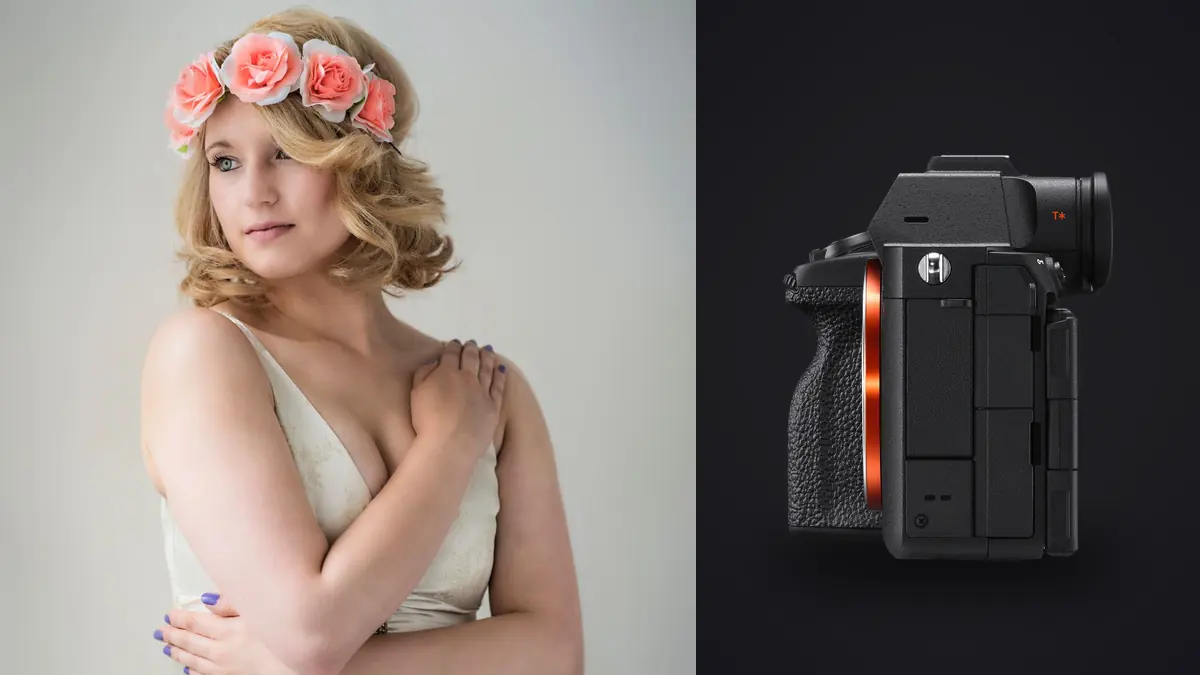
Boudoir work is different from most other portrait genres in one specific way: the person in front of you is usually more nervous about the camera than about anything else in the room. Whatever body is in your hands shows up in that dynamic whether you plan for it or not. I moved from an A7 III to the A7R V for this work a little over a year ago, mostly chasing the resolution bump for large prints, and ended up caring about three things I hadn't expected going in: how quiet the camera can be made, how the screen actually swings to match the angles boudoir demands, and how unforgiving the autofocus is about sloppy direction. None of that shows up on a spec sheet. This is what changed once this specific camera became the one I was carrying into homes and hotel rooms.
Why 61 Megapixels Cuts Both Ways in Intimate Work
The resolution is the reason most photographers look at the A7R V for this genre, and it earns the attention, but not in the uncomplicated way it gets talked about. On the upside, 61 megapixels gives you real room to crop into a detail shot after the fact: a ring on a hand resting on a hip, the texture of lace against skin, a tattoo that only reads at close range. I've pulled album-ready detail crops out of frames that were composed as three-quarter body shots, which used to mean switching lenses mid-session and breaking the subject's rhythm. Now I frame wider and decide what the detail shot actually is later, at the desk.
The downside is that this sensor does not flatter anyone by accident. Pore texture, fine body hair, faint bruising from a bra strap worn all day, all of it is there at full resolution if your light isn't doing the softening work for you. On a lower-resolution body some of that gets smoothed over by the file itself. On the A7R V it doesn't, so diffusion in front of your source (a shoot-through umbrella or a scrim works on most setups, even for window light) stopped being optional. Skip that step and you buy yourself a lot more time in retouching than the resolution saved you in cropping.
Autofocus That Doesn't Need You to Direct Every Micro-Movement
Sony's AI-driven subject recognition is genuinely different from the eye AF on older bodies, and it matters more in boudoir than in most portrait work because so much of the genre happens in movement you didn't call for. A client shifts her weight, reaches to adjust a strap, turns her head into a pillow. On the A7 III I'd lose focus lock the moment a hand crossed in front of the face or hair fell across an eye. The A7R V holds on through that far more often than not, including through sheer fabric and through hands partially covering the face, which are two situations that come up constantly in this kind of shoot.
What that buys you isn't sharper photos in the abstract, it's the ability to stop directing so hard. A lot of boudoir clients relax the moment you stop calling out chin and shoulder positions every four seconds, and trusting the autofocus to follow natural, unscripted movement at f1.4 or f1.8 is what lets you actually stop. I shoot most of a session on continuous AF with a single expanding point rather than a full-frame tracking box, because in a small room the subject fills enough of the frame that a wide net starts grabbing bedding or curtain instead.
The Screen Setup Solves a Problem I Didn't Know I Had
The 4-axis screen, which tilts on a hinge and also swings out and rotates like a vari-angle screen, sounds like a minor spec until you're actually working a boudoir session. A huge share of the compositions in this genre come from low angles shooting up at someone on a bed, or from standing directly over a posing bench looking down, or from a tight side angle next to a window where there's no space to get your eye behind the viewfinder without your own body blocking the light. A screen that only tilts up and down handles maybe half of those positions cleanly. The 4-axis version handles nearly all of them, and it means I'm not crouching in awkward positions or holding the camera at arm's length guessing at framing, which reads as unprofessional in a room where the subject is already self-conscious.
Shooting Quietly Matters More Than It Sounds
The fully silent electronic shutter gets marketed toward wildlife and theater work, but it does something specific in an intimate setting: it removes a mechanical sound that, in a bedroom or hotel room, is louder relative to the environment than it ever is on a wedding dance floor. Early in a session, before a client has settled into being photographed at all, every shutter click is a small reminder that a camera is pointed at her. Running silent for the first block of a shoot, especially anything close to the face or during quiet, non-posed moments, noticeably changes how fast people stop performing for the lens. I switch back to the electronic first-curtain mode for anything with fast movement, mostly to avoid rolling shutter skew, but the option to go fully silent is something I actually use every session, not a feature I tried once.
Body comparison for this specific use case
This isn't a general spec comparison. It's what I'd actually push each body to, and trust, for a boudoir session.
| Body | Resolution | ISO ceiling I'd shoot without hesitation | Screen articulation | Silent shooting | Raw file size (compressed) |
|---|---|---|---|---|---|
| Sony A7R V | 61MP | 3200 | 4-axis tilt + vari-angle | Yes, full electronic | ~85-115MB |
| Sony A1 | 50MP | 6400 | Tilt only | Yes, up to 30fps | ~55-95MB |
| Sony A7 IV | 33MP | 6400 | Vari-angle only | Yes, full electronic | ~35-60MB |
| Sony A7 III | 24MP | 6400-8000 | Tilt only | Partial, mechanical audible | ~25-45MB |
The A7R V is the odd one out on that ISO line, and it's worth being honest about why: the pixel density means noise shows up earlier than on the A1 or A7 IV, so in the low, warm, moody light a lot of boudoir sessions are shot in, I stay more conservative with ISO than I would on a body with larger photosites. I'd rather add a small continuous light or push my aperture than push ISO past 3200 and lose shadow detail in the grade. The trade for that ceiling is everything above it: crop flexibility, print size, and detail work no other body in that table matches.
Lens Pairings That Actually Get Used
The 50mm f1.2 GM gets talked about as the boudoir lens, and it's stunning on a full body shot with room to work, but in a lot of real bedrooms and hotel rooms there simply isn't enough distance to use it for anything but tight portraits. My most-used lens for this genre ended up being the 35mm f1.4 GM for environmental frames in tight rooms, with the 85mm f1.4 GM for close, intimate crops where the compression flatters and the background disappears. I added a 90mm f2.8 macro G specifically for detail inserts, jewelry, lace texture, hands, and it's the lens that earned its place fastest, since those detail spreads add more to a set than a lot of photographers expect.
None of these are cheap lenses, and I'd rather tell someone starting out to buy one good f1.4 prime and learn a small room with it than buy the full kit and never leave the 50mm on the body. The camera's autofocus and resolution are wasted on a lens you haven't learned to use at its widest aperture, and wide apertures are most of what sells this genre visually.
What Happens After You Set the Camera Down
A full boudoir session on this body runs 900 to 1,500 frames once you count burst sequences on movement, and at roughly 90-100MB a file that's a genuinely large card to clear and a genuinely long sit in front of a screen to cull. This is where the resolution stops being an unambiguous win and starts being a workflow tax. I moved my culling over to imagic mostly because it scores sharpness and focus locally on the files as they sit on the drive, so I'm not waiting on a cloud queue to tell me which of forty near-identical frames from a burst actually has the sharpest eyes, and it groups those burst sequences and near-duplicates together instead of making me scroll past them one at a time. For a genre where a single set of hands adjusting a strap can generate fifteen frames I need collapsed into one decision, that clustering saves real hours, not minutes. If you're setting up a culling pass for the first time, it's worth reading how the actual scoring works before you trust it on an important shoot: how AI photo culling works covers the mechanics in more depth than I will here.
The privacy angle matters more in this genre than almost any other kind of portrait work I've shot. Clients ask, directly and often, where their images go and who can see them before delivery. Being able to say the culling and editing happens locally on my machine, with nothing uploaded to a third-party server in between, is not a marketing line for me, it's an actual answer to a question I get asked in nearly every consultation. That's the specific reason I stuck with a local-first tool instead of one of the cloud-based culling services, even ones with faster turnaround claims.
On the editing side, I trained imagic's apply_my_style feature on a batch of my own finished boudoir edits, the warm, slightly desaturated grade I use across most sessions, and it's held that look consistently on new imports since. It's not replacing my grading judgment on hero images, but for the bulk of a set it gets me to a consistent starting point fast, which matters when images from the same session sit side by side and the tone is expected to match. If you haven't settled on a consistent grade for this kind of work yet, it's worth reading through a broader breakdown of tone and color decisions before locking one in: this guide to color grading is a reasonable starting point.
Working the Light You Actually Have
Most boudoir sessions I shoot lean on window light, string lights, or a single warm continuous source rather than strobes, because strobes read as a photo studio and a lot of the point of this genre is that it doesn't feel like one. The A7R V's native ISO range starts at 100 and the files hold shadow detail well when you expose to protect highlights and pull shadows up afterward, which matters because window light in a bedroom is rarely even across the frame. I meter for the brightest part of the subject's skin and let the far side of the room go darker rather than fighting for even exposure with fill, since evenness usually looks flatter than the moody image most people actually want from this kind of session.
Where the camera pushes back is in mixed light, a warm tungsten lamp plus daylight through a sheer curtain, which is extremely common in home sessions. White balance gets picked in post far more often than nailed in camera, and shooting raw only (never raw plus jpeg, the file count is punishing enough already) keeps that decision open until the edit.
Frequently Asked Questions
Is 61 megapixels too much resolution for boudoir and intimate portraits?
It's more than most photographers need for web delivery, but it earns its keep for print sales and detail crops, which are a real revenue line in this genre. The trade-off is that it shows skin texture unflatteringly under hard light, so plan on more diffusion in your lighting setup than you'd use on a lower-resolution body, and budget more time or a faster tool for culling the larger files.
Will the autofocus actually hold on sheer fabric, hair, or hands crossing the face?
In my experience it holds noticeably better than older Sony bodies, including through partial obstructions like hair or a hand near the eyes. It's not flawless when fabric fully covers the face for more than a frame or two, at which point I switch to manual focus confirmation rather than fighting the system.
How much of a storage and culling burden does a full session actually create?
Expect 80-140GB of raw files from a typical 900 to 1,500 frame session once you count burst sequences. That's manageable on modern storage, but it's a real time cost at the desk unless you're running local sharpness scoring and duplicate grouping rather than reviewing every burst frame by eye.
Is this camera too bulky or conspicuous for a home or hotel session?
It's not a small body, especially paired with an f1.4 or f1.2 prime, but it's not out of place next to any other full-frame mirrorless setup. What matters more for client comfort is the silent shutter option and how you carry yourself in the room, not the camera's physical size.