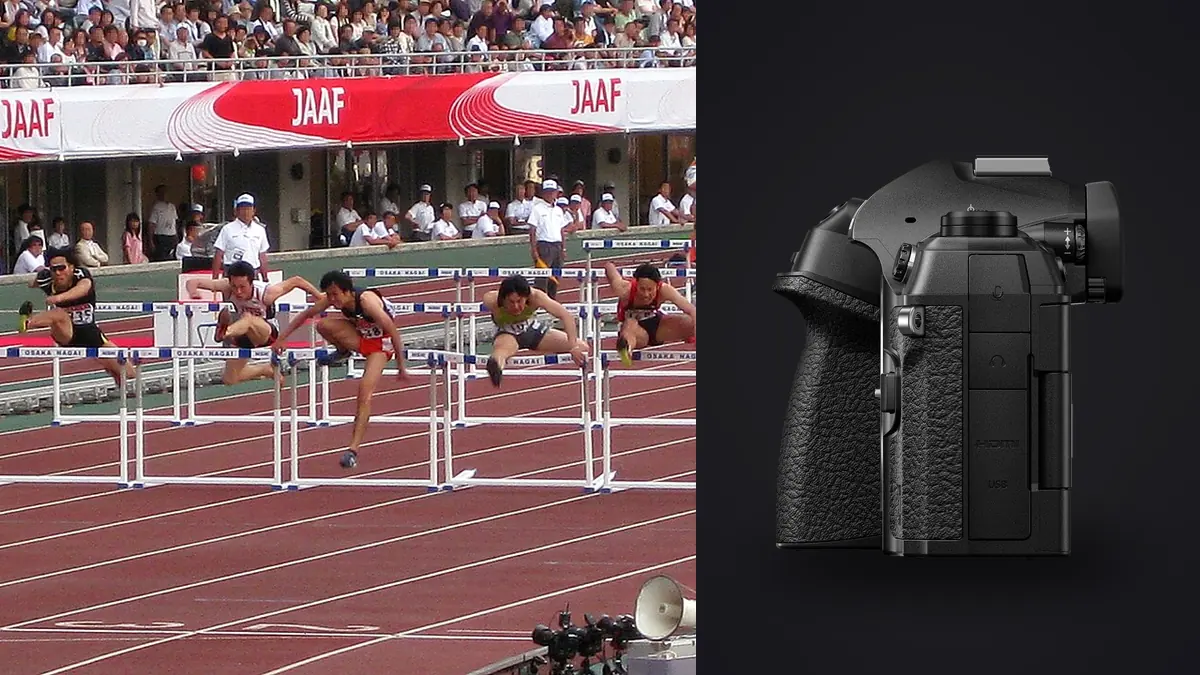
I got talked into shooting a regional track and field meet with an OM-1 Mark II two seasons ago because a friend needed a second body and mine was in for a sensor clean. I went in assuming I'd be fighting the camera the whole day, coming from full-frame sports bodies. I came out having bought one for myself within a month. Track and field is a strange sport to shoot, you're covering sprints, jumps, throws and distance events that all happen at different distances, different speeds and different light, sometimes within the same ten-minute window. The OM-1 Mark II turns out to be built for exactly that kind of chaos in a way that isn't obvious from the spec sheet.
The crop factor math nobody bothers explaining properly
Micro Four Thirds has a 2x crop factor against full-frame 35mm, and most articles either treat that as a dirty secret or skip past it entirely. For track and field it's the single biggest reason to consider this system. A 150-400mm f/4.5 lens, which is a genuinely portable telephoto zoom you can hand-hold for hours, gives you the field of view of a 300-800mm on a full-frame body. Flip on the lens's internal 1.25x teleconverter and you're looking at roughly 375-1000mm equivalent, still shooting at a usable f/5.6. Nobody makes a 300-800mm full-frame zoom you can carry around a stadium all day, because it doesn't exist as a practical object.
The honest caveat: the f-number doesn't change for exposure purposes, a lens is still gathering light as f/4.5 regardless of sensor size, but if you're used to full-frame depth-of-field intuition, double the f-number in your head. An f/4.5 lens on this body renders depth of field closer to what an f/9 lens would on full frame. For track and field that's mostly a non-issue, you generally want more in focus at these distances anyway when a runner's whole body needs to be sharp, not just an eye.
What it means in practice is that from a normal press-box or infield shooting position at a typical outdoor track, a 100-400mm becomes a 200-800mm equivalent and covers everything from the far turn to a straight-on finish line shot without a lens change. I stopped carrying a second telephoto body to meets. That's not a small thing when you're standing for six hours.
Pro Capture is the actual reason to reach for this body
Sprint starts and field events live and die on timing, and that's where Pro Capture earns its keep. The mode buffers frames continuously while you have the shutter half-pressed, so when you see the gun go off or the bar start to fall and react, the camera has already captured the frames from before your finger finished moving. Human reaction time is somewhere around 200 milliseconds. At a starting gun, that's the difference between a clean shot of the blocks firing and a shot of runners already three strides out.
The Mark II deepened the buffer noticeably over the original OM-1, climbing from around 70 raw frames to close to 100 in the fastest Pro Capture mode. In practice that's the difference between catching one clean high jump clearance and getting three or four frames of the bar wobbling, which matters because a bar that looks cleared in frame one can be ticking off the standard by frame four. I run Pro Capture on nearly every field event now and treat the raw shutter release as more of a "start recording" button than an actual capture trigger.
Below is roughly how I set up focal length and drive mode by event, based on shooting from a normal media position at a standard outdoor oval, not from an infield credential you probably don't have.
| Event | Typical shooting distance | Native focal length | Full-frame equivalent | Drive mode |
|---|---|---|---|---|
| 100m / 200m blocks and start | 15-25m | 70-150mm | 140-300mm | Pro Capture SH2, pre-shutter 0.3s |
| Long jump / triple jump pit | 20-35m | 150-300mm | 300-600mm | Pro Capture SH2 through takeoff and landing |
| High jump bar | 25-40m | 200-400mm | 400-800mm | Pro Capture SH2, tight framing on the bar |
| Pole vault | 30-45m | 200-400mm | 400-800mm | Standard SH1 continuous, plant through release |
| Shot put / discus / hammer circle | 35-50m | 300-400mm | 600-800mm | Pro Capture SH2 on the release moment |
| 4x100 / 4x400 handoff zone | 10-20m | 100-200mm | 200-400mm | Standard SH1, panning follow |
| Distance race mid-pack | 20-60m variable | 150-400mm zoom range | 300-800mm | Mechanical shutter, standard continuous |
What actually changed between the OM-1 and the Mark II for this kind of shooting
If you're weighing the original OM-1 against the Mark II specifically for track and field, the upgrades that matter aren't the ones that get top billing in the marketing copy. The sensor is the same 20.4MP stacked BSI unit, so resolution and base image quality haven't moved. What changed is buffer depth, processing headroom, and AI subject detection, which added a dedicated Human detection category the original body launched without. That last one sounds minor until you're shooting a distance race with forty runners bunched together and the camera is actually picking out and holding focus on the runner nearest your selected point instead of drifting to whoever's biggest in frame.
| Factor | Original OM-1 | OM-1 Mark II | Why it matters trackside |
|---|---|---|---|
| Pro Capture raw buffer | ~70 frames | ~99 frames | More cushion through a full jump or vault attempt before the buffer clears |
| AI subject detection | Birds, planes, trains, cars/motorcycles | Adds dedicated Human detection | Locks onto a specific runner in a crowded pack instead of hunting |
| Launch price (body only) | ~$2,199 | ~$2,399 | Roughly a $200 premium for the buffer and AF gains above |
| Live ND filter | Up to ND64 | Up to ND64 | Unchanged, still useful for daylight panning shots without a physical filter |
Autofocus that's good, not the magic it gets sold as
The 1053-point cross-type phase detect system covers the full frame and the subject tracking is genuinely strong for anything that isn't a dense scrum of bodies. Sprints, jumps, throws, all of it tracks cleanly once you've told the camera what to look for. Where I've had it lose the plot is exactly where every camera struggles, mid-pack distance running with runners overlapping and swapping positions, or a relay handoff where two athletes momentarily merge into one silhouette. In those situations I've had better luck manually placing a small AF point and doing the tracking myself than trusting Human detection to pick the right person out of a cluster.
One thing worth knowing before you buy in specifically for this: Human detection on this system prioritizes face and eye when it can see one, but at 300-800mm equivalent distances during a race, you're often getting body and gait more than a clear face. It still tracks, it's just tracking a slightly fuzzier target than the marketing demos with a portrait subject standing still would suggest.
Where it actually struggles
I'd be doing you a disservice pretending this body is flawless for the job. Indoor meets are the honest weak point. Fieldhouse lighting is dim, often mixed sodium and LED, and a Four Thirds sensor at ISO 3200 and above starts showing noise that a full-frame body handles more gracefully. The anti-flicker scanning feature helps with banding under mixed lighting, but it doesn't fix the underlying noise floor. If your season is mostly indoor track, this isn't the camera I'd lead with.
Battery life is the other honest gripe. The BLX-1 pack is an improvement over the older BLH-1, but you're still looking at CIPA numbers in the low-to-mid hundreds of shots, not the all-day figures you get out of a chunkier DSLR-shaped sports body with a bigger cell. Bursts with Pro Capture running eat into that faster than the rated number suggests. I carry three batteries to a full day meet and have run the third down before the last relay.
And the lens lineup, while genuinely good, has a gap in the middle. The 40-150mm f/2.8 PRO II (80-300mm equivalent) is fantastic and light for closer infield work, and the 150-400mm f/4.5 PRO is the reach monster, but there isn't a fast native option that comfortably bridges the two without either compromising on speed (the 100-400mm f/5-6.3) or spending flagship money (the 150-400mm at roughly $7,200). Budget planning for this system means picking a lane rather than covering every focal length at f/2.8.
What happens to four thousand frames after the meet ends
A full day at a track meet with Pro Capture running on field events and standard bursts on the track produces a genuinely absurd number of files. I've come home from single meets with north of four thousand raw frames, and Pro Capture alone means a huge chunk of those are near-duplicates of the same jump or throw a few milliseconds apart. Sorting that by eye at midnight isn't a workflow, it's an exercise in going slowly insane. This is where I've actually changed how I edit. I run everything through imagic before I open a single frame in an editor. It's local, it never touches the cloud, which matters when I'm doing this from a hotel room with meet wifi that can barely load a webpage. The duplicate and burst clustering groups those near-identical Pro Capture sequences automatically, so instead of scrubbing through forty near-copies of the same high jump attempt I'm looking at one representative frame per cluster. The local sharpness and focus scoring then flags which frame in each cluster actually has the sharpest eyes or the cleanest bar clearance, which saves the part of the night I used to spend zooming into each frame at 100% trying to tell two nearly identical shots apart.
I also built an apply_my_style preset from a season's worth of already-edited meet photos, so new imports get a first pass in something close to my usual color and contrast before I touch a single slider. It's not magic and it doesn't replace real editing on the frames that matter, but it turns the boring middle of the process, the part where you're just getting three thousand images to a consistent starting point, into something that happens while I'm packing up gear instead of something I do at 1am. If you're new to the idea of software doing that first sorting pass, our piece on how AI photo culling actually works goes into more detail on what's happening under the hood, and these workflow tips cover the rest of the pipeline from import to delivery.
Frequently Asked Questions
Is the OM-1 Mark II fast enough for sprint finishes?
Yes, comfortably. At 50fps with continuous AF and AE tracking in the electronic shutter mode, you're getting a frame roughly every 20 milliseconds through the finish line, which is more than enough resolution in time to pick the exact frame where a torso crosses the line. The stacked sensor also keeps rolling shutter distortion under control at that speed, which matters for anything moving fast laterally across the frame like a sprint finish.
Do I need the 150-400mm PRO lens or can I get by with cheaper glass?
For most amateur and high school level meets, the 100-400mm f/5-6.3 covers the reach you need at a fraction of the cost, and the 2x crop factor means you're still working with 200-800mm equivalent framing. The 150-400mm earns its price at the collegiate and elite level where you're often shooting from farther back and need the extra stop or two of aperture and the built-in teleconverter for the longest field events like javelin and hammer.
How does it handle rain or a wet track surface?
The IP53 weather sealing rating held up fine through a genuinely miserable rain-delayed meet I shot last spring, condensation on the outside of the lens was more of a problem than the camera itself. I wouldn't submerge it, but light to moderate rain over several hours hasn't caused any issues on mine.
Is the smaller sensor a real disadvantage for track and field specifically?
Less than you'd expect outdoors, more than you'd want indoors. Outdoor meets in daylight rarely push past ISO 800-1600, and at those settings the noise difference against full-frame is barely worth discussing. Indoor meets under fieldhouse lighting are a different story, where you're often at ISO 3200-6400 and the smaller sensor shows it. If your calendar is mostly outdoor invitationals and championships, the reach advantage outweighs the sensor size tradeoff. If you're shooting a heavy indoor winter season, weigh that honestly before committing.