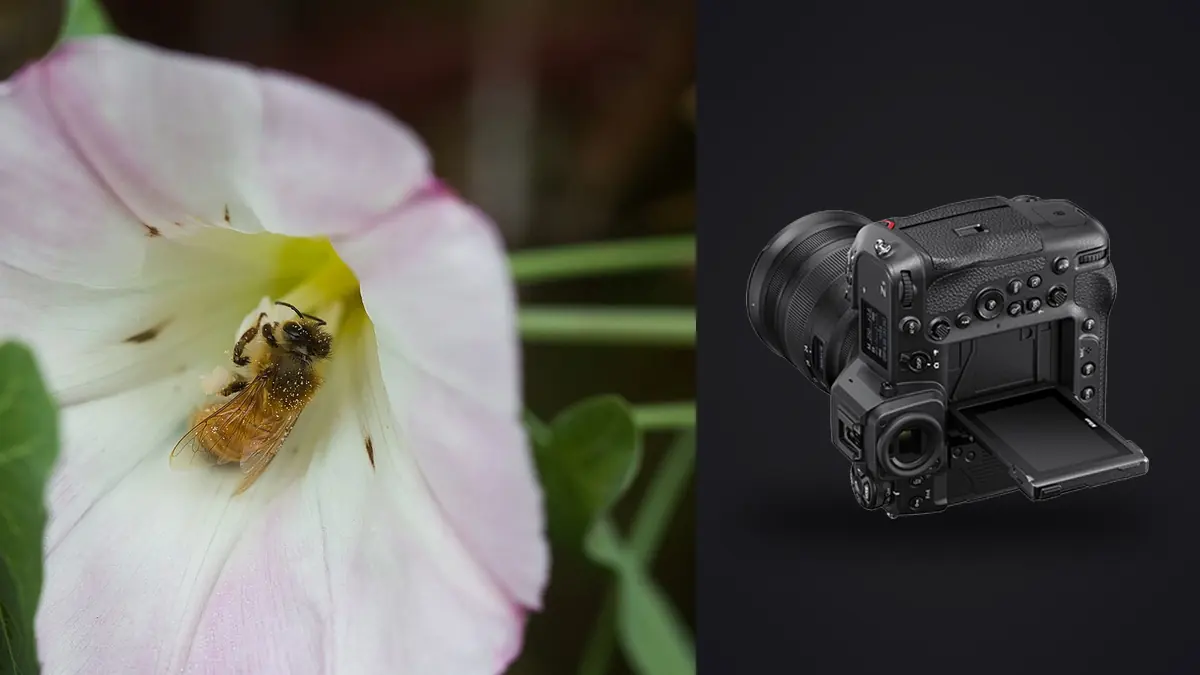
A Big Body for a Small Subject
Kneeling in wet grass at the edge of a pond, tracking a female emperor dragonfly as she dips her abdomen into the water to lay eggs, is not where most people picture a Nikon Z9. It's a 1.3 kilogram flagship built for football sidelines and bird hides, and the instinct is to assume it's wasted on something that fits in a matchbox. I've shot enough insect sessions with it now to say the opposite: for erratic, fast subjects, the things that make the Z9 excessive for a landscape photographer are exactly what save a macro session.
This isn't a general "how to shoot macro" piece. It's specifically about what happens when you put a 45.7-megapixel stacked sensor, a blackout-free viewfinder, and a buffer that essentially never fills, behind a 1:1 macro lens and point it at something that can launch itself sideways in a tenth of a second. Some of what the Z9 offers here is a genuine advantage. Some of it is money and weight you're paying for that a smaller body would give you almost as well.
Lens Pairings That Actually Make Sense
The Z9 doesn't have a dedicated macro lens of its own, so the pairing matters more than the body spec sheet does. Four options come up constantly in insect-focused forums and they behave differently enough on this camera that it's worth laying them out side by side.
| Lens | Max magnification | Working distance at 1:1 | Weight | Best for |
|---|---|---|---|---|
| Nikkor Z MC 50mm f/2.8 | 1:1 | ~4.5cm | 260g | Static subjects only, too close for anything that spooks |
| Nikkor Z MC 105mm f/2.8 VR S | 1:1 | ~14cm | 630g | The default choice, enough clearance for bees and hoverflies |
| AF-S 200mm f/4D Micro (FTZ II) | 1:1 | ~25cm | 1190g | Skittish dragonflies and damselflies, slower AF via adapter |
| Laowa 100mm f/2.8 2x Ultra Macro APO | 2:1 | ~15cm at 1:1, ~6cm at 2:1 | 638g | Extreme close-up detail, fully manual focus and aperture |
The 50mm MC is the one people buy first and regret second. At true 1:1, the front element is close enough to cast a shadow over anything with wings, and most insects treat that shadow as a predator. The 105mm S is the one I reach for on nine sessions out of ten because 14 centimeters of clearance is roughly the difference between "the bee tolerates me" and "the bee leaves." The old 200mm f/4D, adapted through the FTZ II, is slower to lock focus and hunts more in low light, but the working distance lets you photograph territorial dragonflies that won't let anything closer approach a perch. The Laowa is a specialist tool, fully manual, and honestly a strange match for a body built around autofocus speed, but for eye and wing-scale detail on something like a jumping spider it produces results the native lenses can't touch.
Autofocus for Things That Don't Sit Still
Here's the limitation nobody puts in the marketing copy: the Z9's subject detection categories cover people, dogs, cats, birds, and several vehicle types. Insects aren't one of them. So all the tracking intelligence that makes the camera exceptional for eagles and gymnasts contributes nothing when you're pointed at a hoverfly. You're back to single-point or a small dynamic-area box, manually placed, same as you'd be on a much cheaper body.
At true macro magnification the practical depth of field at f/2.8 can be under a millimeter, so continuous autofocus chasing a moving insect is often fighting a losing battle against its own hunting. What actually works, and what took me a while to accept, is setting a fixed focus distance manually and rocking the whole camera forward and back on your knees or wrists until the eye snaps into the plane of focus, firing a burst the instant it does. The Z9's frame rate is what makes this reliable rather than lucky. Back-button focus is worth setting up here specifically so a stray AF-C hunt doesn't throw away the manual distance you just dialed in.
Where 3D-tracking genuinely helps is larger, more predictable flyers, a dragonfly patrolling a fixed loop over the same three meters of water, for instance. It has enough contrast and size for the tracking box to hold on. For anything smaller working a single flower head, I've had better hit rates ignoring tracking entirely.
One feature that does pull its weight is in-camera focus-shift shooting, useful on cool mornings when insects are cold and near-motionless with dew still on them. You can rack focus through 20 to 40 frames on a tripod-mounted setup and stack them later, something the DSLR-era macro crowd had to do with separate rail hardware.
Taming the Buffer and the File Flood
The Z9's electronic-only shutter shoots full-resolution 45.7-megapixel raw at 20 frames per second with no mechanical blackout, and dual CFexpress Type B slots mean the buffer essentially doesn't run out during a realistic macro session. Pre-release capture, which buffers roughly a second of frames before you fully press the shutter, is the single most useful feature this body brings to insect work specifically, because the moment a dragonfly decides to launch off a perch gives you no warning at all.
The cost of all that speed is what it does to your card. A three-second burst chasing a single takeoff is 60 raw files, the overwhelming majority of them near-duplicates separated by a fraction of a wingbeat, with maybe four frames actually sharp on the eye. Multiply that by a full morning at a pond and you're looking at a memory card holding several thousand frames that need sorting before you can find the handful worth editing.
This is the part of the workflow I stopped doing by eye. I run the card through imagic before I open anything in an editor. Its local sharpness scoring checks focus at the pixel level rather than trusting what looks acceptable at thumbnail size, which matters enormously when the difference between a usable frame and a soft one is which side of the compound eye the focus plane landed on. The duplicate and burst clustering groups that 60-frame launch sequence into one stack instead of 60 separate thumbnails to scroll through, and because it runs entirely on the machine, there's no upload step to wait on when you're working off a laptop at a trailhead with no signal. If you haven't compared how automated culling actually scores focus versus doing it manually, this breakdown of how AI photo culling works covers the mechanics in more detail than I have room for here.
Light, Aperture, and the Diffraction Trade-off
At 1:1 magnification, depth of field at f/2.8 is razor thin, thinner than a compound eye is deep on most insects. Stopping down to f/13 or f/16 gets enough of the subject in focus to read as sharp, but on a 45.7-megapixel sensor you're deep into diffraction softening by that point, well past the roughly f/8 to f/11 crossover where per-pixel sharpness starts degrading. In practice this means macro insect files off the Z9 rarely look as crisp at 100% as the same sensor does on a landscape shot at f/8, and that's simply the physics of the genre, not a camera flaw. Downsampling for web or print hides most of it.
Because you're stopped down that far, ambient light alone usually isn't enough, so a flash diffuser rig, a small twin-flash bracket like the ones built for macro (Godox and similar third-party options both mount fine) does more for image quality here than any camera setting. Flash duration freezes the motion, not shutter speed, which matters because the Z9's electronic shutter tops out under 1/250s for full-sensor flash sync, plenty for this kind of work since the flash itself is doing the freezing.
Field Handling: Weight, Battery, Weather
Body alone the Z9 is about 1340 grams. Add the 105mm MC at 630 grams and a flash bracket, and you're carrying over two kilograms held at odd low angles for hours. On a three-hour dragonfly session my wrists know about it the next day in a way they didn't with a lighter Z6III body on the same lens. If macro insects were the only thing I shot, I'd think hard about whether the smaller body is the better tool.
What the size buys back is the EN-EL18d battery, which comfortably lasts a full dawn-to-noon session without a swap, useful because insect activity windows shift with temperature and you don't want to be changing batteries when the light and the bugs finally cooperate at the same time. Weather sealing has held up fine through wet meadow mornings and one unplanned splash into pond-edge mud that would have worried me with a lesser-sealed body.
Where It Falls Short
Price is the honest sticking point. At body-only pricing well north of five thousand dollars, it's hard to justify the Z9 if insect macro is the only genre in your bag. A Z6III paired with the same 105mm MC lens gets you roughly the same optical result for a third of the cost and about 400 grams less to carry, and the main thing you give up is buffer depth and pre-release capture, which matter for takeoff sequences but not for the majority of static or slow-moving subjects like caterpillars, beetles, or resting moths. The subject-tracking system, one of the Z9's headline features, contributes nothing to this specific genre since insects were never added as a detect category, so a chunk of what you're paying for sits unused.
None of that makes it a bad choice if you already own the body for other work and macro is a side interest. It just means buying a Z9 specifically for insects, rather than already having one, is a harder case to make than the spec sheet suggests.
A Simple Field-to-Desk Workflow
The routine that's worked for me: shoot in short, deliberate bursts rather than holding the trigger down, since a two-second burst at 20fps already gives you 40 frames to sort through per attempt. At the end of a session, cull locally before touching an editor, letting sharpness scoring and burst clustering do the first pass so you're only opening the frames worth your time. From there, I lean on imagic's apply_my_style feature, trained on my own past macro edits, to get consistent color and contrast across a batch instead of re-deciding the look for every single beetle and dragonfly shot from scratch. It's a small thing, but insect macro sets are large enough in volume that consistency across dozens of similar frames matters more than it would for a handful of portraits. For anyone whose workflow is still bottlenecked at the sorting stage rather than the editing stage, these workflow speed tips are worth a look regardless of what camera is producing the files.
Frequently Asked Questions
Does the Z9's subject detection recognize insects like it does birds?
No. The detect-subject list covers people, dogs, cats, birds, and several vehicle categories, but insects aren't included as of current firmware. For insect work you're using single-point or small dynamic-area AF manually, the same as on far cheaper bodies, so don't buy the Z9 expecting it to lock onto a bee automatically.
What aperture actually works for 1:1 insect macro on this sensor?
Most usable results land between f/11 and f/16. Wider apertures leave too little of the subject in focus at true macro magnification, and much past f/16 diffraction starts noticeably softening detail on the 45.7-megapixel sensor. It's a compromise, not a clean answer.
Is the Z9 too heavy to shoot macro handheld for a full session?
It's manageable but not effortless. At roughly 1340 grams for the body plus 600 or so for a macro lens, a few hours of low-angle handheld shooting is noticeably more tiring than the same session with a Z6III or similarly sized body. A monopod or a bean bag for ground-level shots takes the edge off.
Can I use an adapted F-mount macro lens without losing autofocus speed?
Through the FTZ II adapter, older screw-drive or AF-S macro lenses like the 200mm f/4D focus noticeably slower than native Z lenses, especially in low light, and hunt more before locking. It's still usable, particularly for static or slow subjects, but don't expect it to match the 105mm MC S for speed.